Featured

Sacred Bears

When I shared the following events with my writer’s group and asked them to put a timeline on them, most guessed the 1950’s. Learning this occurred in 2002 disturbed them. Truly disturbing, though, is that, sadly, no one in this country right now would be surprised to enter a town square in nearly any southern state in the US and see again today what I saw then.

Black and White Teddy Bear on overturned children's chair

Sacred Bears

“Some old lady got my buddy in trouble!” was what I heard another pastor declare as I sat down at the weekly lunch of local United Methodist pastors in the county. (“Local Pastors” do not attend seminary but rather several years’ worth of courses in order to be allowed to preach from United Methodist pulpits.) I was running late, but I knew immediately what he was complaining about and I was annoyed to realize quickly he had only heard part of the story. “He was at the weekend school…”

“Course of Study,” I offered.

“Yeah. The Course of Study. Anyway, there was this festival on the square down there in Pulaski….”

“They called it ‘White Christian Heritage Festival’ but they were handing out KKK literature,” I added. He frowned.

“Okay…. so, this old lady just took what my buddy said all wrong. Then…then, she told the guy in charge.”

“Grady?” 

My colleague stared at me, determined to finish the story. “That old lady told Grady my buddy was part of the KKK!”

“Actually,” I said after I ordered my chicken salad with ranch on the side, “that ‘old lady’ told Grady that your buddy confessed to her that he could see where their teachings made sense. He said they made sense.’  So, since he is allowed to preach at a United Methodist church and to teach children and youth….”

“She probably just misunderstood.” 

Surely, I thought, this guy will catch on soon. I sighed. “So, I shoulda just let that slide?”  

The others at our table were clearly amused that my colleague didn’t get why I knew the story so well. In his defense, he attended a different Course of Study, lasting four weeks, in Atlanta for full time pastors in the United Methodist Church. His buddy and I were part time, which meant only 60 hours a week of work. Our Course of Study classes met over eight weekends a year with reading and papers in between those weekends, sometimes in Jackson and other times at Martin Methodist College in Pulaski. Pulaski, if you aren’t aware, is known for being home to some members  of the Mars candy family (think Milky Way) and is also generally credited with being the birthplace of the Knights of the Ku Klux Klan, the KKK.  

I especially hated the overnight stays at these weekend schools. That particular weekend, I do not remember another woman in attendance. Not only was I away from my sons, but I was alone. In a motel room. In a strange town. A single woman.  Newly in recovery from trauma. In other words, someone who knew bad people did lurk in the shadows. Assuming all the men around were trustworthy was a luxury. So, I slept not at all. I took to wedging whatever chairs were in the room in front of the door in an effort to at least rest. 

On one particular Saturday, several of us left class to make a lap around the nearby downtown square on our lunch break only to encounter what was that day touted as a “Celebration of Southern Culture.” Displayed on the assorted tables were handtooled leather goods, canned peaches, okra and pickles. A brochure I found had previously invited area residents to join in the “family fun,” including a cakewalk.

Pretty quickly, though, I was stopped, jolted a stuffed teddy bear sitting among the books and maps under the magnolia trees. I believe God created Teddy Bears to provide a tactile reminder of love and affection, of comfort. This bear, though, had, through no fault of his own, become aligned with pure evil: he wore a white cotton robe and a white pointed cap that covered his face. This child’s toy was disguised, as if he, too, needed to hide his collusion with evil, like the men who had donned those robes and hoods in the night for so long. I thought they were a thing of our past and yet there they were, not hiding their affiliation at all and they had brochures, newsletters, books and even maps, the texts and visual aids to present these “Southern” beliefs. The first murmurs from the other pastors with me were indignant: how did these folks get to determine the definition of what was “southern”?
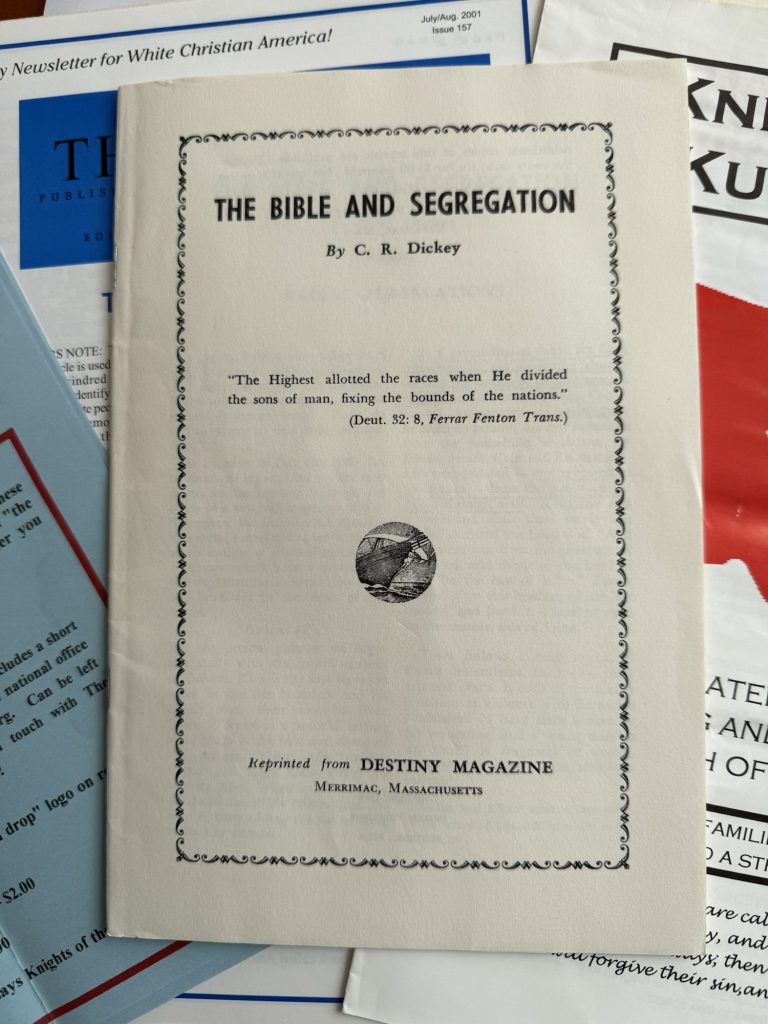
Eager to share with us about how God meant to order society, one of the men began to carefully explain the rationale for hatred, including their understanding that God, of course, looked just like them. In that moment,  the inference was that God most resembled a skinny, pasty middle-aged man in black slacks, a white shirt and a decades-old tie. A couple of pastors seemed interested in engaging. I was far from confident in my ability to face evil head on though; I, instead, focused on the contents of the tables.

Besides books and t-shirts, decals, key rings, watches, pins and flags, there were maps. I would not give them my money for books but I did consider buying one of the maps, a large laminated wall map designed to settle once and for all the mystery of the disappearance of the two “Lost Tribes” of Israel. Finally, I chuckled. They’d migrated, it seemed, from the Middle East and crossed over the Caucasus Mountains, stopping, of course,  in Scotland before heading into North America.  My ancestors were among those Scots who came through the Cumberland Gap and moved on into Kentucky, Tennessee, Missouri. I hadn’t known, however, that we were either lost or a tribe of Israelites. This journey was credited with solving the mystery: the Lost Tribes were now known as “Caucasians,” according to the map, by virtue of having traversed the Caucasus Mountains. I kick myself now for not purchasing that map, but, at the time, I could not stomach giving these people my money.

I did try to offer them money for the Teddy Bear, for the sake of the children these men likely influenced, for the sake of the legacy of Teddy Bears the world over, and for the comfort and benevolence children had so long depended on them to provide, I wanted to scream, “How dare you?!” 

Gotta hand it to the KKK, though. Aligning an innocent source of comfort and safety with the evil of the KKK, twisting what a child loves and trusts and using it to promote hatred and exclusion is socially and theologically powerful. Teddy Bears are bordering on sacred, as far as I’m concerned, objects that carry children through those times when the adults are absent or preoccupied or already asleep.

The Teddy Bear in the hood and robe makes more sense when you recognize how much of the most destructive theology through the ages has been born out of childhood pain. We may never know who was the child who’d been hurt enough that he grew up and somehow chose to cover himself and his head and face with a white hood so his grandmother or his neighbors or his children did not see him when he was cruel and ugly. I wanted so badly to rescue that child, or at least rescue the Teddy Bear, to allow God to do what God does best: redeem both that Teddy Bear and whomever it was who dressed him up. 

I wanted so badly to rescue that child, or at least rescue the Teddy Bear, to allow God to do what God does best: redeem both that Teddy Bear and whomever it was who dressed him up. 

“He is not for sale” was the response, though, and so I left behind that embodiment of evil and prayed for the trust and spirits of all the children these pasty white men were teaching or had taught so far. 

I did pick up some brochures and printed newsletters and walked away before they realized I did not, in fact, agree with their understanding that our country was designed as a White Christian nation or that we ought to somehow respect men who hid behind masks to terrorize others. Later, I would discover the literature went so far as to advocate for internment facilities for those who had contracted AIDS, for example, or that we all were invited to a worship service that night, complete with “great white Christian fellowship” and a “brilliant cross-burning!” 

I was no longer hungry, so I walked back with one of the younger pastors. After a few moments’ walk in silence, I said simply, “I was not expecting that.” I was feeling shaken that this evil was so openly displayed and discussed; I’d been blissfully ignorant, I realized. I had honestly thought these clowns in hoods were anachronisms, relics of a bygone era, that they were no longer active, like the sundown signs I would later learn sat as sentinels along the highways at the edges of the town where I preached. Those signs–simple painted sunsets on road signs–were nonverbal warnings: if you were a person of color, you’d best not be found in this town after sunset. The signs had been taken down, but the sentiments, fears and prejudices were not so deeply buried. I would later be disturbed to find out, for example, that two members of my congregation had been “card-carrying” KKK members while  I was pastor there. As a white woman, I had been ignorant and thus, negligent.

As we walked back to classes that weekend, though, my companion, a pastor who was about 15 years my junior, pointed out that “southern culture” was his culture. Then he added, “They did make some valid points. Did you realize they’re Christian?” 

The hair on the back of my neck stood up.

“If you listen to what they are saying,” he went on, “you will discover that they make a lot of sense.” 

He was a pastor. 

He taught a children’s Sunday School class, too, and he seemed interested, not disturbed, but interested in the Teddy Bear in the robe and hood.

“How,” I asked as calmly as I could while placing one foot in front of another, “would you go about teaching this to children?” I wanted him to clarify, to make me realize I’ve misunderstood, to tell me he wasn’t teaching ‘southern culture’ to the children, but he didn’t say any more. As we approached the classroom for our last afternoon that weekend, I wondered what the other pastors might say. Turns out, very little. I remember watching the others in the rest of the day’s lecture and discussion, wondering why no one mentioned what we’d seen. Had they debated at lunch? Had they discovered  others open to these ideas? No one seemed angry, at least not that they’d admit. I felt like I was playing a game my sons liked where you had to pretend that the floor was lava, so don’t dare put your feet down; it was dangerous. I hoped that the overt racism we’d witnessed had shocked them too. I feared, though, they knew from experience not to admit out loud they “got” where these guys were coming from, that, like my walking companion, they knew to simply shut down the conversation if they thought they’d shown their own hood to the wrong person. 

Once we’d finished for the day and each of the pastors was headed home to prepare to preach the next morning, I found Grady, the professor in charge. I explained I did not want to cause an issue for a colleague but I was disturbed about what this pastor might be teaching, especially in Sunday school for children. I wasn’t sure what to do and had not felt safe addressing him directly. Grady listened, got the particulars, then told me it was his place to address it. 

I heard nothing else for a month until I received an email from Grady; he’d spoken to the younger pastor’s District Superintendent, who evidently had found “no reason to believe such reports” and had never even spoken to the guy. This information hit my inbox just before leaving for the next weekend class. Once there, I was dismayed to find that the young pastor was there before me, annoyed, and looking for me. He was pretty sure I was the one who had ratted him out. I was the only “old lady” there. 

He greeted me with “I got called on the carpet by my DS,” which was a stark departure from what my professor had been told.  “When can we talk about this alone?” he wanted to know. 

“Excuse me,” I said, walking away; that was as much as he got for the rest of the weekend from me.

I still count that entire episode a disappointing failure, though I didn’t know how to do anything differently at the time. Not tossing my books and overnight bag in my car and leaving right away seemed the best I could manage for the time being. Clearly, I needed to learn how to counter this twisting of theology openly, to be prepared to teach the children and youth in the churches I served that Jesus really meant it when He said He loved every body. So I stayed. For the rest of that weekend, I kept my distance. I kept my guard up. I didn’t sleep.

I wasn’t surprised then a few weeks later at lunch, though, when this “old lady” was being castigated and labelled a busybody sticking her nose in other people’s business. 

Just to be clear, I asked my angry colleague, “That old lady ought to have simply looked the other way?” 

“Exactly!” he said. “It was none of her…your business.”

Featured

Speak Up, Young Lady! Part 1 of 2

Warning: parts of this post may trigger victims.

Take care of yourself.

Wise ones tell us that we often have to “learn” the same lesson over and over until we get it right. My hint: once you figure out whatever lesson it is you seem doomed to repeat in your life, get on that. Study it. Dissect it. Get it right so you can get it done, or, at least, get good at it.

For me, evidently, one lesson that I have felt doomed to repeat is “Speak up.” 

In some ways, I credit/blame my ninth grade Speech and Drama teacher not only for teaching me debate techniques but also for getting me labeled a troublemaker. She asked me to argue in favor of the Equal Rights Amendment in the fall, which was still being considered by states for ratification. The main concept was consideration of equal pay. I honestly, as a pretty-self-absorbed teen, had not really considered any of the ideas that led us to the creation of that piece of legislation. I had never encountered the idea of women being treated as equally important and valuable or as the bearers of essential ideas and points of view that had been discounted and ignored for too long or as important and valuable as men. Like most of the women around me, I’d been raised to consider males the norm and females the “second run,” tolerated but not equal in much if anything. We were like fish swimming in the ocean of male dominance; until someone else from outside pointed out there were other ways to see the world, all I saw was the water in which I was swimming. For better or for worse, that assignment set my life on a course I could not fathom before.

Spoiler alert: we didn’t get there; the ERA was not passed by the necessary number of states.

Anyone remember the Equal Rights Amendment?

What I was reading to prepare for the debate was novel to me, but it made sense. I researched and prepared arguments in favor of this amendment as was the assignment, but on the day of the debate, I was embarrassed, disappointed, discouraged and hurt that the teacher allowed the opposing team to argue relying heavily on personal insults thrown mostly at me even though they learned the same rules we did about ad hominem arguments. Silly me. I had expected a fair and respectful discussion. I lost a couple of friends that day simply because I was trying to fulfill the assignment I was given, but even more disturbing to me was the aftermath of this debate: I was from then on labeled as a girl who hated boys, something that would crop up at the most unexpected times throughout high school.

Turned out whether or not I believed the arguments didn’t matter. What mattered was that I dared to consider them.

Suddenly, whether I wanted it or not, I was perceived as radical and even dangerous because of being willing to consider something as radical as equal pay for equal work. 

I became, unbeknownst to me at the time, the poster child in our high school for “women’s lib.”

After a while, I simply embraced it. I even decided with some other girls to try out to be managers for the boys wrestling team because the wrestling coach, our history teacher, could not find boys who wanted to do the job. We all three got “hired” and we did the jobs, even earning our wrestling letters for our work.

Unfortunately, consciously or not, the wrestler I started dating decided I needed to be put in my place after we’d been dating for a few months.

Painful Lessons

Warning: This may trigger victims.

David didn’t have to say anything much at all. What he taught me while he held me down on that floor in my family’s apartment and raped me was that there was always someone stronger out there and they could overpower you if they wanted. It’s a lesson that’ll stick with you, make no mistake.

Within the scope of that lesson, there were others, all seemingly responses to the ideas of women being as free to be themselves as the men. “Be more ‘girly.’” “Be quiet when the boys are talking.” “Be available when your boyfriend wants you and be willing to do what he wants when he wants.” The lesson was a powerful one for me and I was, I know now, in shock afterwards; I went through the motions at school and at home.

It didn’t long to realize that the accepted rules were not ones I could live by. Because they were familiar, though, it took a minute to get to the real lesson. I needed to learn to say what I needed, to say no when I meant no and to say it regardless of whether or not anyone else agreed and as much as possible, in a safe way. This has become my life lesson.

I was desperate after that to get him to leave me alone but I did not feel safe to share what had happened with my parents. I tried several times over the next few months to get him to leave me alone: I even cut my long hair and took to wearing cutoffs and sweatshirts, a move to seem even less feminine than I was; our mail carrier was convinced I was a boy. My attempts to “hide” did little good, though; he would wait until he knew I was home alone and then call and knock on the windows and doors and tell me through the door he knew where to find me when he wanted. I knew he was right. I had no one I believed would help, no one whom I believed would believe me.

He was a wrestler, of course, which meant keeping my coveted wrestling manager position meant seeing him often. After a while, he changed tactics: he apologized. Where before he’d been angry and threatening, he became sweet and caring. He took me to meet his family. His little sister liked me. My little sister wouldn’t speak to me. His mother encouraged me to grow my hair out again and cooked special meals for me. We all watched “Laugh-in” together.  I finally agreed to go with him to junior prom. We’d get to dance, something he knew I loved dearly. We’d get to go to after parties with others in our class; before he had never wanted to participate in group activities. On prom night, though, we danced one dance, took the prom picture, then left, I thought, to go to a friends’ party. Instead, he drove me to a cliff overlooking the Kansas City airport, nearly an hour’s drive from my home. He raped me again, then fell asleep. I crawled into the backseat and watched the occasional plane land until the sun came up and he took me home. When I walked into our apartment, my father was visibly disgusted, evidently certain I’d been a willing participant. I’ll never know if our speech teacher knew what that assignment on the ERA had set into motion. I’ve never told her what I learned about the cost of speaking up or how long it took me to learn to push back, stand up and speak out.

Dropping Out/Finding A Safe Place

At the end of that junior year in high school, my high school “career” ended. People are often surprised to find that a person who’s earned a master’s degree “dropped out” of high school. Actually, though, I didn’t quit high school as much as I gratefully moved on. My family moved from North Kansas City to Springfield, Missouri when I was headed to my senior year. The move was disappointing because I had been chosen for the yearbook team at my old school, but I was also grateful. And hopeful. My hope was to be away, finally, from him. Imagine my horror when he showed up one day in the beginning of that first summer after we moved, standing at my front door with one of the other wrestling managers; she had told him where to find me. I remember clenching my teeth for an entire afternoon while we “visited.” I had no intention of doing anything that might require me telling my parents what I did not want to tell anyone and he likely knew that. I was grateful when they simply left and I did not hear from him ever again. I didn’t need to. He would haunt my thoughts for years until I was able to get help and start evicting him from any thoughts, conscious or unconsciousness.  

The rest of that summer would involve figuring out how not to face a senior year at a new school when I knew no one and I was the youngest kid in class. (I would turn seventeen in my senior year because I’d gone to a church kindergarten where they didn’t mind if I wouldn’t turn five til the end of November; the only requirement had been that I could tie my own shoes.) In addition, the high school I was leaving had been non-traditional in that we attended classes on a college schedule and were free to come and go as if we were in college. I had no intention of going back to a traditional school schedule once I’d grown accustomed to keeping my own schedule.

Looking for a new start…asking for help.

By mid-June, I’d decided to check into GED classes. “Why not,” I figured. High school had not been particularly friendly. College held the promise of starting out simply as the skinny girl with freckles in search of open minds and greater variety of interests and personalities and experiences.  College was my chance to leave the provincial and limited nature of high school and be reminded that everyone in the world was not of one mind on much of anything. I looked forward to finding I wasn’t as alien or as weird as the next-door neighbors seemed to think. First step was being legally allowed to quit high school. At that point, I didn’t care one bit about being labeled a quitter.

I quickly found myself in a small classroom in that summer before what would have been my senior year, being tested to determine if I would be eligible to take the GED. Four of us were testing, including myself, a twenty-something guy in a leather jacket asking me if I wanted to see his switchblade and two folks who’d recently moved to the country. I was sixteen and wouldn’t even try to get my driver’s license for another year because I knew once I did, I’d become the chauffeur for my brother and sister. I rode a ten-speed bicycle everywhere then, easy enough in Springfield. In the GED class, we were given a paper test and told to bring our copy to the teacher’s desk when we completed it.  She would score our test, then divide by 4 to determine if we had scored at a 12th grade level. If we hadn’t, we’d be offered remedial work to help us make the grade. Being seated next to “switchblade guy” probably spurred me to complete my work quickly, and I took my test booklet to the teacher. 

“Wait here,” she said, so I stood next to her desk as she graded my work. “It won’t take long before we know if you need more studies.” I’d completed my junior year back in Kansas City on the honor roll and was hopeful until the teacher wrote my score on the top of the page.  “Grade 11 equivalence. Remedial work needed,” she wrote.

 As she reached into her desk drawer, ostensibly for some remedial resources, though, I peeked at her tabulations, took a breath and pointed to her numbers, whispering so the others wouldn’t hear. 

“Excuse me, but your long division is wrong: forty-eight divided by 4 is twelve, not 11.” I wondered if her job required a high school diploma.

She slammed the drawer closed, looked at her calculations, and told me to come back at 8 a.m. Saturday for the GED. I elected to leave before my classmates had time to comment. I am proud to say that my school work prepared me well because I passed the GED easily. 

The next step then was to convince the local college to admit a sixteen-year-old. Somehow, it did not occur to me that they’d hesitate. First, the admissions office informed me, I would need to take an ACT before enrolling. Since the next openings weren’t until October, I’d be lucky if I managed to start classes before January, and that was only if I tested well enough, I was told. I felt pretty discouraged, but by this time I could not imagine going back to high school. I don’t remember why, but I decided to write to the only educator I could think of who might help me. Dr. Kahler was the principal of the school I’d left in Kansas City and a long shot: while I had good grades and had scored well on the Pre-SAT, my only personal encounter with my high school principal had been when I was hitch-hiking to school one morning. Imagine my surprise when a car stopped and I opened the passenger door only to see Dr. K. He then gave me a ride to class and a lecture on the dangers of hitchhiking.  (This was in the 70’s. We hitchhiked in our bellbottoms. Strangers were, sadly, the least of our worries; we had to be more afraid of the men we knew.) 

I wrote to him, though I didn’t even know if he would remember me, and told him I was trying to enter college that semester rather than attend a high school where I knew no one for my senior year. I told him I’d passed my GED and what the school said about my needing to wait until the next year. I doubt it was an eloquent letter; I simply recounted my efforts to move ahead in school. I heard nothing for a month, then in early August, nervously opened a letter on the stationery of my former high school. Dr. Kahler wished me well and included a copy of a letter he’d sent to the college, evidently a few weeks prior. I got on my bike and was at the admissions office within the hour. Yes, they’d received the letter, I was told. From the exasperated tone, though, it seemed likely they were not going to go out of their way to mention that to me, but, since I was there, the admissions office reluctantly agreed I could enroll on probation pending the results of my ACT in October. I sent back a note thanking Dr. Kahler. I also sent him an update and thank you note at the end of my first semester after making the honor roll. 

This was one of the first times I can remember speaking up, asking, over and over, for what I felt like I needed. Small steps maybe but steps nevertheless. Speaking up was not a quality I’d learned at home, though, and I know enough now to say I was taught to be a good victim long before I met that wrestler.

Most of my life, I had been the child who figured out quickly how to avoid being punished, who hid quietly to the side to keep from incurring any wrath on difficult days, who toed the line closely, even when the line seemed to change at random moments. My brother and sister more often were in trouble; they seemed to operate on the theory that any attention is better than none while I made it my goal to stay in the shadows.

After working in a fast food store at half of minimum wage, I doubled my paycheck by donning a sailor’s white middy with a red, white and blue sailor collar to serve fish and chips for a pirate-inspired franchise. In our blue skirts and knee socks and white sailor caps, we worked around fryers and hoisted benches up onto long wooden tables so we could mop underneath them. We reeked at the end of our work shifts of sour milk after tossing oversized trash bags leaking coleslaw dressing into the dumpsters. I was in my first semester of college and worked thirty-plus hours a week along with two other girls who attended a local Bible college. The job was ideal for them because we provided our own skirts and, with all the bending and lifting, longer skirts were helpful for modesty for me. For my two co-workers though, knee-length skirts were required by their school in order to be allowed to work there.

Nevertheless, it was the 70’s; while maxi skirts were popular for school or a Joan Baez concert, shorter was better for uniforms, it seemed. The “Fly Me” campaign was still fresh in our collective memories and plenty of folks thought any feminist protest over that kind of advertising was just, well, for troublemakers. After working there for several months then, we received notices that, beginning the next week, our skirts must be at least five inches above our knees and no more knee socks. Pantyhose only. No discussion. The two girls from the Bible College would have to quit. I naively thought we could reason with the Corporate offices. I wrote a letter. Polite. Reasonable. I explained how pantyhose were in fact dangerous around fryers, and short skirts made it difficult to bend and lift without flashing customers. I also suggested they would lose some honest, hardworking employees by making it impossible for thousands of students from Bible colleges to work at their stores. I mailed my letter on a Friday and worked all that weekend as usual. 

Monday morning rolled around, though, and guess who was not scheduled to work at all? No explanation. No notice. Might have been a 70’s version of ghosting.  I always wondered whether if that’d happened today, I might not have gotten some relief from being fired simply for writing a letter to corporate. Instead, my parents chastised me for being such a troublemaker and I went looking for another job after having been fired.

Speaking up in this case did not seem successful but it seemed right.

More importantly, for the first time, I could not stomach staying quiet, going along to get along, or looking the other way simply because that’s what someone else wanted me to do. This was new behavior, foreign to most of the people I knew and disturbing to my family for sure.

This life lesson continues to show up, often quite unexpectedly. While I am more adept at recognizing the need to speak up, it’s taken all of my life to get here and I still feel a deep discomfort saying no. I’ve learned, though, that learning to speak up has been as much for others in my life as it has been for me. I wish it were easier but I reason that, if it were easier, it would no longer be something to worry about. We’d all be able to speak up. We are clearly not there yet.

For more on this life lesson of learning to speak up, see the next installment: Facing the Big Dogs.

Featured

What’s ‘Just enough’ Christmas?

Christmas swings like a pendulum do….

My paternal grandmother, Arbaleta (Grandma Leta), and maternal grandmother, Marie (Grandma Ree), could not have been more different creatures, and this was never more obvious than at Christmas. At first glance, it seemed to me that they were polar opposites when it came to wintry holidays especially; in retrospect, it is evident they were each on opposite points of the pendulum that has come to symbolize Christmas for me. Generation after generation on both sides of my family seemed to be unconsciously caught up by the wild swings of this holiday pendulum, a reactionary arc between a resounding “Yes!” to Christmas and its counterpart, an adamant “Hell, no!” 

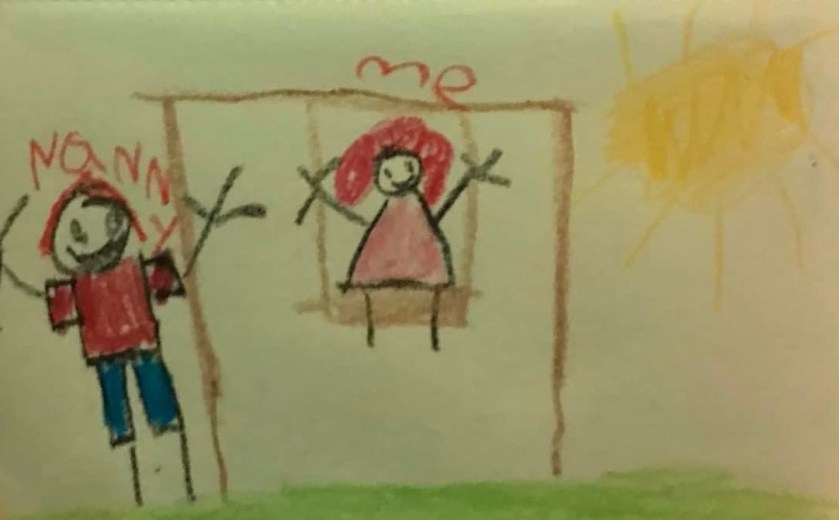
My Granddaughter’s depiction of our favorite activity: swinging. She is so wise….

Finding Healing Around Christmas

Maybe your family needs some healing around holidays as well. Sure, it seems strange to talk about Christmas amidst all the paper and ribbon and cookies and tinsel, but it is, in fact, the best time to step back, recognize struggles and disappointment and start our families on paths to peace with Christmas; maybe along the way we could even figure out what’s “enough” for joy. I offer this reflection then to all our families because we cannot find healing if we do not know our family’s wounds. Here’s hope for discussions about upcoming celebrations: may they be intentional, loving and truly joyful for all.

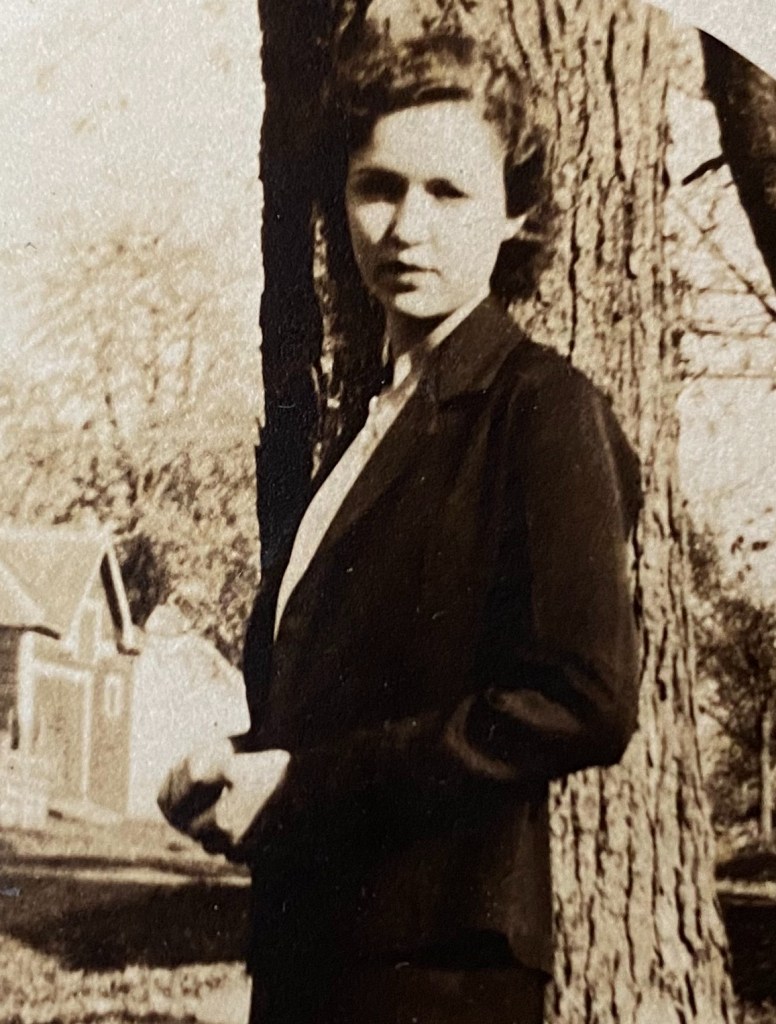
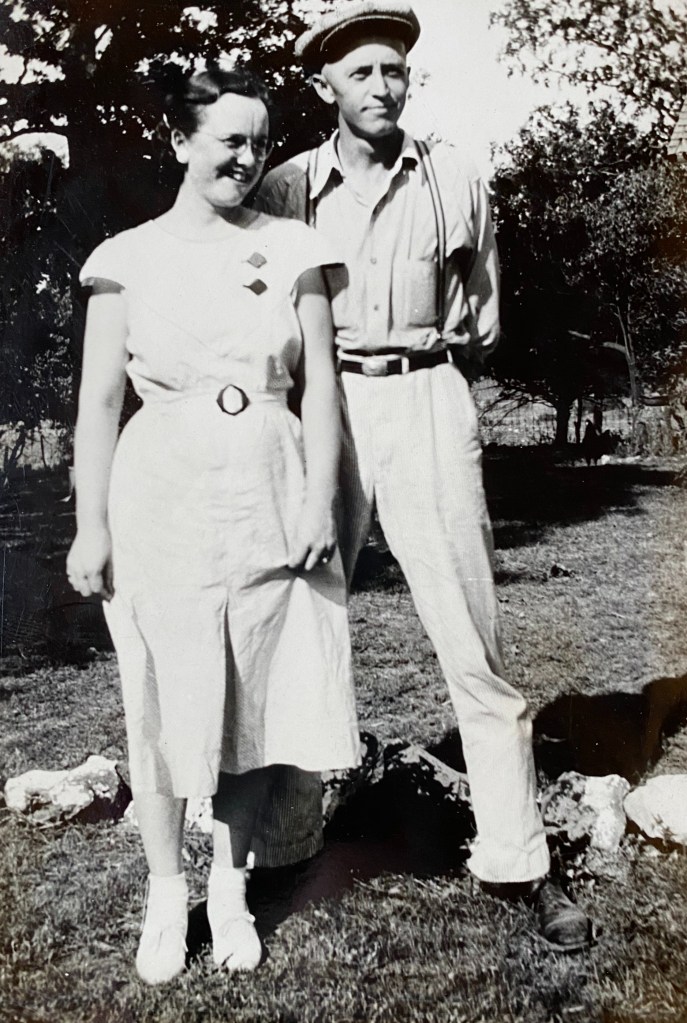
For me, it seems the best place to start is with the grandmothers. Both of my grandmothers were born around WWI; each married during the Great Depression. Neither had, as they say, “a pot to piss in,” not while they were growing up and not while they were young mothers. Both worked hard to support their families outside the home as well as in. Dad’s mom, Arbaleta, had two children, a boy and a girl, nine years apart. Mom’s mother, Marie, had three daughters all close in age. 

Arbaleta’s husband, my Grandpa Mac, fell from an electric pole when he was young and wasn’t supposed to ever walk again, but did, in great part because Arbaleta would not let him not walk. She reportedly insisted he move his legs and even moved them for him for months as physical therapy until he could walk and work again. While I was never close to Grandma Leta, I have always admired the steely determination that these actions showed.

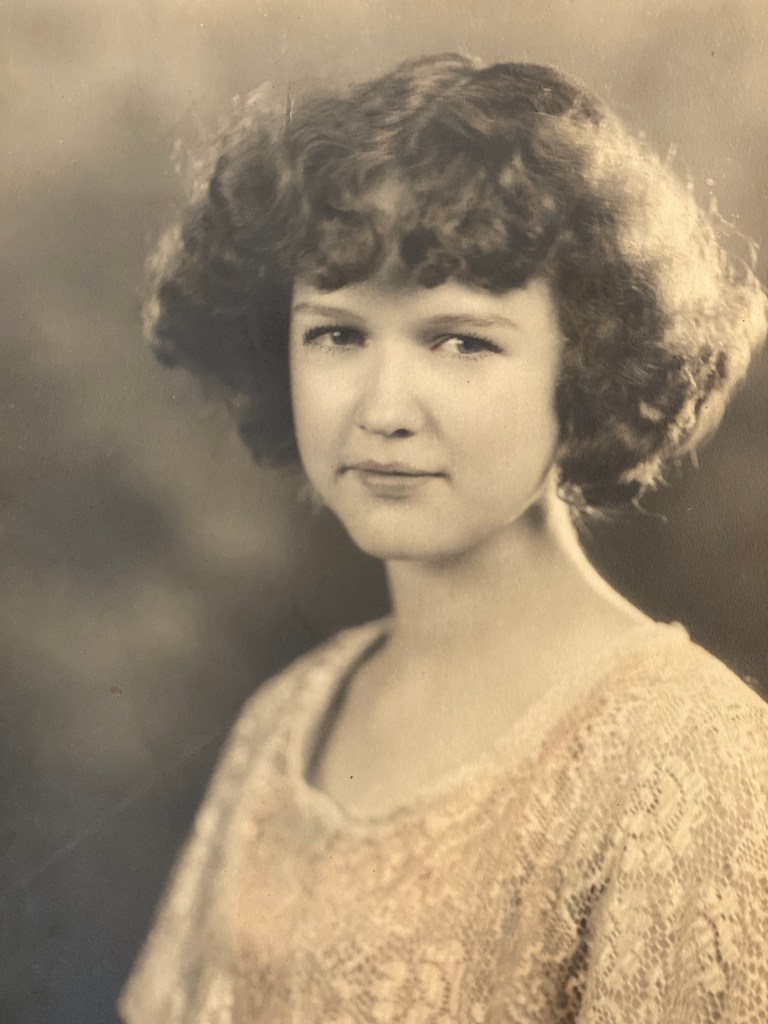
Marie had a husband who was always on the road as a truck driver, mostly because the bus or truck driver jobs close to town weren’t well-paying. He died of a massive heart attack at age 50; she lived another 30-plus years and married her high school sweetheart, then outlived him and married another kind man when she was eighty. At that wedding, the minister declared what we all knew, “Marie is a hopeful woman!” Grandma Ree, as we called her, was the quintessential kindergarten teacher when teachers still had time for nature walks, ironing leaves between sheets of waxed paper, and silly songs. Thus, she was the kind of grandmother I aspired to be: she played games with us, prayed for us, encouraged us and defended us when necessary.  For most of her life, she modeled a love of learning: she earned a master’s degree, helped “plant” two churches, became an accomplished painter and was memorizing her favorite Bible verses in her seventies because she was losing her eyesight.    

While I know little of Arbaleta’s childhood except poverty and hardship, I know Marie helped her mother run a boarding house after her chiropractor father divorced her mother, something which mortified both women.

That I’m aware of, Arbaleta seldom left her home after we were born. At least we never saw her leave her home, though, as far as we knew, she was perfectly capable. Our collective memory of her is of her seated on the sofa in her silk pajamas. Every time we visited her, we would wave to her from a few feet away as she perched on the sectional sofa in the corner, surrounded by shelves of various sizes and shapes of cacti. In one hand she held a lit cigarette, ashes threatening to crumble onto the silk, and the other hand held the ever-present bean bag ashtray (you know, the kind that has the bean bag on the bottom and the colorful aluminum tin bowl on the top.) That I can remember, she never once kissed, hugged or touched us in any way, shape or form. And, though she was pleasant, there were no memorable conversations, just the cloud of cigarette smoke that circled above her. 

As for Christmas, well, I can’t remember there being much of it in their home at the edge of a Kansas golf course where she and Grandpa had retired. Ironically, I’m not aware Grandpa played golf, though my Dad did well into his eighties. As far as Christmas goes, Arbaleta represented the point in the arc where celebration was merely tolerated. Every few years, our parents would tote our gifts to their house to open on that rare occasion we woke up there on a Christmas morning, but the mood in the house was that Christmas decoration was, well, perfunctory. There was a tree and maybe a wreath, but evidently, for Grandpa and Arbaleta, a tree and some lights outside were “just enough,” though I suspect they were only put up to satisfy us. If overcoming poverty was Arbaleta’s life goal, she met it, thus the home on the golf course as well as the purchase of a new Lincoln every year. Secular or religious, it didn’t matter; Christmas was a formality, expected, tolerated for the children. Christmas dinner involved polished silver and store bought sweets, if any. “Please wait until you have permission to touch.”

Arbaleta died when I was seven and, suddenly, the focus of Christmas on my father’s side of the family shuddered and swung hard to the opposite extreme. Her daughter brought in Christmas every year from then on with a vengeance, lovingly, but with an overwhelming force. Every year, my aunt seemed to be competing for best Christmas ever, ostensibly in response to her own mother’s lackadaisical attempts.

While certain treasured and expensive statuary graced my aunt’s mantle for Christmas, for example, every year, the Christmas tree itself, usually the biggest tree I’d ever seen, sported a different theme with new, all handmade ornaments. I often asked when she started making them, sure she must have begun the previous New Year’s Day. She also made most of our gifts; they were always of Pinterest quality and I treasured several sweaters she knitted for me, for example. 

As if it were necessary, she also became an amazing cook and thus, Christmas visits always involved impressing us with recipes for new dishes. Ironically, my mother didn’t want the recipes and my mother’s mother, Marie, didn’t need them; my mother was too busy leaning into that dysfunctional pendulum that was swinging back to the starker side, likely in reaction to her mother’s seasonal excess. 

Marie, my mother’s mother, was on that same swing of the pendulum as my aunt, though I believe Grandma Ree went all out for her Christmas celebration for different reasons. Her husband, Grandpa George, also died when I was seven, but that did not slow Marie down in life or around the holidays. From the moment you opened the door into her home at Christmas, the scent of pine and wild berry candles carried you through room after room of greenery, holly, bells, poinsettias and new figurines or miniatures each year. Also new each year were the sweetbreads and cookies and homemade candies, all awaiting our discovery after hugs and kisses were exchanged and the coats and mittens and caps were piled onto a bed in the back of the house. 

Grandma Ree with her brother, Mother and Sister, c. 1960’s.

A Family Nightmare

While Marie’s response seemed to me to somewhat resemble that of Arbaleta’s daughter, the driving force behind Marie’s likely unconscious Christmas reverie gone amuck was a well-kept secret, a family nightmare. On two separate Christmas Eves, during her childhood and youth, Grandma Ree had lost family members to suicide. I was, of course, an adult before I was made aware of that history or the details: one drank poisoned alcohol and one shot himself, both on separate Christmas Eves. Of course, the grief and shock of their actions was complicated by their (conscious or unconscious) efforts to ruin Christmas forever for some of their family.

How painful were their memories of the holidays?

Before we assume that Marie’s attempts to reclaim Christmas was the reason for the pendulum’s extreme movements, though, we need to recognize that some calamity in earlier generations drove those men to choose Christmas Eve to end their lives; we have to ask how painful were their memories of the holidays that drove them to risk also ruining the holiday for their spouses and children? How far back did the pain begin and what don’t we know about that? 

In other words, it’s not likely either man, both of whom must have been suffering and feeling hopeless, started the family on that path.

The result, though, seems to have been an unconscious struggle to compensate. Those grand swings between holiday excess and hopelessness left subsequent generations still unconsciously at a loss to figure out what’s enough celebration. Further, while we can understand what might have spurred Marie’s need to excel at Christmas, I’ll likely never know what caused Arbaleta’s lack of enthusiasm for the holidays, and so I’m left simply to marvel at the overwhelming force of her daughter’s frenzied Christmas efforts. Sadly, or thankfully, no one now has picked up that mantle and the extended family is so fractured as to make these discussions nearly impossible.

I offer these reflections then to my nuclear family as the beginning of some discussions around conscious choices rather than wild reactions.

How does a family figure out what’s enough Christmas when the family’s history is, well, fractured? My own efforts were often emotionally unsatisfying; not only were my mother’s Christmas efforts headed for the stark extreme in reaction to her mother’s and her sister-in-law’s excesses, but they were complicated by my general lack of interest in cooking or baking except when absolutely necessary. 

It was my ex-husband who started me thinking about some of our responses to holidays years ago: he protested the idea of Valentines’ Day for example, saying we could and should give one another cards or flowers or candy at anytime of the year and not just one day chosen by candy and card companies and florists. Yes, we can, I agreed wholeheartedly. But do we? Of course not, I pointed out. To his credit, he came by his dislike and struggle with holidays honestly and thus brought his own reactions to our holiday table: his birthday is the day after Christmas, and he was one of six children. His Christmas gift always came with a declaration that, “Oh-that’s your birthday gift too.”

Over the years, I certainly have struggled with holidays, whether it’s decorating or preparing a feast or just planning. Don’t get me started on birthdays for children; too many of those ended in my tears from exhaustion and a sense of failure. Did I tell you about all the “Pinterest Fails?”

All these things and more (all these things and more) that’s what Christmas means to me, my love….)

Stevie Wonder

Plenty of us struggle with the holidays, though, whether because of grieving a loss or knowing you’re the only one who can’t afford the gift exchange. I’ve tried over the years to make our gifts for Christmas but again, I know too many of my family members and friends were less than thrilled with the results. Mea culpa. We tried spreading the Christmas holiday over several days to lessen the wild two-minute frenzy of Christmas morning. We tried taking Christmas to the mountains; we tried staying home. We wondered what would happen if our family just gave up one Christmas and had lots of little ones? Could that not translate into lots of chances to do or give or be kind to one another? So many of our attempts at intentional Christmases revolved around not expecting one or two people to create a magical holiday that only left them in tears and exhausted.

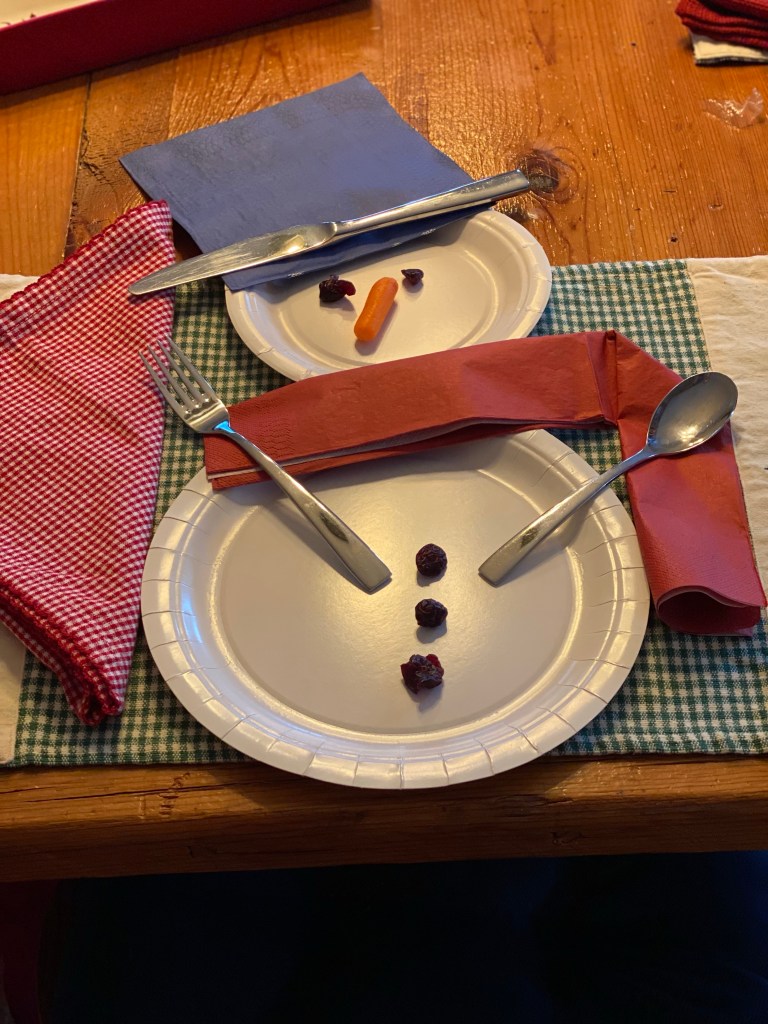
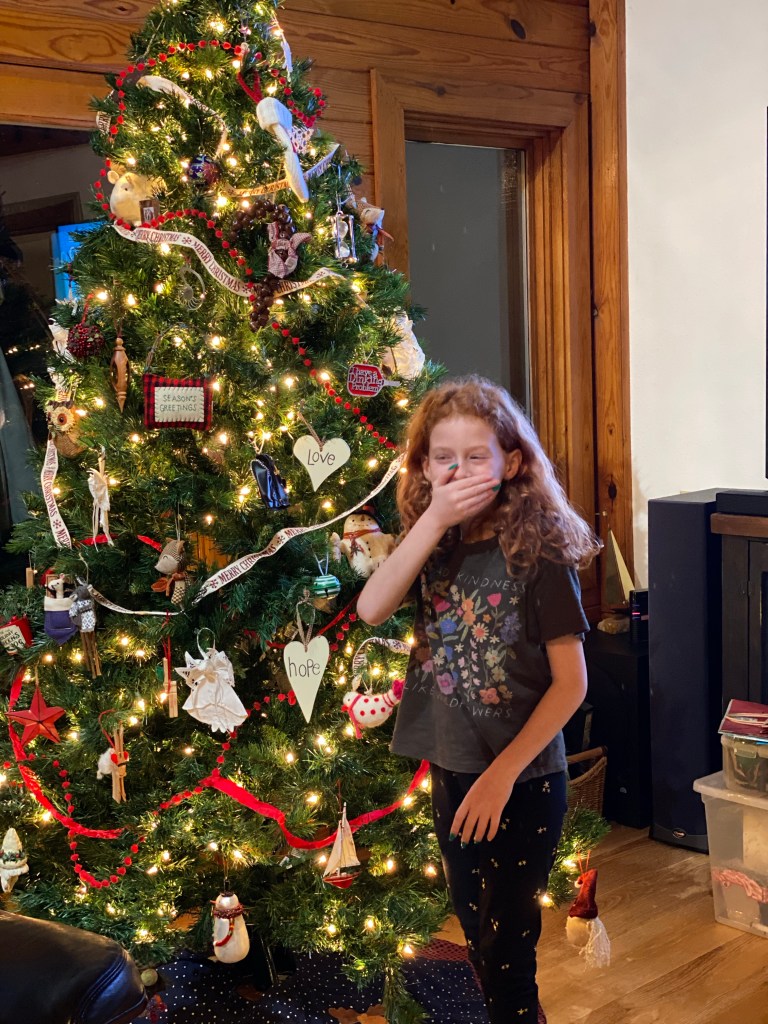
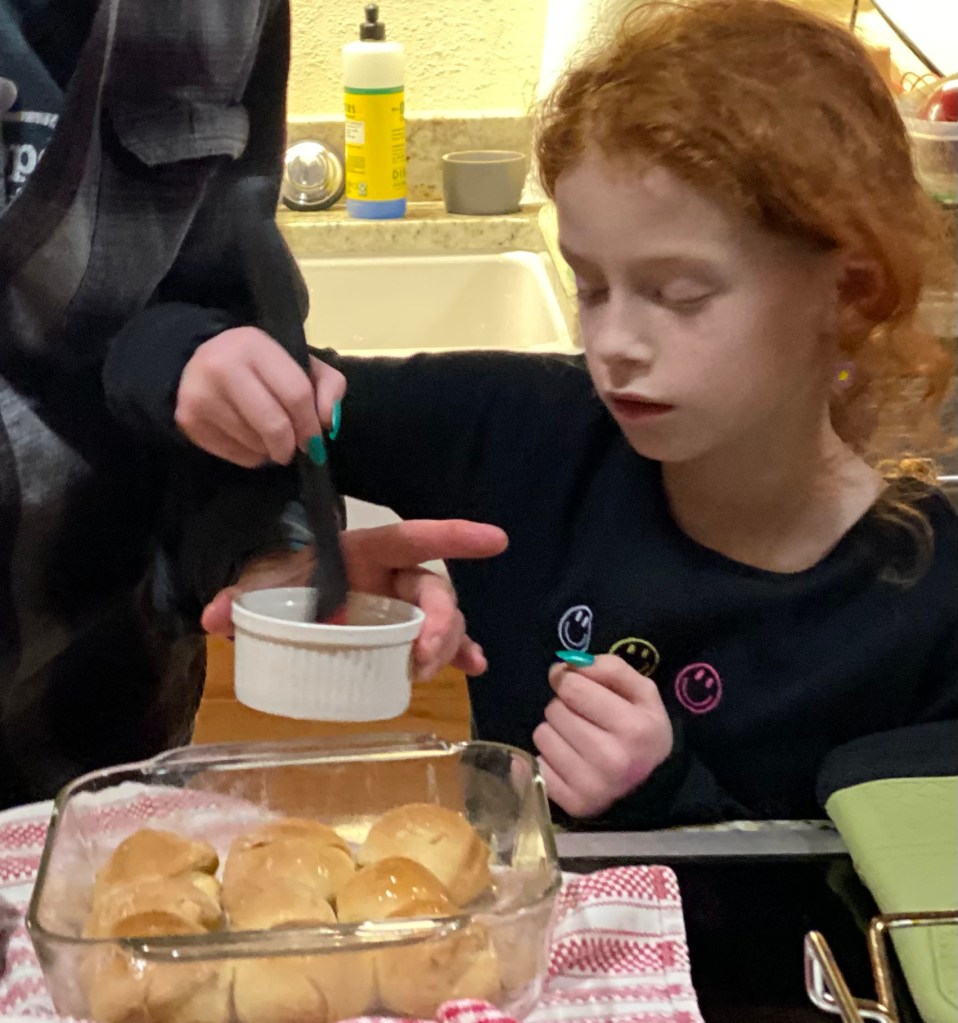
We’ve finally begun to incorporate some activities intentionally. Instead of china and crystal, we copied someone else’s snowman place settings, something the granddaughter and I could share. Last year, we started some silly story telling. This year, we introduced Karaoke and I am trying to reclaim the joy of baking by helping my granddaughter learn; watching her “knead” the goop she bought at the store made me think. Lo and behold, she discovered the joy of yeast and how it rises and how the baker must punch down the dough, then knead it. Her eyes grew wide after she made a fist and punched away. “That is soooo satisfying,” she said. A keeper. 

In case you’re wondering, religion did not seem to figure at all in the wild reactions to the holiday through the years for my extended family. While Arbaleta was, as far as I know, agnostic, and Marie was a strong Christian, neither of them addressed or seemed to include the religious holiday in their efforts to reclaim or dismiss Christmas. For our family, that’s a different pendulum altogether. I personally love a good candlelight Christmas eve service singing and the idea that God came to be with us as an infant. Nevertheless, culturally we continue to struggle with all that Christmas celebrations have become for generations and we cannot heal from pain we do not acknowledge.

For our family, the faith and religious rituals are different pendulum altogether. I will never know why my Grandma Ree did not incorporate more of her personal faith into the celebration. Personal experience suggests she was treading lightly with agnostic family members and, as is true for many families, also celebrated on different days with different parts of the family, balancing church events with home. Nevertheless, culturally, we continue to struggle with all that our secular celebrations of Christmas have become for generations, often leaving us to begin another year frustrated, sad, discouraged. That is where we can start, but we must look collectively at this because we cannot heal from pain we do not acknowledge.

The best time, I believe, to reflect on how we celebrate Christmas is when we are all together…and we’ll before Christmas comes around-unexamined-again.

For my family, I continue to try to reframe Christmas in light of the history I bring to the holiday. I guess I hope through reflections and questions to step completely back from that wild, reactionary swinging between excessive celebration to indifference and even disdain. 

I think one key is that we focus on the children, but with respect for their needs and not our own needs to give them the best holiday ever! 

They get tired; we pay attention. They want to dress up; they don’t want to dress up. Quiet time, dancing in the kitchen time, gifts that involve us engaging with them. I’m not saying we’re the best with children ever or that ours are happier than any other. What I am saying is that like in so much of life, the children around me ground me. What they need is so often what I need. Let’s sing Jingle Bells, yes, at a gathering, but we mustn’t forget the bells themselves and our need to jingle them to make the song come to life.

A little percussion goes a long way and when we sing “Jingle Bells” there need to be jingling bells….A five-year-old taught me that.

Music must also be a source of holiday joy for many families. I’m jealous of those who manage a musical gathering but hopeful that might be in our future as well. Certainly with percussion everyone can participate! The idea of introducing music brings us back, though, both to the need for sensory awareness and to the idea of joy and reverie throughout the year. In order for there to be music next year, we need to practice throughout the year – often and, by practicing, remember the things that do bring us joy without wearing us out. I write this and share it now, after the holiday blitz, planning to share it with my family, to start the conversation we can have in anticipation of next year. I am curious to hear from them, and find out if they are aware of, or experiencing their own pendulum of Christmases, maybe even unknowingly riding that pendulum right now. I’m hopeful that with some lowered expectations of ourselves and a little yeast, we just might be able to rescue the holidays from the extremes of that dysfunctional pendulum my family rode for far too long AND decide for ourselves what is “enough Christmas.”


Leave a comment

Featured

Check, Please!

Adventures in

Dating After 50

Ask anyone who’s played the “dating game” as an older adult and they will likely be able to offer up some horror stories, especially if they ventured into the world of dating sites (and later dating apps on phones.) Even if they succeeded in finding that special someone, and plenty of folks do, the journey can at times more closely approximate a game of MarioCart than a stroll down EHarmony Lane; the rules change quickly, toads abound and princes and princesses can be tough to locate and even tougher to engage.  

As I approached my fifties, after twenty-one years of marriage, I found myself clumsily navigating the dating world. I hated being alone, but I would end up single for far too many years before I found a man in Tennessee who would even consider a relationship with a liberal, divorced, (female) Methodist minister.

Lonely People (by America)

“This is for all the lonely people, Thinking that life has passed them by, Don’t give up until you drink from the silver cup And ride that highway in the sky.”

For readers living in more socially open-minded areas of the country, the divorced aspect was actually the least of the problem. I had stayed in Tennessee for one reason: our divorce decree would not permit me to move and take my young sons with me. Evidently, though, my being liberal in Tennessee was way more repugnant to many men I met, and, too often, I felt like a little blue raft adrift on a sea of red. I tried making sure that “liberal” was prominent on my profile’s description in hopes that those with more conservative leanings would just move on; sadly, being up front about social issues also attracted plenty of ugly comments. 

In contrast, being a minister was, apparently, just plain confusing for potential dates. “Are you allowed to date?” “Are you allowed to kiss?” Female clergy quite often seemed as foreign as Cyborgs. I understand that. When I started looking into preaching nearly three decades ago, I was asked if I could see myself preaching and leading worship and I had to confess I’d never seen a woman do either. I was not alone in my lack of experience at the time with clergywomen and so I could understand why single men quite often were at a loss as to what a relationship with a woman in ministry might look like. Still, there’s lack of education, and there’s rude. I was stunned when a guy who was working on my campus ministry building leaned over one day and said, “I guess you don’t want people to see you out on a date, so why don’t you just meet me at the hotel down the way? And, do you have a dress because I bet you’d look good in a dress.” Gee, how can a girl resist?
I held onto hope through several abysmal dates arranged on dating sites on the internet; this was before you simply looked at a face on your phone and swiped left or right. If I met someone on EHarmony.com, we talked for a week or two before they got my full name or even my phone number. I even joked that I didn’t date anyone I couldn’t Google. If a guy didn’t have a positive history, we would not meet up.


One hopes we all learn as we get older, but, if you have never experienced online dating or dating apps, you might be surprised by the shenanigans, even on sites catering to the “silver” set, guys who are old enough to know better. Surely, I thought, they’d be more mature than the younger guys who were often simply looking for a one-night stand or someone to talk dirty to them for a while. Now I wish I had a dollar for every time an older “gentleman” made sure before we even ordered our meals that I knew he’d taken his little blue pill. Can you say, “Check, please?”

Once I arranged to meet a potential dating partner at a local restaurant, but didn’t see him in the restaurant even though there were only two other patrons and one was a woman. Turns out, his picture online was from more than a decade earlier, so, once I walked over to the booth and determined he was indeed the man I’d spoken to on the dating site, I had to wonder why he had sent his father to meet me. Foolishly constrained by politeness, I ordered and drank down a soda, then asked the waiter for my check and told the old man sitting across from me, “I’ll call you.” I lied. 

Another guy complained about middle-aged women “letting themselves go” and gaining weight. “I hate it when they sit at a table and their breasts rest on the table,” he said. Yes, I would agree in hindsight that such a ridiculous comment ought to have been enough to prevent further conversation, but I was still hopeful that one comment didn’t sum up his entire attitude towards women. When I saw him walk into the restaurant, I didn’t recognize him, though, because, it turns out, he had gained more than forty pounds since the picture he had posted of himself! Okay, I thought, he’s embarrassed about his weight. When, though, halfway through the meal he gave me directions to his apartment in case I had trouble following him home, I excused myself to use the restroom. Nowhere had we discussed going anywhere together after the meal, let alone his place. I found the waiter, paid for my own dinner at the hostess station and left alone. 

 One guy openly lied about smoking – I said no smokers on my page – because, he said, he was looking for a girlfriend to help him quit. Another guy, who agreed to meet even after discussing the fact that I was a minister, informed me before we had even gotten our menus that whatever relationship we developed would not end in marriage. “Just to be clear,” he said, then he asked what I’d like to drink. No check necessary. One guy commented on my profile page that he didn’t date women with short hair. I responded that we at least had one thing in common! Yet another was charming throughout our phone conversations but then, during our first dinner, when I commented that his family sounded lovely, he calmly informed me that he was looking for a mistress and would not ever be introducing me to any of his family. I just left him with the check. 

Photos I used on my dating profile in the dark ages….

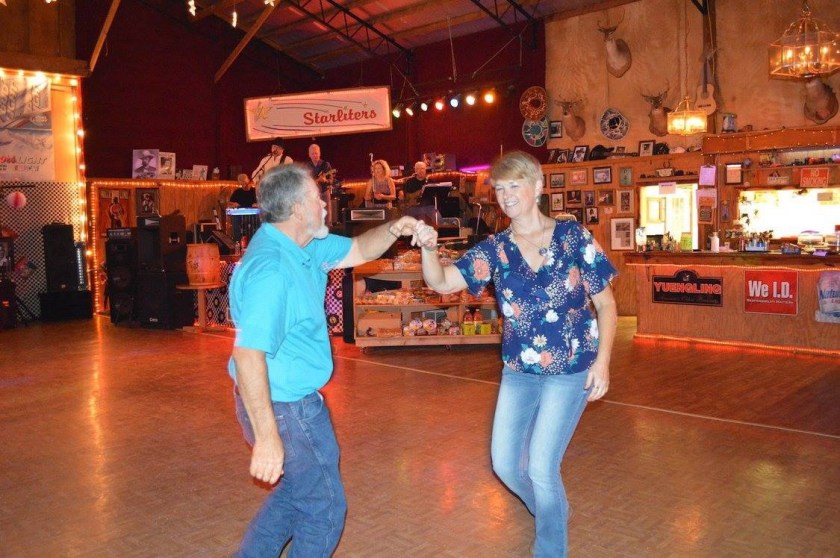
I did go on some dates that were not arranged through sites. I’d started taking social dancing classes and met a few nice men but no one I wanted to go out with until one New Year’s Eve. A charming man I met while dancing that evening, who was funny and who was respectful of my vocation, danced well and we ended up dancing nearly every dance together.  At the end of the evening, we were sitting around a large table with of my friends, enjoying a champagne toast to the new year when he invited me to visit his “compound” in rural South Carolina. Seemed innocuous enough until he began to press me for specifics. How soon could I make the trip? I wouldn’t need a car, he said. He’d drive me there and then I could have my choice of any of three refurbished RV’s (if I wanted privacy once we arrived.) When he lifted his glass in a toast to the fact that my impending visit to his compound would be a “forever thing” now that we’d found one another, he was sent back to South Carolina alone. 

I honestly wondered for the longest time if it were going to be possible to find anyone even to date, let alone to hope for a mutually supportive and loving relationship. I did meet some nice guys but both of us being liberal or even both of us being Christian wasn’t enough to build a relationship. As a pastor, I couldn’t date congregation members because of ethical concerns. The few colleagues I knew who weren’t married were often looking for a more conservative and/or less outspoken wife. It really seemed hopeless for so long. 

Mirror, mirror, on the wall….

What was most depressing was realizing there were often obvious reasons why some folks weren’t married any more; too often, a failed attempt at a connection caused me to look at my own foibles and failures and, more than a few times, caused me to wonder if I was just meant to be alone. 

Then I met the man we will just call Walt. No, not his name. He was also a minister. We met for the first time when my campus ministry team visited his church. A week later, he brought his youth group to an event we held for prospective students. He was the life of the party and danced several times. We shared dating horror stories. Then he asked about spending more time together and I began to hope my solitary days were coming to an end. I was happy to find such an out-going, gregarious non-conformist; he even spent evenings, he told me, on his porch surrounded by the hummingbirds who had become his friends.  

We arranged for a first real date, which started with a brief meeting of his mother and young granddaughters. They were delightful and it was a positive sign, I thought, and so I didn’t blink when he said he wanted to share a little bit at dinner before we officially began dating. I agreed. We were both old enough to have some baggage and we needed to begin any relationship with our bags open for inspection. 

Dinner began quietly. He did not drink any more, he shared. I was a longtime member of Al-Anon and we understood one another on that topic. I told him about my divorce and he shared about his; we both lamented the struggles of sharing children with exes, especially when the rift was still painful.  

“One thing it’s tough for me to share, though,” he said after we ordered. He took a breath and said simply,  “You need to know: the probation will be over soon.” 

Probation

By “soon,” he meant, “there are only eight months left on a twelve-month sentence.” 

“It’s okay, though,” he said, reaching across the table and putting his hand on mine, seemingly to reassure me all would be well. “The drugs were not mine; they belonged to the prostitute.”

I remember staring, confused, at his hand patting mine. Knowing that the drugs weren’t his made it better? 

“No one here will ever know,” he explained. “It’s in another county.”

I pulled my hand back, still silent.

“You should probably say something here,” he said. I had just been staring at him, trying to process this information. “You know,” he said, “you can’t tell anyone about this. What people tell clergy, you know.” 

I remember I laughed just a bit at that. He was wrong about so much at that moment. No such privilege existed, though he clearly hoped I believed it did. Most baffling was that he seemed convinced I’d be fine with the idea of him soliciting a prostitute so long as she had been the one who brought the drugs to the party. 

Not only were we not on the same page at that moment, we weren’t even in the same book. In fact, I was only clear about one thing at that moment. I raised my hand, caught the eye of the waiter nearby, and said, as calmly as I could manage, “Check, please.” 

Pickleball? Really?

I will tell you that, after many years alone, I did enter into a caring relationship with a man whom I met playing pickleball, of all things. Who knew pickleball would replace EHarmony, Match.com or the vegetable aisle in Whole Foods as the place to meet eligible singles? By the time my husband and I met, though, I’d pretty much given up looking. That was wise, though, because, honestly, when I review my dating experience before that, well, I think you’d agree, if I didn’t laugh, I’d cry. Check, please.

Featured

“Good? Bad? Who Knows?

There’s an often told Chinese story, “Good or Bad, Who Knows?” about a farmer, his son and his horses. The farmer used an old horse to help plough his fields, but one day, the horse escaped and galloped off. When the farmer’s neighbors offered their sympathies to the farmer over the bad news, he simply replied, “Good? or Bad? Who Knows?”

As it happens, a week later, the old horse returned and brought with it a herd of horses! This time the neighbors congratulated the farmer on this good fortune. Once again, though, he replied, “Good? or Bad? Who knows?”

As it happens, a few days later, when the farmer’s son was attempting to tame one of the wild horses, he fell off the horse’s back and broke his leg. Everyone thought this was very bad luck. The farmer’s reaction again was, “Good? or Bad? Who knows?”

Some weeks later, then, when the army marched into the village requiring every able-bodied youth they found to enlist, they found the farmer’s son with this broken leg and he was not drafted.

“Good? or Bad? Who Knows?”

Banner Week? Week From Hell? Who Knows?

It was a banner week. Or the week from hell. Depending on when you asked me. Start seminary. Check. Get divorced. Check. Buy a house solo. Check. In one week. Ugh. Scheduling all three in one week had not been my choice: the seminary starting date was set, but the other two were simply the luck of the draw. I agreed because I wanted to be done with those moments where legal experts, signatures and explanations of terms and fees were laden with shame. Time to move forward.

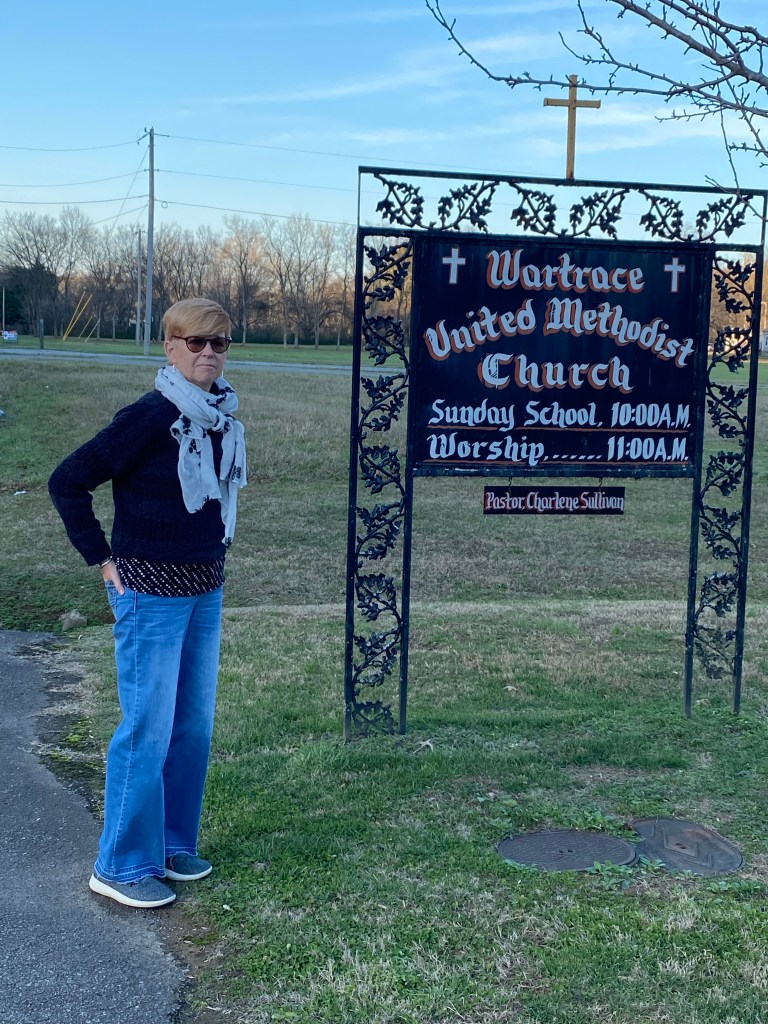
Thus, on a Monday morning in 2003, I began what would be a four-year run at Vanderbilt Divinity School, one of many steps to ordination in the United Methodist Church. I had already been serving as the pastor at a small United Methodist Church. For seven years, I’d been what the UMC calls a Local Pastor, meaning I was the only pastor for that congregation and licensed (given authority) to preach, teach, marry, bury and serve communion for that congregation. During that time, I attended classes offered by the church but all the while I was waiting until my sons got a bit older before entering seminary and moving closer to ordination. I served at Wartrace United Methodist Church in Greenbrier, Tennessee, while living in Portland. Portland, Tennessee, lies about 30 miles from the church to the west and nearly 45 miles north of Nashville where the school is located. For those four years, the daily trek between the three locations would be my own little Bermuda Triangle, and I would clock 40,000 miles each year, though God knows I hated driving.

God also knew that, when I was called into ministry, one of my biggest concerns was that I swore “like a sailor.” How’s this gonna work I wondered? God held my tongue, though, and miraculously, only one time did an obscenity escape my mouth while I was in front of anyone in more than a decade. (I’m gonna blame campus ministry and later working with combat veterans for my language eventually going south again.) 

Back to that week. I started seminary and the daily drive back and forth forth and through the back roads. I also would close on a house on Wednesday of that week, my first solo home purchase. Though my husband and I had bought two houses together, I still found the process baffling on my own. With the help of a patient agent, I got there though and much to the relief of my youngest son, we were staying in our little town which meant he could finish high school with friends.  More importantly, at least to him, we weren’t going to live in a trailer, apparently a fate worse than any other his teen brain could conjure.

I closed on this house alone on Wednesday after classes because the day before, somewhere in the midst of visits to shut-ins or the hospital and more orientation for my new Vanderbilt classes, I went to court to finalize my divorce. The court appearance was still required then and ours was early in the morning on that Tuesday. I drove down the ridge and sat in the courtroom as the judge appeared and called couple after couple to stand before him to ask if either had any other concerns or if they could agree to the final settlement.

Couple after couple said yes. Some answered quietly and sadly. One or two barked their answers as they stared at their soon-to-be exes. We were last except “we” weren’t there. The judge moved the process along fairly quickly so it was only 9: 15 or 9:20 when our names were called, but my soon-to-be ex was nowhere to be found. I went before the judge, wondered a minute or two whether or not I could change the agreement since my husband wasn’t there yet, then answered. “Yes, I am in agreement to the terms we negotiated with the help of a mediator.” 

And then I was divorced. Something I’d never believed I would be. My parents were not happy together, but they stayed married. His parents struggled too but they also were still married. I had never imagined myself divorced. Of course, I never imagined in my forties I’d be preaching or attending seminary and studying theology and Bible and the elements of worship or prison ministry, either, but there I was in classes 9 a.m. every day of the week suddenly. Even nine years earlier, it had not yet entered my mind that I’d be standing in a pulpit trying to help a congregation feel closer to God OR divorced OR buying a home as a single mom. I answered yes, the gavel hit the wooden block on the judge’s bench, and we were done.  

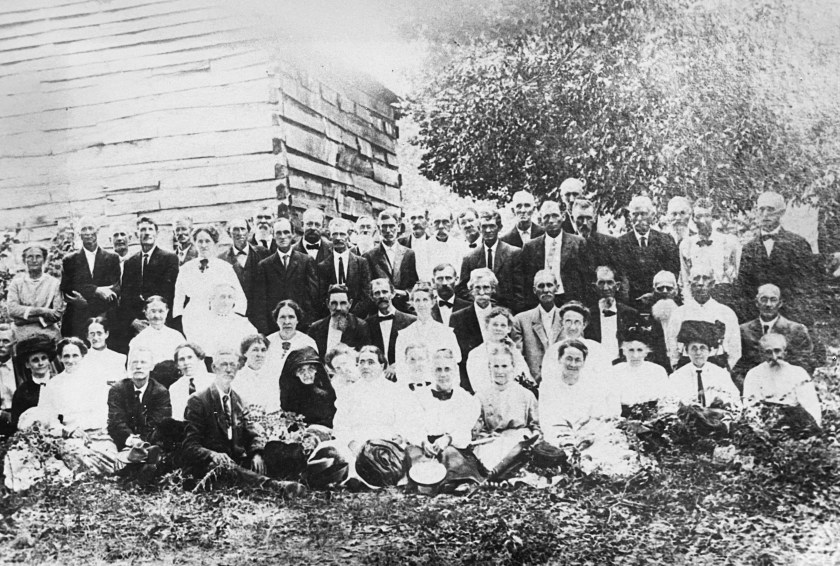
Wartrace United Methodist Church was approaching 150 years old when I went there in 1996 and the photo at the left is in front of the original building, taken around the turn of the last century.

I next saw my now ex-husband again as I walked out of the courthouse around 9:30. He was just then walking in a bit late even though he lived in the same town as the county courthouse. I had driven some thirty minutes down the ridge to get there.

“Are you here alone?” The judge had asked me before declaring us divorced. 

“Yes, sir.”I had said, “It’s appropriate,” I explained, “It didn’t feel like he showed up for the marriage so I guess there’s no reason to expect him to show up for the divorce.”

The judge frowned, but declared I was no longer married to the man I’d expected to live with forever. I used to tell friends I imagined fondly the two of us walking hand in hand when we were elderly. Perhaps he’d wear a beret; I’d once seen an elderly couple walking together and the man wore a beret. They seemed to walk as if that was simply the most natural thing in the world. The two. Together. 

We’d walked through life together but, ironically, we had never actually taken many walks together until our twentieth year of marriage when we were in counseling and needed to talk out so much.  The only reliable privacy we had was to go for walks in the neighborhood so we could talk, or argue, without our sons needing to hear it all. I lost about twenty pounds that last year from stress and walking. I’d love to say I never found it again but that’s a different post.  

I stopped briefly on the steps leading into the courthouse as my now “ex” husband entered, looking at me quizzically. 

“It’s done,” I said, and he frowned. 

“Do you want some coffee?” he asked. 

My turn to frown. “Pass, “I said. “Heading to class.” 

“How’s that going?” he asked, He’d finished his own doctorate while we were married and was none too happy to be paying me alimony while I got my Masters of Divinity, but he also liked academia and worked in it, so he was happy to chat about that if I wanted. I didn’t. 

My day would be filled, thankfully, with the business of becoming a Vanderbilt student, and the myriad tasks that entailed would keep my mind occupied that day, I hoped. As soon as I got in the car, though, I wondered if I’d missed a chance. I should have planned to meet up with a friend and get drunk or find a rebound relationship or get a tattoo, I thought. Was I missing out on the chance to be self-destructive and not be judged? Damn.  

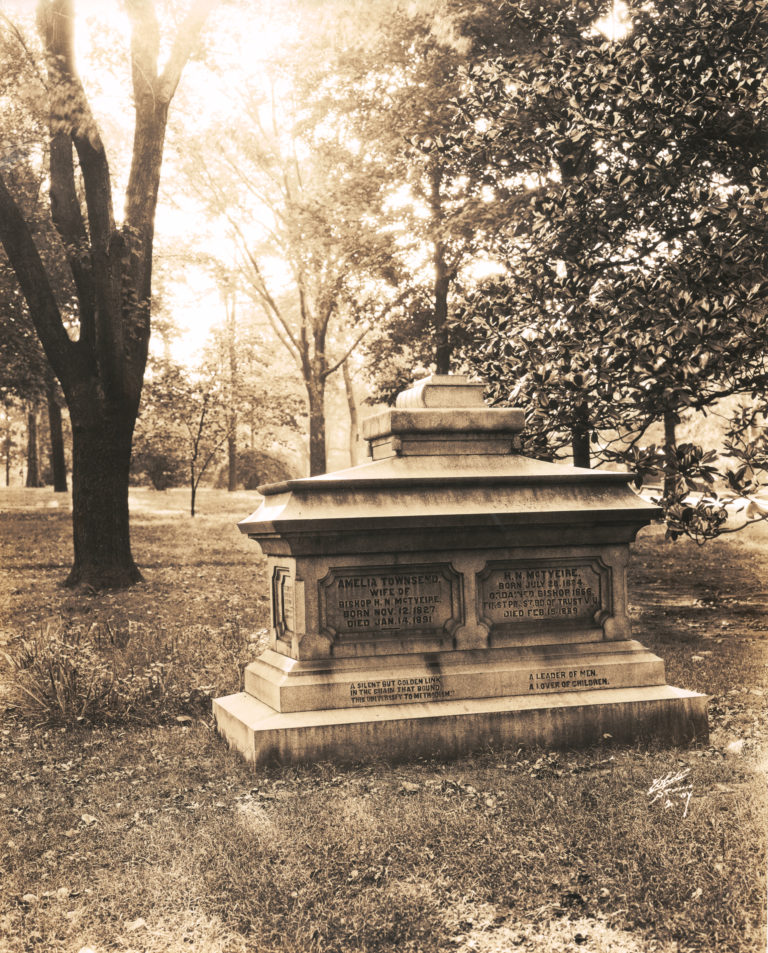
I drove silently to the campus for more paperwork. Classes began on Wednesday and honestly, at the time, it felt like they would be a welcome relief. Before that, there were school loan papers to sign, books to buy, an ID to be photographed for; time to don my student pastor identity. Orientation day at Vanderbilt Divinity School was, of course, as was the entire week, played out in the muggy heat of August in Tennessee. Sadly, that all required I move about the campus in the heat dressed as a professional without looking wilted. Complicating the day for me was the layout of the campus with the walks between buildings. Those walks meandered through the beautiful campus, but not in any grid-like pattern. While pastoral on cooler days, the campus on that steamy day seemed to confound me every time I had to leave the Divinity School quad to visit another building. The paths between buildings curved and intersected and wound around various statues and even the stone crypt of Bishop William McKendree, who, I would learn, was the first Methodist Bishop born in the USA and credited with establishing Methodism on what was the western frontier in the early nineteenth century. McKendree UM churches dot the countryside in Tennessee, Kentucky and Missouri. He died near Nashville while visiting family and in 1876, his remains were interred in the grounds of Vanderbilt University, along with those of other Methodist bishops, in part because the school originally was created to help educate Methodist ministers.   

View of the gravestone of Bishops McKendee, Soule and McTyeire, and Amelia McTyeire, Chancellor Garland, and Dean Thomas O. Summers in 1925. Vanderbilt University Special Collections and University Archives photo archives PA.CAF.GRAV.002 (https://www.vanderbilt.edu/trees/mctyeires-grave/)

Pastoral, bucolic, flowering garden beds sat next to benches that encouraged rest and beautiful old stone buildings invited meditation, but those paths seemed designed to confuse me even though I had grown up reading maps. My father, who helped survey the paths for hundreds of miles of Missouri state highways, taught us how to read maps early, and every year at Christmas, he presented us each with the state highway version of “bling,” a new, revised state map. I was always particularly gifted at directions and maps; I corrected pathways to destinations regularly. It was a gift that I could tell you how to get “there.” Not that day, though and not in that place. The Vanderbilt campus walkways, I soon discovered, curved and meandered enough that, on at least three trips on that sweaty afternoon, I wound up at the wrong building in spite of the decorative campus maps posted prominently. I guess the designers felt students needed to be lost more often. At one point, after finding my campus mailbox, I followed a group who all said they were looking to get campus ID’s next. One by one we got pictures taken and laminated. Mine was a witness to my defeated state on that afternoon. Perspiration matted my hair and my cheeks were red from the heat. The bad news was no one would recognize me in that picture. Perhaps that’d be good news one day. My query about retaking the photo on another day was met with a glare. The clerk was spending her afternoon in the air conditioning, I thought. What’s her issue?

I moved along, aware a library card still needed to be acquired and a locker in the Divinity School building as well. If I could find the library, the Divinity School would be close, I reasoned, but the heat was getting to me. At one point, I stopped into the food court to find some lunch but found the choices bewildering and the process moved more quickly than I was prepared to navigate. Students who’d only recently attended undergraduate classes jostled me and moved around me and the hot food worker glared until I took my tray and moved to the salad bar. A few minutes later, I stabbed at my salad and wiped the sweat off my forehead trying to unstick my bangs. As I dabbed at my sweaty forehead with a napkin, another worker, a woman, stopped at my table and put her hand down and said, “You look like you need to put your head on the shelf now, dear.” 

“I’m sorry?”

“Put your head on a shelf. Take a break? Stop thinking for the day, you know.” 

I frowned.

“Rest your mind, sweetie,” she said and she moved on. Words of wisdom from a stranger, but I didn’t have time to rest yet; that’d come years later. 

On my way back to the library, my phone pinged to tell me I was late for an orientation I’d completely forgotten about, and I stopped and looked around me, lost again. I felt old. I felt like I wasn’t going to be able to keep up. How would I manage classes and single parenting and being the pastor and preaching and visiting and paying for all those books and driving? It was too much. What was I thinking? The next day I’d be signing papers to buy a house on a part-time salary and school loans. The students around me were twenty and thirty years younger and most were accustomed to the changes on college campuses that threw me, like salad bars in the cafeteria and computer charging stations everywhere. Those students didn’t seem lost.

I sat down on a bench, defeated. I would have just quit right then and there, if I could have found the damn Divinity School building.  Obscenity doesn’t count if no one hears you, right? I would be walking into the orientation with the other 60-plus students who would be in my cohort for three to four years. Only I’d be late, sweaty, disheveled and feeling defeated. I sat on a stone bench and looked at the backpack I had been steadily filling with more and more, mostly because I couldn’t figure out how to make the locker work in order to leave some of the many required books in there. Tears filled my eyes as I began to pray.

“I can’t do this, Lord. It’s too hard. I don’t know what I was thinking. I was foolish to even consider I could manage. I still had a house to close on and God knows that process never made sense to me. How am I gonna manage that AND Divinity school? I can’t even find the damn school.” I was trying not to just start sobbing.

I took a breath and looked up at the elderly and majestic magnolia tree shading me, one that had been planted with a couple of hundred other southern magnolias in 1895 by Bishop McTyeire, one of the bishops buried near the Divinity School. I squinted to look through the dark leaves at the sun shimmering and the cross…. Wait. What?

There was a cross on top of that building. 

Suddenly, I was laughing as I cried. Of course, there was a cross on the top of the Divinity School Building! My guess is that everyone else knew that, except those of us sitting in our self-pity piles. Geez. Yeah, I’ll cop to a tendency to self-pity, fueled by a glass half full mentality. Sometimes I’ve wondered how I ever got anything done, but, then again, I’ve always been teachable. I wasn’t alone like I felt I was either, but there’s seldom been room for or recognition of any company in my self-pity dinghy.

In that moment, sitting on that concrete bench, though, laughing at the shiny cross against the blue sky, I kicked myself. Had I taken a moment to look up and to seek God in the midst of my exhausting week, I would’ve seen it. Like on the steeple of a Christian church in most places, shiny and bright, that cross topped the Divinity School building, there to guide us all day back home, like the North Star. I would have seen it if I had just looked up, if I had started my days with an awareness of God’s presence.

The rest of the week would be mostly a blur, but by time I stepped back into the pulpit that next Sunday, I would have “celebrated” or “survived” three momentous life changes in the course of one week. I was living in a new home, divorced, and a seminary student, but I was still standing, gratefully. I shared with my congregation about looking up and seeing the cross and realizing it had been there all along waiting for me to notice. I also shared the image of putting my head on a shelf. Both would carry me through the next four years of school as well as the decades I’d spend in ministry, reminders of who brought me to that moment and who would guide me through all the struggles, if I would pay attention.

Featured

Of Hiking, Floods and Fragmented Memories

In the previous Post called The Boulder Fields of our Lives, about hiking Longs Peak and working at the YMCA of the Rockies, I ended by explaining that our summer work (and “Hikemaster” Course) were cut short not long after we scaled the 14,000+ foot Longs Peak because of a natural disaster in the canyon below us. A few days after the climb, a year’s worth of rain fell in 70 minutes and the Big Thompson River below our camp washed out nearly everything and everyone in its way.

“On July 31, 1976, the skies opened up over the Big Thompson Canyon, setting off the deadliest natural disaster in Colorado history that claimed 144 lives and caused $35 million of damages.” (https://www.coloradoan.com/story/news/2016/07/29/big-thompson-flood-killed-scores/87524858/)
Fragmented Memories

For decades now, because my memories of being just above the “500-Year Flood” are so fragmented, I have not told the story of being there, which is unusual for me. Most days, I am known to bore anyone close enough to listen with a story or two; I usually can’t help myself. The stories I have not told then generally are ones I cannot remember OR ones I do not want to remember. Only after writing about climbing Longs Peak, as I looked at the photo of me and my climbing companion, did it occur to me that the story of that summer was not complete without talking about the flood.

“The chaos along an otherwise trickling Big Thompson River killed 144 people, five of whom were never found, and carved out a chapter in the history books as Colorado’s deadliest natural disaster.”

https://www.coloradoan.com/story/news/2016/07/29/big-thompson-flood-killed-scores/87524858/

Both the hike and the flood were, for lack of a better word, watershed moments for me, but the lessons have been realized slowly and in fragments. To better remember those days, I looked at a couple of television news reports of the flood, but they were recorded decades after the flood. Strangely, the lack of technology at the time affected both the before and the after, the event and the memories. The only phones in 1976 were landlines and, so, warnings came only through emergency personnel going door-to-door; at least one first responder died trying to warn others that night. Only a few black and white photos are available as well, making attempts at remembering as cumbersome as the warning system had been. Nevertheless, I have felt driven to try to piece together a coherent memory of those days and, as I researched and read and poured over old photos online, I read the words of one Colorado disaster preparedness official. She said,”We learn the most from chaotic events.” As I have tried to remember and reflect, I think that she was right; we do learn much from chaos, but we have to work to find those lessons.

First, setting the stage for our story….

After my freshman year in college, I went to the mountains near Estes Park to work for what I thought would be a summer of fun. Once there, I was surprised to find a sense of peace that I had not expected. I was, for the first time, hopeful that I might actually be able to find a peaceful and stable home once I could support myself. I surprised myself, in fact, by making some plans to continue working at the camp in the fall.

Though I kept journals off and on, little remains of what might have been written that summer. I do remember that, on the back of placemats, during lulls in our work, I sometimes wrote letters or journal entries; most of them are lost, but the only one I have found from before the flood surprised me. I wrote:

  • Tuesday, July 20, 1976

    “Storm clouds have mingled with the mountain peaks since sunrise; we here in the valley are enclosed, shut away from the crowds that would disturb us….peace of mind must certainly follow. Here, in my room, I am lulled into a tranquil mood by the clouds every day. Even when my work day is long and busy and even frustrating,” I wrote, “…the calm is inescapable.”

Calm was something I could not claim before that trip and safety was not a place I remembered.

At that point, the clouds covering the tops of the mountain peaks around us (The highest peak in our area was Longs Peak at more than 14,000 feet in elevation.) were benevolent. I wrote: “These clouds draw your thoughts. Constantly changing, first ringing, then entrapping the peaks, they are playing quietly and are a source of constant amusement.”

Those “playful clouds” would soon turn deadly, though. During our Hikemaster classes that summer, we learned to appreciate the danger of the storm clouds that often came up quickly in the mountains. On July 20, though, I was simply calmed by their presence and movement. I needed that calm desperately; the family life I would return to was chaotic, unpredictable, traumatic. The rules changed daily and nothing that occurred in my home could surprise me anymore. The overwhelming feeling that I had carried with me when I tried to escape to the mountains from a tumultuous family life was fear. Fear and anxiety wore me out and, I know now, the trauma, fear and stress are why so many of my memories are fragmented at best.

And now, a word about trauma….

Trauma is destructive. Like the different kinds of skin cancer, trauma can create a wound that burrows deep or spreads outside of you, like when you fear for your loved ones in such a depth as to make others question you, call you hysterical even. And yet, because you have experienced trauma, you know. Accidents DO happen. People, even people you trust, DO harm one another. Your parents did not protect you. No one saved you. Nothing, not even seeing another day, was guaranteed. All the worst, all you feared, was indeed possible, did happen. And no amount of reassurance from others can repair that trust completely; we can learn to manage the fear but we never know when some sound or smell or person or newscast will bring it all rushing back.

Like a broken mirror, trauma shatters both our sense of self and our memories. Too many of my memories lie in shards on the floor and picking through them, trying to piece them together, trying to make sense, to have some timelines or events make sense is most likely why I write.

Even the effort to capture the memory of that time is fragmented: all that remains are three pages written by that seventeen-year-old me as I tried to capture what I saw and a couple of newspaper pieces I wrote after I got a job working at the local paper and my editors learned I’d been in the “500-year Flood of ’76.”

The morning of July 20, 1976, though, I was feeling calmer than I ever had, safer, more at peace and, to my surprise, I was enjoying even the colder weather on the mountains. I have long been known to dislike the cold intensely, so as I read the words I wrote, I am struck by what I believed I had found there: a home and place where I was being trained to pay attention to my surroundings, to know my own capabilities, and how to prepare for and help others in disasters. Wanting to help others is one response to trauma. I know I was hopeful that I might at the very least return the next summer to be Hikemaster and even one day make my home near the clouds.

I wasn’t able to stay, though, and thus much of what I remember, even as I try to piece it together, still seems fragmented and lost to me. Like most of my co-workers, I went home soon after the flood, and immersed myself in college classes. I never saw any of my coworkers again and I never spoke to any of them afterwards either; those relationships simply ending undoubtedly contributed to a sense of loss.

Now, as I try to access any memories of that time, I am left with the handful of days afterwards, days when all of us above the canyon were trying to figure our what was happening below us. Even though we were aware, we did not want to talk about how we ourselves inexplicably had escaped being swept up.

That first day, though, we didn’t know what was going on below us in the canyon.

Like the many campers along the river, we were enjoying the scenery. The Big Thompson River was one of the jewels of the area, a mighty source of income because of all the tourists it drew. Most of the year, “…the water runs only a few feet deep and fifteen to twenty feet wide…happily rushes over rocks and gurgles through pools as it descends 8,000 feet from the high range to the south Platte on the prairie. The water is clear, numbing cold, and playfully sparked by the sun.” (Big Thompson: Profile of a Natural Disaster by David McComb, Pruitt Publishing Company, 1980.)

  • Saturday, July 31, 1976

    Today is unusually rainy.

    Normally, storms approached Estes Park and the YMCA camp from the south; thunderstorms, while normal, are of short duration, with clouds often enveloping peaks by 10 a.m., which was why hikers needed to climb summits of the various peaks in the range in time to skedaddle back down below the treeline or risk becoming a lightning rod.  Our Hikemaster course is teaching us a great deal about safety and we are training to lead hikes, which would mean teaching tourists about safety as well. Too often, though, tourists in the park dismiss any safety preparations or climbing instructions with disastrous consequences. The tourists we met traveling up to the summit the day we climbed Longs Peak weren’t interested in safety tips.  As we were headed down to the timber line, we passed, for example, a woman in a summer dress, wearing tennis shoes and carrying a purse on her arm as if she were headed to a party. They would be fine, they told us, and they waved us on. They had evidently never seen a person who’d been struck by lightning. Unprepared hikers found their way to our camp often enough though and several of our coworkers are among those trained to rescue hikers.

We did not know at that time that many of our Hikemaster instructors would be called upon to help flood victims the next day.

The storm was approaching from the East, though, we noticed, and it just seemed to camp above us, a thunderhead with no high westerly winds to move it. Reports were that during that Saturday evening, twelve inches of rain fell, about the normal annual rainfall amount for the area. Estes Park and the YMCA are above Lake Estes on the Big Thompson River, but, just below us, the unrelenting water from several tributaries gathered debris and swept down the canyons, both restricted by and guided by steep walls. By the time the waters reached the North Fork and the Big Thompson, there was already enough force to destroy bridges. All along the canyon, this storm surge ripped up everything in its way, including homes and campsites, swept up by a water level estimated at nearly twenty feet above the normal. Reports I read later told of at least one emergency worker dying in his attempts to go door-to-door to warn people.

We Learn from Chaos….

One of the innovations that came out of the Big Thompson flood was a national warning system for floods and other national disasters. That, with the advent of cell phones has greatly reduced the number of deaths in floods.

  • Sunday, August 1, 1976

    The camp is secluded from the world as usual, except for the hymns and local newscasts being broadcast on the radio in the bakery. Rain falls steadily still and a heavy fog had settled on Big Thompson Canyon. Four of us went by van higher up into the mountains to a lodge to feed some visitors. While the lodge was only thirty feet higher than the camp, it was eerily sitting just above the clouds and driving on those narrow roads on the sides of those mountains felt even more dangerous than normal.

    Sitting in the lodge’s kitchen after breakfast, we listened to the radio to learn when we could expect some sunshine. Mountain thunderstorms seldom lasted even more than an hour or two, so this second day of fog and rain was disconcerting. The announcer became somber, reading a report that surprised us: “The Big Thompson River had overflowed its banks in the narrow canyon leading to the valley and four persons were reported dead.” We became quiet, not having known that the storm was dangerous. The cook was worried about his family, knowing they lived near the flooded area. The storm, we heard, was stationary, and we could look forward to more rain.


    A lightning flash warned us we needed to take the van back down the mountain before trying to drive became even more treacherous AND before the van started attracting electricity. We warned the visitors in the lodge not to drive anywhere or even to go outdoors because they’d be lightning rods.

    Throughout the morning, as we worked back at the bakery and kitchen, we listened to any news reports coming over the radio. We worked silently through the day as the reports began to seem unreal; the number of dead grew to more than sixty before evening. We began to slowly comprehend the devastation that was apparently just below us. No one wanted to ask if it were just dumb luck that we were above the deadly flood and others were below it. The folks in charge were not sharing much information; maybe they didn’t want us to panic. No one really was surprised to learn that our phone lines were down. That was not terribly unusual, but the announcement added to the somber mood and hushed tones all day. The frequent updates on the radio and our director forbidding us to leave the YMCA property kept us all close to the kitchen even long after our own shifts had ended. Only the maintenance crew left to take the trash but the normal 30-minute round trip took hours and they returned with widely varying reports of the flooding just 1500 feet below us. If any of my coworkers or those in charge were afraid, I did not see it.

Monday, August 2, 1976

  • Monday, August 2, 1976

    This morning, the fog is even lower than before, which meant rescue helicopters were grounded. Several refugees have been brought into the camp in the night. So forlorn, they are wet and cold and dirty. They wait for some coffee and a blanket; dirty pillowcases in the hands hold the few belongings they were able to salvage. They are lucky, though; hundreds more are still stranded. Many more are missing and most are expected to be dead. Still there are no phone lines available and a trip to Denver, normally a couple of hours, would take six or seven and that was only if you had a four-wheel drive vehicle. Technical climbing skills are needed now for rescuers because roads are washed out in the canyon and the only way out is up over the cliffs.

  • Tuesday, August 3, 1976

    For three days, we have heard little about what was happening below us, except by the radio. I suspect now they were trying to prevent any kind of panic; we also did not know what the rest of the world thought about our fates, either. We were surprised to find for example, that our parents had heard mostly dire reports about Estes Park and the YMCA camp above it being unreachable and even obliterated. Some men we didn’t know came to get us today and told us we were going to be calling our parents via ham radios set up. The instructions to “tell your parents you’re still alive” stopped me for a moment. I had not known nor had I had a moment to worry what they might be thinking at home.

The overriding feeling it seems was somber but also a bit bizarre. For one example, our local radio station published a newsletter/bulletin we could see every morning, and next to the names of the dead each day were that day’s baseball scores.

Rumors

Rumors abounded. One account said all manner of snakes, also apparently trying. to escape the waters, were chasing survivors up the sides of the Big Thompson River canyon.

There was one report of a baby, who became known as Baby Moses, stranded on a rock in the rushing water.

One newspaper wrote: “After it opened, the refugee center at Loveland High School became a source of personal details as survivors, some with nothing more than the clothes they had worn into the canyon, told how an evening of cards with friends was interrupted by rushing water and a mad dash to scale slippery rocks. Throughout the first days rumors were abundant. There was one report of a baby, who became known as Baby Moses, stranded on a rock in the rushing water. One national publication called to verify that the baby had been rescued by a woman who lassoed it while riding a white horse. But no one could substantiate any of it, and The Coloradoan reported it as an example of the rumors.” (Big Thompson: Profile of a Natural Disaster by David McComb, Pruitt Publishing Company, 1980.)

“We learn the most from chaotic events.”

Disaster Preparedness Official in Colorado

I Learn from Chaos

For the longest time, I realize now, I felt profoundly disillusioned after that flood; the safe home I thought I had found, in fact, was as treacherous as any place could be.  I was not able to stay and create a home there that I was seeking because of the flood and damage. It took me years to acknowledge that and even longer to name the terror. I could not risk feeling that terror then; none of us could afford to name the terror that was just below us. 

I certainly had seen the power and wisdom of what we had been taught while learning to hike safely on those granite peaks. I cannot necessarily agree that we “learn from chaos,” but I can admit that I learned from how others around me operated in the chaos. 

Over the years since I left the camp, I know that I consciously incorporated lots of those lessons into my life. When you hike, take only pictures and leave only footsteps. When you journey, make sure someone knows where you’re going and when you should be back. When it’s cold outside, layering is the key to staying warm. If you’d asked me before what that summer taught me, I would have acknowledged all of that readily. I also spent a lot of time the next few years in jeans, hiking boots and denim shirts. I even decorated any space I inhabited with topographical maps. I started jogging in order to build up my endurance. I even tried caving because I was not near any mountains.

Mostly, trying to remember any part of that time has shown me that I had learned and incorporated lessons from the flood into my daily life much more extensively than I realized. Being just above the flood and watching how others navigated that danger, in fact, would inform and guide me for decades, if only because so much of what we’d learned in our classes had been especially effective in the midst of that chaos and tragedy.

There is wisdom and, often, survival, in choosing to be careful, and to work together. We learned to look before you step over a log or rock, make sure you pack what you need but only what you need, and, naturally, respect the power of nature and especially of water. In life lessons, those translate to being intentional, learning when enough stuff is enough and admitting to ourselves that we are not the most powerful force out there.

When my parents showed up a few days later to take me back to Missouri, they said I was different. The summer had been grueling in a number of ways, but I had learned so much that would inform every step I took from then on, would help me create the safety I craved whatever path I chose. I don’t doubt that the summer has helped me feel brave enough to continue to travel and explore new places, albeit with safety ever in mind.

Until now, I hadn’t talked or thought much about that time. I chalked it up to being forced by circumstances to abandon the path I had begun to enjoy so much. I felt for the longest time that I’d had an adventurous summer but it was over and so the memory and the possibilities were simply filed away like a summer fling; they were simply not relevant going forward. What I didn’t recognize was that I was on another trek, one that would last my lifetime and what I learned during that summer was helping me all along to find my way, help me create the safety I craved. I say “create” rather than find because all that I learned that summer helped me slowly realize that the safety I sought I had learned to carry with me. “Safety” would be wherever I found myself when I paused long enough to look up from the path.

I will continue to unpack the backpack, to try to remember the story of those days and others still dark. I can recognize one truth, though, folded neatly like a bandana in my jeans pocket: chaos and danger will be all around no matter where I travel or where I land, no matter where I make my home. Because of that training, though, I have tools, guiding principles and more confidence to continue exploring whatever path has been before me.

Featured

Shopping Cart Fiasco – Learning to Listen to Yourself

When our two adventurous boys were toddlers, their father, Mick, the bearded, brown-eyed singer I’d fallen in love with a decade before, demanded I stop being constantly worried about the survival of our off-spring.  

“They’ve made it just fine so far,” he said one warm evening outside Kroger, punctuating his point by, rather roughly, I thought, depositing our two-year-old, Spencer, into the basket of a creaky shopping cart. 

In my defense, I countered silently, we had thus far prevented any plaster casts or spidery-black sutures on those precious cheeks because of the diligence and quick reflexes of their mother and the fact that the two-year-old, in particular, bounced well.  

The first time I’d left my husband alone with Arlo, our first-born, to play at the park, I had not realized I needed to explain to him that the rubber, wraparound baby swings were for one-year-olds like our son or that he was nowhere near big enough to sit on a sagging rubber seat meant for an older child and hold onto a chain. Our beautiful brown-eyed boy got his first bloody nose that day.  My husband read my mind.  

“It’s not like he broke his nose when he fell from that swing,” Mick countered while helping the now four-year-old into the cart. Arlo wrapped his arms around his bent knees and lowered those eyes onto the patches on his jeans, happy he wasn’t going to be expected to walk but pouting because his father had said no toy aisle.

I frowned at the squeaking of the wheels as we pushed the cart towards the sliding glass doors.  I pointed to the two-year-old, and commanded, “Sit.” He sat.   

“We know better now than to leave them alone with anyone else,” he said, both of us remembering our last visit to his parents in this now well-worn argument.  His mother had suggested a fifteen minute stroll down to the dry creek for some time alone only to discover on our return to the house that Spencer had burnt the palm of his chubby little hands because no adult was paying attention. 

“I wasn’t there though,” my husband continued his line of argument.  “Even when I’m here with them, you worry.” He pointed out to the busy parking lot.  “I see,” he said, “cars and parents and grocery carts out there. You,” he said, sweeping his arm across the parking lot like Vanna White, “you see death everywhere!”   

He wasn’t exaggerating.   

I did see death everywhere, especially in parking lots.  We had spent the past four years in a small Japanese town where there were few cars and the biggest danger for a child was being smothered by too much attention. Back home, however, new dangers lurked everywhere.  

“You just go shop. Alone,” Mick suggested.  “I’ve got them and we will get home a whole lot sooner if you just pick out the apples and chicken alone. Okay?”

He abruptly parked the cart by the magazine rack.  “We’ll be right here.  We’ll be fine. We can be home soon if you don’t come looking every time you hear a child crying.” I slunk away under the weight of his disdain, clutching a plastic hand cart and  thankfully-short grocery list scribbled on the back of an envelope.  He was right. I did not need to assume every crying child was yet another example of Mick being distracted at just the wrong moment. 

I first heard the clatter of metal on the tile floor as I left the cereal aisle.  Someone has knocked one of those end displays, I told myself, honing in on the bone-in chicken breasts at the meat counter.  I chose a shrink-wrapped package whose price sticker showed it to be family-sized, then turned towards the milk display. I wrinkled my nose as a sour smell hit me: milk had been spilled at my end of the store. I skirted the spill, and reminded myself of my goal. I had focussed and was still going to focus, I told myself, pushing the cart away from the sound of a child crying at the other end of the store.  “Not all crying children are mine, not all crying children are mine,” I sang to myself to the tune of the “Wheels on the bus.”  Whoever they are, they are with their mother and my boys are fine, I reassured myself.  

One gallon of two percent secured, I headed to the express lane.  I set the items on the grocery belt and tried not to look towards the gathering crowd near the far end of the store and the self-checkout.  I smiled to myself, proud of progress, then stopped the cart abruptly, and leaned back to look around the endcap filled with M & M’s and sugar-free gum to see my husband holding our two-year old.  The four-year-old had a firm grip on his father’s thigh and a store clerk was dabbing Spencer’s face with a cloth. Leaving apples, chicken, milk where I had neatly organized them, I forced myself not to run.  Mick looked up and apologetically.  The four-year-old did run and I scooped him up without breaking stride.  I looked at the overturned cart and then at my husband in horror.


The store clerk backed up to let me assess the two-year old; he would have a bloody and swollen lip but no teeth damaged, no need for stitches and neither had broken any bones, it appeared.  A miracle. 

 “I was looking at the magazines,” Mick explained.  “Arlo must have reached over for the children’s books and made the cart fall over.  They’re okay, see?” Mick turned  Spencer’s chubby, snotty cheeks towards me.  

I set Arlo down, put the crying child on my right hip and sighed as he wiped his nose on my shirt.  Arlo grabbed onto my left hand, then looked back at his father as we started for the door.  Mick took the bags of groceries from the manager who apparently had followed me from the 10 Items or Less checkout. “Did you pay…?” Mick’s voice trailed off behind me and I heard the manager encourage him to take the bags and go, please. 

I kept walking.  

“Never.” I said, without breaking stride, not really caring if anyone heard me.

“Never tell me again how to be a mother.”

Featured

The Boulder Fields of Our Lives

(This is for all of us who try to do too much alone, for those lone wolves who don’t need any help. You know who you are because you’re always worn out!)

My prized first pair of hiking boots. One of my first hikes in the summer of 1976.

Forty-plus years ago, as the summer between my freshman and sophomore years in college was coming to an end, I embarked on what was to be an epic journey for me. During that summer, I was working at the YMCA of the Rockies in Estes Park, Colorado, adjacent to the Rocky Mountain National Park. Our days were spent working in the YMCA camp that hosted thousands of visitors in the summers; but, once work was over, several of us were studying to be hikemasters. If we completed this course that summer, we would be able to return the next summer and help lead hikes for visitors. The park is beautiful with numerous peaks well above timberline and some of the peaks even had glacier packs of ice. The highest peak in that park was Longs Peak, standing more than 14,000 feet in elevation, and, to climb Longs Peak was the final test for the hikemaster course.

Climbing Long’s Peak

You feel small standing there because you are.
Photo credit – https://www.nps.gov/romo/planyourvisit/longs_peak_conditions_report.htm

The 15-mile round-trip from parking lot to summit takes about 12 to 15 hours, and is usually completed in one day. Much of the hike was just plain exhausting, even though we had spent the summer training by climbing higher and higher peaks, acclimating to the elevation and learning about safe climbing and emergency measures.  We started the hike at about 2 a.m. and, for our test, the entire trip to the summit and back was required to be done in one day.  The plan was to be able to make enough progress to be on the peak by 8 or 9 a.m. because you needed to be back down to timberline (i.e., back over the boulder field) by 10 a.m.  Timberline is that place where trees stop growing and where hikers become the tallest targets for the lightning that would start when the storms rolled in by 10 a.m.  If you are above timberline after 10 a.m., you are just a walking lightning rod. There is no “trail” to the summit of Longs Peak once the Boulder Field begins, which is about five miles into the hike.  There you leave any semblance of a path and climb over car-sized boulders. A slip, trip or fall could be fatal and IS fatal every season, so the going is slow.

The Boulder Field. Warning: Objects in view ARE further away than they appear.
Photo credit – https://www.nps.gov/romo/planyourvisit/longs_peak_conditions_report.htm

The Boulder Field

I remember several parts of the climb – and each presents a different kinds of challenge: there are enormous vertical rock faces exposed to falling rock, which requires scrambling on all fours; there are narrow ledges, which require you just not look down; and, even in the summer, depending upon conditions, you can expect to encounter snow and ice.   The part I remember as most daunting, though, was that Boulder Field, which was what you encountered first when you emerged from the forest and left the protection of the trees. From there you scrambled over boulders toward an opening in the rock face called the Keyhole. The actual Keyhole Route begins after the Boulder Field. The last 1.5 miles after the Keyhole is by far the most difficult, exposed and hazardous portion of the route.

While that sheer face after the Keyhole requires climbing on all fours and was perhaps the most dangerous, what I remember most vividly is  that Boulder Field.  Over the next third-of-a-mile the trail climbs roughly 500 feet. This is an extremely rugged section of “trail” that requires scrambling, use of hand-holds, hopping over boulders, and a great deal of route finding. There are, along the way, several cairns – stacks of rocks – to help with navigation. As you proceed higher, the terrain becomes progressively steeper and more difficult to climb and it would be very easy to break a bone falling off a boulder. 

I still look back at successfully completing the climb to the top of Longs Peak as proof of the power of preparation and determination and teamwork to accomplish what seems most daunting.  We were only able to spend a few minutes at the top then turn around and repeat the climb in reverse because the danger of being above timberline for very long; we had to reverse our course and hustle back down the sheer cliffs and over the boulder field only pausing long enough to take a picture. There, were, of course, no cell phones back then but someone else was thoughtful enough to carry a camera up there so the moment could be memorialized. We also added our names to a written list in a container there to record visits. Maybe the list is not physically there anymore, but we know we were part of a hardy group that made it to the top and back down safely. I look at that entire climb still as a pivotal moment in my life, a reminder of what I can do. Though I cannot fathom today covering 15 miles in one day, climbing over boulder after boulder and making my way thousands of feet up then back down; we managed,though, and remembering I’d been part of that successful endeavor helped me more times than I can count.

All those boulders….

When I face struggles still today, though, standing safely at timberline and staring at the boulder field is what I often remember; it seems the perfect example of a task that seems overwhelming, daunting, too big to even consider.   

Years later, as a young mom with two boys under five, working evenings as a writer and teacher and volunteering in my church, that boulder field was an image that came to mind regularly.  It was especially in the forefront of my mind when I was starting to feel, in the midst of the exhausting chaos that was my life, that God was calling me into ordained ministry.  

I was in my mid-30s, and had returned to church with two boys because I wanted them to know the Bible stories I had learned as a child.  

At first, because there was no organized Children’s ministry and I wanted that for my children, I became the leader.  Soon, my pastor asked me to consider becoming a Lay speaker, someone who on occasion preached.  I agreed to do that and even spoke a few times but the idea of speaking more was simply overwhelming – and besides, every time I did, I got so nervous, I thought I’d throw up.  

I also was just plain tired with all I needed to do every day.  Every time anyone suggested I might take on more, I would ask them to find me some free time in my schedule just to iron a shirt or get a hair cut or sleep more than five or six hours a night.  More was just not realistic.  Just taking the weekly evening lay speaker courses was a family sacrifice.  

I was flattered that my pastor thought I had a calling on my life and leadership “potential,” but he had to badger me for a year before I finally agreed to more training; foolishly I didn’t  pay attention when he mentioned that the advanced lay speaking course was going to be a weekend retreat and not just a daylong class. I was not keen on leaving my husband alone with two children under six for the weekend – mostly because I wouldn’t want to be left alone with two very busy little boys myself for a whole weekend either. Nevertheless, it was at a retreat center so I thought maybe I’d get to hike and get in a nap before the weekend ended.  Wrong. 

I have to say there was some relief there – mind you, it wasn’t restful – they kept us pretty busy so that was annoying; but there was relief in that for the first time as an adult, I realized I was with “my people.” For the first time as an adult, I felt I was in a place where I  could talk about my faith without being ridiculed or told that religion and faith were only “for the weak.” 

I was worn out at the retreat though. At one point, they suggested we each find a place around the perimeter of the room to pray silently and I remembering being so tired, I just leaned up against the wall, my forehead against the brown paneling as if I were in “time-out.” As I turned around and slid down the wall to sit on the floor though, I was not terribly thrilled when, after that long morning of worship, lectures and personal sharing, they handed each of us a slip of paper. On each one was a Scripture passage, and, they told us, we would be preaching on those in the evening. Then they sent us back to our cabins, clutching our slips of paper.  There would be no nap and no hike, only swelling moments of panic and annoyance.     

Then I read the Scripture they had given me and I laughed out loud.  Perfect, I thought. They’d handed me Matthew 11:28-30: Come to me, all you that are weary and are carrying heavy burdens, and I will give you rest.   

That’s appropriate, I thought rather sarcastically.  Then I read the rest of it:  

Take my yoke upon you, and learn from me; for I am gentle and humble in heart, and you will find rest for your souls. For my yoke is easy, and my burden is light.

Is this a joke?

Wait, what? Is this a joke? God calls me to come closer to rest, then says, oh, by the way, I want you to be my beast of burden???

I remember sitting there and, in my mind, picturing that “yoke” that I was expected to take upon my shoulders, asking God how the hell was I supposed to take on more when I clearly could not manage what I was already expected to do?  I put my head down on the desk in that cabin, exhausted, and felt like even more of a failure, defeated. Here I was at the beginning of the next boulder field in my life and I just wanted to cry.  I had no more to give to anyone, no more energy to climb. I didn’t even know what direction to head.

That’s no silo…and no yoke.

Before we go further, you should know I grew up in the suburbs of a midwestern town and so, when I would later be sent to pastor a church in a small Tennessee town, it would be painfully apparent on regular basis that I knew little or nothing about farming.  Or any other culture, for that matter. My “culture” of midwest suburban life meant TV dinners on TV trays more often than not. I remember as a teenager being jealous of people who could share with you, for example, foods from their family’s culture. Like breads. Rye, sourdough, flatbread and don’t get me started on ciabatta! My culture? White bread. Plain, homogenous, more filled with air than anything substantial. Suburban life meant I’d gotten through life thus far never having tasted peaches that weren’t canned, cheese that wasn’t individually sliced and wrapped, or tomatoes off the vine. I was an adult before I learned that tomatoes actually had their own flavor and not just the flavor of whatever dressing you used to drown them.

Thus, when I woud be sent to pastor a rural Tennessee church, I would be about as out of place as I would’ve been on Mars. Early on, for example, I was corrected when I referred to a silo in a sermon. Within in minutes after leaving the pulpit and offering the benediction, before I even got to the door of the sanctuary, I’d been told at least three times that I clearly did not know the difference between a grain bin and a silo. And there IS a difference.

This is all to say that when I got to the lay speaking retreat, I certainly did not get what this scripture was about because I didn’t know any more about a yoke than I did a silo.

In my mind, I was standing at the edge of another boulder field, exhausted.

This is all to say that when I got to the lay speaking retreat, I certainly did not get what this scripture was about because I didn’t know any more about a yoke than I did a silo. I was at a loss. In my mind, I was looking at another boulder field exhausted.  I COULD tell you it was just a coincidence that I had brought an Upper Room devotional with me, but, it’s no small thing that there was a devotion about this Scripture in there just waiting to be discovered.  Just a few sentences, mind you, but it was all I needed to craft an entire sermon. Because the writer of that devotion knew about farms and explained to this city girl about yokes, he helped me see the Matthew passage completely differently.

For example, I didn’t know that, very often, a larger, more experienced ox would be paired with a younger ox, which meant that the older, stronger ox would carry the majority of the weight of the yoke.  The  younger ox would benefit from the larger ox – and the only task for the younger, weaker ox was to allow himself to be led.  

The joke is that the yoke really was easy for the younger ox.  The only thing that would have been harmful or exhausting would have been for the younger ox to fight the yoke.  Just to allow the yoke to guide you while you took one step at a time was easy, though, if you didn’t insist on being in charge.  The burden really was light, because the weight rested on the shoulders of the leader, and, that is not me. That is good news.  The path that led me to ministry has been filled with examples and reminders of that.  

Come to me, God says, if you are weary of carrying the world today, and I WILL give you rest.  

And God doesn’t just refresh us, God equips us. “Take my yoke upon you and learn from me, for I am gentle and humble in heart, and you will find rest for your souls.” That devotional was just the first example of how God would equip me time and time again. I left that retreat with with great respect for the many resources I would discover through the years. As a pastor, I would have been severely limited as a preacher, Bible scholar and teacher if I had simply relied all those years on my own experience and learning. That weekend was a heads-up to pay attention because there is great wisdom to be gleaned – with discernment – from the studies and writings of others.

As life lessons go, it was a big one.

That weekend also offered me a chance to share in that sermon a new and different understanding for what God was calling me to do, of the yoke God was offering me. That may have been the most important lesson of my life.  Sadly, I have had to learn it over and over because my personal instinct when things get tough has always been to dig in and work harder.  I find myself learning over and over how to let God be in charge AND to let God lead because things go better when I do. I get to use the wisdom of the ages when I let God lead; I get to be led by someone who sees the bigger picture.  Turns out, being overwhelmed and exhausted was the best thing that could have happened to me because I so often have struggled with that balance. The good news is that I don’t struggle for nearly as long because I know several things now that I didn’t know when I faced that boulder field forty four years ago: 

First, God can see the path when I cannot; 

Second, if I listen, God guides me – sometimes only a marker on the path at a time – but it’s always enough to get me to the next marker; 

God always guides me – often it’s only one marker on the path at a time – but it’s always enough to get me to the next marker…

…and there’s always another marker waiting.

Third, when I cannot carry the load I’ve been given, God carries it for me; 

Fourth, I fall down a lot less than I used to, so my knees in particular thank me;

Fifth, life is easier when my backpack is lighter and sharing what’s in there is what helps lighten my load; and  

Finally, seldom am I alone on the trail. All I need to do is look around to find others also trying to follow, also climbing over boulders, up and down and up again, often ready to grasp an outstretched hand and just as willing to offer one. We may never meet again, but in that moment, we are a team, sharing a life journey and grateful for the company.

My best friend on that journey.
Haven’t seen him since that summer but remain grateful for him.

Side Note: We didn’t complete our hikemaster course. Our summer work was cut short a few days after this climb when the Big Thompson River below our camp flooded, killing 145 persons and closing off contact for the YMCA camp for days. I went home early as my parents, relieved to speak to me via Ham radio three days after the flood, showed up to cart me home. I’m still processing that. See the next post if you want to know more.

Featured

D-Day Promises, Guilt and Forgiveness

Because coming home is just the beginning….

In a previous post, (“You Can Have My Seat on the Mourner’s Bench,”) I introduced James, (not his real name), who struggled mightily with ongoing guilt and grief about his past actions. For years, I didn’t have a clue what those might be.

I did not know what troubled James, only that he was miserable, but when the Lady Preacher came by, he focussed on how I wasn’t preaching or leading worship in a way that would help him feel like he’d “been to church.” Apparently, as I explained in that eariler post, he was convinced that IF that Lady Preacher could dish up some good old-fashioned confession, that would fix things for him, at least temporarily.

My job, as he saw it, was to offer him a chance to relieve his guilt (for at least a week) through confession and some time on that mourner’s bench. There was no mourner’s bench at Wartrace UMC by the time I was sent there as pastor, though, and, unfortunately for James, I was not on board with the kind of spiritual bloodletting he seemed to want.

Wartrace United Methodist Church circa 1850
where a split log bench wih no back was reportedly the “mourner’s bench.”

Sadly, though, James, perhaps more than anyone at Wartrace needed his Preacher to see how guilty he believed he was, to convict him and then to help him leave that guilt on there, even if he never actually graced the church with his presence. I tried a few times to reprise my sermon from my perch on a sticky metal kitchen chair on his back porch, but the sad truth was that even if James had been able to feel forgiven by God every week, even if he had felt Scriptural preaching wash over him every Sabbath morning, he was in grave danger of never being able to forgive himself.

For years, I was unaware this was what he felt he needed. I would visit him regularly but we were not speaking the same spiritual language for the longest time. Until I preached about D-Day.

Wartrace United Methodist Church,
Greenbrier, Tennessee
(Photo Property of Rev Jodi McCullah) 2023

I finally learned why James was continually unhappy with my preaching on a sticky Sunday afternoon in June when I was directed to lift some old blankets and newspapers and take a seat on a sagging recliner in the corner of the porch at James’ house, a corner too dark and hidden even to be seen before. James had decided I was to be trusted finally, not because I had finally made him feel like the worm he thought he was; rather, on that sweltering Sunday in June, his son had called right after worship let out to tell Daddy that the Preacher Lady had shared a D-Day story in her sermon.

D-Day Promises

I had told the story of Rev. Herman Yates, a retired pastor connected to the church; he and his wife had moved there a few months earlier. He had never preached at Wartrace, not even in revivals, and he and his wife were homebound, too, but Wartrace claimed him because he’d grown up in the area. He was on my list of shut-ins to visit, and he had given me permission to share his story on the first Sunday in June. Herman, a sergeant in the United States Army on D-Day sixty years before, had joined other NCO’s who strapped on flimsy orange and white vests with large crosses on them in order to lead their platoons’ landing crafts and soldiers onto the shore. Eyes and throat burning from the acrid smoke, trying to drown out the screams, they were halted time and time again by the force of nearby explosions. Herman and the other Sergeants moved methodically forward, though, careful to move slowly enough for their men to follow and, of course, he said, slowly enough to be a perfect target. When I met him, Herman was able to tell the story calmly after relating it hundreds of times from pulpits across the area. He told powerfully of how he had bargained with God that day that, should he survive, he would dedicate the rest of his life to preaching. God took him up on the deal.

For those unfamiliar with World War II, “The D-Day operation of June 6, 1944, brought together the land, air, and sea forces of the allied armies in what became known as the largest amphibious invasion in military history,” according to the Eisenhower Presidential Library. “The operation, given the codename OVERLORD, delivered five naval assault divisions to the beaches of Normandy, France. The beaches were given the code names UTAH, OMAHA, GOLD, JUNO, and SWORD. The invasion force included 7,000 ships and landing craft manned by over 195,000 naval personnel from eight allied countries. Almost 133,000 troops from the United States, the British Commonwealth, and their allies, landed on D-Day. Casualties from these countries during the landing numbered 10,300.” Combat would continue for nearly another year in Europe. (eisenhowerlibrary.gov)

Knowing what little I do about the massive undertaking that was D-Day, I have long been amazed at the instructions Herman received that morning before the terrifying landing began. “If you make it to the beach,” Herman’s orders had been to “go to the ‘big’ tree, turn right and meet up a mile down.” Herman and at least a few of his platoon somehow safely made their way onto the beach, somehow found some trees still standing on that battlefield, and somehow chose the right big tree from among many. Herman always knew how all that happened and how he had survived the rest of the war. He went on to serve churches for some forty years.

James was proud, he said that Sunday, proud I’d shared Herman’s story. For the first time since I’d arrived at Wartrace, sitting in the old recliner, I did the math and realized James was shaking because he’d been there as well. Tragically, though, James’ story was neither heroic nor admirable.

“I sent them all out there,” he said with litte introduction, “out there to die.” He paused and looked at the flickering television screen, his only constant companion for years. “One by one,” he continued, “the boats went out. We heard and we knew. We were wishing them a safe journey. We knew though. We didn’t know how many, but we knew, we knew. We were safe, right where we were.” He wasn’t in danger but he was painfully certain that his actions were killing soldiers – his own soldiers – on that beachhead as brutally as any bullet or exploding shell. After he shared his story, his voice trailed off and he mumbled to himself for a bit before I made a pitiful attempt to be helpful.

An estimated 20 percent of all combatants historically suffer from the effects of “combat trauma.”

Soldier’s Heart

nostalgia

“to be broken”

shell shock

“The affliction (Post-Traumatic Stress Disorder) has had many names over the centuries, demonstrating that it is a condition accompanying not just modern wars but all wars. Its cluster of symptoms was first diagnosed as ‘nostalgia’ among Swiss soldiers in 1678. German doctors at that time called the condition Heimweh, and the French called it maladie du pays; both mean homesickness. The Spanish called it estar roto, ‘to be broken.’ Civil War Americans called it soldier’s heart, irritable heart, or nostalgia. In World War I, it was called shell shock; in World War II and Korea, combat fatigue. ‘Soldier’s heart’ indicates that the heart has been changed by war. ‘Nostalgia’ and ‘homesickness’ bespeak the soldier’s anguished longing to escape from the combat zone and return home. Estar roto describes the psyche’s condition after war—broken.”

(War and the Soul: Healing our Nation’s Veterans from Post-Traumatic Stress Disorder, by Edward Tick, Ph.D, p. 99)

I doubt James heard anything I said that afternoon. I’d like to believe I offered him some kind of relief from his guilt but I’m pretty sure my words were wasted. I couldn’t do what he wanted, couldn’t agree with him that he should feel guilty, couldn’t acknowledge that he was indeed as guilty of killing Allied soldiers as any German bullet, bomb or soldier. I toyed with the idea of offering him one of the confessions we regularly used from the hymnal on Communion Sunday, but not one word I could think of was gonna do.

In every house of worship in the nation, veterans of wars are in the pews. Many have spent decades grappling with grief from their wartime experiences. Few of them feel like their part was heroic or admirable. Maybe they “won,” but too often, they are leary of telling us how ugly the “winning” was.

Evidently, James had been needing to visit that mourner’s bench for decades, so maybe telling Herman’s D-Day story created a space for James, as if we gave him permission to risk sharing the shame he felt. Perhaps being able finally to tell his story out loud was the confession James craved. Like too many combat veterans, though, he needed not only to share but also to not be shunned.

Years later, I would sit in a veteran’s retreat and listen to veteran after veteran tell their combat stories, usually with trepidation. So many were like the Iraq war veteran who shared his story of killing “anything that moved” from the helicoptor he piloted. That veteran believed himself to be a “monster” and was certain he should no longer be allowed in our midst. Like this combat veteran and so many others, James needed to tell his story and not have anyone, as one veteran feared, “run screaming from the room.” He needed to know I didn’t see him as a monster and that I would still visit, still speak to him, still consider him part of the flock. He had been needing to visit that mourner’s bench for decades, and telling Herman’s D-Day story gave him permission, at least in his mind, to risk telling his story out loud. Maybe Herman knew what would happen when I shared his D-Day story. God certainly did.

Leave a comment

Featured

For Combat Veterans, Memorial Day is No Picnic

For those who survive combat and return home, the duty to keep the memory alive of the ‘true heroes’ can become a lifelong, sacred mission lived out daily.

Conversations with veterans of war will teach you one thing quickly: for many, the only true “hero” is the one who didn’t come home. Thus, for so many combat veterans who have lost a battle buddy, a friend, even an enemy, in war, the duty to keep the memory of the “true heroes” alive can become a lifelong, sacred mission lived out daily.

Sadly, Survivors’ Guilt is one of the main contributors to veteran suicides that continue to plague this country. Living with the fact that you survived when so many others did not then means Every Day Becomes Memorial Day. 

For many combat veterans, the survivor’s guilt, or the belief that you have done something wrong by surviving a traumatic event when others did not, can be debilitating and disturbing. Survivors of all sorts of traumas will question, feel guilty, and often even begin to believe their survival makes them somehow responsible for the other person’s death. 

“Why did I survive?” 

“I stepped one way and my buddy went another. He took the bullet.”

“I switched seats with another pilot and he was killed. It should have been me.”  

“If I’d leaned forward, I would have been the one hit, not him.” 

The grief of losing those under your command or knowing that another person died saving you is a particularly heavy burden. Especially plaguing for so many combat veterans is the reality that they were responsible for taking the life of a child, whether a combatant or just an innocent bystander.

Even just returning when so many others did not, though, can feel like too much to bear. Thus, remembering and honoring the “real” heroes with some kind of meaningful ritual or task that honors the fallen then becomes the new mission.  

Eddie G.

His Sergeant Major brought Eddie G. to my campus ministry one rainy day in 2011. He’d already deployed into combat as an engineer three times and he was only 25-years-old.

“Got any work our guy can help with?” Eddie stood by his truck across the parking lot, out of earshot.

“Well, I was needing to make this entrance accessible. Probably a ramp….” I nodded to the young vet leaning against his truck.

Seems Eddie was sleeping in that truck. He was not allowed to see his daughter or go home. Sergeant Major was running out of ideas and Eddie was not the only vet in crisis in Clarksville, which is adjacent to Fort Campbell, Kentucky, home to the 5th Special Forces Group and 101st Air Assault. At that time, the base was dealing with more active duty suicides than any other U.S. military base. Eddie was just one of many vets in crisis but he’s the one Sergeant Major brought to see me that day.

“You need something built; Eddie’s your man,” said Sergeant Major. Eddie had been building bridges for combat transport. Never having done that, I could not and did not at the time realize the frustration and grief of building a bridge to transport your unit into combat only to watch them be destroyed almost immediately. Too often at the cost of the lives of your buddies. “He just needs a task. To be useful. Helpful.”

And just like that, a hurting vet was building a ramp for our campus ministry. He showed up at an ungodly hour the next morning in the pouring rain. For the next four days, our only conversation was me asking him if he wanted a cup of coffee or needed anything. He never needed anything but the coffee. I’d stand out there with him, attempting to make some small talk but everything I said seemed pretty lame.

He worked silently. Alone. In the rain. For four days. Didn’t need any help. Didn’t want to talk to anyone much. I watched him a lot those four days, wondering about how we could help him. I called another, older veteran I knew and asked him for suggestions, ways we could help this guy who worked so methodically, silently, almost prayerfully to build a ramp to make our building accessible.

“Leave him alone, and let him build,” my friend said. “You ARE helping him.”

For four days, Eddie worked in the rain, silently, taking only the occasional break to smoke a cigarette and stare at the ramp as it took shape. The day he finished, he sat for a couple of hours, I guess, in his truck, smoking and looking at the finished ramp.

I was afraid to let him leave, afraid he needed so much more, but painfully aware I didn’t know what that might be. I went out and took some pictures and he said I could send them to Sergeant Major and he’d get them. I said thank you and he stabbed his cigarette out, then said goodbye. As he turned to leave, though, he added so quietly I almost didn’t hear it: “At least nobody is gonna blow this up.” I never saw him again. I pray he found another project.

“Survivor’s guilt is a complicated kind of grief and treating it needs to be very individual,” says counselor and combat veteran Lantz Smith, former Executive Director of Soldiers And Families Embraced (SAFE), a free counseling program near Fort Campbell.

Often, he says, the kind of complicated grief carried by war survivors is never finished. Certainly, he says, there seems to be no straight progression through the many stages of grief, and little hope of the grief ending neatly with any sense of closure.  

“Quite often,” Smith says, “survivors of combat are more afraid of forgetting than anything else. Their fear is that NOT feeling grief intensely is dangerously close to forgetting, and forgetting would be unforgivable.”   

Ask any combat veteran and they will tell you whose memories they personally are keeping alive.

In his invaluable book, “Warriors Return,” Dr. Edward Tick of Soldier’s Heart explains, “Survivors shape their lives and suffer their nightmares as ways to not break faith with the fallen. Canadian Lt. Colonel John McRae’s World War I poem, ‘In Flanders Fields,’ reads, ‘If you break faith with us who die / We shall not sleep…’” 

Poppies are still reminders of those who have fallen in conbat.

“Civilians taking oaths of military service become bound to serve and sacrifice no matter what is asked of them, even unto killing or being killed,” says Tick. “Combat also binds, producing an intense intimacy between brothers-and sisters-in-arms and with foes. Survivors often take oaths to remain loyal forever to those with whom they have shared the experience of hell. They strain to honor the memories of their fallen, prove themselves worthy of their sacrifices, and fulfill last promises, such as delivering messages home,” he explains.

Tick, Edward, PHD, Warrior’s Return: Restoring the Soul After War, Sounds True Publications, Boulder, Colorado.

Helping these survivors find ways to remember a fellow service member’s death without constantly emotionally reliving the trauma is the challenge for trauma counselors.  

The New Mission

While many combat veterans will never finish the healing process after they return home when their brother- or sister-in-arms did not, they can find ways to make peace with and live with this new mission in life. Memorializing is one effective method, says Smith. Like Eddie G., for example, they can build something that will not be destroyed.

Memorializing means creating places and activities to hold part of the grief and help the veteran find a healthy way to keep alive the memory of those who have fallen in battle.  

One veteran, a fighter pilot, was haunted by the way he could take another life while staying “above the fray,” and be an anonymous danger to those below him. His memorial? He has loaded as many pennies as he can in a large bowl; each one represents a life lost in a bombing raid.

He regularly picks up the weighty reminder because, he says, he needs to feel a physical weight to accompany the emotional burden of those whose lives he took, who shared the hell of war with him but who did not ever see him. He feels the weight of this grief and does his part to remember the weight of war.

A sailor who cannot “unhear” the voices of those who could not be saved from drowning becomes a counselor to help those who are drowning emotionally like he once was.

Some veterans find help for the guilt of surviving by sharing it in music or stories. Ancient cultures are said to have brought warriors home and, after a time of cleansing, asked them to tell the rest of the community everything they saw and felt and all that they did. When they finished, the community then helped them carry the burden of their memories and guilt. Sharing is also a way of keeping a memory alive, of honoring the fallen.

Aaron Voris, combat veteran, attending a SAFE songwriting retreat. Used with permission.

One young soldier, who was wounded himself when he returned, was haunted by the memory of having to carry the body of a small child to a burn pile after a battle. He knew nothing about her, and her family could not be found. Perhaps they did not survive either. For the longest time, that memory was disturbing and his greatest desire was to drive the pain of that moment from his mind.

With the help of a counselor, however, he chose to see the memory not as a haunting spectre but as a desire to be honored and remembered. That child – whoever she was – deserved to be honored and remembered, too, and, he realized, there might be no one else to do that. Remembering this innocent victim of war was his new mission and embracing that gave him some peace. He gave her a name and then he planted a tree dedicated to her in the field behind his home. He tends to it and hopes she is at peace as well, knowing she was remembered.

“If you break faith with us who die / We shall not sleep…’” 

Canadian Lt. Colonel John McRae’s World War I poem, “In Flanders Fields.”

These rituals will never erase the profound sense of loss or the survivors’ guilt, but they can keep the veteran from turning the grief and guilt inward in destructive ways, Smith says.

Veterans build raised gardens to provide hands on therapy “giving life,” rather than taking it .

Finding Meaning in Survival

Rituals also serve as regular reminders that survivors were likely spared for some reason. These acts and memorials become the new missions that can help combat survivors bear the duty of remembering.

I believe Eddie was deep in thought the entire time he was building our new ramp, promising his fallen buddies that each nail driven and each step taken on this ramp was a reminder that war was not all there was and that those who fell would be remembered and honored every time someone entered that campus ministry building.

Accepting their new mission, embracing this sacred duty to remember and honor, can, with the help of families, friends, counselors and ministers, ease the survivors’ guilt enough for today and help them cope with the fact that, once a combat veteran returns home from battle, every day becomes Memorial Day. 

Thank a veteran next time you see him or her but remember, they don’t think of themselves as the heroes. In fact, it may disturb them to be called a hero. “Thank you for your service” is enough. Even better, how about we all just take a minute and reflect on why we have designated a Memorial Day in the first place?


This is first of a series of posts about war, loss and healing.

I am a veteran, retired United Methodist Minister and co-founder of Soldiers And Families Embraced (SAFE), a non-profit offering free counseling to combat veterans and their families.  In 2011, at the height of the US military’s largest scale armed conflicts since the Vietnam War in Iraq and Afghanistan, I served as the campus minister at Austin Peay State University in Clarksville, Tennessee, which is adjacent to Fort Campbell, Kentucky.  At the time, more than 17,000 Soldiers were deployed into combat from the fort, which had the highest suicide rate of any other base in FORSCM.  Veterans, their spouses and their children began bringing to campus the effects of multiple, year-long combat deployments, including Post-Traumatic Stress Disorder and Traumatic Brain Injuries.  In response, with the help of a veteran studying social work, we began a free and totally confidential counseling program based on the story of Lazarus emerging from the tomb, still wrapped in the trappings of war and death.  SAFE continues today providing free counseling to those affected by all wars.

Leave a comment

Featured

You Can Have My Seat on the Mourner’s Bench

Rituals are meant to be the beginning of the healing process, not the end of it.

Rituals can be powerful for healing, and we need them to help us heal after loss and tragedy. That memorial service we hold when someone dies? It is for the living, not the person who died. Those impromptu memorials after shootings? They help us come together to start the healing.

Rituals are just the beginning, though. This is especially true when our own behavior is part of the problem, when we keep doing the same things and expecting different results. At that point, our rituals are pointless and empty. Visiting a shut-in about once a month for nearly a decade taught me this.

By the time I started preaching, James (I changed his name for this post.) and his wife of close to 60 years were both homebound shut-ins and so were on a rotation of homes for the pastor to visit after worship. Visiting their home was ever the adventure, though.

The entry of the home was a strange mix of antebellum and 70’s influences. A folding metal lawn chair leaned up against one of the original plaster columns that framed the ten-foot-high wooden doors, for example. Heavy enough to kill you if they fell on you, the doors were never allowed to completely close as long as I knew James; opening them would have required at least two grown men. A makeshift screen door was all that separated visitors from the cluttered yard and the porch strewn with more folded lawn chairs, some dead potted plants and a half-empty bag of mulch.

The first time I visited, after knocking several times, I gingerly pushed the screen door open and started towards the voice of a television newscaster beckoning me from the farthest end of the great entry hall. On my right, was a set of partially closed doors, and from them I could see Jame’s wife, whom I also had not met, but whom I was told was not interested in visitors. I later did manage to introduce myself and be admitted to her room but that was apparently only out of necessity: I was allowed in long enough to change the channel on her nearly-antebellum black and white television for her. I was only in her room long enough to realize that, though she was hooked up to an oxygen machine, sitting next to her on the bedside table was a pack of cigarettes and a full ashtray. I declined to empty the ashtray for her, and she waved me out of the room.

I passed two more sets of floor-to-ceiling wooden doors on either side of the great hall before arriving at what must have originally been the site of the grand staircase. Evidently, the top floor of the old home had been caving in, so James’ predecessors had lopped it off before moving it to the current site facing a four-lane highway. The opening to the old stairwell had been boarded up with thin, dark paneling, creating a wall for a now-enclosed back porch. From an opening on the far left I could see the shadows from the television news cast flickering. I peeked around the opening to see the now rather annoyingly loud black and white television, a tv tray lined with medicine bottles and half-opened packages of lemon cookies, and James in a recliner.

He looked up that first visit and asked, “You the lady preacher or are you here to check my sugar?”

“Lady Preacher,” I offered and he pointed to the ottoman next to his recliner, the only other piece of furniture I could see in the dark, enclosed porch under the stairwell. Sitting on the ottoman meant I was looking up at James as we chatted, as if I had been relegated to the children’s table at Thanksgiving.

In my eleven years serving that church, James sat in that recliner for every conversation. The trajectory of our conversations and our relationship, however, determined the seat I would be offered. My perch progressed over the years from the lowly ottoman to a metal and vinyl kitchen chair and eventually to a second recliner, the offer of which required clearing away a years’s worth of mass mailing ads and cookie wrappers. My own recliner. I though I had arrived.

Preaching “Scripturally”

Even after my graduation to adult seating, though, our struggle continued. Over the years James’ oldest son indicated that James did not believe I was preaching correctly. I was not, in James’ words, “preaching Scripturally.” Though James did not actually attend and only heard secondhand about my preaching from his son, evidently, when his son told him about my sermons, James’ complaint remained the same. “Not preaching Scripturally.”

Years would pass before I would be able to grasp the kind of preaching he would consider “Scriptural.”

Every sermon I preached began with a Scripture passage, intentionally allowing the text to speak for itself. I trust the Scripture to tell us something about God and ourselves. I didn’t always like what I learned but I respected it, so I knew James’ accusations either were incorrect or misinformed. His son had reassured me he was reporting my sermon Scripture choices and preaching points, so neither of us realized for some time exactly why James consistently was disappointed. It took me years to realize that, for James and likely for many others of his upbringing, church was supposed to “convict.”

Someone went to the mourner’s bench or church had not broken out.

From the moment you entered the sanctuary apparently, church was meant to be a frightening experience; God knew what you had done all week and before the sermon was over, an honest-to-God, bona fide pastor would have directed your miserable self to come forward and sit on the hardest bench, a single bench at the front of the sanctuary, the one without a back, the “Mourner’s Bench.” There you were expected to confess that you were a sinner – lower than a worm on really bad weeks in spite of being a baptized believer. You were directed then to confess, then you were forgiven and then the congregation would sing, “Shall We Gather at the River” or “Just As I Am” before heading home.

Take me to the real church. Find me a mourner’s bench. God knows what I did all week.

This process, I learned, what James would call “preaching Scripturally,” would render backsliding baptized members “Good-to-Go” for another week. Sadly, though, it was usually then a week of the same damn behavior that had made you feel so guilty the week before, but it was fine because you could count on the Preacher to help you confess and be forgiven all over again the next week. That was apparently how folks knew they’d been to church.

Sure, not everyone went to the mourner’s bench every week but someone did or preaching had not really broken out.

By the time I got there, it didn’t matter that there was no longer a mourner’s bench in the sanctuary; the expectation was still that sitting in the pew on a Sunday invited guilt and shame and the preacher must offer a chance to ask for forgiveness so folks could feel better about themselves for at least a few days.

Full disclaimer: this is not Methodist theology.

For James to feel like he’d “been to church,” he would need to go through the whole ritual, to confess and be forgiven before he was good to go. Then, though, he apparently felt that he would be free to live his life however he wanted…until he needed to come back and do it again.

Nothing in his life changed after that ritual. It was empty. This is the kind of empty ritual that God does not want, we are told in our Scriptures. As much as God loves a good ritual, even God does not seek or require ritual simply for ritual’s sake without any change in behavior. 

In Isaiah 58, “God mocks people who seek God as if they were ‘a nation that acted righteously.’  God accuses them of saying they want to be close to God, but ‘you do whatever you want…oppress all your workers… quarrel and brawl…hit each other violently.’  In classic Hebrew style, [Isaiah makes God sound] like a Yiddish grandmother saying, ‘Oy vey! You call this a fast? Enough with the thoughts and prayers, already!’ (58:5)”

Harnish, Jim, https://jimharnish.org/2022/05/26/is-god-fed-up-with-our-prayers/

Isaiah 58 is tough to read.  God rejects empty piety. God rejects our “lying down in the mourning clothing and ashes” while we still oppress, quarrel and brawl, rejects us going through the rituals but then continuing the behavior that caused us to need to mourn in the first place. More to the point today, God calls us to concrete actions, not simply thoughts and prayers:

“Isn’t this the fast I choose:

releasing wicked restraints, untying the ropes of a yoke,

setting free the mistreated, and breaking every yoke?

Isn’t it sharing your bread with the hungry

and bringing the homeless poor into your house,

covering the naked when you see them,

 and not hiding from your own family?

With God’s command comes God’s promise:

Then your light will break out like the dawn,

and you will be healed quickly….

Then you will call, and the Lord will answer;

you will cry for help, and God will say, I’m here.

Isaiah 58

God loves a good ritual, but even God does not seek ritual simply for ritual’s sake without any change in behavior. 

A few weeks ago, a second-grader fell at a school in the Nashville area, less than an hour from the Covenant School. She stumbled and fell, sadly, during an active shooter drill, cutting her knee and scraping her elbows, after the teacher had screamed at the children to “Run!” A sweet gesture from another child helped ease the pain and panic in that moment: one of her classmates stopped, helped the distraught child get back up and ran with her to the safe gathering spot.

The good news: her friend didn’t leave her behind.

The horrible terrible very sad news: our response to people who take AR-15’s into schools is to step up active shooter drills.

For God, our rituals mourning all of these shootings are empty and meaningless if we continue to do what we do and wonder why things never get better.  As a nation, we’ve gotten pretty good at this, though, acting as if our stint on the mourner’s bench is sufficient.

After the Covenant shooting, a large number of Nashville neighbors including many clergy colleagues participated in actions beyond candlelight vigils and prayers and leaving stuffed animals and flowers and balloons at an impromptu memorial. Thousands staged a sit-in and even marched on the state capitol. The overwhelming message to the politicians who would not consider bans on assault weapons was “Save your ‘thoughts and prayers.'”

With no apparent policy changes, though, the best efforts are still empty rituals, something we are sadly proficient at in this country.

We mourn, but we still can legally purchase an AR-15 and make up for it by telling our children to learn to run faster.

The horrible terrible very sad news is we still think the best response is teaching children to run faster and hide better.

Maybe you believe the problem is guns. Maybe you believe the problem is certain types of guns.

Maybe you support more police in school or arming teachers.

I know I want people to understand there can never be enough equipment for any SRO to combat an 18-year-old in a Kevlar vest and a helmet with an assault rifle. 

Maybe you believe the problem is broken families, no prayer in schools, the lack of mental health care, or children who come to school having never sat down with an adult to read a story book. The truth is, it’s likely some of all of these but focussing only on mental health care without limiting access to the weapons that leave small bodies in shreds is mourners’ bench behavior. That renders our thoughts and prayers empty.

What is critical here is that we do not make our rituals empty, that we do not sit on the mourner’s bench and cry and pray and then go home and keep doing what we have been doing. Because that is making a mockery of our faith and rituals.

Whichever side you fall on, God asks what are you doing to help fix it? Are you just making more room on the bench?

To lament, to pray, to mourn, and then to change nothing is to miss the point.  It is, in fact, to fail–to fail our children and to fail our God.

At the very least, educate yourself. And by that I don’t mean just read what people write who agree with you. Read what people write who don’t agree with you. Learn the actual issues in your area. Every state has different issues and different laws. More than anything, listen to people who disagree with you.

Everyone of us is afraid and sad and none of us has answers that will work for each situation, but God calls us to work together to keep our children safe. Look up your community’s Peace and Justice Center and join in. No Center? Look into starting one.

Grieve, pray, then do something that shows you have truly taken in the gravity of the situation; but for God’s sake, let us not keep acting as if nothing has happened.   

Our children

need us to

figure it out.

  1. Nancy Bradshaw Avatar
    Nancy Bradshaw

    Challenging piece about an horrific plague on our land. What are our lawmakers thinking? They hear the voices of the people and yet do little to address the problem. I need to do more, I know. Letter writing is just not getting it either. Thanks for your focus on what’s going wrong in our world.

    Like

  2. Martha Ann Pilcher Avatar
    Martha Ann Pilcher

    Amen!

    Like

  3. D-Day Promises, Guilt and Forgiveness – Emptying The Backpack Avatar

    […] a previous post, (“You Can Have My Seat on the Mourner’s Bench,”) I introduced James, (not his real name), who struggled mightily with ongoing guilt and grief […]

    Like

  4. D-Day Promises, Guilt and Forgiveness – Eighty Years Later – Emptying The Backpack Avatar

    […] a previous post, (“You Can Have My Seat on the Mourner’s Bench,”) I introduced James, (not his real name), who struggled mightily with ongoing guilt and grief […]

    Liked by 1 person

Featured

What Tolstoy Said….

All happy families are alike, but every unhappy family is unhappy in its own way.

Leo Tolstoy, Anna Karenina, 1878

People who are happy are not paying attention. And probably stupid.

Me, 2005 in a seminary class (Yeah, I’m not proud of that.)

We all learn lessons growing up. Some friends tell me today about learning how to hold their own in a fist fight or how to plait hair or how to make a decent pie crust. Those tend to be the friends whose families do not match the same clinical dysfunction criteria mine did. Warning: some of this post might be triggering for readers. Take care of yourself, please.

Little sister, older brother and me in happier times. Circa 1962.

If you looked at my family tree, you’d see the roots are severed. I am grateful, though, that the tree trunk has survived and flowered nonetheless. While I have been cut off from my family of origin for more than a decade, I am so very grateful for my husband, my sons, my granddaughter and my husband’s large extended family. I do not lack for people who care about me; what I was not able to produce for some time, though, was a witness to much of my life before the break with my parents, siblings and extended family. I lacked someone who could pick me out of the class photo (usually one of the taller kids on the back row). Missing was anyone who knew I didn’t usually eat my birthday cake, only the icing, or that I read every biography and autobiography in my elementary school library and that I grieved when I finished books because, for the few hours when I was reading, I was able to wander around in another space and time – one that was not mine. I lacked anyone who could give a witness to any of the reasons why I thought for so long that happy people were not paying attention to the pain in life.

Can I get a witness?

When asked to describe my family as I was growing up, I’d explain: you could be lying on the braided rug in the living room, devastated, distraught, lost, and sobbing, and every member of my family would step around you at best. Or, at worst, they would chastize you for your selfishness: just look how you are upsetting everyone else by your pain! Not only did we NOT hold onto one another in times of crisis or pain, we denied one another’s right to be in pain. “How long you gonna be a victim?” was what was asked of me by a family member after she’d heard I was in counseling for being assaulted as a teen. I was in my early twenties. I had just remembered the assault that I had blocked out of my consciousness for several years because it was just too painful to remember. I had only just begun counseling and I felt her rebuke keenly. There was evidently no place in our family for that. She, a woman thirty years older and presumably three decades wiser, could not cotton my taking any time to understand and come to terms with what had happened to me. Today, thanks to counselors and learning about trauma, I would be able to put my hand on her arm and reassure her that she would never need to listen to my struggles. I would also explain to her that recovering from trauma requires some reflection, though, and some help understanding what happened and more than a little work to heal. I would assure her I certainly did my part to finish that work – to come home from the journey someone else started me on. I would also plan to be there for her if she ever felt like she could share her own pain.

Sadly, family breaks are more common in my family than not, though, so, when the relationship with my mother’s family was severed, our entire nuclear family was already split from Dad’s people. As an adult, I started a genealogical search only to find I had a great-grandmother living about an hour away by car until I was a teen whom I hadn’t known existed. I asked my parents at the time and was told “We didn’t like her very much.” Later, I found an old family photo with one woman’s face scratched out completely (and she had been sitting next to her twin brother in the photo!). What do you have to do, for goodness, to get completely scratched out of existence? Evidently, severing ties, splitting up was the response of choice for my people.

In the past few years, though, through the magic of the internet, I have been able to reunite with some folks from my childhood. While for some, that can be a hilarious trip down a bumpy old memory lane, for others of us, restablishing connections can be healing and grounding. As a sixty-something woman estranged from her entire family of birth for more than a decade, finding these old friends had been spurred by the need to find folks who could vouch for my previous life.

This, then, is a post about my friends from childhood and teen years reconnecting and discovering how little we knew about each other in spite of how close we thought we were.

Photo by Malcolm Hill on Pexels.com

I was always jealous of those who stayed close to their friends long after school; I believe now that most of my friendships were more akin to life boats in the midst of stormy seas. Survival was the goal, and perhaps we knew instinctively that two or three strands of rope were stronger than one, so we held onto one another. Once we found ourselves in new oceans, though, we grabbed onto new, different life connections, and let go of the old ones, not because we were inconsiderate or uncaring but out of necessity. No one had time or energy to look back; survival was the priority.

Puzzle Pieces

Trauma, though, can leave fragmented memories. One definition of trauma is that we remember all too well what we cannot forget but struggle to remember all the pieces in between – the rest of the story. I have long been embarrassed at being unable to remember large chunks of my life because I didn’t realize how large was the shadow of trauma and how it can so deeply darken the rest of our lives. The details, so many pieces, seem lost, scattered, in my case, all over the world like a favorite nesting toy. Through more than seventeen moves before I was old enough to leave home, curiously, I have somehow held onto most of a wooden nesting toy from Pakistan, where we lived when I was a child (stories for another post.) Some of the pieces are missing and others have been glued back together; today they serve as an apt metaphor for the struggle to repair and hold together memories of traumatic childhoods.

Comparing Notes

Once we reconnected, my friends and I began comparing notes. One childhood friend thought I was an only child though I have two siblings and we are all just a year apart in age. One of us had grown up with an abusive father. She married four times before she got help and stopped getting herself into abusive relationships. Another lived with an older brother who we now realize was a sociopath. She had found not words for when, as a seven-year-old, he had cheated, stole and tried to be sexual with her. Weren’t there rules about that?

That no adult saw all of this meant it continued, and by the time she was eight, he had run her over with a bike causing her to need stitches and hit her in the head with cutting board causing more stitches, and routinely touched her inappropriately. “Just a rowdy boy, right? Just a kid who doesn’t like to lose, wasn’t he? He’ll grow out of that, we are certain.” She grew up searching for an adult – any adult – around her to be the adult and a witness to what she was experiencing. She knows now that her brother simply passed along his own pain.

Healing began when a counselor said, “You were not imagining this. You are hurt, angry because you were betrayed by parents who were supposed to take are of you. You have those feelings because you have a brain and eyes to see. You doubted yourself and what you saw and experienced because you were raised by parents who were overwhelmed by their own pain and shame and guilt; they had nothing to offer you for yours.” A teen aged girl, she wanted her mother to teach her to curl her hair; instead, she watched her mother threaten to cut herself.

While it was happening, though, none of us “knew.” As teens in the late 60’s and early 70’s, we braved new styles together: we traded bell bottoms and hip huggers and together we tried cheap strawberry wine behind the concession stand at the drive-in movies, but we never shared about home. We didn’t “know” even though we saw each other every day at school, ate lunches together, joined cheer club together, and moved around in a pack as if we were attached to each other by velcro. We were all taken aback when we collectively realized that none of us, though fast friends throughout junior high and high school, had ever visited the others’ homes. No sleepovers. No parties together. None of us had ever even met the others’ parents. We didn’t know why, but we all somehow understood one another. Somehow we saw in each other kindred, if broken, spirits, and we found respite in our time together.

High School Dance 1973
We didn’t know how much we didn’t know.

Today, as the three of us somewhat gingerly share our memories, fragments and misunderstandings are beginning to make sense to us. Counselors and social scientists tell us now that we compartmentalised our lives, partly out of shame, partly to protect the others. We never spoke of life at home or after school; we kept those separate. In our defense, we didn’t often know what was going on in our homes wasn’t going on in everyone’s homes. Part of the power of dysfunction is that it simply seems like “that’s how it’s done, so why are you whining?” Or worse, we feared that the pain and chaos and constant crisis of our homes was somehow our own faults and if we’d only be better daughters….

Dysfunction, though, happens in shadows and darkness and thrives on secrecy.

We know now that each of us fought to get out of that darkness once we left those homes and we celebrate our individual efforts to keep our own lives in the light.

“The light came into the world, and people loved darkness more than the light, for their actions are evil. All who do wicked things hate the light for fear their actions will be exposed to the light.”

John 3:19b-20 CEB

What do we do differently?

We learned to encourage the children in our lives because each of us could remember at least one person who had encouraged us. Never underestimate the power of encouraging a child or teen; you may well be the only encouragement they receive.

We refuse to keep secrets. We ask tougher questions. When we see someone sobbing, we approach them gently and ask what we can do. If they don’t know or can’t answer, we sit down with them and wait until they are calmer. We hold sacred space for our own pain and for theirs.

One of the three of us refuses, even when facing family verbal and emotional abuse herself, to walk away completely herself because of a child in the extended family; she doesn’t want the child to feel alone. She knows how important it is for someone to say, “I see you. I see what happened. I see how confusing it must be.”

One of us worked hard to figure out why she kept getting herself into abusive relationships over the years and now she is able to choose healthier relationships and she doesn’t need to hide that relationship from us.

None of our parents paid any attention to where we went or with whom, so we each had resolved to offer our children a healthier childhood, making sure their friends knew us and we knew the parents of their friends.

We also grieve those who did not make it; each of us has family members still hurting, still in the darkness, unable for a variety of reasons to find their way out. We are grateful and we do not take our own growth for granted.

Okay, sharing isn’t always “nice,” but it IS healing.

The tagline on this blog is “Sharing is nice.” That is my witness. Sharing is difficult. Sharing is scary. Sharing is necessary. Sharing is essential. Sharing is healing. Sharing is powerful.

The good news is that we all found healing because we shared. There’s help out there and hope and healing and lots of folks who are called to listen and trained to help us when we share. Make sure you find someone who is trained and, if you don’t feel like you are being heard or they are helping, find someone else.

Several years after my aunt’s rebuke and her impatience with my healing process, I shared with a female friend at church. Sharing with the counselor had helped but the counselor wisely encouraged me to share with a friend. Me sharing, the counselor explained, can also create that sacred space where others find healing, too. That is the power of sharing. Choose someone safe, she said, but share. When we share safely, we create a safe place for ourselves and often for others, a place of healing. Amazingly, pain shared safely dissipates and loses its power over us.

Ask before you share with anyone other than a professional. Be aware that your trauma might trigger theirs. Always ask permission but ask and keep asking until you find someone to listen.

I did share and my friend was lovely and listened and the moment felt healing. The next day, though, her husband dropped by and stunned me when he said, “Mary told me what you told her.” I felt betrayed. How had Mary not known that I would not want others, especially men, to know? How dare she share my story? It was not hers to share.

“You just need to get over it,” he demanded. And suddently there I was again, back home, back where we keep our pain and illness in the dark, back where we keep secrets. I felt my pain rise up and choke me.

This time, however, I was different. This time it was the thought of going back into the darkness that had turned my stomach. “As it happens,” I told him, trying not to vomit, “healing apparently will only happen if I walk through the memory. They tell me I have to share to get well, so I’m gonna.” I was on the verge of apologizing to him for sharing with his wife because it had upset him so much when suddenly he sat down hard and started sobbing. Then he began his own sharing. He’d never talked about being a fighter pilot in VietNam and he desperately needed to tell someone. I don’t remember much of what he shared; what I do remember was being amazed that holding my own space for healing had created space for him. In that moment, he felt safe, too, and he stepped into that space for just a bit. We never talked again about his trauma or mine. Perhaps sharing helped him enough; perhaps he went on to seek more help because he, too, had seen the power of sharing.

Stepping out of the squirrel cage….

Mostly, the friends I reconnected with and I had individually found that, in an unexamined life, pain just gets passed down the line, generation to generation. We all were recipients of pain passed along, never knowing why or where it originated. The effects of trauma will keep rolling back around from generation to generation if no one stops long enough to find some healing and try to get out of that squirrel cage of crazy. Just ignoring the pain, or worse, denying its existence, guarantees the next generation will be expected to hold it, too, and they often have no idea the why or the where of that family trauma.

We may not have been able to protect our own children as well as we might have liked but it was not from lack of trying and we console ourselves by remembering that, because we have reflected, educated ourselves about trauma, shared with counselors, written and prayed, we have at least helped our children to get out of that damn cage. We may have done it clumsily, we may all be still rolling sometimes out of control on the floor after hurtling ourselves out of the cage, but we’re clear. We can take a breath. We can stop, stand back and reflect on that still-spinning wheel and maybe even pray for the family members still running on it. Because we are out, though, because we are talking, because we won’t hide any more, we have a fighting chance to NOT pass that trauma and dysfunction on down the line.

For a recent, well-done example of how trauma not shared can affect us and those around us, consider Tom Hanks’ movie, “A Man Called Otto,” or the book it’s based on, “A Man Called Ove,” by Fredrik Backman.

Featured

Talking About Death Won’t Kill You.

Pulling death out from the shadows and examining it in the light does not make death happen. In fact, it does just the opposite. Thinking about death, learning about it and accepting it, makes life happen.

Virginia Morris, “Talking About Death Won’t Kill You,” Algonquin Books. Kindle Edition.

Death is a funny thing. And I don’t mean in a dark humor kind of way but, rather, funny as in strange: we all do it, and, these days, we all know we ought to muster up our courage and talk to our loved ones about what we know is coming at some time, and yet few of us do.

Talking about how we want to die and what needs to be done when we do is a gift to our families and friends, kind and considerate; sometimes that’s the last gift we give loved ones. Pastors and health care workers and counselors encourage us to start the conversations early but far too few of us ever get our courage up to start, even though we surely love our families.

We often don’t even talk to our loved ones

AS we (or they) are dying.

The first person I sat with who was dying, died alone in a hospital room while his family waited out in a waiting room. That was thirty years ago. We did not know how to help him not be afraid and nothing we said could ease the fear but no one wanted to name that or claim it either, so we talked around him when we were in the room. We talked about the weather, the dog, the cost of eggs, anything except death and eventually most went back out into the aptly named “waiting” room.  I, just starting out as a pastor, stayed in the darkened room with this man who no longer wore his own clothing but rather a hospital-issued and worn cotton gown and asked for some socks that weren’t neon blue or orange and didn’t have those silly dot on them or some salt for the instant potatoes and who was just plain furious. He was angry about sox and pajamas and dying without some damn salt and without any choices: no choices about dying and not even any choices about how he would die. Thus far, as a pastor just starting out, I had read and discussed one book about how to minister to someone who is dying and could remember none of what the damn book said. I drove home that night screaming in my car. I had not signed up for that, and I was unprepared both for his anger and mine and this helplessness we shared. The journey into ministry was going to be rougher than I ever could have imagined.

Once I’d calmed down a bit, a pastor with more experience offered this simple advice: “Next time,” she said, “name it. Fear. Uncertainty. Anger. Questions. Whatever is in front of you while you sit there, name it.” There was a time when I would have discounted such a ridiculously simple suggestion, but it turned out to be great advice. In fact, in any difficult situation, naming whatever is in “in the room,” especially if it is scary, lessens the fear and opens up the space for questions, laments or even the jokes, all ways of sharing.

I buried about a couple of dozen members of that church over the next few years, including a suicide, my 18-year-old communion steward and a couple who had been married for more than 75 years and who died within a week of one another. All of those deaths brought up questions, and I tried to name what I saw and reassure us all that talking about death would not kill us. Most of those folks’ deaths happened fairly quickly, but one member of that first church took almost a year to die after receiving what he called his “death pink slip.” Over that year, David showed an entire church how to die a good death. Diagnosed with metastasized prostate cancer already destroying his back and ribs, the construction engineer who could no longer build houses started building birdhouses. He built hundreds of them in the months he was dying. His mind and his hands still moved well and in sync and he was grateful when his friends’ eyes lit up. He designed bird homes that celebrated the University of Tennessee for a Vols fan, several that looked like our little white country church and one I requested that mimicked a Lincoln Log cabin.

More importantly, though, as David died, as he dealt with the diagnoses, the treatments and the rapid onslaught of decay and death, he shared. He talked about what was happening to him to everyone who visited him. He taught us what the Hospice folks were teaching him, even describing what death might look like, how he might have some better days right before he died and what to watch for in his breathing as death grew nearer. In short, he did not hide or try to protect us from what was happening.  He named all of it and we are grateful for this evidence of his courage and love for us.

Because of David, I also found a great resource and over the years referred to it both for personal help and also to preach and teach. In, “Talking About Death,” Virginia Morris addresses so much of what keeps us from these important discussions. First of all, she says, “Pulling death out from the shadows and examining it in the light does not make death happen. In fact, it does just the opposite. Thinking about death, learning about it and accepting it, makes life happen.”

When I started this project a friend of mine called me, all upset. She felt that this endeavor was not only morbid, but dangerous. By studying death, she said, I might make it happen. A friend of hers had died of cancer while studying Portuguese death rituals. I, too, might be on a suicide mission. This subject was better left untouched. Her concerns may seem a bit odd at first, but they are not unusual. Death is the boogeyman, hiding in the shadows of our bedrooms, arousing all sorts of anxieties and fears—some valid, some silly, some we don’t readily admit even to ourselves. Most of us can’t imagine the end of our existence as we know it. We dread the process of dying, the pain and disability. We panic at the thought of leaving loved ones, or having them leave us.

Morris, Virginia. Talking About Death (p. 7). Algonquin Books. Kindle Edition.

What Did COVID teach us?

So many died during COVID alone and unable to be comforted by family or friends and we are more aware now than ever of the importance of being there for one another.

NEVERTHELESS, we struggle with starting the conversations before we are ill, before we are hospitalized, before we need hospice care.

Part of the issue is that we simply don’t have to talk about death much anymore. We simply do not talk about death, not even in churches even though a church seems like the best place to talk about death.

Wartrace United Methodist Church, est. 1849. Homecoming suppers were “on the grounds.” For most smaller Methodist churches, the cemetery often surrounded the church building.

In so many of those little churches we attended, all of the “Saints” who’d gone before were buried all around the church in the cemetery just outside the doors. Every few months, we would have “supper” on the grounds, meaning we spread our biscuits and fried chicken legs and pickles on platters on old checked table cloths on top of the graves of our ancestors, who were buried all around us.

There was no pretending they weren’t there with us, bodies underneath and souls swirling overhead, whispering in our ears, reminding us all they’d taught us and all they’d done, good, bad or just human. Don’t slouch. Eat your greens, too. Wipe your fingers on that napkin and not on your shirt, young man. These were the folks who’d walked through those cemetery gates and into that old wooden sanctuary each week and they had taught us how to follow those 10 rules Moses brought down from the mountain AND to turn that other cheek. Still, they didn’t have to create a moment to talk about death because they reminded us of it every Sunday and during revivals as we entered that sacred space.

Today we don’t have those reminders.  We do not see the cycle of life and death firsthand on a daily basis now. We do not wring the chickens’ necks and pluck them ourselves; few of rely on butchering hogs to have food for the winter, and we no longer prepare loved ones’ bodies for burial ourselves. We have people called to and trained to do these tasks and so the majority of us will never touch any dead body, never be faced with the need to handle a lifeless body, never have to be reminded we too will die, never find an occasion to talk about our deaths.

Easy for You to Say.

You might be thinking that as a retired pastor, of course, I have lots of experience sitting with people who are dying, sitting with the family and friends of someone who has died and just talking about death in general.  That is true, but all that professional experience did not make it any easier to start the discussions with my own family or to begin the work personally. In fact, I am embarrassed to say that it was a neighbor who suggested the book that started me on the process for myself and my family, by suggesting the book she’d found: “I’m Dead, Now What?” (See below.)

I want to offer some suggestions, then, some topics and some resources to help you do what is one of the most loving things you can for your family: discuss with them, prepare and plan so they are not left with the burden when you are gone or can no longer help. We can do this.

Excellent planner to provide peace of mind for those who need to settle your affairs. Helps organize your information, from pet needs to email and social medea to banking. Available on Amazon. By Peter Pauper Press

Start with the easier stuff.

If talking about death at all is just difficult for you, start with putting your papers in order and maybe your mind will become more used to the idea of realizing there will be a day when you (posthumously) say, “I’m Dead. Now What?” When you are gone, will your papers be in order? Will whomever is left to pay the bills, deal with property, take care of Fido or make other decisions know where to find what they need? Thankfully, there are wonderful resources for that as well. Starting here will often help us begin the many conversations we need to have around our own deaths.

Passwords, please. Can I get an amen?

If nothing else, safely providing a list of the seemingly thousands of passwords we all have now is one of the greatest gifts you can give these days. Don’t forget to tell them what the site is for the password; you know how you have spent hours trying to get back into your Netflix account. Think about how that’s going to work when it’s time to close out the account and stop the automatic draft for that times about fifty or a hundred, depending on how many apps and accounts you have.

Talk About How You Want to Die

We all hope to die at a certain way if we are honest and think about it for a moment and sharing that with one another around a kitchen table is a way to learn about one another.

Some of us want to die quickly, instantly. Some of us only hope for no pain. Many of us in my culture hope to die at home in our own beds surrounded by family and friends. Some of us hope to die with a silk parachute inflating overhead one last time; others of us hope to die in in satin ballroom shoes, our hips responding to the beat on the congas as a Latin band plays a cha-cha. Still others of us would love to take our last breaths in the arms of a lover. Some of the sweetest couples I’ve known debate who should go first: some do not want to be left alone after a longterm companion goes but most are more concerned about their sweetheart and hope that the other will go first so they are not left alone to grieve. They would take that grief upon themselves.

Consider doing a bit of research, then sharing.

In Japan, at least thirty years ago when I lived there, everyone in the neighborhood chips in to help pay for the costs of a neighbor’s funeral knowing that everyone else will do the same when their own time comes.

Funeral traditions there offered us a number of occasions to talk about dying and our own deaths. Once, a neighbor came to visit after her father had died and shared with me about the funeral since I had not been in town on the day of the funeral. I remember trying to put my finger on what was wrong as we sat and looked at a picture album of the funeral gathering and ceremonies until I realized that what was strange for me was that there was a photo album of the event. I had never known anyone to photograph a funeral.

There’s some fascinating and/or disturbing historical examples of cultural differences around death, such as mummifying and burying with everything you’d need to survive in the afterlife, including, sadly, your pets, and others we pray have been banned forever such as the Hindu custom of a wife immolating herself on the funeral pyre of her dead husband.

Write down your information first, then your wishes.

Think about what you want for a service, write down your wishes and share them with a family member and a pastor or another family friend who can help when the time comes. What are your wishes around being kept alive? Wishes around resusitation, extreme measures and even feeding tubes are much more difficult for family members if they are not aware of your wishes.

Do you want certain songs included in your service? Have a favorite verse? Talk about what you want and need or don’t want. Tell a pastor or trusted friend who can help you when you need to let your loved one die the way they’ve chosen, whether that means no , no on every possible intervention, i.e., their choices as best can be honored.

Clean up after before yourself.

In some societies, sorting through all your belongings, “death cleaning” is an established tradition. They are aware of the stress and pain of leaving all our “stuff” behind for our family to have to sort and clear and give away or sell or keep.

“Death cleaning,” or “döstädning” is a Swedish term that refers the process of downsizing before you die. Death Cleaning, explained in “The Gentle Art of Swedish Death Cleaning” is an gift you give your family. Sorting through, clearing out, giving away or selling all the “stuff” we can accumulate throughout our lives is an indication, the author writes, that you love your family enough to clear our unnecessary things and make your home nice and orderly well before you think the time is coming closer for you to leave the planet. The idea is that our spouses and children or grandchildren are not burdened with what can become a beast of a process, yet another source of pain for those grieving us when we’re gone, yet another indication that we didn’t want to talk about death.

(Magnusson, Margareta. The Gentle Art of Swedish Death Cleaning: How to Free Yourself and Your Family from a Lifetime of Clutter (The Swedish Art of Living & Dying Series) (p. 2). Scribner. Kindle Edition.) Also available on Amazon.

Start the conversation any way you can.

We all face it; people all over the world face it, but not always in the same manner, using the same customs, so, I’m thinking maybe talking about cultural differences around death and dying might be a way to start a conversation.

Did you know that those death masks, usually made by taking a cast of a person’s face after their death, were often kept as mementoes or used for the creation of a portrait or perhaps a scupture after the person had died and been buried. That could open a conversation. A lock of hair often is kept, a tradition started by Queen Victoria after the death of her husband. Tiny brooches might hold cremation ashes. Do you want to be cremated? This is the time to make sure a loved one knows that.

Just start.

Finally, to start the conversation, if none of the suggestions above have spurred you to sit down with your spouse or children or companion or pastor or priest yet, here is a poem I wrote after sitting with a man at my last church who was dying. Perhaps you can start simply by sharing this poem over a cup of tea, a pint of beer or some lovely scones your neighbor dropped by to share. “Hey,” you can say, “I read this poem about death and dying today and it made me think. Can I read it to you and you tell me what you think?” You get a yes and maybe some discussion will follow. Have some questions ready. Maybe a version of “Would you rather…?” Would you rather be buried at sea or on a mountain? Would you rather have everyone sing happy songs at your funeral or maybe tell their favorite joke?

Every time I have spent time with someone who is close to death, I recognize I am closer to my own death and my own fears and though both death and the fear of dying creep ever closer, neither seem to crowd out the peace I have found in talking about, in naming, what is before me, even death. It’s pretty much the one thing we all have in common. Let’s talk!

Sitting with the Dying

I used to think sitting with someone who's dying took courage.
Now I think it is much more selfish than I might ever want to admit.
It is an act of hope, yes.
If I am honest, though,
the hope is that someone else will sit with me when I'm the one who's dying.
There is prayer
but the prayer is that someone who knows me will wipe the drool
from my chin when the time comes.
There is the seeking of promises, guarantees, bartering if
necessary,
so that someone whose face I used to recognize will
cup my face in the palm of their hands when I cry like a baby, or
pluck the hairs from my upper lip because even a dying woman
deserves to feel pretty.
The first time I sat with someone who was dying, I went into that dark room because no one else would and because I couldn't bear
anyone dying alone.
Except now I know we too often do anyway.
Still, if there's any comfort to be offered there, I will selfishly offer warm, gentle and soft touches if only because I know I want the return.
I confess then that sitting with someone who's dying
is a selfish act for me.
It is my way. A way to make the world the place I want it to be,
where no one dies alone
if only because I cannot bear to live in a world where we do.

~Jodi McCullah 2022

4 responses to “Talking About Death Won’t Kill You.”

  1. Anne Culver Avatar
    Anne Culver

    Thank you for these reflections, Jodi. As a hospital chaplain, I’ve found that many people who’ve been told “some bad news” (that they’re dying), desperately need someone willing to help them work through just what that might mean for them and their loved ones in our culture in which even thinking about death seems to be taboo.

    Liked by 1 person

  2. A. Getty Avatar
    A. Getty

    Thank you for sharing. We have been having more of these conversations lately and your reading suggestions are helpful.

    Liked by 1 person

  3. Earnie L Avatar

    I was raised with grandparents who took me to their church’s dinner on the grounds. One of my favorite places to photograph is a cemetery. I imagine all of the lovely lives and interesting people there. And, my Mother taught me that there are far worse things in this life than dying. Thanks for the lovely article.

    Liked by 1 person

  4. Joan Butler Avatar
    Joan Butler

    Jodi, thanks so much for these thought provoking words. We’ve started the process, but need to go deeper.

    Liked by 1 person

Leave a comment

The Irony of Music: A Family’s Guitar Journey

A family comes full circle with a classic guitar.

Nov 24, 2025

“Puleeeze…put that thing away til you learn how to play it!!”

“If I don’t inherit at least one Martin D-28,” my oldest son Arlo declared recently, “We’ve got serious relationship issues here.” We were both noting the irony. He had come along with me to pick out a new guitar for a birthday gift from my husband. Now, both of his parents own Martin D-28 guitars – beautiful, classic, what Arlo called the Porsche of the guitar world. This is in spite of the fact that Arlo is the best guitarist of us all, and if anyone deserves one, it’d be a kid named Arlo anyway, right? Seriously, I will never in my life be as good a player as he is, for sure.

That wasn’t the most ironic part of the story, though, we had to admit as we wandered around that candy store for musicians.

For twenty-plus years, while I was married to his father, Mick, I was the one who dropped the two of them off at the music store then wandered elsewhere killing time while they tried out guitar after guitar, both acoustic and electric, drum kits, steel drums, banjos and even the occasional glockenspiel. Now, though, I’m doing plenty of my own wandering around these stores trying percussion instruments and now guitars.

I sure didn’t see it coming, though, that I’d be part of the pack inside the music store, always searching, wondering, collecting. According to a plethora of guitarists I know, though, I am way behind though with only five guitars to my name. Don’t ask about the drums.

This past week, at the music store, I was trying out some of the models that were above the budget just to dream when one of the sales people walked by and asked if we’d seen that used Martin HD 28 that they’d just put out? And just like that, a Martin D-28 was within reach.

Let me say first of all that I do not feel at all deserving-in fact if I don’t work hard and improve noticeably before I get to play music with others besides my son, I may hide it “til I can play that thing!”

The real irony that amused us so much that day, though, is that Mick and I have a history with musical instruments, in general, and Martin guitars in particular.

Well before we were married, after he’d been in the military, he hitchhiked across country and halfway back, stopped in Missouri to use some of his GI bill at the college where we met in a poetry/song-writing class.

We became friends first, then started dating and eventually moved in together. For much of that time, he was traveling the midwest in a country band and we’ve got the pictures of him in a 10-gallon hat to prove it. It was difficult time trying to build a new relationship and we struggled a bit as new couples do, especially when he began touring for six or eight weeks at a time.

We lived in an old fourplex, on the second floor. It was actually pretty roomy with two big balconies and a claw-foot tub. The frig door sported a bottle opener. Meals as often as not were macaroni and cheese and beanie weenies. A local carryout provided a shared meal of cashew chicken with two egg rolls for under $5 at the time, a real treat. Dishes and lamps and blankets and, well, most of our furnishings, were hand-me-downs, except for glasses. Every time we bought jelly, we got a new glass.

The rent in 1980 was $100 a month and with him on the road barely making expenses and me in school full time and working part time, some months we barely scraped together that last $10.

We considered it a step up, though, from my first apartment where the kitchen was so tiny I could not open the oven door more than six inches. In his previous apartment, paid for largely by tips from waiting tables before he went on the road, the door wouldn’t unlock so the only way in and out was to climb through a window next to the door. When I rode anywhere with him in his car at the time, I had to put a piece of cardboard under my feet to cover the hole in the floor.

The idea of dating a musician seemed romantic at first, but the reality, especially the constant schedule changes, expenses and no income to speak of became wearying.

Because of the stress of being broke and apart much of the time, we ended up separating for several months. One reason in particular came to mind on my birthday this year as we stood in the music store: the day Mick came home to show me his new Martin D-28. At the time, forty-some years ago, it cost $1200, or one year’s rent for us. He was so proud of that admittedly gorgeous instrument; he played it well and still owns it. I was livid, though, in large part because there was no discussion, i.e., one of those red flags I am so adept at ignoring. Eventually, we did split up for several months, and the Martin was definitely still a sore point for me.

We did get back together, married, moved to California and then to Japan where we had two sons.

“You almost never happened because of a Martin D-28.” I reminded Arlo at the store, though.

We spent twenty-one years married, and Mick played that guitar often and well. I boast today I know almost every John Prine song-the lyrics, at least-because he played so many of them. For my own playing, knowing all those lyrics makes it easier to learn to play the songs I like by Prine – and there are many -except that when I learned them, I mostly learned by singing along on the harmony parts, so I’m working on learning the melodies.

We could not deny the irony, though, a few weeks ago, as we pulled up some stools and played the Martin HD28 that I eventually picked out. It is a gift from my amazing and generous husband, who is not a musician. I will tell you that he’s a much more generous person than I have ever been. He doesn’t necessarily understand why I hole up in another room every day to practice or lament any time I have to miss playing with others, but he feeds my addiction anyway. Two years ago, when I was just starting to be able to put together some chords and play a song or two, he asked me on a trip out west to think about what I’d like him to buy me something as a souvenir of the trip. I immediately took him to a pawn shop where we bought a used guitar so I could play while we were traveling. He never questioned that.

I certainly did NOT understand, though. None of my ex-husband’s and then my son’s desires to play and learn and practice and look at other instruments registered for me before, though I was curious and a bit jealous. I understood another guy who, a decade ago, asked me why on earth I might want to play drums. “Other than hitting things with sticks,” he asked, “what’s the draw?” I couldn’t explain it then but remember I considered hitting him with a stick….

Until I started making music with percussion, then picked up a guitar, though, I didn’t know much about the desire to play. I certainly had not anticipated that becoming a need, that there was a hunger I wasn’t feeding or that a part of my soul was being starved. Had you asked me even ten years ago if would I be allowed to play with other musicians as a group with no one telling me to put that instrument down until I learned how to play it, I would’ve laughed. Last month, after being part of a group at a house party, though, another musician told me when he looked at me during the evening, he could see so much joy. I always thought it’d be cool to play guitar; I never expected I could feel such joy though as I do when I get to be part of making the music.

Arlo certainly makes my new Martin sound prettier, but the Martin makes me sound a bit better, and I admit I could play it for hours.

The irony that we had to acknowledge, as we stood in the music store a couple of weeks ago, was how my life had led me to my own fabulous Martin HD 28. (Mine is prettier, too, which matters some, with Herringbone inlay, and abalone diamond and square inlays, prettier than the instrument that vexed me all those decades ago.)

I’ll never play as well as my son or my ex-husband, I know, and yes, when other musicians I know see me pull it out of its case at a jam, I will feel sheepish and even feel something of an imposter. Nevertheless, I cherish the joy fix I get even as I expect I will smile at the irony every time I take my Martin down and start to play.

And yes, absolutely, Arlo will inherit at least one Martin some day.

Wait! Which day is Thanksgiving?

Nov 17, 2025

Photo by Nancy Zjaba on Pexels.com

Thanksgiving is next week. 

Not this week. 

Thanksgiving is next week. Not this week. Nevertheless, at least a handful of folks will show up at Aunt Frankie’s door, cranberry jello mold and Mrs.Schubert’s rolls in hand this Thursday, convinced that holiday we set aside for football and eating is indeed upon us.

I believe we can blame the whole “4th Thursday” rule. That formula for football and the fixins’ was reportedly set by Franklin Delano Roosevelt in order that retailers could establish a set shopping schedule. 

Good for them. For us, it may be too complicated. It reminds me of that strange game we played on our knuckles that was supposed to help us remember which months have 30 days, not 31. Even if we take the time to look at a calendar and count, well, it’s math. In our heads. 

Find a calendar (hint – might be a handy one on your phone). Find the 1st Thursday of November 2025, which is the 6th, then count…so 13th, 20th, oops, yeah, Thanksgiving is the 28th.  Not this week. 

Given half a chance, some of us still standing on the stoop might try to convince Aunt Frankie. She has, by this time, rummaged around and found an actual paper calendar to prove to us how wrong we are. 

Maybe we would  cajole her while the jello mold wiggled in our hands. “How do you feel about two celebrations? I mean, here we are on the stoop, maybe a fresh pie in hand. You know those pumpkin pies don’t keep well.”

Sadly, we’re probably not the only idiots who didn’t show up for work…on the wrong holiday.

Getting the day right for Thanksgiving is not as easy as if the date were set, like how Christmas is December 25. Nevertheless, having a set day doesn’t guarantee a stressless holiday either. Just ask any pastor or priest. 

When I served a church, I was swept up into a fierce debate more than once because, that year, Christmas fell on a Sunday. Gasp!

“You’re not planning on having Church on Christmas, are you Pastor?”

“You’re not planning on having Church on Christmas, are you Pastor?”

“Well, it is a Sunday. And we would be celebrating Christ’s birth in worship. Wouldn’t that be great?”

“We can celebrate the baby Jesus the week before” was the retort. 

“Let me get this straight. You want to celebrate the baby Jesus, the birth of Jesus, a week early so it won’t interfere with Christmas?”

“Precisely. All the grandchildren will be waking up at our house and running downstairs to open presents on Christmas morning!”

“How about you come after opening the presents?”

“I’ll be cooking the Christmas meal.”

“But it’s Sunday.”

“Right. It’s Sunday AND Christmas. You cannot expect us to come to church on Christmas.”

The logic still escapes me.

I personally have been needing to remind myself for two weeks now to hold off on the turkey because I keep wanting to make crescent rolls a week early. Actually, the whole confusing holiday discussion started in my home this year at the beginning of November when I explained to my husband that, while we often remember veterans on the Sunday before the actual day, Veterans Day is always on 11/11. November 11. Always. Actually at 11 a.m. on 11/11. This discussion quickly devolved, though, into the confusing world of holiday “days versus dates, fixed days versus floating dates.”   

Fixed date holidays occur on the same calendar date every year regardless of the day of the week: New Year’s is always January 1 and Independence Day is always July 4. We generally don’t mess with those. 

“Labor Day is always a Monday but it’s the first Monday, just like Halloween is the last Friday in October,” my husband offered. 

Actually, the holiday of Halloween is always October 31st, but that’s really confusing because sometimes the day is celebrated earlier to allow kids to “trick or treat” when it isn’t a school night. That can be especially confusing, though and I suspect we’re not the only family who has had people show up on a random day in the week of Halloween annoyed when we didn’t have candy to offer them.  

“One way we can mark Thanksgiving might be to remember it comes the day before Black Friday,” my husband suggested, “except now Black Friday sales start before Halloween, so there’s that.”

As if the whole fourth Thursday thing isn’t complicated enough, our son is playing fast and loose with the need for a set calendar date for his wedding anniversary (2nd one coming up soon). Our daughter-in-law points out it is November 17, but our son suggests it’s easier for him to remember to celebrate on the Friday before Thanksgiving, since that was when they got married. Granted that’d be easier in some respects since this year the anniversary is on a Monday, but, in the future, that’s gonna make things even more complicated because they’ll be figuring out the 4th Thursday then back tracking 6 days! And if he gets Thanksgiving wrong….

Maybe we just all need Alexa to tell us-like those white boards do in eldercare facilities. We used one during COVID when we did not leave home or see another soul for days. We wrote on it every evening before we went to sleep and kept it posted on the refrigerator. We relied on that white board all those mornings when the calendar and days seemed to just float all around us without any tether. Our trusty, dusty white board told us the day of the week, the date and month and any upcoming holidays. Sometimes we even reminded ourselves the forecast was for rain or that supper would be chicken.  The calendar and especially the upcoming holiday reminders mattered during COVID because it kept us oriented, kept us from flying off into holiday madness or forgetting an important birthday.

We just finished the daylight savings debates, so, maybe we need the date versus day of the week/month debate for holidays. I could make that argument for pastors and priests, for sure. Those among us who don’t attend church and even a few churchgoers have no idea how complicated it is for pastors to plan some of the holidays. Take Easter, for example. Pastors and priests must first find Easter on the calendar which means finding the first Sunday after the first full moon after the spring equinox. From there they count back the six weeks prior to mark Ash Wednesday and Maundy Thursday. And yes, these occur on a Wednesday and a Thursday. People really do ask. Fewer still seem to realize that there is counting  involved before you can start lighting Advent candles on Sundays in Advent.

Perhaps we just need to copy Advent calendars and eat a piece of chocolate each day to lead us up to any given holiday.  Or see if Alexa has a countdown to holidays application?

Better yet, maybe we need to go back to the Town Crier who would walk through the streets of European villages, ringing a bell and shouting, “Oyez, oyez, oyez!” That’s French for “Hear ye, Hear ye, Hear ye!” People in the community would recognize that the bell ringing and the crying of those words would warn us that the crier brought us big news. Or perhaps told us of an impending holiday. 

I’m certain a town crier ringing a bell, waking us in the early hours to warn us that “Today is NOT Thanksgiving!” might have saved a few of us some time, money and embarrassment.

Just Gotta Write

What I realized years ago is that writing is how to scream in a socially acceptable way.

I’ve been thinking of late that I need to write a book where every entry begins with, “I Am Not A Nice Person.”

It seems I frequently wake up thinking of starting an entry with that statement, followed by lots of annoying thoughts that have been buzzing about my head like nasty little kamikaze planes. I wake up certain that, if anyone heard all the complaining and frustrations clogging my poor little brain, they’d agree wholeheartedly that I’m not so nice. Sadly, much of my writing through the years has been nothing more than me complaining. What I have figured out, though, (through writing, thank you) is that dumping all those complaints onto paper for all these years has done me – and everyone around me – some good.

Honestly, I write because I too often wake up wanting to scream.

So, perhaps more accurately: a blog entry today should read simply, “Gotta write.” It will do me (and the people around me) some good.

Seriously, if you know me, you should count yourself fortunate that most of my furiously scribbled pages and pages have been purges no one else will ever read. I’ve spent the majority of my writing time getting my frustrations or anger or complaints off my chest, out of my mouth and thus, (mostly) out of the earshot of those around me. My husband has learned that my being in a bad mood and complaining is quite often a sign I am not writing. 

So maybe, I thought, instead, a blog entry today should read simply, “Gotta write.” It could do you (and the people around you) some good. Perhaps you – or someone you work or live with – is simply a frustrated writer.  

Writing is simply therapeutic.

Let’s be clear, though, there’s being a writer and there’s being an author.

Writing for therapy isn’t the same as writing because you might want to share your stories. The first is for your eyes only, a way to get all those thoughts and frustrations and even giggles out of your head to make room for some clarity or joy or discovery or a story to share. The second is a craft, i.e., what you do to the rare few of those rants and raves that warrant a second glance. Some will be worth a second look and perhaps the effort to fashion them into something another person might be keen to read or gain a personal benefit from the effort. This doesn’t matter as much because there’s honestly great overlap there.

Lots of people around me tell me (now that I’ve published a book and they’ve read it, thank you) they also have stories they love to share over meals, on the bus or while waiting in line, but are stopped by the thought of sitting and typing or writing them out. Simple enough, I tell them, use those easily available programs or apps that allow you to dictate, then go back and edit. For myself, I truly prefer the feel of graphite on paper, I explain, but that means I have to then go back and type up what I’ve written. So I have been using a Remarkable, an electronic pad that lets me use what genuinely feels like a pencil, then converts my scribbles to text. “Oh, my writing is too sloppy,” is the excuse most folks offer for why that method won’t work for them. I write quickly and in cursive on mine and, yes, some editing is necessary but the system works pretty darn well and I’m nearly finished with a second memoir written on the tablet.

“I can’t seem to find the time,” I hear. Years ago, though, I read about how helpful it could be for writers to simply buy some cheap spiral bound notebooks and every morning with coffee just scribble three pages. There’s a book and workshops and support for folks who want to use this method and I recommend them, but the gist is simply to write. You can start every morning with “I am so mad at….” or “I cannot understand….” or “I remember….” Just write is the idea. Write the first sentence over and over if you need but fill up three pages. You may not ever look at those pages again but your purpose is not to write the great American novel. It is simply to write. To get what’s in your head on paper. To grease the wheels. To make it easier and easier and more and more addictive to write than to not write. And to get whatever is annoying you off your chest.

This follows the discipline suggested by the writer and teacher Natalie Goldberg of writing three pages a day- scribbling, really, without allowing my brain to edit while I dump what’s on my mind. “Writing Down the Bones,” by Natalie Goldberg .(https://nataliegoldberg.com/books/writing-down-the-bones/.)

Goldberg teaches about getting those “first thoughts” on paper by keeping your hand moving and not letting yourself have time to edit, not stopping to criticize yourself or correct your feelings, simply to get those thoughts out of my head. The process is similar to keeping the wheels of a wagon greased. Whether you write for yourself or for others, this or some kind of discipline that involves putting pencil or pen to paper is, in my opinion, the place to start. Goldberg also points out the act of writing regularly teaches us to listen to ourselves, can help us overcome our doubts and affirms for each of us the value of our lives.

Often what I end up with after scribbling as quickly as possible in a cheap notebook  amounts to nothing more than a jumble of frustrations but that allows me to get it out of my system. That way, I don’t bore others around me with complaint after complaint and I don’t repeat myself all day because, I suppose, my subconscious knows it’s out of me. This is similar to writing lists for myself. I can go to sleep at night without worrying about what I need to do tomorrow because I’ve deposited those tasks onto a written list that’ll be waiting for me by the side of the bed when the alarm rings.

I also know where I can find it if I need to complain more. Again with the complaining. In all seriousness, writing out what I think helps me know what I think, discover how I feel, remember better, understand myself better and even uncover ideas about how to actually do something about what makes me so angry and frustrated, something more than simply grousing.

Whatever helps you write helps you write.

I read a quote some years ago declaring that the best discipline for any writer is to read. Gonna have to disagree. I respectfully disagree. The best discipline for a writer is to write. If you want to be an author, there are further steps. Find a continuing education course on the craft of writing or poetry or songs or memoirs. Next best: get your butt into a writer’s group. Writing to be an author is after all a craft and the steps to any kind of writing you want to publish are many. There is nothing to be brought to the crafter in you, though, if you don’t actually write. I don’t manage three pages everyday but I scribble enough to provide fodder for all kinds of stories if I want to use them.

Seriously, writing is simply therapeutic.

More critically, writing saves my friendships, my marriage and my sanity and, on occasion, helps me figure out how to help.

Last week, my furiously scrawling carried me back to those “Weekly Readers,” those newspapers designed for school-children. You remember? Where we learned about preventing forest fires, about how littering made others so sad, especially that American Indian chief with one single tear rolling down his cheek? Remember trying to wait patiently as the copies were passed out. Remember how we eagerly but gingerly turned each page to learn about how seatbelts saved lives, about the Civil Rights Movement or Rachel Carson or the value of community service?

Those little newspapers were both welcome departures from math problems and verbs and adverbs AND they presented as gentle guides to create better neighbors and friends. Through them, we all became more aware of poverty, child labor, the dangers of tobacco smoking, and racism, among so many other issues.

Why do I find myself remembering and writing about Weekly Readers? You know why. Because so much of the progress we were inspired to help bring about over the past 50 years has simply been erased or rolled back at a terrifying speed.

Good God, if we keep going, the next logical outcome will be another Executive Order banning handicap accessible restrooms because they discriminate against the “able-bodied.”

You remember what things were like back then, before so many of the “woke” ideas helped make our world a better place, don’t you? My mother could not get a job, a bank account or rent an apartment without her husband’s or her father’s permission, for just one example. Um, not willing to go back.

Today, those newspapers would likely be considered anti-American. How dare they, for example, teach us about global warming, slavery or trying to normalize women and minorities in leadership, business or science roles?

The power of the Weekly Readers was they helped turn us into informed and empathic citizens, people who cared about one another and who recognized that we needed one another to be the best we each could be.

I am wondering now, if there isn’t some way to bring those back and deliver them right to the children at their homes? How subversive is that? Maybe Dolly would help. That’s the kind of idea that surfaces when I write. I want to know what comes to mind for you? Share. Let’s collaborate.

For now, next time you – or someone you know – thinks all you do is complain, go to the corner store and buy a cheap notebook. Choose a pen or pencil that feels good in your grip and start writing. Every morning. Only, make yourself a deal. Just write and know that most of what you write for a while, maybe for a long while, will just lay there scrawled in cheap notebooks. Don’t expect great things. Just write about all the things that you can’t stand – you may never get it all out of your system but you and everyone around you will thank you for leaving it on the page. You may not ever want to use any of that but, then again, you might.

Maybe you will be the one who come up with some ideas about how we can stop what appears to be a national temper tantrum. 

Ever notice how our leader always SCREAMS his posts on social media? What if we could get him to write BEFORE he shared?

Seriously, doesn’t it lately feel like so many people are simply pouting because they don’t want to share anymore or be nice or take turns? Faithfully writing out my three pages has helped me share with others what I think without screaming at them.

What I realized years ago is that writing is how to scream in a socially acceptable way.

I too often wake up needing to express my frustrations with the world, perhaps now more than ever. So, I am convinced the world is a better place because I leave most of it on the page. Less anger is spewed, less frustration gets passed along, less whining and complaining and criticism.

I DO think more about how to take action, though, and I’m a bit clearer on what and why. I remain certain that if people in my life knew how much I spewed, well, they’d be sure I wasn’t such a nice person. Because I write, though, at least some people like me most of the time. And occasionally, I figure out something to say that is helpful, useful, perhaps even wise. Through writing, I am learning that my superpower may be that I see and feel and cannot pretend the emperor is dressed. That’s what writing does. Honestly, it’s subversive.

And that’s what so many of us need right now to help us keep our sanity.

Now more than ever. I saw a meme last week that showed a woman holding up a sign that read, “We should all receive Oscars for acting like everything is okay.”

Every damn thing is not okay, let me assure you, and, depending upon where you live and who populates your family, maybe it never has been. So start writing about it. Get the screaming out in a way that doesn’t hurt anyone else. Figure out what you think. Let the rest of us know you’re with us, that you see, too, and especially, share any ideas. I’m seriously considering a Weekly Reader reboot and I’m gonna ask Dolly to help. 

Leave a comment

My Alamo

Individually, collectively, as a nation, there have been times when we’ve needed to draw a line. This is one of those times.

“Those who would give up essential Liberty, to purchase a little temporary Safety, deserve neither Liberty nor Safety.” Benjamin Franklin

Much of the time when any of us need to draw a line in the sand, as they say, I suspect it is a surprise. I say that because we are often not expecting the person moving aggressively towards us; thus, we are not prepared to mark any line. When we do draw a boundary, when we insist that the next step the person in front of us takes will be too far and we will stand in their way, it can feel jarring and aggressive, like we are the ones being combative. We are simply not prepared to counter aggression or abuse, individually or collectively. 

This is somewhat ironic, at least in the United States, though. Remember the Alamo? Legend has it that when Lieutenant-Colonel William “Buck” Travis, Texian Army officer and his fighters faced overwhelming forces at the famed fort, Travis drew a line in the sand with his sword and told his fighters to cross it if they were willing to stay and fight. Nearly all of them did. While that story is possibly more fiction than fact, it is nevertheless the lore many of us were inspired by, taught to emulate, part of the “GIve me liberty or give me death!” understanding of the cost of freedom of speech, freedom of religion, freedom from tyranny. We know what’s right. We know abuse when we see it. We know when someone is trying to frighten us into not fighting for those freedoms. We know and yet we are reticent, loathe to draw our line in the sand, whether personally, as a family or as a community and nation. We want it to all go away. But it won’t.

Years ago, an experience from the first church I served paved the way for an extended family finally to take a stance, to draw their line in the sand to stop the abuse that had been harming women in that family for at least a generation. In this case, what had been a family secret became quite public because the abuser got reckless and over-confident and, in some ways, that arrogance made taking a stand easier for the family.

“Herb” (name changed to protect his victims) wasn’t a regular attendee at the church I served, so my radar was not pinging when I greeted him that Sunday morning. He was a 60-something married man who always dressed in seersucker and bow ties and prided himself still sporting a full head of hair, even if it was graying. I’d brushed off his previous suggestions about how my congregation would like it, he was sure, if I wore more colorful outfits when I stood in the pulpit. I glared at him and walked away when he suggested I unbutton a button or two on my blouse, but nowhere was there any guidance on responding to such behavior from this man whose family members occupied nearly one-third of the pews. I wondered why his wife never attended with him and started avoiding him, thinking he would remember he was talking to the preacher. Turns out, I should have opted for outrage from the beginning. At least I might have been prepared for battle when I walked out of the little white building one Sunday afternoon to see him seated in his big old Buick in the parking lot across the road. I waited for two cars to speed by, then crossed the two-lane blacktop warily, my chest tightening. My arms were full with my Bible, sermon notes, my purse and some funeral home fans that I’d grabbed off the table in the back of the sanctuary. The cardboard fans helped you breathe on the days when the humidity was looking for an excuse to break into a summer shower. 

Already sweaty, and looking forward to an afternoon of visiting the shut-ins, I moved cautiously across the road, hoping he would stay in his car. I had been headed to the fellowship hall to lock up before I started the afternoon’s visits. Herb exited his car and was next to me nearly as soon as I stepped off the highway onto the parking lot. I had to stop mid-stride to avoid running into him; I was off-balance as I tried to look behind me before stepping back because that would put me back onto the highway. 

Turning towards him, I stumbled to my right just in time to miss him grabbing my arm. I looked at him in confusion as he reached out again and said, “Why don’t we go inside?” 

In an uncharacteristic flash of assertiveness, I shoved him with my books. He stumbled back a bit, startled. I darted as quickly as I could around to the passenger side of his car. Did he really just grab at me? Herb started around the side of the car and reached for me again, so I threw my books at the ground near his feet to stop him long enough for me to move around the car until I was back on the driver’s side. I know my hands would have been shaking if I had not been clutching my black leather purse, instinctively wrapping the strap around my hand in case I needed to use it as a weapon. 

I would never have expected a man from my church to be bold enough to try to grab me in the church parking lot in broad daylight. That simply was not something I expected. Worse, he acted with such confidence, as if he would face no opposition.

Herb laughed. “Don’t be so silly,” he said, putting one hand on the trunk of the car as he slowly headed back around towards me. He seemed quite amused, at first, that I managed to run around his car—a rather large late model car–but all I could think about was the fact that, thank God, he could not reach across. When he snatched his hand back quickly in pain because the metal was hot enough to sting his hand, I bolted. 

He was moving around the car towards me again; I managed to dart into the fellowship hall, drop my purse and the ridiculous fans, and turn the lock on the wooden door. Maybe it was the sound of the door locking–maybe something else–but, apparently something brought Herb back to reality; he “came to himself,” like the prodigal son in Luke, and stopped grinning. Unlike the repentant son who asks forgiveness of the father, though, Herb stood before me, his fist raised, threatening to bust through the window of what seemed suddenly like a very flimsy door. I tried to breathe. Even though he was a member of my church with a large and influential family and now he was angry, I had clearly—finally—drawn a line in the sand. 

When he finally got back into his car and drove away, I leaned against the wall and let out a scream, then frantically ran to the other door, grateful to find it was locked. He hadn’t tried opening it anyway. He’d just driven off. 

I couldn’t catch my breath.

I gave myself the afternoon off from visiting parishioners. I did not let myself cry until I got home; navigating back roads is difficult enough when you’re watching the rearview mirror for a Buick the whole time.

The next Sunday, and for several Sundays after that, I was greatly relieved that Herb did not return to the church. For months, I would imagine his hand grabbing for me. While I was grateful not to see Herb for a while, I also felt quite alone and indulged in some hefty self-pity as I pondered how large a contingent his family was in our congregation. His wife, for example, was one of several sisters, many of whom attended the church. Herb had married the oldest sister when most of the sisters were still children. At least his wife was not attending our church. A few months later, though, his wife was scheduled for surgery and the prognosis was not good. A pastoral visit to the hospital was in order, if only to console her sisters.

I arrived at the hospital intentionally late. Even after the family was sent to the waiting room before surgery, nursing staff was willing to allow clergy in to pray. I smacked the oversized button to open the doors just in time to go back into the surgical prep area to see her alone. She was still awake and aware enough and thanked me for praying with her. Then I made my way through the winding hallways to the family waiting room. 

Nearly every seat was taken by a sister, but I spotted Herb on a chair in the far corner. I took a breath, said a silent prayer, and walked over to him. I leaned down to offer him my hand in greeting but, before I knew it, he was laughing because he’d managed to pull me onto his lap and wrap his arms around me. Even now when I think about how shamelessly he seemed to operate, how little he feared anyone’s disapproval, how brazenly he disregarded the line I had drawn, I want to scream. I’d been pretty damn clear, I thought, that his behavior was not welcome.

I jumped up as quickly as I could and found a chair on the other side of the room, next to one of the sisters. I did not look at anyone for several minutes; I was afraid they would have seen how hot my cheeks were with anger and embarrassment. I was grateful, finally, to look up and notice that sister number two, one of my regular members, was sitting next to me. Voices soft, we chatted quietly about how long the surgery was expected to last. I was grateful she quickly offered to call me when the surgery was over. “We know you have other calls to make, Pastor,” she offered. I thanked her, chose the fastest way out of the room and made it to my car before the tears began. 

I drove home discouraged. How could I keep being the pastor at that church? Even if they wanted me to continue, could I keep dealing with this man and his aggressive behavior? I could not shrug it off, and I did not find it amusing, like he did. Worse, I feared other congregation members might also find it amusing. 

Everyone in that waiting room had seen Herb pull me onto his lap and me pushing his arms off of me and jumping up but no one had said a word. I’d not received help when I’d spoken to my mentor: “It’s part of the job,” I was told. I did not sleep well that night; I was drafting my letter of resignation from the ministry and imagining the sensation that would ensue within the church once it was made public.  

The next morning, I was praying about the letter when sister number two called me, I assumed, to tell me how recovery was going. The conversation was so short I almost didn’t remember it.  

“You need to know,” she said quietly but deliberately, “Bobby has spoken to Herb,” she said. “He won’t be bothering you anymore.” She paused. “He won’t be bothering anyone any more.” She paused again. “We’ll see you Sunday.” 

Suddenly, I was not alone. One of the other men in the church had stood up to Herb. Sadly, though, slowly, I began to imagine several young women standing next to me with tears in their eyes. I had not considered how many others Herb probably had “bothered” over the years but they were suddenly standing next to me.  

All those younger sisters and their daughters would have been easy targets. No one had stood up to him before then. Evidently, no one had even spoken in any voice louder than a whisper about his behavior for decades until that day in the waiting room when he accosted the preacher. The family finally found the line they would not let him cross.   

Likely, in the past, the family had hoped Herb’s behavior, something most of them could not even fathom, would have just gone away on its own. Challenging one of the patriarchs of the family had been too painful and even frightening for them to consider. What would they do if he said “she” initiated it? Who might he go after next? What if he suddenly turned the tables and claimed he was a victim? How many of the neighbors might take his side because THEY were already victims and afraid or feared becoming targets? 

Because they had never expected to even contemplate such abuse from one of their own, the family could not choose a line. 

Because they were afraid to talk to one another about what was going on, no line was drawn.

Because no line was drawn, the abuse continued, unchecked.

Trouble is, this is a common pattern. Whether the abuse is of a person or a group of persons, though, not wanting to talk about it only aids and abets the abuser. Not wanting to talk about what we know is wrong because we are afraid or because it is not our family or because we’re not sure the child maybe “deserved” some punishment or worst of all because we simply don’t want to believe what is happening only emboldens and strengthens the aggressor.

Do not be fooled. These lessons apply to us—to our families and our nation. 

We know in our guts how this goes. We know but we are hoping we won’t be asked to draw any lines ourselves.

We wish some people would stop constantly reminding us how more and more boundaries are being crossed every day, how free speech and due process, decency and respect for others are being blatantly, publicly disregarded, then even applauded. We are afraid and tired. Didn’t we move past this decades ago? 

Are we waiting for another Colonel Travis to draw the lines for us? Have you admitted you need to think about those now, like it or not?

Are we waiting for another Colonel Travis to draw the lines for us? Have you admitted you need to think about those now, like it or not?

A public school teacher told me today she had decided she would obstruct any immigration authorities who tried to take her students – children – from their classroom. She has admitted to herself what is possible, even as horrific as it sounds, and she decided where to draw her line.

Where is your line?


Understanding Fragility: The Hidden Lessons of Power Outages

We forget we operate on trust. That is, until the light switch doesn’t respond and we are left sitting in darkness.

You’ve been there. You flip the light switch but nothing happens. You push the covers back and scurry across the chilly floor only to realize the thermostat doesn’t respond with some heat, so you curse yourself for not investing in throw rugs, slippers, a generator.

As minutes become hours, what started out as annoying can become a serious hurdle to starting your day with the looming potential to morph into danger for you and your family though. We’ve seen how easily a home without heat can become deadly. 

In the case of my granddaughter, who has Cystic Fibrosis, lack of power for any length of time means someone has to beat her on the back and chest for thirty minutes twice a day to break up deadly mucus that can build up. At night, because she has a feeding tube, losing  power for more than a couple of days means she cannot consume enough calories to provide the nutrition her body needs.

In the United States, though, most of us operate on the assumption that the things we trust will be there. Switches provide light. Cars start. Ambulances come. Social Security checks are deposited. We will be able to buy insulin. The medicine will be available and safe.

We forget we operate on trust. 

That is, until the light switch doesn’t respond—until we are left sitting in darkness. 

Again, it’s mostly just annoying in the short term for most of us because our experience is that we can have faith someone out there is working on it. Maybe we call the power company to report the outage to verify the powers that be know our predicament, but our expectation, our experience has been that someone out there is doing their job and working to restore our power. 

Until we realize they aren’t. 

Until we realize no one is on the job, maybe because they cannot get there, maybe because there is no way to fix the problem, or maybe, we fear, there is someone in control who feels empowered to decide who gets attention and service and who doesn’t, who deserves light and food and civil rights and who isn’t worthy of those things.  

It’s terrifying to realize you might not be able to pay your rent next month if you do not, in someone else’s opinion, deserve to be paid. To add insult to injury, that same someone and his cronies even demonize you for the audacity to work for a non-profit whose aid reaches outside the country.

It’s even more terrifying to wonder if there is anyone doing anything about the chaos since reporting is sporadic and mostly limited to U.S. news sources. Visit another country and watch the news, though; we are not only not alone, but neighbors the world over grasp how interconnected we all are.

Few of us in the U.S. are aware of how incensed our friends in other countries are in reaction to the chaos in our country. 

We, on the other hand, seem to be simply baffled.

We’re watching those in power operate in a way we’ve not experienced, maybe ever. They are moving aggressively, not collaboratively. Hell, they are starting the conversation by turning off the power, then daring us to come and stop them. We are baffled.

When did we decide we needed to regress socially? When did we agree to dismantle all the social advances of the past century? What’s next? Smokey the Bear is homeless? Littering is okay? Seriously, will we be told soon that teachers, libraries, recycling centers, veterans’ services are the problem? How long before we’re being told child labor laws are unnecessary? All it takes – all it has taken – for most of us is a few weeks of watching this behavior around us before the fear, the terror we feel, is that no one will try now and eventually no one will be able to stop him.

The rug has been pulled out from under us. 

We have been reminded as of late just how fragile our lives and how vital are our interactions. I’m thinking this painful recognition, though, is a gift. That may sound incredible, but I believe that those of us who are pretty secure most of the time are blessed when we become painfully aware of the tenuous nature of those threads that hold us together.  I believe we more fully join the ranks of humanity when we who do not usually go hungry or worry that someone will start shooting at us when we are in the market, feel that sudden sick feeling in our stomach and become acutely aware of how easily our bones break and our breathing can stop. Fragile. Vulnerable. In denial until we aren’t able to be any longer.

So many people in our world cannot rely on a light switch to have any effect. So many might not even have a light switch at all. 

Reminding myself of that, though, does slow me down, make me look around, and help me think about the countless others in this world who are struggling. Two decades ago, I visited Nicaragua with a study group for Vanderbilt Divinity School.  In Nicaragua, the literacy rate at the time was 50%, and the material conditions are worse than that: no one, for example, not even in the government offices, had toilets down which you can flush paper because there existed no viable sewage treatment facilities; no one had clothes washers, let alone dryers; everyone did their wash on a washboard. Because there are no emissions standards to speak of, air pollution was a palpable problem. In that tropical heat, only major buildings could be air-conditioned; most houses had no screened windows, and the majority of the people living outside of towns lived without electricity or running water, let alone sewage.  A family with a new cinder-block, two-room house was considered rich, even though the floors were dirt and there was no electricity, even though they used an outhouse and got their water from a well.

The family I stayed overnight with in the countryside had a five-year-old son.  The parents–in their twenties– both worked five days a week in the coffee fields or the local elementary school; then, on Saturdays, they both walked seven kilometers to the bus stop to ride into town to attend high school because neither of them had had the money to attend high school when they were teens.  The elementary school which their son attended had 120 children, in three rooms with 25 desks; it had three teachers, few supplies, no water and no toilet, and no heat or air conditioning. 

Medical care was rare; most people in the countryside would walk an entire day sometimes to see a doctor and get a tube of antibacterial cream.  In Managua, children who lived on the streets (the numbers were in the thousands) sniffed airplane glue every day because the glue and the high they got was the only thing that would dull their constant hunger. Tragically, while the glue, which numbed their hunger, also killed their brain cells; most of those street children would die from the damage within ten years. This is their reality, the reality of more than ¾ of our world still today, a reality we neither see nor want to see and yet most of the world has no choice in the matter like we do.

One of the first things I learned on this trip to Nicaragua was that I am rich. I realized I carried more in my daypack than most of our hosts owned altogether. I can afford to throw away food when it goes bad or when I don’t finish my plate. I do so every day. I’m not considered a particularly wasteful person, but I have learned to take for granted that I am not going to starve and so I did not feel much guilt throwing food away. Until I started noticing how carefully people in Nicaragua prepared and kept food in order not to waste it. We would never eat food that came off a stranger’s plate; many of us will not even share food with family members. Once it’s been touched, we tend to toss it because it is contaminated with germs, bacteria, who knows what. Now I realize what a “luxury” it is to be able to throw food away. Far too many of our international neighbors cannot afford such a luxury. The people who fed us in Nicaragua took whatever was left on our plates and put it back in with the other leftovers to be eaten at the next meal. This luxury to waste, though, I realize now, is part of what isolates us.

When we do not recognize a need for one another, sitting alone on our own couch binging movies is just easier.

This is particularly evident in the U.S., I believe, and the COVID lockdowns of 2020 only exacerbated our tendency to isolate. It simply does not occur to us here as easily as it seems to in other countries that, together with our neighbors, we could figure out how to find – and take – some power. 

One of the questions we got most often in Nicaragua was how it was that so few of us were active in politics; grassroots movements and neighborhood groups were the norm there and everyone played a part in helping make decisions about governance. When I offered that I was impressed with how everyone played a part, they asked, “How is it that you don’t?”

How is it that we do not reach out naturally, do not work together, do not at least recognize we are not alone? Why does that idea seem so foreign to us? 

When I returned home to preach in the rural church I served, I shared with my congregation this local legend I’d found while researching poverty.

A poor peasant lived daily on the verge of starvation. One evening, the old man found a basket of apples on the doorstep of his tiny hovel. Delirious with hunger and joy, he sat down to eat in the light of his one flickering candle. You can imagine his disappointment when he bit into the first apple and found it rotten and wormy. He tossed it aside and tried a second only to find it in the same condition. Again, a third and fourth apple were rotten. Torn by hunger and disgust at what he saw in the apples, the starving peasant paused to consider his choices. Hesitating for only a moment, he blew out his candle and ate.  

I’m grateful to report that such stories and meetings with those living in poverty changed much of how I see our world. Even twenty years later, lessons emerge regularly from unexpected places. Recently, I experienced an epiphany while riding my bicycle that moved my understanding of this story and connected it to the questions we’d been asked by our hosts in Nicaragua.  One of the reasons I live where I live is because I can ride my bicycle or walk to much of what I need. Walkability. Walkability scores in most of the places I’ve lived in this country are low. Not that there aren’t plenty of motorized vehicles of all sorts in my neighborhood, but riding during the day is only frightening to me when I need to cross the main 4-lane road. The usual vigilance does take some of the joy out of the ride: drivers who don’t see you as they pull out of a home or parking lot, grates in the road, debris in the road, rocks in the road. Just to be safe, I often will walk my bike across this road even while I’m in the crosswalk, furtively watching for that racing driver who might not see me even though I am in the marked crosswalk and have the green light. 

Recently, I left an event later than I had planned, though, and so the ride home at dusk was more dangerous than normal and the spectacular sunset wasn’t helping visibility. My mood was darkening as well, until I looked around me (while stopped and waiting for the light).  I was spiraling from frustration to self-pity, I realized, then from defensive to angry. I began to wonder if the people around me were feeling the same; my tendency has been to believe I am the only one. 

My epiphany, though, was that I was not alone. Older couples were waiting for trolleys, a neighbor who commuted by bike to work was waiting to walk across the road, a couple trying to get to the grocery store across the road was stepping over debris left from the last storm; all of them were vulnerable like me. I did not know if any of them were consciously feeling fragile or in danger, because we were not communicating; hell, we barely made eye contact. If we had been at least acknowledging one another, though, perhaps we would eventually discover one or two of us had ideas about making the commute safer for bikes or pedestrians. We might even have discovered in some locales, for example, that there exist efforts for community organizing around safe travel for non-motorized travelers. Because they do; it’s just that so many of us in this country do not know about them because community organizing has not been a necessary part of our lives until recently. 

Stopping to get to know a pedestrian at that moment simply did not seem like it would have been welcome, though, so I did the next best thing I could think of to connect: I prayed. I began to pray for not only my own safety but that of others as they passed me on the way. I could connect, I realized, at least for a moment and still allow all of us to focus on safely completing our journeys. 

Moving out of myself required a conscious effort, but that is where I will find others struggling just like me. When I am most afraid or feeling most alone, the best thing for me to do is to get out of myself because I am seldom as alone as I think in my grief or fear or struggles. 

Turns out, what seems most personal is quite often universal. If I am hurting, others around me are, too.

For the first time, it occurred to me to wonder why the  farmer in the story had not considered taking his apples next door to see what the neighbors had, a kind of stone soup potluck sharing. Maybe we can find our neighbor and compare notes about what has worked in the past when the lights went out. Maybe we can pool our resources for when generators are needed. Maybe we go together to speak to our representatives or, when they do not listen, organize to elect new ones because together we now more keenly recognize that keeping the light switches working might require some effort on our part. Maybe that’s not all bad. 

Realizing how fragile we are, then, is a gift, one that can isolate us or bring us together.

At the very least, when the lights go out and we can no longer assume we are safe, perhaps we take a breath, greet our fear with gratitude and look around us, recognizing that we are, in fact, most fully human when we feel the most fragile.

Because every veteran needs a mission.

The rain was relentless. And aggressive. Errant drops ricocheted off the railing and sprayed me and my companion as we stood on the stoop of the aging A-frame building. I would have struggled in that moment to offer a hopeful assessment of the continued usefulness of that building. Housing the United Methodist Campus Ministry at Austin Peay State University in Clarksville, Tennessee, the fifty-year old A-frame’s faux-wood siding was turning gray, the third story was sagging and the tired building was just begging to be torn down. Though I didn’t realize it as I stood on the stoop, this building, the one real asset that came with the position of campus minister, would be remodeled, revisioned and revamped over the next few years to accommodate the mental health needs of combat veterans, student interns and counselors in newly-carved out counseling rooms.

At that moment, though, I was painfully aware that three adults could huddle intimately on that stoop, but only if they were very friendly. My companion, whom I knew only as Sergeant Major, and I’d only very recently met; we had joined forces because we each felt called to ministry with the hurting military men and women and their families who were connected to Fort Campbell, Kentucky. Sitting adjacent to Clarksville for decades, the fort was home to the 5th Special Forces and the 101st Airborne Division. At that moment, as we shook off the drops beginning to run down our marginally waterproof jackets, our two worlds were connected awkwardly, like our perch on that stoop, by one dirty little secret: there was still a war – actually more than one – going on, still soldiers coming home injured and still families being destroyed, but few if any other people outside that geographic locale even noticed. 

The war in Iraq (2003-2011) was nearing its end but the war in Afghanistan (2001-2021) was going strong. Over the years the 101st Airborne became one of the Army’s repeatedly deployed divisions. Just the year before, in 2010, the President ordered a surge to roll back the Taliban. For the 101st, the year had been deadly both on the field of battle and at home. Many never made it back and the Fort became infamous for the number of suicides among active duty soldiers. Suicides of active duty and veterans, in fact, outpaced combat deaths, to some accounts by four to one. Clarksville and Fort Campbell were reeling and many of those veterans, especially those injured, took their discharge and their GI Bill benefits and enrolled in APSU.

Outside of the immediate community, though, the wars and the pain felt by families and soldiers and the pastors and community around them was a well-kept secret. I was certainly guilty of having put the ongoing wars on a back burner when I was sent to be the campus minister a couple of years earlier as my first full time appointment after seminary. Like most of the country, I was oblivious, in part because the War on Terror was being fought by only about 2% of our nation, the 2% who volunteered to serve, many after witnessing the planes flying into the World Trade Center. While the college and Clarksville had lived with the military in their midst for decades, these wars were different. Too many soldiers deployed into combat two, three, or more times, usually for a year at a time. There was little time for any kind of healing in between wheels down and the subsequent wheels up. Far too many of the wounds were invisible like Traumatic Brain Injuries, usually inflicted by an evil known as the IED (Improvised Explosive Device); these bombs usually were remotely detonated and inflicted brain injuries even hundreds of yards away – think football fields. The brain is shaken inside the skull even though no projectile or weapon actually touched the soldier, which also meant no diagnosis or treatment, just damage that caused otherwise “good soldiers” to struggle with symptoms like unexplained anger issues, loss of peripheral vision and/or the inability to process commands. 

 As Sergeant Major and I stood on the stoop that day, we were part of those trying to respond when APSU realized that these impatient, angry, injured recently-discharged combat veterans made up nearly 20 percent of its student body without warning or preparation. One of those struggling veterans watched us from the cab of his scratched and dented Ford F150. 

The irony of this moment did not escape me, though I did not share it with my companion. While I was an Army veteran myself, I did not have fond memories of my time in service, did not hold a particularly favorable opinion of most military and, in fact, was quite proud of two anti-war bumper stickers on my car. On the front bumper, a bright yellow sticker read, “You cannot simultaneously wage war AND peace,” and on the back, a dark blue with white letters declared “Military Intelligence is an oxymoron.” (I’d been a 98G, Military Intelligence, when I served, so I always felt like I was within my rights to sport that last bumper sticker.) The decision to attach those bumper stickers to my car had been capricious, a joke mostly, and, I thought, innocent at the time. Today, I’d say it was more intentional than I realized. I’d been, I believe, like most of the country, unconscious to the fact that our country was still at war because it did not affect me or anyone I knew. 

Until I was sent to APSU. 

I proudly possessed, at the time, a number of anti-war stickers and posters, most of them left-over from the Vietnam War.

Once it became clear to me that our campus ministry needed to recognize the veterans on our campus as part of our ministry, I remember sitting in my car, waiting to drive onto Fort Campbell for a conference called “Healing the Hidden Wounds.” I was arguing with God. “I don’t like military people. I really don’t want to do this. They won’t want to work with me either, you know! Have you seen my bumper stickers! Seriously?” Within the next few months, however, through no fault of my own, I would need to replace both bumpers and thus lose both bumper stickers. One of God’s little jokes, I believe, and I am still annoyed.  

I had met Sergeant Major at the conference and a few days after we met, he brought Eddie G. to my campus ministry. Eddie had been recently demoted to sergeant for not understanding and following even some of the simple orders he’d been able to follow months earlier. At age 28, he had already been deployed into combat as an engineer three times. 

“Got any work our guy can help with?” Sergeant Major asked. The rain had finally stopped and Eddie stood by his truck across the parking lot, out of earshot, smoking.

“Well, I was needing to make this entrance nearer the parking more accessible,” I offered, nodding to the young vet leaning against his truck. Seems Eddie had taken to sleeping in his truck. He was not allowed to see his daughter or go home. Sergeant Major was running out of ideas and Eddie was only one of thousands of combat vets in crisis at the time but he was the one Sergeant Major brought to see me that day.

“You need something built; Eddie’s your man,” said Sergeant Major. Eddie had been building bridges for combat transport. Never having done that, I did not at the time realize the frustration and grief of building a bridge to transport your unit into or away from combat only to watch your hard work be destroyed in minutes, often at the cost of the lives of your buddies. 

“He just needs a mission.”

And just like that, a hurting vet was building a ramp for our campus ministry. Eddie showed up the next morning at an ungodly hour in the pouring rain – my students living in the building called me to complain – and, for the next four days, he worked silently and alone with the supplies I provided. Our only conversation was me asking him if he wanted a cup of coffee or something to eat. He never needed anything but the coffee. He mostly worked silently. Alone. In the rain. For four days. Didn’t need any help. Didn’t want to talk to anyone much. I watched him so much those four days, I felt like a voyeur, but I was struggling to know how our fledgling military ministry could help him. After the third or fourth foray into the parking lot each day, I gave up on my saturated rain gear and just stood to one side, under the eaves, feeling lame but praying he’d offer an opening. Eddie may have taken up space next to me but he was clearly not “there;” he was somewhere I’d never been, somewhere I could not go. I didn’t know what to do except to faithfully show up early each morning with coffee and wait for him to leave at the end of the day so he would not feel alone. 

I felt lame and useless, though, so, on the third day, I called an older veteran I knew. As I watched Eddie work from inside my office, I said I was looking for suggestions, for ways we could help this guy who worked so methodically, silently, almost prayerfully to build a ramp to make our building accessible but who was so inaccessible, even it seemed, to himself.

“Just let him build,” my friend said. 

“I promised Sergeant Major I would help, though.” 

“Leave him alone,” he repeated slowly. “You ARE helping him.” 

 I said goodbye, as discouraged as I had been when I dialed the phone. 

For four days, Eddie worked in the rain, silently, taking only the occasional break to smoke a cigarette and stare at the ramp as it took shape. The day he finished, almost magically, the rain stopped. He sat for a couple of hours, I guess, in his truck, smoking and staring silently at the finished ramp.

I was afraid to let him leave, afraid he needed so much more, but painfully aware I didn’t know what that might be or if he wanted or needed anything from us. After a couple of hours, I took one last cup of coffee out to the parking lot, and took some pictures of the finished ramp. Eddie said I could send them to Sergeant Major and he’d get them. I said thank you and he stabbed his cigarette out, shook my hand and said goodbye. As Eddie turned to leave, though, he stopped, adding so quietly I almost didn’t hear it. “At least nobody is gonna blow this up,” he said, then he nodded at farewell and drove away.

He left the military not long afterwards and Sergeant Major came by to tell me he’d lost track of him, too. That conversation would be repeated too many times over the next decade; combat veterans returning physically from war didn’t seem to need to circle back and report on progress to counselors or pastors. Many did figure out, though, how to live with what they’d seen, done, and learned. I just hope Eddie was one of them. Often, all it seemed we could do was offer them a ramp. I hope he found his.


Soldiers And Families Embraced

Spurred by the struggles we saw of the veterans on campus and their families, encouraged by veterans who’d enrolled in social work courses to help out, I enlisted the help of another veteran, one who was enrolled at APSU to earn a social work degree. We spent the next few months listening to military and their families. One huge problem was that soldiers were not seeking needed counseling because of the stigma and potential harm to their military careers; The intensity of the ongoing wars also drove soldiers to avoid counseling because they did not want the rest of their company to be redeployed without them; the loyalty to the others in their units too often overshadowed much needed care. In response, we began a counseling program that was free to all who had served and their families. That program, originally called the Lazarus Project, became Soldiers and Families Embraced (SAFE).

This Veteran’s Day, you can thank a veteran for their service, you can offer them a free meal, or you can help them heal by educating yourself about the struggles of those who have gone to war for us and by donating to programs that continue the work of healing well after the veteran has returned. SAFE

In creating this program, we sought out other counseling programs in the mid-state area: there were few if any counselors outside of those in the military who were serving this demographic at the time. The program has also worked closely with APSU to provide internships to help prepare social work students (many of them veterans or family members themselves) with training and supervision. Since 2011 SAFE has helped double the number of counselors in the area. In addition to counseling, SAFE has offered or partnered with a variety of programming in addition to counseling, including weekend retreats for healing, music and storytelling and a War Garden, for example. SAFE still offers services, support and hope today.

Since 2011, advertised mostly by word of mouth, SAFE has provided free, professional counseling to military and their families and now first responders.

One response to “Because every veteran needs a mission.”

  1. Anne Avatar
    Anne

    Jodi, once again you overwhelm me with your ability to succinctly convey breathtaking stories. My initial reaction is sadness, then realized hope for what you worked hard to provide for these needy vets. God bless you for the effect you have on people. Hugs and love, Anne

    Like

Leave a comment

Here Lies Jimmie’s Arm: A Pastor’s Tale of Smalltown Challenges

(Includes an excerpt)

With your support and encouragement, Here Lies Jimmie’s Arm, my first book, is out and ready for consumption.

Click here to go to my Amazon author page. From there you can Follow the Author and be the first to hear about new books.

Or, point your phone’s camera to this QR code to be taken to the book’s page. (Available in paperback or Kindle download.)

Be sure to leave me a review if you liked what you read!

An excerpt:

From “The Women’s Kitchen Jug Band.”

Lela, Rebecca, Molly and Sally were all part of this impressive gaggle of hardy women who had lived long enough and worked hard enough to say they didn’t really care what anyone else thought any more, though they were not shy about telling you what they thought. What they “thought” often and vocally was that “Mildred was goin’ to hell.” That was because Mildred, who lived across the street from Lela, never let the shadow of the steeple at church fall across her path, even though she was mobile and still drove when she wanted. 

The first time I tried to visit Mildred, I called to ask if she’d mind a visit and she proceeded to cuss me out and tell me with every imaginable expletive why I needed to leave her the #*#* alone! Then she stopped and took a breath, but before I could apologize for bothering her, she asked, “Now, who IS this?”

“Your new preacher,” I offered. 

“Well, damn.”

Like many of the elderly I visited, Mildred, who was even tinier than Rebecca, and even more impatient with the younger folks around her, complained about the same issues every time. She also told me about her “constitutional.” Her need for me to know her bowel habits was, strangely, not unusual for this congregation which was, admittedly, mostly populated with folks old enough for regularity to be an issue. Nevertheless, I never knew so many people in one congregation who needed their pastor to know they were regular. I was not prepared for that. I expected they’d share what they were ashamed of or when they’d strayed from the straight and narrow, but not this. If I’d had a bingo board to take to every visit, “regular bowel movement” would have been the center spot. Mildred was no different. 

I learned quickly to move to another topic in those visits. If I’d been willing, I could have shared what was working or not working for others in the congregation and even wondered if I needed to copy those old timey door-to-door peddlers and carry with me a big black valise filled with stool-softeners, laxatives and Pepto-Bismol. I decided instead that this line of conversation was simply a warped reminder of my responsibility to keep boundaries and not share what was not mine to share. I chose not to take the bait in those conversations.  

All of these women, at different times, worried me to no end, and the challenge was to try to talk them down off those ladders at their age. Mildred prided herself on a perfect lawn, and no one could do it as well as she could. She was so tiny, though, that the brand new “Yardman” riding mower she bought would not start for her because she was not heavy enough for the seat to register that she was actually riding the mower. Undeterred, she doctored the spring system and drove around her steep and hilly lawn at least twice a week during the warmer months while the neighbors cringed and begged her to let one of their sons help her out. Her own son would not help, however, so she was damned if she would let someone else’s son show him or her up. She would not stop mowing, not even after she tipped the mower because she found a new gopher hole. One tire dropped into the hole but kept going even after Mildred fell off. Thankfully, it did not get far before it rested against a small tree and burned itself out. The jolt sent Mildred tumbling and she found herself stuck, headfirst, in a hole. It wasn’t a tight hole and her head had fallen into it so she hadn’t gotten hurt too badly. She would have easily been capable of extricating herself from the offending hole except she didn’t have the arm strength to push herself back upright and so she had to wait, head first in that hole, listening to her precious mower burn itself out against the silver maple tree until one of the neighbors smelled the engine burning and came over to see what was what. That neighbor got cussed out, too. Mildred was nothing if not consistent.

A couple of years later, Mildred died, still alone, and still cussing out anyone in her way, but also still quite regular. All she wanted was a short graveside service and that was certainly her choice except that she died during the coldest February I could remember. Only the Kitchen Band ladies attended and, as was to be expected, each dressed “to the nines” to send Mildred off to her fiery eternal home. Because the only people who would be attending on that frigid morning were these ladies in their nineties, I was grateful the funeral home was prepared with a small tent and some space heaters. I assured the Directors I would keep things brief, and only included a prayer and Proverbs 31. “Who can find a virtuous woman?” In retrospect, I had to admit Mildred had only sparsely shared about her past issues so talking about her as an excellent wife might have seemed disingenuous to the women who knew her well. At the time, though, we all were simply grateful to recite the 23rd Psalm and The Lord’s Prayer and be done with it. Unfortunately, as I took a flower from the pall and broke it up to crumble onto her casket, while I prayed, “Ashes to ashes,” a foul and acrid smell made me choke. I looked up to see one funeral director frantically trying to swat sparks while the other gagged. Rebecca, who’d ventured too close to the heater, had decided friends don’t die every day, so she would celebrate the occasion by resurrecting her fox fur stole, its head hanging where a nice brooch ought to have been. The beady eyes of the dead fox haunted me throughout the short service, but it was the smell that was most memorable. It was not just the smell of hair burning, which is foul enough; it was seventy-year-old fox hair we were smelling, an odor that stayed with me for days. I know, as we moved as fast as we could to get the ladies back into their cars, Mildred was either cussing up a storm or, perhaps, cackling gleefully. Maybe both.


Not convinced? How about some advance reviews?

“Here Lies Jimmie’s Arm is a treasure of a book, especially if you have ever attended a small church. The author describes her experiences growing up and becoming a pastor with much humor and great style. The reader is drawn into the dramas of small towns, small churches and in some cases small minds. How she survives and thrives and laughs along the way is truly brilliant and entertaining.” ~ Nancy B. 


“Very readable. And engaging. These pieces welcome the reader into this country setting, with all its charms, peculiarities and characters. The author juxtaposes the troubled histories of her parishioners with her own, inviting readers  into a novice pastor’s inner thoughts, worries and fears. Should be required reading for all would-be pastors.” ~ Charlie M

Eyes to See

I lived in Japan for three and a half years.  Both of my sons were born there. The whole time I lived there, I studied and practiced speaking Japanese.  In fact, I had known for a year I’d be moving there so I had started trying to learn the language a full twelve months before ever stepping foot off the plane in Tokyo.  My husband and I lived the entire time in an apartment building where we were the only “gaijin,” the only foreigners. In fact, we were often the first foreigners our neighbors had ever met even though there were in fact many foreigners living where we lived – in Himeji, a castle town on the inland sea. This is all to say that we spent our days immersed in Japanese; we learned quickly how to ask for what we needed or just to be able to understand what others were saying because, while most Japanese studied English in school, they learned to read it and write it but not necessarily to speak it. Teaching Japanese to speak the English language was what foreigners like us were hired to do.  A common belief we encountered throughout our time there was that gaijins could not learn the Japanese language any more than they could learn to eat sashimi, nori or yakisoba. While we (and most of the gaijin we came to know there) loved the food, we still encountered regularly the declaration that we could not possibly eat, let alone enjoy, the cuisine.

Even funnier was the fact that, more than a few times, we spoke to a neighbor in Japanese, only to be told in Japanese that we were not speaking Japanese.  

On a spring morning, I was part of a field trip up into the mountains to eat, of all things, roses prepared in a variety of ways, from batter-dipped and fried to jams. This was with a group of women I to whom I taught English every week for three years. I generally did not speak Japanese to them, but they’d known me long enough to have seen me converse with others who weren’t my students. Standing next to a couple of them, I could hear them talking about me in Japanese. I turned to them and said, in Japanese, “You know I can understand what you are saying, right?” I know I said it correctly because two other students snickered at their friends getting caught and the woman I had addressed turned red. Still, she turned to her confidante and said, “Good thing she can’t understand Japanese.” She could not see how anyone other than a person born Japanese and raised in Japan could possibly speak the language. This was not true for all our neighbors, but it happened, even after we lived next door to them for a couple of years, had worked alongside them, shopped in their stores, enjoyed holiday meals in their homes and gossiped together in the neighborhood’s public bath. Depending on the day, it was either humorous or annoying that a handful of the folks we interacted with regularly simply never could see it though. It went against everything they had been taught and they simply could not imagine, could not see that ever being possible. 

They did not have eyes to see.

Six days later, Jesus took with him Peter and James and John, and led them up a high mountain apart, by themselves. And he was transfigured before them, and his clothes became dazzling white, such as no one on earth could bleach them.

And there appeared to them Elijah with Moses, who were talking with Jesus. Then Peter said to Jesus, “Rabbi, it is good for us to be here; let us make three dwellings, one for you, one for Moses, and one for Elijah.”

He did not know what to say, for they were terrified.

Then a cloud overshadowed them, and from the cloud there came a voice, “This is my Son, the Beloved; listen to him!”

Suddenly when they looked around, they saw no one with them any more, but only Jesus.

As they were coming down the mountain, he ordered them to tell no one about what they had seen, until after the Son of Man had risen from the dead.

Mark 9:2-9 NRSV

Jesus referred fairly often to us having eyes to see and ears to hear – meaning usually us being willing and able to see something new, a new way to see, because this life, this journey, this faith God offers us through Christ is meant to transform us, to help us to see, hear, understand and ultimately be different.  This requires that we enter into that relationship ready and willing each moment to be surprised and to change how we see what is in front of us.   

We are in good company if we often find that difficult to do.   We simply cannot easily change what we “see.” When I was exploring being called into ministry,  I was asked, “Do you see yourself preaching or serving communion?”  I simply said, “No.” I had never seen a woman do any of that and could not even imagine it. 

Here’s the difficult truth about life in Christ: you cannot enter into that relationship and expect to be unchanged; you cannot experience the transformation that is possible without being willing to see differently, even if that means seeing something that is surprising, or bewildering or that you do not know how to explain.

In Mark 9:2-9, we read, “He changed in front of them.” Transfigured is the word that we have become used to reading here. Transfiguration sounds more holy somehow, more theological than to say simply that he changed. But the Greek word here is where we get metamorphosis — or change.

So what happened on that mountain? Evidently it was something they couldn’t really explain. It remains hard to say what happened, except by repeating the words that we read there. He was transfigured; he was changed before them. What they were used to seeing they no longer saw; and something they had never seen before suddenly appeared to their frightened eyes.  We can be sure it was confusing and we can be sure they had choices just like we do: try to forget what they just saw, try to make sense of it or simply move closer because that is where we will be transformed by the renewing of our minds.  

“The Gospel of Mark tells us that Peter was so terrified by the transfiguration that he did not know what to say. The Gospel of Matthew reports that Jesus touched the disciples because they were overcome with fear at the transfiguration. And the Gospel of Luke records that the disciples were terrified after they entered the cloud along with Jesus, Moses, and Elijah. All three Gospel accounts record the transfiguration as an experience that was not shared with anyone else for quite some time.”

(Feasting on the Word, Year B, Vol. 1, loc 16361, Kindle Version.)

By the time Mark was writing these Scriptures, he had already witnessed the crucifixion and resurrection. He already knew the end of the story.  When our three disciples were on that mountain, though, they did not know what to think and they were just as happy not to have to share the story.

Photo by Jonathan Borba on Pexels.com

Mark wasn’t even on that mountain.  He didn’t see what Peter James and John saw.   They weren’t supposed to tell so maybe they didn’t. They certainly would not have understood it at the time and if they indeed told anyone, whomever heard it would likely think they’d been drinking strong wine. 

Perhaps it would have seemed a lot less crazy AFTER Jesus had come back from the dead to see the disciples. Maybe then they would have had “eyes to see” and could have believed this story and so many others. 

He had told them already though. He had told them he’d be raised from the dead. They didn’t believe it apparently. 

He’s no pilot…is he?

In “Remembering the Night Two Atomic Bombs Fell—on North Carolina,” a story in National Geographic, we not only learn about a piece of seldom-told history, but also find an example of not having “eyes to see.”

Seems that sixty years ago, at the height of the Cold War, a B-52 bomber from Seymore Johnson Air Base, near Goldsboro, North Carolina, was carrying two 3.8-megaton thermonuclear atomic bombs when the plane disintegrated, killing four of the eight crew members. The plane crashed in a fiery mess, but not before jettisoning the two bombs, what the Air Force would call “Broken Arrows.”  Somehow the bombs both landed without exploding or this event would be a whole lot more well-known than it is.  

(All quotes from this story are from National Geographic, Bill Newcott, 1/23/21, told by eye-witnesses and Joel Dobson, author of a book on the subject (The Goldsboro Broken Arrow.) https://apple.news/AZQ4ng5GNQQ65TcanqBG4yg.)

What the people of Goldsboro did not know then was that their little air base had “quietly become one of several U.S. airfields selected for Operation Chrome Dome, a Cold War doomsday program that kept multiple B-52 bombers in the air throughout the Northern Hemisphere 24 hours a day, 365 days a year. Each plane carried two atomic bombs.”

“A few weeks before, the Air Force and the plane’s builder, Boeing, had realized that a recent modification—fitting the B-52’s wings with fuel bladders—could cause the wings to tear off. Tulloch’s plane was scheduled for a re-fit to resolve the problem, but it would come too late.”  The plane started rolling and tearing apart and [The pilot] knew his plane was doomed, so he hit the “bail out” alarm.”

“Of the eight airmen aboard the B-52, six sat in ejection seats. Adam Mattocks, the third pilot, was assigned a regular jump seat in the cockpit. The youngest man on board, 27-year-old Mattocks was also an Air Force rarity: an African-American jet fighter pilot, reassigned to B-52 duty as Operation Chrome Dome got into full swing. At this moment, it looked like that chance assignment would be his death warrant.”

Mattocks’ only chance was to somehow pull himself through a cockpit window after the other two pilots had ejected.

“He was a very religious man, and telling the story later, said he  looked around and said, ‘Well, God, if it’s my time, so be it. But here goes.’”  

“It was a surreal moment. The B-52’s forward speed was nearly zero, but the plane had not yet started falling. It was as if Mattocks and the plane were, for a moment, suspended in midair. He seized on that moment to hurl himself into the abyss, leaping as far from the B-52 as he could. He pulled his parachute ripcord. At first it didn’t deploy, perhaps because his air speed was so low. But as he began falling in earnest, the welcome sight of an air-filled canopy billowed in the night sky above him.

“Mattocks prayed, ‘Thank you, God!’” 

“Then the plane exploded in midair and collapsed his chute.”

“Now Mattocks was just another piece of falling debris from the disintegrating B-52. Somehow, a stream of air slipped into the fluttering chute and it re-inflated. Mattocks was once more floating toward Earth. Looking up at that gently bobbing chute, Mattocks again whispered, ‘Thank you, God!’”

“Then he looked down. He was heading straight for the burning wreckage of the B-52.”

“Well, Lord,” he said out loud, “if this is the way it’s going to end, so be it.” Then a gust of wind, or perhaps an updraft from the flames below, nudged him to the south. Mattocks landed, unhurt, away from the main crash site.”

“After one last murmur of thanks, Mattocks headed for a nearby farmhouse and hitched a ride back to the Air Force base. Standing at the front gate in a tattered flight suit, still holding his bundled parachute in his arms, Mattocks told the guards he had just bailed from a crashing B-52.”

“Faced with a disheveled African-American man cradling a parachute and telling a cockamamie story like that,
the sentries did exactly what you might expect a pair of guards in 1961 rural North Carolina to do:
They arrested Mattocks for stealing a parachute.”

Nothing else made sense to them – they could see no other possible explanation. They did not have eyes to see.

“Of the eight airmen aboard the B-52, five ejected—one of whom didn’t survive the landing—one failed to eject, and another, in a jump seat similar to Mattocks, died in the crash. To this day, Adam Columbus Mattocks—who died in 2018—remains the only aviator to bail out of a B-52 cockpit without an ejector seat and survive.”

The guards that night could not see it though, could not see how this man could be the pilot of a US bomber. 

What can WE not see? What can we not accept because we cannot explain it, cannot see it, cannot imagine it being right?

We do not do this alone.  We stand together in open-mouthed wonder at the fullness of the Christ we worship; together we marvel at something we didn’t think could ever be, things we didn’t think we could ever see. The Good News then is that we don’t have to explain everything, only to follow and be willing to follow somewhere that perhaps we can’t explain and can’t understand, trusting the promise that we will have eyes to see, and we will be transformed, if we will follow.