

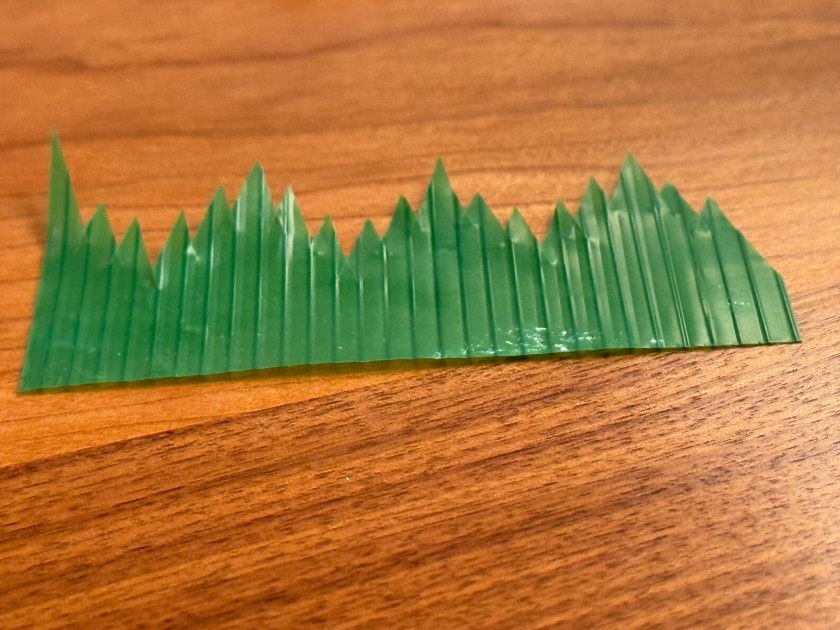
IF you’ve ever bought sushi or sashimi “to go,” you’ve encountered, likely without much thought, those green Japanese bento box dividers. that look (kinda) like grass.
These ubiquitous decorations, called Haran (pronounced Hah-Rah-uN) have graced nearly every sushi or sashimi carryout or bento box since the Edo Period (1600’s). That’s billions of bentos.
(This plastic grass is available, of course, in packages of 1000 pieces from your favorite “they really do sell everything” online shop.)
Of course, they didn’t start out as plastic; in the beginning-the bento beginning, that is – those dividers that kept your wasabi from contaminating your ginger were orchid leaves (ha meaning leaf and ran meaning orchid or lily.) No sushi container, it seems, would have been complete without Haran for now, well, centuries. Certainly, they have to be, with plastic straws and balloons, one of the mainstays of landfills today, at least in Japan.
Now, I would not personally find it an affront or a calamity if I should pull the plastic wrap off my carryout California roll and find there’s no haran separating my ginger from my wasabi. Having lived several years in Japan, however, I can tell you that you could expect a very different reaction from a factory worker or primary school child popping the lid off a plastic (now), or lacquer (historically) bento box and, finding (ACK!) no green divider resembling grass. Their immediate fear? What else might have been left out? How long has that tuna sashimi been touching the packet of soy sauce or dollop of wasabi?
Point is: the details matter.
Me, I tend not to notice. The details, that is.
I have always thought I might want to be a detective but a good sleuth needs to notice details. I’d be a lousy witness, too, because I’d either miss critical details or, and I think this is
because I love to tell stories, my mind quickly fills in missing details, even though my details may have been gleaned from memory or another setting entirely. Not great for being a detective or witness.
This week, though, a plastic piece of grass in my sushi got aggressive and confronted me about all the many little details I do not notice. Every day. Busted.

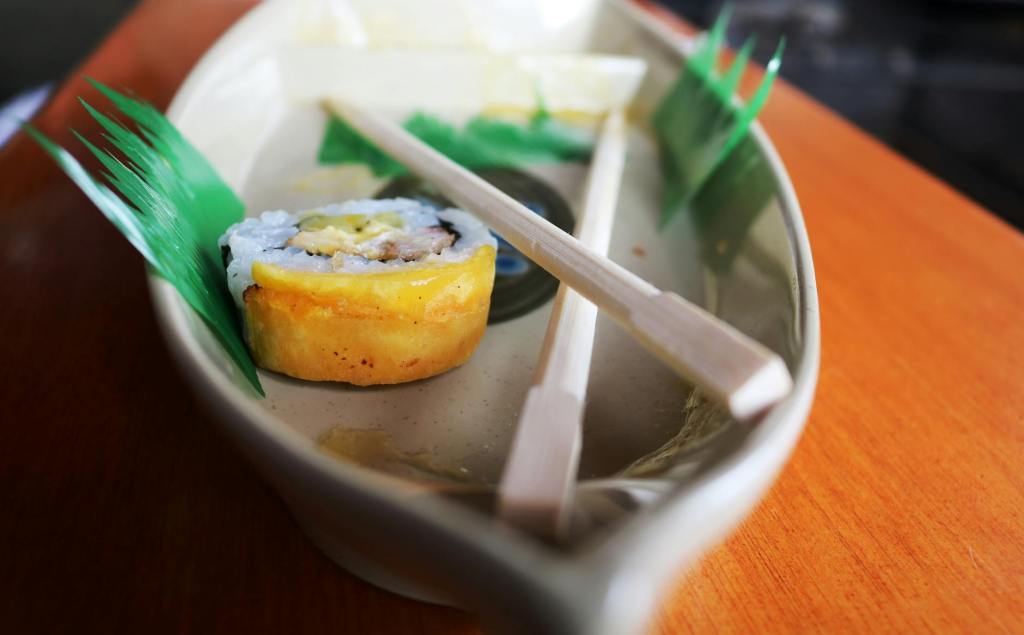
I can say today that one of my life lessons will be developing an appreciation for the rich palette of color and flavor and sound I miss every moment simply because I am not a detail person.
I have painted much of my life with a wide brush, mostly seeing the big picture and largely missing details but I am now becoming more aware daily of how this affects most of my favorite activities, including, for just two examples, writing and guitar.
When I get excited about telling a story, for example, I can easily bulldoze through a narrative rather than take the time to first set a concrete scene for the reader to settle into. A good memoir brings the reader into the moment with concrete details from all the senses. Sight, sound, touch, smell, even taste. Those are how we are meant to experience our world. Burning your tongue on the hot chocolate or feeling the mud between your toes or covering your ears when the fingernails squeak on the blackboard, these details place us in the moment, whether squishy, irritating, painful or lovely.
To slow her students down, to help us focus on the minute differences that create such variety in our world, one writing instructor suggested each day we take some time to learn about the many varieties of birds or autos or cheeses. Our task is to learn to recognize their differentiating characteristics, and their habits or uses, for example. The discipline was to help us become detail-oriented, a challenge for me.
The writer or storyteller being specific and precise can help readers place themselves in the story, help them take a seat in the action and, with some work and luck, help them be swept up into the tale.
Getting the details right can make life a lot less difficult and help us get where we want to go, be it in a story, a song or a daily chore. I’ve certainly found the opposite to be bonafide.
I once shared an anecdote in worship, referring to a silo.
Oops.
Turns out, I should have said a grain bin.
Same thing, right?
The result of my imprecise language was that the entire congregation of farmers was so distracted that they stopped listening to any more of the sermon.
Not noticing differences has long hampered my participation in substantial conversations as well as my ability to relate evocative stories. I used to simply describe cars as either sedans or station wagons – or the occasional Beetle/Bug. Respecting the details, though, means I can fully participate in the story and so can my reader.
A sedan is a wide brush stroke, an image that may float by offering little reason to listen or read on. Conversely, a reader can almost imagine polishing the headlights on the 1970 Dodge orange Super Bee. Wide brush strokes keep the vehicle in the side view mirror while a more detailed image causes the reader to want to pull over and jump into your ride.
The same is true of music – one of the first rules of participating in a music jam, of being part of making the music, is respecting the details enough to play in the same key and tempo as everyone else. Simply strumming a guitar without placing the right fingers on the right frets and strings – NOT just in the vicinity – was only cute when you were three.
What the plastic piece of grass made me realize is that my lack of attention to detail affects my guitar playing in some powerful ways. Remedying this though will again require me to slow my roll. I know the other folks I play music with will very much appreciate my respect for the pertinent details because they often already notice when one finger needs to be closer to the fret or if my rhythm playing is significantly different from the original.

Failing to appreciate the details, I realized, has driven me to use my guitar as a tool. I have reduced my guitar to being simply a means, a tool for making music, regardless of whether or not I can do that decently.
Being respectful of the details isn’t just being picky, though; it means being respectful of the other musicians, the composer and even the music itself.
I know I tend to barrel through my days. When I can slow my roll long enough to notice whatever I fly past on the way to my car or the next gathering or activity, I begin to grasp – and thus respect – the differences that change a melody or invite a deliciously unique solo lead during the instrumental break.
And I am trying to use the tools I have for feedback. I have rushed, but again, I am aware, and am working at slowing down, at being more precise and creating cleaner notes.



One piece of advice I appreciated when I first picked up a guitar three years ago was to wander more. Just wander on the guitar. I can grasp that concept. I struggle to do it but I can I can appreciate wandering. Any time I have moved to a new place, I have enjoyed walking and wandering with no particular destination in mind, just meandering to explore. When I first started studying guitar, I asked a friend for advice and he said simply, “Don’t rush the process.” And it does seem to be a process.
Like anything else in our culture today, hawkers on social media have worked to reduce playing guitar to mastering three chords, two if you want to play bluegrass. Play these three chords and you can start playing paid gigs next week!
I heard last night about a kid who when he began playing, though, played six hours a day for two years. It occurred to me that by the end of that period the guitar must have felt like an extension of his hands- he would have been so comfortable with his guitar. I still hold mine awkwardly I know. Taking the time focus on getting the F or the C chords every time. Knowing how to curve your fingers and using the tips not the pads of your fingers, the many ways to play each scale and the variations all factor into making that instrument sing.
Why does it matter? Why should you care?
Maybe it’s as simple as knowing that your attention to detail shows you care.
When I respect that details do matter, others around me feel seen, important if just for the moment, like I get what’s important to them. We all need that now more than ever.

Receiving a handwritten note, attending a well-prepared meeting, or taking time to prepare or notice a thoughtfully designed object is a powerful and much-needed tonic.
When others don’t care about getting the details right, it can feel like nothing we do matters.
When details are ignored, we can feel discouraged and even powerless. We are familiar with those repeated small failures — confusing paperwork, unanswered questions, broken promises, sloppy communication and they simply create the sense that nothing we do matters.
Good teachers, artists, good leaders and craftspeople know, though, that details are not “extra.”
I may get sushi for supper tonight on my way to the jam session if only to remind myself of what the haran-sensei teaches me:
Details, my child, are not just for pretty.

