The Irony of Music: A Family’s Guitar Journey

A family comes full circle with a classic guitar.

Nov 24, 2025

“Puleeeze…put that thing away til you learn how to play it!!”

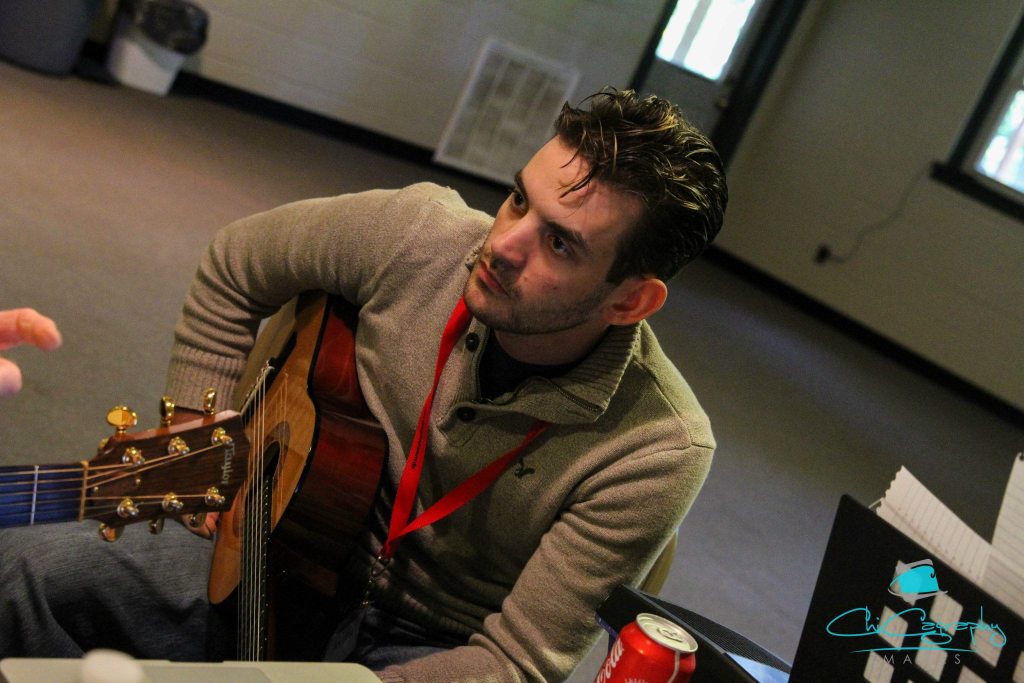
“If I don’t inherit at least one Martin D-28,” my oldest son Arlo declared recently, “We’ve got serious relationship issues here.” We were both noting the irony. He had come along with me to pick out a new guitar for a birthday gift from my husband. Now, both of his parents own Martin D-28 guitars – beautiful, classic, what Arlo called the Porsche of the guitar world. This is in spite of the fact that Arlo is the best guitarist of us all, and if anyone deserves one, it’d be a kid named Arlo anyway, right? Seriously, I will never in my life be as good a player as he is, for sure.

That wasn’t the most ironic part of the story, though, we had to admit as we wandered around that candy store for musicians.

For twenty-plus years, while I was married to his father, Mick, I was the one who dropped the two of them off at the music store then wandered elsewhere killing time while they tried out guitar after guitar, both acoustic and electric, drum kits, steel drums, banjos and even the occasional glockenspiel. Now, though, I’m doing plenty of my own wandering around these stores trying percussion instruments and now guitars.

I sure didn’t see it coming, though, that I’d be part of the pack inside the music store, always searching, wondering, collecting. According to a plethora of guitarists I know, though, I am way behind though with only five guitars to my name. Don’t ask about the drums.
This past week, at the music store, I was trying out some of the models that were above the budget just to dream when one of the sales people walked by and asked if we’d seen that used Martin HD 28 that they’d just put out? And just like that, a Martin D-28 was within reach.

Let me say first of all that I do not feel at all deserving-in fact if I don’t work hard and improve noticeably before I get to play music with others besides my son, I may hide it “til I can play that thing!”
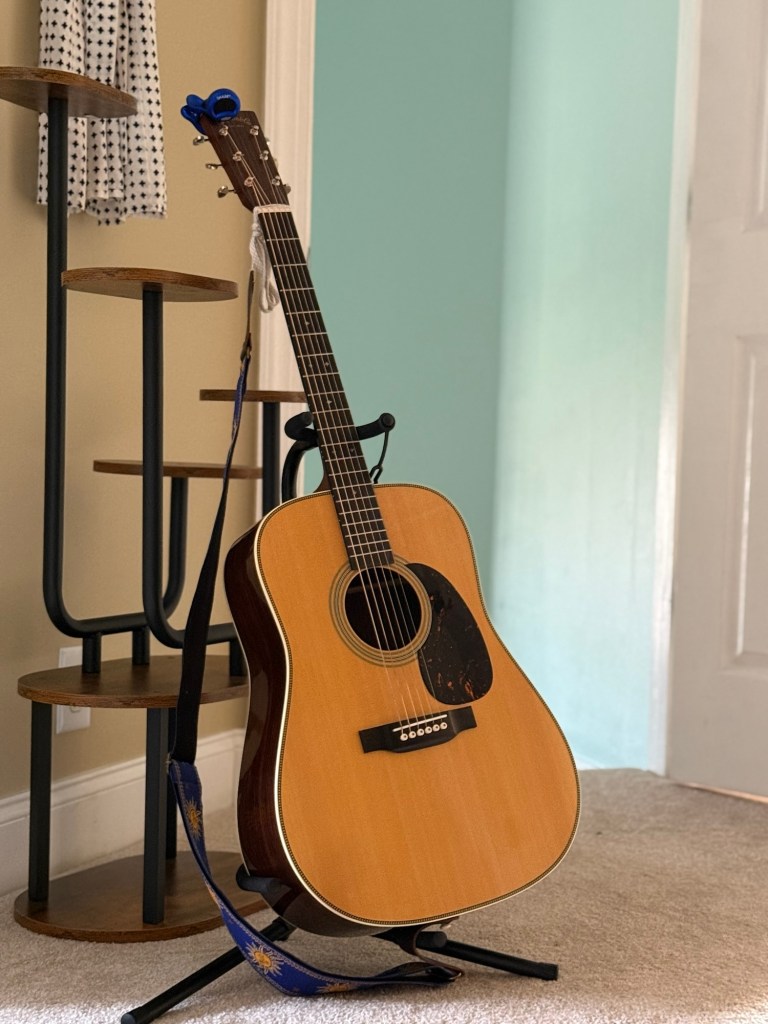
The real irony that amused us so much that day, though, is that Mick and I have a history with musical instruments, in general, and Martin guitars in particular.

Well before we were married, after he’d been in the military, he hitchhiked across country and halfway back, stopped in Missouri to use some of his GI bill at the college where we met in a poetry/song-writing class.

We became friends first, then started dating and eventually moved in together. For much of that time, he was traveling the midwest in a country band and we’ve got the pictures of him in a 10-gallon hat to prove it. It was difficult time trying to build a new relationship and we struggled a bit as new couples do, especially when he began touring for six or eight weeks at a time.

We lived in an old fourplex, on the second floor. It was actually pretty roomy with two big balconies and a claw-foot tub. The frig door sported a bottle opener. Meals as often as not were macaroni and cheese and beanie weenies. A local carryout provided a shared meal of cashew chicken with two egg rolls for under $5 at the time, a real treat. Dishes and lamps and blankets and, well, most of our furnishings, were hand-me-downs, except for glasses. Every time we bought jelly, we got a new glass.

The rent in 1980 was $100 a month and with him on the road barely making expenses and me in school full time and working part time, some months we barely scraped together that last $10.

We considered it a step up, though, from my first apartment where the kitchen was so tiny I could not open the oven door more than six inches. In his previous apartment, paid for largely by tips from waiting tables before he went on the road, the door wouldn’t unlock so the only way in and out was to climb through a window next to the door. When I rode anywhere with him in his car at the time, I had to put a piece of cardboard under my feet to cover the hole in the floor.

The idea of dating a musician seemed romantic at first, but the reality, especially the constant schedule changes, expenses and no income to speak of became wearying.

Because of the stress of being broke and apart much of the time, we ended up separating for several months. One reason in particular came to mind on my birthday this year as we stood in the music store: the day Mick came home to show me his new Martin D-28. At the time, forty-some years ago, it cost $1200, or one year’s rent for us. He was so proud of that admittedly gorgeous instrument; he played it well and still owns it. I was livid, though, in large part because there was no discussion, i.e., one of those red flags I am so adept at ignoring. Eventually, we did split up for several months, and the Martin was definitely still a sore point for me.

We did get back together, married, moved to California and then to Japan where we had two sons.

“You almost never happened because of a Martin D-28.” I reminded Arlo at the store, though.

We spent twenty-one years married, and Mick played that guitar often and well. I boast today I know almost every John Prine song-the lyrics, at least-because he played so many of them. For my own playing, knowing all those lyrics makes it easier to learn to play the songs I like by Prine – and there are many -except that when I learned them, I mostly learned by singing along on the harmony parts, so I’m working on learning the melodies.

We could not deny the irony, though, a few weeks ago, as we pulled up some stools and played the Martin HD28 that I eventually picked out. It is a gift from my amazing and generous husband, who is not a musician. I will tell you that he’s a much more generous person than I have ever been. He doesn’t necessarily understand why I hole up in another room every day to practice or lament any time I have to miss playing with others, but he feeds my addiction anyway. Two years ago, when I was just starting to be able to put together some chords and play a song or two, he asked me on a trip out west to think about what I’d like him to buy me something as a souvenir of the trip. I immediately took him to a pawn shop where we bought a used guitar so I could play while we were traveling. He never questioned that.

I certainly did NOT understand, though. None of my ex-husband’s and then my son’s desires to play and learn and practice and look at other instruments registered for me before, though I was curious and a bit jealous. I understood another guy who, a decade ago, asked me why on earth I might want to play drums. “Other than hitting things with sticks,” he asked, “what’s the draw?” I couldn’t explain it then but remember I considered hitting him with a stick….

Until I started making music with percussion, then picked up a guitar, though, I didn’t know much about the desire to play. I certainly had not anticipated that becoming a need, that there was a hunger I wasn’t feeding or that a part of my soul was being starved. Had you asked me even ten years ago if would I be allowed to play with other musicians as a group with no one telling me to put that instrument down until I learned how to play it, I would’ve laughed. Last month, after being part of a group at a house party, though, another musician told me when he looked at me during the evening, he could see so much joy. I always thought it’d be cool to play guitar; I never expected I could feel such joy though as I do when I get to be part of making the music.

Arlo certainly makes my new Martin sound prettier, but the Martin makes me sound a bit better, and I admit I could play it for hours.

The irony that we had to acknowledge, as we stood in the music store a couple of weeks ago, was how my life had led me to my own fabulous Martin HD 28. (Mine is prettier, too, which matters some, with Herringbone inlay, and abalone diamond and square inlays, prettier than the instrument that vexed me all those decades ago.)

I’ll never play as well as my son or my ex-husband, I know, and yes, when other musicians I know see me pull it out of its case at a jam, I will feel sheepish and even feel something of an imposter. Nevertheless, I cherish the joy fix I get even as I expect I will smile at the irony every time I take my Martin down and start to play.

And yes, absolutely, Arlo will inherit at least one Martin some day.

Wait! Which day is Thanksgiving?

Nov 17, 2025

Photo by Nancy Zjaba on Pexels.com

Thanksgiving is next week. 

Not this week. 

Thanksgiving is next week. Not this week. Nevertheless, at least a handful of folks will show up at Aunt Frankie’s door, cranberry jello mold and Mrs.Schubert’s rolls in hand this Thursday, convinced that holiday we set aside for football and eating is indeed upon us.

I believe we can blame the whole “4th Thursday” rule. That formula for football and the fixins’ was reportedly set by Franklin Delano Roosevelt in order that retailers could establish a set shopping schedule. 

Good for them. For us, it may be too complicated. It reminds me of that strange game we played on our knuckles that was supposed to help us remember which months have 30 days, not 31. Even if we take the time to look at a calendar and count, well, it’s math. In our heads. 

Find a calendar (hint – might be a handy one on your phone). Find the 1st Thursday of November 2025, which is the 6th, then count…so 13th, 20th, oops, yeah, Thanksgiving is the 28th.  Not this week. 

Given half a chance, some of us still standing on the stoop might try to convince Aunt Frankie. She has, by this time, rummaged around and found an actual paper calendar to prove to us how wrong we are. 

Maybe we would  cajole her while the jello mold wiggled in our hands. “How do you feel about two celebrations? I mean, here we are on the stoop, maybe a fresh pie in hand. You know those pumpkin pies don’t keep well.”

Sadly, we’re probably not the only idiots who didn’t show up for work…on the wrong holiday.

Getting the day right for Thanksgiving is not as easy as if the date were set, like how Christmas is December 25. Nevertheless, having a set day doesn’t guarantee a stressless holiday either. Just ask any pastor or priest. 

When I served a church, I was swept up into a fierce debate more than once because, that year, Christmas fell on a Sunday. Gasp!

“You’re not planning on having Church on Christmas, are you Pastor?”

“You’re not planning on having Church on Christmas, are you Pastor?”

“Well, it is a Sunday. And we would be celebrating Christ’s birth in worship. Wouldn’t that be great?”

“We can celebrate the baby Jesus the week before” was the retort. 

“Let me get this straight. You want to celebrate the baby Jesus, the birth of Jesus, a week early so it won’t interfere with Christmas?”

“Precisely. All the grandchildren will be waking up at our house and running downstairs to open presents on Christmas morning!”

“How about you come after opening the presents?”

“I’ll be cooking the Christmas meal.”

“But it’s Sunday.”

“Right. It’s Sunday AND Christmas. You cannot expect us to come to church on Christmas.”

The logic still escapes me.

I personally have been needing to remind myself for two weeks now to hold off on the turkey because I keep wanting to make crescent rolls a week early. Actually, the whole confusing holiday discussion started in my home this year at the beginning of November when I explained to my husband that, while we often remember veterans on the Sunday before the actual day, Veterans Day is always on 11/11. November 11. Always. Actually at 11 a.m. on 11/11. This discussion quickly devolved, though, into the confusing world of holiday “days versus dates, fixed days versus floating dates.”   

Fixed date holidays occur on the same calendar date every year regardless of the day of the week: New Year’s is always January 1 and Independence Day is always July 4. We generally don’t mess with those. 

“Labor Day is always a Monday but it’s the first Monday, just like Halloween is the last Friday in October,” my husband offered. 

Actually, the holiday of Halloween is always October 31st, but that’s really confusing because sometimes the day is celebrated earlier to allow kids to “trick or treat” when it isn’t a school night. That can be especially confusing, though and I suspect we’re not the only family who has had people show up on a random day in the week of Halloween annoyed when we didn’t have candy to offer them.  

“One way we can mark Thanksgiving might be to remember it comes the day before Black Friday,” my husband suggested, “except now Black Friday sales start before Halloween, so there’s that.”

As if the whole fourth Thursday thing isn’t complicated enough, our son is playing fast and loose with the need for a set calendar date for his wedding anniversary (2nd one coming up soon). Our daughter-in-law points out it is November 17, but our son suggests it’s easier for him to remember to celebrate on the Friday before Thanksgiving, since that was when they got married. Granted that’d be easier in some respects since this year the anniversary is on a Monday, but, in the future, that’s gonna make things even more complicated because they’ll be figuring out the 4th Thursday then back tracking 6 days! And if he gets Thanksgiving wrong….

Maybe we just all need Alexa to tell us-like those white boards do in eldercare facilities. We used one during COVID when we did not leave home or see another soul for days. We wrote on it every evening before we went to sleep and kept it posted on the refrigerator. We relied on that white board all those mornings when the calendar and days seemed to just float all around us without any tether. Our trusty, dusty white board told us the day of the week, the date and month and any upcoming holidays. Sometimes we even reminded ourselves the forecast was for rain or that supper would be chicken.  The calendar and especially the upcoming holiday reminders mattered during COVID because it kept us oriented, kept us from flying off into holiday madness or forgetting an important birthday.

We just finished the daylight savings debates, so, maybe we need the date versus day of the week/month debate for holidays. I could make that argument for pastors and priests, for sure. Those among us who don’t attend church and even a few churchgoers have no idea how complicated it is for pastors to plan some of the holidays. Take Easter, for example. Pastors and priests must first find Easter on the calendar which means finding the first Sunday after the first full moon after the spring equinox. From there they count back the six weeks prior to mark Ash Wednesday and Maundy Thursday. And yes, these occur on a Wednesday and a Thursday. People really do ask. Fewer still seem to realize that there is counting  involved before you can start lighting Advent candles on Sundays in Advent.

Perhaps we just need to copy Advent calendars and eat a piece of chocolate each day to lead us up to any given holiday.  Or see if Alexa has a countdown to holidays application?

Better yet, maybe we need to go back to the Town Crier who would walk through the streets of European villages, ringing a bell and shouting, “Oyez, oyez, oyez!” That’s French for “Hear ye, Hear ye, Hear ye!” People in the community would recognize that the bell ringing and the crying of those words would warn us that the crier brought us big news. Or perhaps told us of an impending holiday. 

I’m certain a town crier ringing a bell, waking us in the early hours to warn us that “Today is NOT Thanksgiving!” might have saved a few of us some time, money and embarrassment.

Just Gotta Write

What I realized years ago is that writing is how to scream in a socially acceptable way.

I’ve been thinking of late that I need to write a book where every entry begins with, “I Am Not A Nice Person.”

It seems I frequently wake up thinking of starting an entry with that statement, followed by lots of annoying thoughts that have been buzzing about my head like nasty little kamikaze planes. I wake up certain that, if anyone heard all the complaining and frustrations clogging my poor little brain, they’d agree wholeheartedly that I’m not so nice. Sadly, much of my writing through the years has been nothing more than me complaining. What I have figured out, though, (through writing, thank you) is that dumping all those complaints onto paper for all these years has done me – and everyone around me – some good.

Honestly, I write because I too often wake up wanting to scream.

So, perhaps more accurately: a blog entry today should read simply, “Gotta write.” It will do me (and the people around me) some good.

Seriously, if you know me, you should count yourself fortunate that most of my furiously scribbled pages and pages have been purges no one else will ever read. I’ve spent the majority of my writing time getting my frustrations or anger or complaints off my chest, out of my mouth and thus, (mostly) out of the earshot of those around me. My husband has learned that my being in a bad mood and complaining is quite often a sign I am not writing. 

So maybe, I thought, instead, a blog entry today should read simply, “Gotta write.” It could do you (and the people around you) some good. Perhaps you – or someone you work or live with – is simply a frustrated writer.  

Writing is simply therapeutic.

Let’s be clear, though, there’s being a writer and there’s being an author.

Writing for therapy isn’t the same as writing because you might want to share your stories. The first is for your eyes only, a way to get all those thoughts and frustrations and even giggles out of your head to make room for some clarity or joy or discovery or a story to share. The second is a craft, i.e., what you do to the rare few of those rants and raves that warrant a second glance. Some will be worth a second look and perhaps the effort to fashion them into something another person might be keen to read or gain a personal benefit from the effort. This doesn’t matter as much because there’s honestly great overlap there.

Lots of people around me tell me (now that I’ve published a book and they’ve read it, thank you) they also have stories they love to share over meals, on the bus or while waiting in line, but are stopped by the thought of sitting and typing or writing them out. Simple enough, I tell them, use those easily available programs or apps that allow you to dictate, then go back and edit. For myself, I truly prefer the feel of graphite on paper, I explain, but that means I have to then go back and type up what I’ve written. So I have been using a Remarkable, an electronic pad that lets me use what genuinely feels like a pencil, then converts my scribbles to text. “Oh, my writing is too sloppy,” is the excuse most folks offer for why that method won’t work for them. I write quickly and in cursive on mine and, yes, some editing is necessary but the system works pretty darn well and I’m nearly finished with a second memoir written on the tablet.

“I can’t seem to find the time,” I hear. Years ago, though, I read about how helpful it could be for writers to simply buy some cheap spiral bound notebooks and every morning with coffee just scribble three pages. There’s a book and workshops and support for folks who want to use this method and I recommend them, but the gist is simply to write. You can start every morning with “I am so mad at….” or “I cannot understand….” or “I remember….” Just write is the idea. Write the first sentence over and over if you need but fill up three pages. You may not ever look at those pages again but your purpose is not to write the great American novel. It is simply to write. To get what’s in your head on paper. To grease the wheels. To make it easier and easier and more and more addictive to write than to not write. And to get whatever is annoying you off your chest.

This follows the discipline suggested by the writer and teacher Natalie Goldberg of writing three pages a day- scribbling, really, without allowing my brain to edit while I dump what’s on my mind. “Writing Down the Bones,” by Natalie Goldberg .(https://nataliegoldberg.com/books/writing-down-the-bones/.)

Goldberg teaches about getting those “first thoughts” on paper by keeping your hand moving and not letting yourself have time to edit, not stopping to criticize yourself or correct your feelings, simply to get those thoughts out of my head. The process is similar to keeping the wheels of a wagon greased. Whether you write for yourself or for others, this or some kind of discipline that involves putting pencil or pen to paper is, in my opinion, the place to start. Goldberg also points out the act of writing regularly teaches us to listen to ourselves, can help us overcome our doubts and affirms for each of us the value of our lives.

Often what I end up with after scribbling as quickly as possible in a cheap notebook  amounts to nothing more than a jumble of frustrations but that allows me to get it out of my system. That way, I don’t bore others around me with complaint after complaint and I don’t repeat myself all day because, I suppose, my subconscious knows it’s out of me. This is similar to writing lists for myself. I can go to sleep at night without worrying about what I need to do tomorrow because I’ve deposited those tasks onto a written list that’ll be waiting for me by the side of the bed when the alarm rings.

I also know where I can find it if I need to complain more. Again with the complaining. In all seriousness, writing out what I think helps me know what I think, discover how I feel, remember better, understand myself better and even uncover ideas about how to actually do something about what makes me so angry and frustrated, something more than simply grousing.

Whatever helps you write helps you write.

I read a quote some years ago declaring that the best discipline for any writer is to read. Gonna have to disagree. I respectfully disagree. The best discipline for a writer is to write. If you want to be an author, there are further steps. Find a continuing education course on the craft of writing or poetry or songs or memoirs. Next best: get your butt into a writer’s group. Writing to be an author is after all a craft and the steps to any kind of writing you want to publish are many. There is nothing to be brought to the crafter in you, though, if you don’t actually write. I don’t manage three pages everyday but I scribble enough to provide fodder for all kinds of stories if I want to use them.

Seriously, writing is simply therapeutic.

More critically, writing saves my friendships, my marriage and my sanity and, on occasion, helps me figure out how to help.

Last week, my furiously scrawling carried me back to those “Weekly Readers,” those newspapers designed for school-children. You remember? Where we learned about preventing forest fires, about how littering made others so sad, especially that American Indian chief with one single tear rolling down his cheek? Remember trying to wait patiently as the copies were passed out. Remember how we eagerly but gingerly turned each page to learn about how seatbelts saved lives, about the Civil Rights Movement or Rachel Carson or the value of community service?

Those little newspapers were both welcome departures from math problems and verbs and adverbs AND they presented as gentle guides to create better neighbors and friends. Through them, we all became more aware of poverty, child labor, the dangers of tobacco smoking, and racism, among so many other issues.

Why do I find myself remembering and writing about Weekly Readers? You know why. Because so much of the progress we were inspired to help bring about over the past 50 years has simply been erased or rolled back at a terrifying speed.

Good God, if we keep going, the next logical outcome will be another Executive Order banning handicap accessible restrooms because they discriminate against the “able-bodied.”

You remember what things were like back then, before so many of the “woke” ideas helped make our world a better place, don’t you? My mother could not get a job, a bank account or rent an apartment without her husband’s or her father’s permission, for just one example. Um, not willing to go back.

Today, those newspapers would likely be considered anti-American. How dare they, for example, teach us about global warming, slavery or trying to normalize women and minorities in leadership, business or science roles?

The power of the Weekly Readers was they helped turn us into informed and empathic citizens, people who cared about one another and who recognized that we needed one another to be the best we each could be.

I am wondering now, if there isn’t some way to bring those back and deliver them right to the children at their homes? How subversive is that? Maybe Dolly would help. That’s the kind of idea that surfaces when I write. I want to know what comes to mind for you? Share. Let’s collaborate.

For now, next time you – or someone you know – thinks all you do is complain, go to the corner store and buy a cheap notebook. Choose a pen or pencil that feels good in your grip and start writing. Every morning. Only, make yourself a deal. Just write and know that most of what you write for a while, maybe for a long while, will just lay there scrawled in cheap notebooks. Don’t expect great things. Just write about all the things that you can’t stand – you may never get it all out of your system but you and everyone around you will thank you for leaving it on the page. You may not ever want to use any of that but, then again, you might.

Maybe you will be the one who come up with some ideas about how we can stop what appears to be a national temper tantrum. 

Ever notice how our leader always SCREAMS his posts on social media? What if we could get him to write BEFORE he shared?

Seriously, doesn’t it lately feel like so many people are simply pouting because they don’t want to share anymore or be nice or take turns? Faithfully writing out my three pages has helped me share with others what I think without screaming at them.

What I realized years ago is that writing is how to scream in a socially acceptable way.

I too often wake up needing to express my frustrations with the world, perhaps now more than ever. So, I am convinced the world is a better place because I leave most of it on the page. Less anger is spewed, less frustration gets passed along, less whining and complaining and criticism.

I DO think more about how to take action, though, and I’m a bit clearer on what and why. I remain certain that if people in my life knew how much I spewed, well, they’d be sure I wasn’t such a nice person. Because I write, though, at least some people like me most of the time. And occasionally, I figure out something to say that is helpful, useful, perhaps even wise. Through writing, I am learning that my superpower may be that I see and feel and cannot pretend the emperor is dressed. That’s what writing does. Honestly, it’s subversive.

And that’s what so many of us need right now to help us keep our sanity.

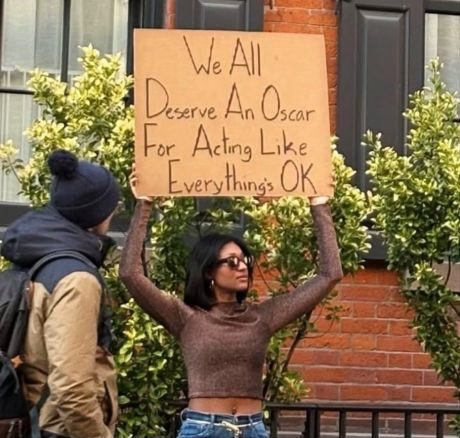
Now more than ever. I saw a meme last week that showed a woman holding up a sign that read, “We should all receive Oscars for acting like everything is okay.”

Every damn thing is not okay, let me assure you, and, depending upon where you live and who populates your family, maybe it never has been. So start writing about it. Get the screaming out in a way that doesn’t hurt anyone else. Figure out what you think. Let the rest of us know you’re with us, that you see, too, and especially, share any ideas. I’m seriously considering a Weekly Reader reboot and I’m gonna ask Dolly to help. 

Leave a comment

My Alamo

Individually, collectively, as a nation, there have been times when we’ve needed to draw a line. This is one of those times.

“Those who would give up essential Liberty, to purchase a little temporary Safety, deserve neither Liberty nor Safety.” Benjamin Franklin

Much of the time when any of us need to draw a line in the sand, as they say, I suspect it is a surprise. I say that because we are often not expecting the person moving aggressively towards us; thus, we are not prepared to mark any line. When we do draw a boundary, when we insist that the next step the person in front of us takes will be too far and we will stand in their way, it can feel jarring and aggressive, like we are the ones being combative. We are simply not prepared to counter aggression or abuse, individually or collectively. 

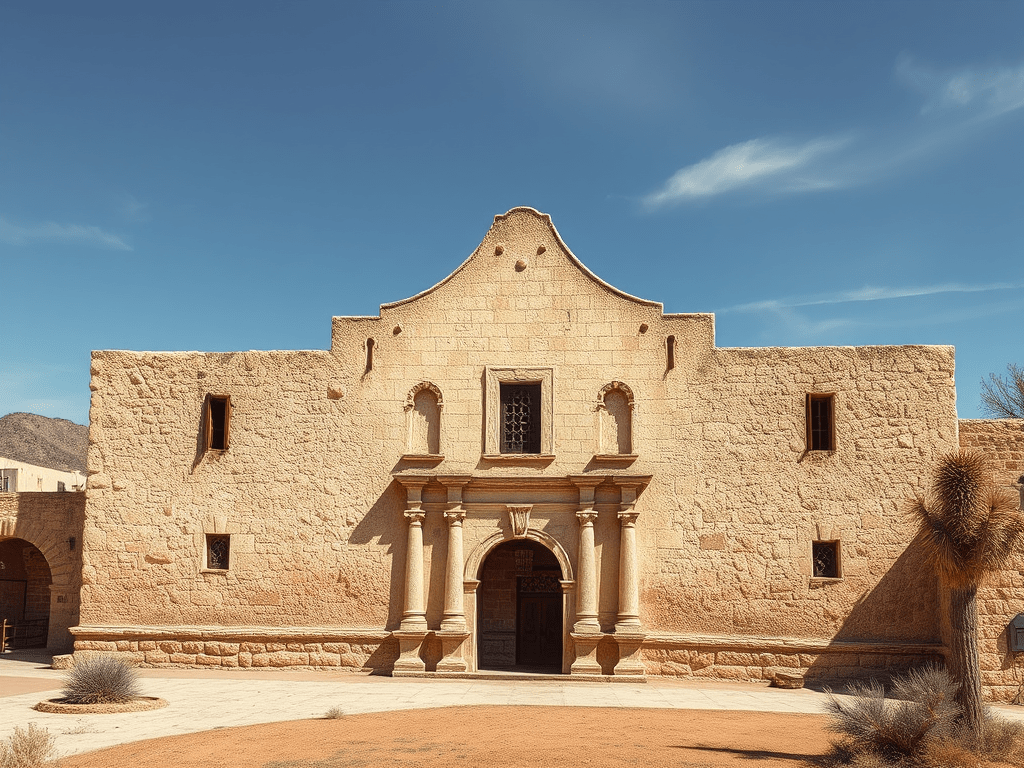
This is somewhat ironic, at least in the United States, though. Remember the Alamo? Legend has it that when Lieutenant-Colonel William “Buck” Travis, Texian Army officer and his fighters faced overwhelming forces at the famed fort, Travis drew a line in the sand with his sword and told his fighters to cross it if they were willing to stay and fight. Nearly all of them did. While that story is possibly more fiction than fact, it is nevertheless the lore many of us were inspired by, taught to emulate, part of the “GIve me liberty or give me death!” understanding of the cost of freedom of speech, freedom of religion, freedom from tyranny. We know what’s right. We know abuse when we see it. We know when someone is trying to frighten us into not fighting for those freedoms. We know and yet we are reticent, loathe to draw our line in the sand, whether personally, as a family or as a community and nation. We want it to all go away. But it won’t.

Years ago, an experience from the first church I served paved the way for an extended family finally to take a stance, to draw their line in the sand to stop the abuse that had been harming women in that family for at least a generation. In this case, what had been a family secret became quite public because the abuser got reckless and over-confident and, in some ways, that arrogance made taking a stand easier for the family.

“Herb” (name changed to protect his victims) wasn’t a regular attendee at the church I served, so my radar was not pinging when I greeted him that Sunday morning. He was a 60-something married man who always dressed in seersucker and bow ties and prided himself still sporting a full head of hair, even if it was graying. I’d brushed off his previous suggestions about how my congregation would like it, he was sure, if I wore more colorful outfits when I stood in the pulpit. I glared at him and walked away when he suggested I unbutton a button or two on my blouse, but nowhere was there any guidance on responding to such behavior from this man whose family members occupied nearly one-third of the pews. I wondered why his wife never attended with him and started avoiding him, thinking he would remember he was talking to the preacher. Turns out, I should have opted for outrage from the beginning. At least I might have been prepared for battle when I walked out of the little white building one Sunday afternoon to see him seated in his big old Buick in the parking lot across the road. I waited for two cars to speed by, then crossed the two-lane blacktop warily, my chest tightening. My arms were full with my Bible, sermon notes, my purse and some funeral home fans that I’d grabbed off the table in the back of the sanctuary. The cardboard fans helped you breathe on the days when the humidity was looking for an excuse to break into a summer shower. 

Already sweaty, and looking forward to an afternoon of visiting the shut-ins, I moved cautiously across the road, hoping he would stay in his car. I had been headed to the fellowship hall to lock up before I started the afternoon’s visits. Herb exited his car and was next to me nearly as soon as I stepped off the highway onto the parking lot. I had to stop mid-stride to avoid running into him; I was off-balance as I tried to look behind me before stepping back because that would put me back onto the highway. 

Turning towards him, I stumbled to my right just in time to miss him grabbing my arm. I looked at him in confusion as he reached out again and said, “Why don’t we go inside?” 

In an uncharacteristic flash of assertiveness, I shoved him with my books. He stumbled back a bit, startled. I darted as quickly as I could around to the passenger side of his car. Did he really just grab at me? Herb started around the side of the car and reached for me again, so I threw my books at the ground near his feet to stop him long enough for me to move around the car until I was back on the driver’s side. I know my hands would have been shaking if I had not been clutching my black leather purse, instinctively wrapping the strap around my hand in case I needed to use it as a weapon. 

I would never have expected a man from my church to be bold enough to try to grab me in the church parking lot in broad daylight. That simply was not something I expected. Worse, he acted with such confidence, as if he would face no opposition.

Herb laughed. “Don’t be so silly,” he said, putting one hand on the trunk of the car as he slowly headed back around towards me. He seemed quite amused, at first, that I managed to run around his car—a rather large late model car–but all I could think about was the fact that, thank God, he could not reach across. When he snatched his hand back quickly in pain because the metal was hot enough to sting his hand, I bolted. 

He was moving around the car towards me again; I managed to dart into the fellowship hall, drop my purse and the ridiculous fans, and turn the lock on the wooden door. Maybe it was the sound of the door locking–maybe something else–but, apparently something brought Herb back to reality; he “came to himself,” like the prodigal son in Luke, and stopped grinning. Unlike the repentant son who asks forgiveness of the father, though, Herb stood before me, his fist raised, threatening to bust through the window of what seemed suddenly like a very flimsy door. I tried to breathe. Even though he was a member of my church with a large and influential family and now he was angry, I had clearly—finally—drawn a line in the sand. 

When he finally got back into his car and drove away, I leaned against the wall and let out a scream, then frantically ran to the other door, grateful to find it was locked. He hadn’t tried opening it anyway. He’d just driven off. 

I couldn’t catch my breath.

I gave myself the afternoon off from visiting parishioners. I did not let myself cry until I got home; navigating back roads is difficult enough when you’re watching the rearview mirror for a Buick the whole time.

The next Sunday, and for several Sundays after that, I was greatly relieved that Herb did not return to the church. For months, I would imagine his hand grabbing for me. While I was grateful not to see Herb for a while, I also felt quite alone and indulged in some hefty self-pity as I pondered how large a contingent his family was in our congregation. His wife, for example, was one of several sisters, many of whom attended the church. Herb had married the oldest sister when most of the sisters were still children. At least his wife was not attending our church. A few months later, though, his wife was scheduled for surgery and the prognosis was not good. A pastoral visit to the hospital was in order, if only to console her sisters.

I arrived at the hospital intentionally late. Even after the family was sent to the waiting room before surgery, nursing staff was willing to allow clergy in to pray. I smacked the oversized button to open the doors just in time to go back into the surgical prep area to see her alone. She was still awake and aware enough and thanked me for praying with her. Then I made my way through the winding hallways to the family waiting room. 

Nearly every seat was taken by a sister, but I spotted Herb on a chair in the far corner. I took a breath, said a silent prayer, and walked over to him. I leaned down to offer him my hand in greeting but, before I knew it, he was laughing because he’d managed to pull me onto his lap and wrap his arms around me. Even now when I think about how shamelessly he seemed to operate, how little he feared anyone’s disapproval, how brazenly he disregarded the line I had drawn, I want to scream. I’d been pretty damn clear, I thought, that his behavior was not welcome.

I jumped up as quickly as I could and found a chair on the other side of the room, next to one of the sisters. I did not look at anyone for several minutes; I was afraid they would have seen how hot my cheeks were with anger and embarrassment. I was grateful, finally, to look up and notice that sister number two, one of my regular members, was sitting next to me. Voices soft, we chatted quietly about how long the surgery was expected to last. I was grateful she quickly offered to call me when the surgery was over. “We know you have other calls to make, Pastor,” she offered. I thanked her, chose the fastest way out of the room and made it to my car before the tears began. 

I drove home discouraged. How could I keep being the pastor at that church? Even if they wanted me to continue, could I keep dealing with this man and his aggressive behavior? I could not shrug it off, and I did not find it amusing, like he did. Worse, I feared other congregation members might also find it amusing. 

Everyone in that waiting room had seen Herb pull me onto his lap and me pushing his arms off of me and jumping up but no one had said a word. I’d not received help when I’d spoken to my mentor: “It’s part of the job,” I was told. I did not sleep well that night; I was drafting my letter of resignation from the ministry and imagining the sensation that would ensue within the church once it was made public.  

The next morning, I was praying about the letter when sister number two called me, I assumed, to tell me how recovery was going. The conversation was so short I almost didn’t remember it.  

“You need to know,” she said quietly but deliberately, “Bobby has spoken to Herb,” she said. “He won’t be bothering you anymore.” She paused. “He won’t be bothering anyone any more.” She paused again. “We’ll see you Sunday.” 

Suddenly, I was not alone. One of the other men in the church had stood up to Herb. Sadly, though, slowly, I began to imagine several young women standing next to me with tears in their eyes. I had not considered how many others Herb probably had “bothered” over the years but they were suddenly standing next to me.  

All those younger sisters and their daughters would have been easy targets. No one had stood up to him before then. Evidently, no one had even spoken in any voice louder than a whisper about his behavior for decades until that day in the waiting room when he accosted the preacher. The family finally found the line they would not let him cross.   

Likely, in the past, the family had hoped Herb’s behavior, something most of them could not even fathom, would have just gone away on its own. Challenging one of the patriarchs of the family had been too painful and even frightening for them to consider. What would they do if he said “she” initiated it? Who might he go after next? What if he suddenly turned the tables and claimed he was a victim? How many of the neighbors might take his side because THEY were already victims and afraid or feared becoming targets? 

Because they had never expected to even contemplate such abuse from one of their own, the family could not choose a line. 

Because they were afraid to talk to one another about what was going on, no line was drawn.

Because no line was drawn, the abuse continued, unchecked.

Trouble is, this is a common pattern. Whether the abuse is of a person or a group of persons, though, not wanting to talk about it only aids and abets the abuser. Not wanting to talk about what we know is wrong because we are afraid or because it is not our family or because we’re not sure the child maybe “deserved” some punishment or worst of all because we simply don’t want to believe what is happening only emboldens and strengthens the aggressor.

Do not be fooled. These lessons apply to us—to our families and our nation. 

We know in our guts how this goes. We know but we are hoping we won’t be asked to draw any lines ourselves.

We wish some people would stop constantly reminding us how more and more boundaries are being crossed every day, how free speech and due process, decency and respect for others are being blatantly, publicly disregarded, then even applauded. We are afraid and tired. Didn’t we move past this decades ago? 

Are we waiting for another Colonel Travis to draw the lines for us? Have you admitted you need to think about those now, like it or not?

Are we waiting for another Colonel Travis to draw the lines for us? Have you admitted you need to think about those now, like it or not?

A public school teacher told me today she had decided she would obstruct any immigration authorities who tried to take her students – children – from their classroom. She has admitted to herself what is possible, even as horrific as it sounds, and she decided where to draw her line.

Where is your line?


Understanding Fragility: The Hidden Lessons of Power Outages

We forget we operate on trust. That is, until the light switch doesn’t respond and we are left sitting in darkness.

You’ve been there. You flip the light switch but nothing happens. You push the covers back and scurry across the chilly floor only to realize the thermostat doesn’t respond with some heat, so you curse yourself for not investing in throw rugs, slippers, a generator.

As minutes become hours, what started out as annoying can become a serious hurdle to starting your day with the looming potential to morph into danger for you and your family though. We’ve seen how easily a home without heat can become deadly. 

In the case of my granddaughter, who has Cystic Fibrosis, lack of power for any length of time means someone has to beat her on the back and chest for thirty minutes twice a day to break up deadly mucus that can build up. At night, because she has a feeding tube, losing  power for more than a couple of days means she cannot consume enough calories to provide the nutrition her body needs.

In the United States, though, most of us operate on the assumption that the things we trust will be there. Switches provide light. Cars start. Ambulances come. Social Security checks are deposited. We will be able to buy insulin. The medicine will be available and safe.

We forget we operate on trust. 

That is, until the light switch doesn’t respond—until we are left sitting in darkness. 

Again, it’s mostly just annoying in the short term for most of us because our experience is that we can have faith someone out there is working on it. Maybe we call the power company to report the outage to verify the powers that be know our predicament, but our expectation, our experience has been that someone out there is doing their job and working to restore our power. 

Until we realize they aren’t. 

Until we realize no one is on the job, maybe because they cannot get there, maybe because there is no way to fix the problem, or maybe, we fear, there is someone in control who feels empowered to decide who gets attention and service and who doesn’t, who deserves light and food and civil rights and who isn’t worthy of those things.  

It’s terrifying to realize you might not be able to pay your rent next month if you do not, in someone else’s opinion, deserve to be paid. To add insult to injury, that same someone and his cronies even demonize you for the audacity to work for a non-profit whose aid reaches outside the country.

It’s even more terrifying to wonder if there is anyone doing anything about the chaos since reporting is sporadic and mostly limited to U.S. news sources. Visit another country and watch the news, though; we are not only not alone, but neighbors the world over grasp how interconnected we all are.

Few of us in the U.S. are aware of how incensed our friends in other countries are in reaction to the chaos in our country. 

We, on the other hand, seem to be simply baffled.

We’re watching those in power operate in a way we’ve not experienced, maybe ever. They are moving aggressively, not collaboratively. Hell, they are starting the conversation by turning off the power, then daring us to come and stop them. We are baffled.

When did we decide we needed to regress socially? When did we agree to dismantle all the social advances of the past century? What’s next? Smokey the Bear is homeless? Littering is okay? Seriously, will we be told soon that teachers, libraries, recycling centers, veterans’ services are the problem? How long before we’re being told child labor laws are unnecessary? All it takes – all it has taken – for most of us is a few weeks of watching this behavior around us before the fear, the terror we feel, is that no one will try now and eventually no one will be able to stop him.

The rug has been pulled out from under us. 

We have been reminded as of late just how fragile our lives and how vital are our interactions. I’m thinking this painful recognition, though, is a gift. That may sound incredible, but I believe that those of us who are pretty secure most of the time are blessed when we become painfully aware of the tenuous nature of those threads that hold us together.  I believe we more fully join the ranks of humanity when we who do not usually go hungry or worry that someone will start shooting at us when we are in the market, feel that sudden sick feeling in our stomach and become acutely aware of how easily our bones break and our breathing can stop. Fragile. Vulnerable. In denial until we aren’t able to be any longer.

So many people in our world cannot rely on a light switch to have any effect. So many might not even have a light switch at all. 

Reminding myself of that, though, does slow me down, make me look around, and help me think about the countless others in this world who are struggling. Two decades ago, I visited Nicaragua with a study group for Vanderbilt Divinity School.  In Nicaragua, the literacy rate at the time was 50%, and the material conditions are worse than that: no one, for example, not even in the government offices, had toilets down which you can flush paper because there existed no viable sewage treatment facilities; no one had clothes washers, let alone dryers; everyone did their wash on a washboard. Because there are no emissions standards to speak of, air pollution was a palpable problem. In that tropical heat, only major buildings could be air-conditioned; most houses had no screened windows, and the majority of the people living outside of towns lived without electricity or running water, let alone sewage.  A family with a new cinder-block, two-room house was considered rich, even though the floors were dirt and there was no electricity, even though they used an outhouse and got their water from a well.

The family I stayed overnight with in the countryside had a five-year-old son.  The parents–in their twenties– both worked five days a week in the coffee fields or the local elementary school; then, on Saturdays, they both walked seven kilometers to the bus stop to ride into town to attend high school because neither of them had had the money to attend high school when they were teens.  The elementary school which their son attended had 120 children, in three rooms with 25 desks; it had three teachers, few supplies, no water and no toilet, and no heat or air conditioning. 

Medical care was rare; most people in the countryside would walk an entire day sometimes to see a doctor and get a tube of antibacterial cream.  In Managua, children who lived on the streets (the numbers were in the thousands) sniffed airplane glue every day because the glue and the high they got was the only thing that would dull their constant hunger. Tragically, while the glue, which numbed their hunger, also killed their brain cells; most of those street children would die from the damage within ten years. This is their reality, the reality of more than ¾ of our world still today, a reality we neither see nor want to see and yet most of the world has no choice in the matter like we do.

One of the first things I learned on this trip to Nicaragua was that I am rich. I realized I carried more in my daypack than most of our hosts owned altogether. I can afford to throw away food when it goes bad or when I don’t finish my plate. I do so every day. I’m not considered a particularly wasteful person, but I have learned to take for granted that I am not going to starve and so I did not feel much guilt throwing food away. Until I started noticing how carefully people in Nicaragua prepared and kept food in order not to waste it. We would never eat food that came off a stranger’s plate; many of us will not even share food with family members. Once it’s been touched, we tend to toss it because it is contaminated with germs, bacteria, who knows what. Now I realize what a “luxury” it is to be able to throw food away. Far too many of our international neighbors cannot afford such a luxury. The people who fed us in Nicaragua took whatever was left on our plates and put it back in with the other leftovers to be eaten at the next meal. This luxury to waste, though, I realize now, is part of what isolates us.

When we do not recognize a need for one another, sitting alone on our own couch binging movies is just easier.

This is particularly evident in the U.S., I believe, and the COVID lockdowns of 2020 only exacerbated our tendency to isolate. It simply does not occur to us here as easily as it seems to in other countries that, together with our neighbors, we could figure out how to find – and take – some power. 

One of the questions we got most often in Nicaragua was how it was that so few of us were active in politics; grassroots movements and neighborhood groups were the norm there and everyone played a part in helping make decisions about governance. When I offered that I was impressed with how everyone played a part, they asked, “How is it that you don’t?”

How is it that we do not reach out naturally, do not work together, do not at least recognize we are not alone? Why does that idea seem so foreign to us? 

When I returned home to preach in the rural church I served, I shared with my congregation this local legend I’d found while researching poverty.

A poor peasant lived daily on the verge of starvation. One evening, the old man found a basket of apples on the doorstep of his tiny hovel. Delirious with hunger and joy, he sat down to eat in the light of his one flickering candle. You can imagine his disappointment when he bit into the first apple and found it rotten and wormy. He tossed it aside and tried a second only to find it in the same condition. Again, a third and fourth apple were rotten. Torn by hunger and disgust at what he saw in the apples, the starving peasant paused to consider his choices. Hesitating for only a moment, he blew out his candle and ate.  

I’m grateful to report that such stories and meetings with those living in poverty changed much of how I see our world. Even twenty years later, lessons emerge regularly from unexpected places. Recently, I experienced an epiphany while riding my bicycle that moved my understanding of this story and connected it to the questions we’d been asked by our hosts in Nicaragua.  One of the reasons I live where I live is because I can ride my bicycle or walk to much of what I need. Walkability. Walkability scores in most of the places I’ve lived in this country are low. Not that there aren’t plenty of motorized vehicles of all sorts in my neighborhood, but riding during the day is only frightening to me when I need to cross the main 4-lane road. The usual vigilance does take some of the joy out of the ride: drivers who don’t see you as they pull out of a home or parking lot, grates in the road, debris in the road, rocks in the road. Just to be safe, I often will walk my bike across this road even while I’m in the crosswalk, furtively watching for that racing driver who might not see me even though I am in the marked crosswalk and have the green light. 

Recently, I left an event later than I had planned, though, and so the ride home at dusk was more dangerous than normal and the spectacular sunset wasn’t helping visibility. My mood was darkening as well, until I looked around me (while stopped and waiting for the light).  I was spiraling from frustration to self-pity, I realized, then from defensive to angry. I began to wonder if the people around me were feeling the same; my tendency has been to believe I am the only one. 

My epiphany, though, was that I was not alone. Older couples were waiting for trolleys, a neighbor who commuted by bike to work was waiting to walk across the road, a couple trying to get to the grocery store across the road was stepping over debris left from the last storm; all of them were vulnerable like me. I did not know if any of them were consciously feeling fragile or in danger, because we were not communicating; hell, we barely made eye contact. If we had been at least acknowledging one another, though, perhaps we would eventually discover one or two of us had ideas about making the commute safer for bikes or pedestrians. We might even have discovered in some locales, for example, that there exist efforts for community organizing around safe travel for non-motorized travelers. Because they do; it’s just that so many of us in this country do not know about them because community organizing has not been a necessary part of our lives until recently. 

Stopping to get to know a pedestrian at that moment simply did not seem like it would have been welcome, though, so I did the next best thing I could think of to connect: I prayed. I began to pray for not only my own safety but that of others as they passed me on the way. I could connect, I realized, at least for a moment and still allow all of us to focus on safely completing our journeys. 

Moving out of myself required a conscious effort, but that is where I will find others struggling just like me. When I am most afraid or feeling most alone, the best thing for me to do is to get out of myself because I am seldom as alone as I think in my grief or fear or struggles. 

Turns out, what seems most personal is quite often universal. If I am hurting, others around me are, too.

For the first time, it occurred to me to wonder why the  farmer in the story had not considered taking his apples next door to see what the neighbors had, a kind of stone soup potluck sharing. Maybe we can find our neighbor and compare notes about what has worked in the past when the lights went out. Maybe we can pool our resources for when generators are needed. Maybe we go together to speak to our representatives or, when they do not listen, organize to elect new ones because together we now more keenly recognize that keeping the light switches working might require some effort on our part. Maybe that’s not all bad. 

Realizing how fragile we are, then, is a gift, one that can isolate us or bring us together.

At the very least, when the lights go out and we can no longer assume we are safe, perhaps we take a breath, greet our fear with gratitude and look around us, recognizing that we are, in fact, most fully human when we feel the most fragile.

Sacred Bears

When I shared the following events with my writer’s group and asked them to put a timeline on them, most guessed the 1950’s. Learning this occurred in 2002 disturbed them. Truly disturbing, though, is that, sadly, no one in this country right now would be surprised to enter a town square in nearly any southern state in the US and see again today what I saw then.

Black and White Teddy Bear on overturned children's chair

Sacred Bears

“Some old lady got my buddy in trouble!” was what I heard another pastor declare as I sat down at the weekly lunch of local United Methodist pastors in the county. (“Local Pastors” do not attend seminary but rather several years’ worth of courses in order to be allowed to preach from United Methodist pulpits.) I was running late, but I knew immediately what he was complaining about and I was annoyed to realize quickly he had only heard part of the story. “He was at the weekend school…”

“Course of Study,” I offered.

“Yeah. The Course of Study. Anyway, there was this festival on the square down there in Pulaski….”

“They called it ‘White Christian Heritage Festival’ but they were handing out KKK literature,” I added. He frowned.

“Okay…. so, this old lady just took what my buddy said all wrong. Then…then, she told the guy in charge.”

“Grady?” 

My colleague stared at me, determined to finish the story. “That old lady told Grady my buddy was part of the KKK!”

“Actually,” I said after I ordered my chicken salad with ranch on the side, “that ‘old lady’ told Grady that your buddy confessed to her that he could see where their teachings made sense. He said they made sense.’  So, since he is allowed to preach at a United Methodist church and to teach children and youth….”

“She probably just misunderstood.” 

Surely, I thought, this guy will catch on soon. I sighed. “So, I shoulda just let that slide?”  

The others at our table were clearly amused that my colleague didn’t get why I knew the story so well. In his defense, he attended a different Course of Study, lasting four weeks, in Atlanta for full time pastors in the United Methodist Church. His buddy and I were part time, which meant only 60 hours a week of work. Our Course of Study classes met over eight weekends a year with reading and papers in between those weekends, sometimes in Jackson and other times at Martin Methodist College in Pulaski. Pulaski, if you aren’t aware, is known for being home to some members  of the Mars candy family (think Milky Way) and is also generally credited with being the birthplace of the Knights of the Ku Klux Klan, the KKK.  

I especially hated the overnight stays at these weekend schools. That particular weekend, I do not remember another woman in attendance. Not only was I away from my sons, but I was alone. In a motel room. In a strange town. A single woman.  Newly in recovery from trauma. In other words, someone who knew bad people did lurk in the shadows. Assuming all the men around were trustworthy was a luxury. So, I slept not at all. I took to wedging whatever chairs were in the room in front of the door in an effort to at least rest. 

On one particular Saturday, several of us left class to make a lap around the nearby downtown square on our lunch break only to encounter what was that day touted as a “Celebration of Southern Culture.” Displayed on the assorted tables were handtooled leather goods, canned peaches, okra and pickles. A brochure I found had previously invited area residents to join in the “family fun,” including a cakewalk.

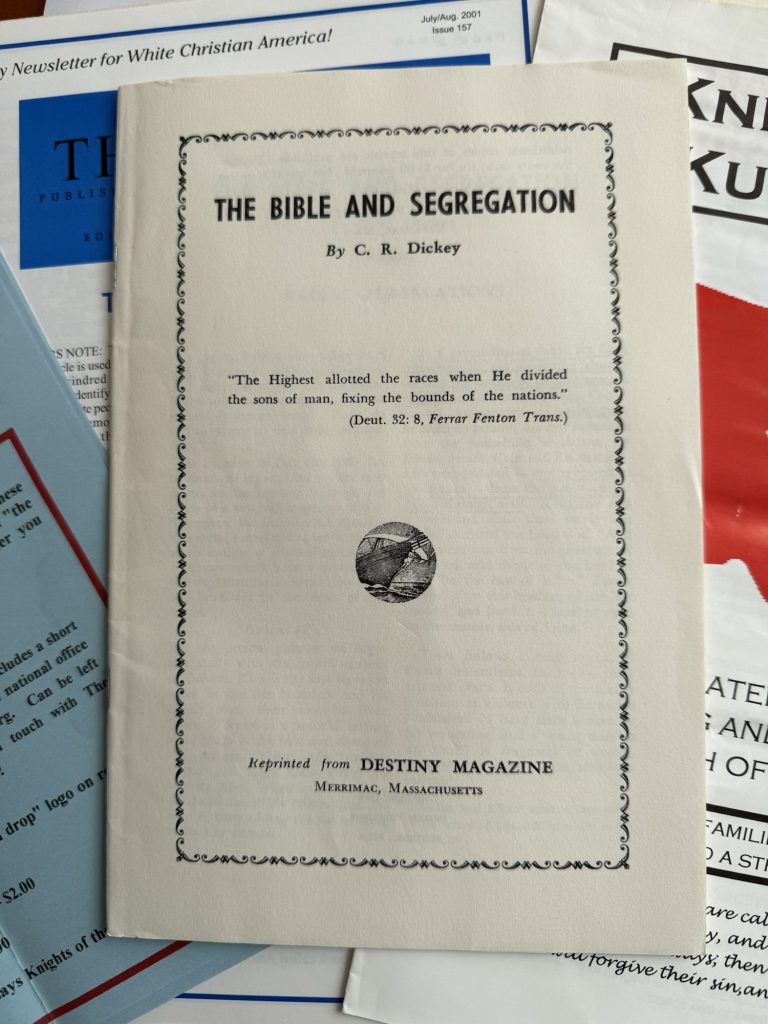
Pretty quickly, though, I was stopped, jolted a stuffed teddy bear sitting among the books and maps under the magnolia trees. I believe God created Teddy Bears to provide a tactile reminder of love and affection, of comfort. This bear, though, had, through no fault of his own, become aligned with pure evil: he wore a white cotton robe and a white pointed cap that covered his face. This child’s toy was disguised, as if he, too, needed to hide his collusion with evil, like the men who had donned those robes and hoods in the night for so long. I thought they were a thing of our past and yet there they were, not hiding their affiliation at all and they had brochures, newsletters, books and even maps, the texts and visual aids to present these “Southern” beliefs. The first murmurs from the other pastors with me were indignant: how did these folks get to determine the definition of what was “southern”?

Eager to share with us about how God meant to order society, one of the men began to carefully explain the rationale for hatred, including their understanding that God, of course, looked just like them. In that moment,  the inference was that God most resembled a skinny, pasty middle-aged man in black slacks, a white shirt and a decades-old tie. A couple of pastors seemed interested in engaging. I was far from confident in my ability to face evil head on though; I, instead, focused on the contents of the tables.

Besides books and t-shirts, decals, key rings, watches, pins and flags, there were maps. I would not give them my money for books but I did consider buying one of the maps, a large laminated wall map designed to settle once and for all the mystery of the disappearance of the two “Lost Tribes” of Israel. Finally, I chuckled. They’d migrated, it seemed, from the Middle East and crossed over the Caucasus Mountains, stopping, of course,  in Scotland before heading into North America.  My ancestors were among those Scots who came through the Cumberland Gap and moved on into Kentucky, Tennessee, Missouri. I hadn’t known, however, that we were either lost or a tribe of Israelites. This journey was credited with solving the mystery: the Lost Tribes were now known as “Caucasians,” according to the map, by virtue of having traversed the Caucasus Mountains. I kick myself now for not purchasing that map, but, at the time, I could not stomach giving these people my money.

I did try to offer them money for the Teddy Bear, for the sake of the children these men likely influenced, for the sake of the legacy of Teddy Bears the world over, and for the comfort and benevolence children had so long depended on them to provide, I wanted to scream, “How dare you?!” 

Gotta hand it to the KKK, though. Aligning an innocent source of comfort and safety with the evil of the KKK, twisting what a child loves and trusts and using it to promote hatred and exclusion is socially and theologically powerful. Teddy Bears are bordering on sacred, as far as I’m concerned, objects that carry children through those times when the adults are absent or preoccupied or already asleep.

The Teddy Bear in the hood and robe makes more sense when you recognize how much of the most destructive theology through the ages has been born out of childhood pain. We may never know who was the child who’d been hurt enough that he grew up and somehow chose to cover himself and his head and face with a white hood so his grandmother or his neighbors or his children did not see him when he was cruel and ugly. I wanted so badly to rescue that child, or at least rescue the Teddy Bear, to allow God to do what God does best: redeem both that Teddy Bear and whomever it was who dressed him up. 

I wanted so badly to rescue that child, or at least rescue the Teddy Bear, to allow God to do what God does best: redeem both that Teddy Bear and whomever it was who dressed him up. 

“He is not for sale” was the response, though, and so I left behind that embodiment of evil and prayed for the trust and spirits of all the children these pasty white men were teaching or had taught so far. 

I did pick up some brochures and printed newsletters and walked away before they realized I did not, in fact, agree with their understanding that our country was designed as a White Christian nation or that we ought to somehow respect men who hid behind masks to terrorize others. Later, I would discover the literature went so far as to advocate for internment facilities for those who had contracted AIDS, for example, or that we all were invited to a worship service that night, complete with “great white Christian fellowship” and a “brilliant cross-burning!” 

I was no longer hungry, so I walked back with one of the younger pastors. After a few moments’ walk in silence, I said simply, “I was not expecting that.” I was feeling shaken that this evil was so openly displayed and discussed; I’d been blissfully ignorant, I realized. I had honestly thought these clowns in hoods were anachronisms, relics of a bygone era, that they were no longer active, like the sundown signs I would later learn sat as sentinels along the highways at the edges of the town where I preached. Those signs–simple painted sunsets on road signs–were nonverbal warnings: if you were a person of color, you’d best not be found in this town after sunset. The signs had been taken down, but the sentiments, fears and prejudices were not so deeply buried. I would later be disturbed to find out, for example, that two members of my congregation had been “card-carrying” KKK members while  I was pastor there. As a white woman, I had been ignorant and thus, negligent.

As we walked back to classes that weekend, though, my companion, a pastor who was about 15 years my junior, pointed out that “southern culture” was his culture. Then he added, “They did make some valid points. Did you realize they’re Christian?” 

The hair on the back of my neck stood up.

“If you listen to what they are saying,” he went on, “you will discover that they make a lot of sense.” 

He was a pastor. 

He taught a children’s Sunday School class, too, and he seemed interested, not disturbed, but interested in the Teddy Bear in the robe and hood.

“How,” I asked as calmly as I could while placing one foot in front of another, “would you go about teaching this to children?” I wanted him to clarify, to make me realize I’ve misunderstood, to tell me he wasn’t teaching ‘southern culture’ to the children, but he didn’t say any more. As we approached the classroom for our last afternoon that weekend, I wondered what the other pastors might say. Turns out, very little. I remember watching the others in the rest of the day’s lecture and discussion, wondering why no one mentioned what we’d seen. Had they debated at lunch? Had they discovered  others open to these ideas? No one seemed angry, at least not that they’d admit. I felt like I was playing a game my sons liked where you had to pretend that the floor was lava, so don’t dare put your feet down; it was dangerous. I hoped that the overt racism we’d witnessed had shocked them too. I feared, though, they knew from experience not to admit out loud they “got” where these guys were coming from, that, like my walking companion, they knew to simply shut down the conversation if they thought they’d shown their own hood to the wrong person. 

Once we’d finished for the day and each of the pastors was headed home to prepare to preach the next morning, I found Grady, the professor in charge. I explained I did not want to cause an issue for a colleague but I was disturbed about what this pastor might be teaching, especially in Sunday school for children. I wasn’t sure what to do and had not felt safe addressing him directly. Grady listened, got the particulars, then told me it was his place to address it. 

I heard nothing else for a month until I received an email from Grady; he’d spoken to the younger pastor’s District Superintendent, who evidently had found “no reason to believe such reports” and had never even spoken to the guy. This information hit my inbox just before leaving for the next weekend class. Once there, I was dismayed to find that the young pastor was there before me, annoyed, and looking for me. He was pretty sure I was the one who had ratted him out. I was the only “old lady” there. 

He greeted me with “I got called on the carpet by my DS,” which was a stark departure from what my professor had been told.  “When can we talk about this alone?” he wanted to know. 

“Excuse me,” I said, walking away; that was as much as he got for the rest of the weekend from me.

I still count that entire episode a disappointing failure, though I didn’t know how to do anything differently at the time. Not tossing my books and overnight bag in my car and leaving right away seemed the best I could manage for the time being. Clearly, I needed to learn how to counter this twisting of theology openly, to be prepared to teach the children and youth in the churches I served that Jesus really meant it when He said He loved every body. So I stayed. For the rest of that weekend, I kept my distance. I kept my guard up. I didn’t sleep.

I wasn’t surprised then a few weeks later at lunch, though, when this “old lady” was being castigated and labelled a busybody sticking her nose in other people’s business. 

Just to be clear, I asked my angry colleague, “That old lady ought to have simply looked the other way?” 

“Exactly!” he said. “It was none of her…your business.”

Because every veteran needs a mission.

The rain was relentless. And aggressive. Errant drops ricocheted off the railing and sprayed me and my companion as we stood on the stoop of the aging A-frame building. I would have struggled in that moment to offer a hopeful assessment of the continued usefulness of that building. Housing the United Methodist Campus Ministry at Austin Peay State University in Clarksville, Tennessee, the fifty-year old A-frame’s faux-wood siding was turning gray, the third story was sagging and the tired building was just begging to be torn down. Though I didn’t realize it as I stood on the stoop, this building, the one real asset that came with the position of campus minister, would be remodeled, revisioned and revamped over the next few years to accommodate the mental health needs of combat veterans, student interns and counselors in newly-carved out counseling rooms.

At that moment, though, I was painfully aware that three adults could huddle intimately on that stoop, but only if they were very friendly. My companion, whom I knew only as Sergeant Major, and I’d only very recently met; we had joined forces because we each felt called to ministry with the hurting military men and women and their families who were connected to Fort Campbell, Kentucky. Sitting adjacent to Clarksville for decades, the fort was home to the 5th Special Forces and the 101st Airborne Division. At that moment, as we shook off the drops beginning to run down our marginally waterproof jackets, our two worlds were connected awkwardly, like our perch on that stoop, by one dirty little secret: there was still a war – actually more than one – going on, still soldiers coming home injured and still families being destroyed, but few if any other people outside that geographic locale even noticed. 

The war in Iraq (2003-2011) was nearing its end but the war in Afghanistan (2001-2021) was going strong. Over the years the 101st Airborne became one of the Army’s repeatedly deployed divisions. Just the year before, in 2010, the President ordered a surge to roll back the Taliban. For the 101st, the year had been deadly both on the field of battle and at home. Many never made it back and the Fort became infamous for the number of suicides among active duty soldiers. Suicides of active duty and veterans, in fact, outpaced combat deaths, to some accounts by four to one. Clarksville and Fort Campbell were reeling and many of those veterans, especially those injured, took their discharge and their GI Bill benefits and enrolled in APSU.

Outside of the immediate community, though, the wars and the pain felt by families and soldiers and the pastors and community around them was a well-kept secret. I was certainly guilty of having put the ongoing wars on a back burner when I was sent to be the campus minister a couple of years earlier as my first full time appointment after seminary. Like most of the country, I was oblivious, in part because the War on Terror was being fought by only about 2% of our nation, the 2% who volunteered to serve, many after witnessing the planes flying into the World Trade Center. While the college and Clarksville had lived with the military in their midst for decades, these wars were different. Too many soldiers deployed into combat two, three, or more times, usually for a year at a time. There was little time for any kind of healing in between wheels down and the subsequent wheels up. Far too many of the wounds were invisible like Traumatic Brain Injuries, usually inflicted by an evil known as the IED (Improvised Explosive Device); these bombs usually were remotely detonated and inflicted brain injuries even hundreds of yards away – think football fields. The brain is shaken inside the skull even though no projectile or weapon actually touched the soldier, which also meant no diagnosis or treatment, just damage that caused otherwise “good soldiers” to struggle with symptoms like unexplained anger issues, loss of peripheral vision and/or the inability to process commands. 

 As Sergeant Major and I stood on the stoop that day, we were part of those trying to respond when APSU realized that these impatient, angry, injured recently-discharged combat veterans made up nearly 20 percent of its student body without warning or preparation. One of those struggling veterans watched us from the cab of his scratched and dented Ford F150. 

The irony of this moment did not escape me, though I did not share it with my companion. While I was an Army veteran myself, I did not have fond memories of my time in service, did not hold a particularly favorable opinion of most military and, in fact, was quite proud of two anti-war bumper stickers on my car. On the front bumper, a bright yellow sticker read, “You cannot simultaneously wage war AND peace,” and on the back, a dark blue with white letters declared “Military Intelligence is an oxymoron.” (I’d been a 98G, Military Intelligence, when I served, so I always felt like I was within my rights to sport that last bumper sticker.) The decision to attach those bumper stickers to my car had been capricious, a joke mostly, and, I thought, innocent at the time. Today, I’d say it was more intentional than I realized. I’d been, I believe, like most of the country, unconscious to the fact that our country was still at war because it did not affect me or anyone I knew. 

Until I was sent to APSU. 

I proudly possessed, at the time, a number of anti-war stickers and posters, most of them left-over from the Vietnam War.

Once it became clear to me that our campus ministry needed to recognize the veterans on our campus as part of our ministry, I remember sitting in my car, waiting to drive onto Fort Campbell for a conference called “Healing the Hidden Wounds.” I was arguing with God. “I don’t like military people. I really don’t want to do this. They won’t want to work with me either, you know! Have you seen my bumper stickers! Seriously?” Within the next few months, however, through no fault of my own, I would need to replace both bumpers and thus lose both bumper stickers. One of God’s little jokes, I believe, and I am still annoyed.  

I had met Sergeant Major at the conference and a few days after we met, he brought Eddie G. to my campus ministry. Eddie had been recently demoted to sergeant for not understanding and following even some of the simple orders he’d been able to follow months earlier. At age 28, he had already been deployed into combat as an engineer three times. 

“Got any work our guy can help with?” Sergeant Major asked. The rain had finally stopped and Eddie stood by his truck across the parking lot, out of earshot, smoking.

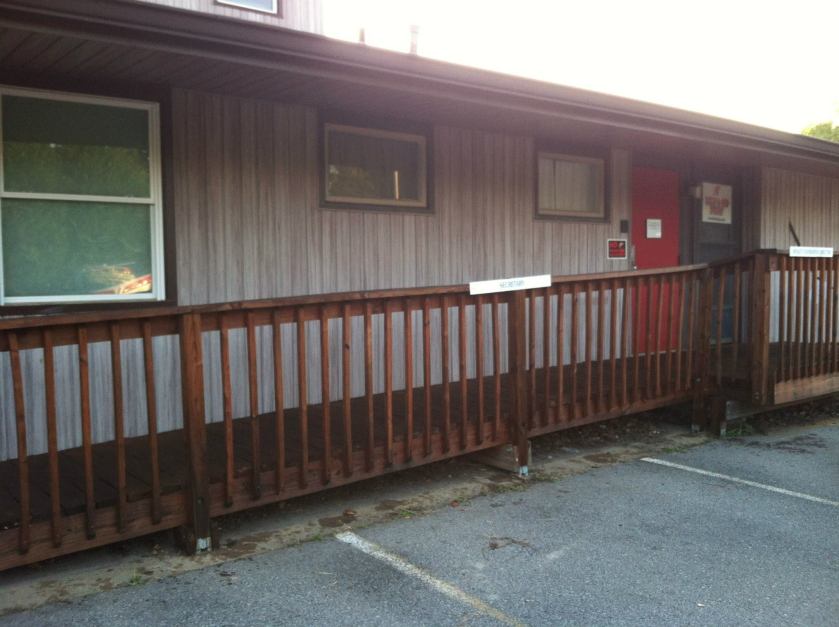
“Well, I was needing to make this entrance nearer the parking more accessible,” I offered, nodding to the young vet leaning against his truck. Seems Eddie had taken to sleeping in his truck. He was not allowed to see his daughter or go home. Sergeant Major was running out of ideas and Eddie was only one of thousands of combat vets in crisis at the time but he was the one Sergeant Major brought to see me that day.
“You need something built; Eddie’s your man,” said Sergeant Major. Eddie had been building bridges for combat transport. Never having done that, I did not at the time realize the frustration and grief of building a bridge to transport your unit into or away from combat only to watch your hard work be destroyed in minutes, often at the cost of the lives of your buddies. 

“He just needs a mission.”

And just like that, a hurting vet was building a ramp for our campus ministry. Eddie showed up the next morning at an ungodly hour in the pouring rain – my students living in the building called me to complain – and, for the next four days, he worked silently and alone with the supplies I provided. Our only conversation was me asking him if he wanted a cup of coffee or something to eat. He never needed anything but the coffee. He mostly worked silently. Alone. In the rain. For four days. Didn’t need any help. Didn’t want to talk to anyone much. I watched him so much those four days, I felt like a voyeur, but I was struggling to know how our fledgling military ministry could help him. After the third or fourth foray into the parking lot each day, I gave up on my saturated rain gear and just stood to one side, under the eaves, feeling lame but praying he’d offer an opening. Eddie may have taken up space next to me but he was clearly not “there;” he was somewhere I’d never been, somewhere I could not go. I didn’t know what to do except to faithfully show up early each morning with coffee and wait for him to leave at the end of the day so he would not feel alone. 

I felt lame and useless, though, so, on the third day, I called an older veteran I knew. As I watched Eddie work from inside my office, I said I was looking for suggestions, for ways we could help this guy who worked so methodically, silently, almost prayerfully to build a ramp to make our building accessible but who was so inaccessible, even it seemed, to himself.

“Just let him build,” my friend said. 

“I promised Sergeant Major I would help, though.” 

“Leave him alone,” he repeated slowly. “You ARE helping him.” 

 I said goodbye, as discouraged as I had been when I dialed the phone. 

For four days, Eddie worked in the rain, silently, taking only the occasional break to smoke a cigarette and stare at the ramp as it took shape. The day he finished, almost magically, the rain stopped. He sat for a couple of hours, I guess, in his truck, smoking and staring silently at the finished ramp.

I was afraid to let him leave, afraid he needed so much more, but painfully aware I didn’t know what that might be or if he wanted or needed anything from us. After a couple of hours, I took one last cup of coffee out to the parking lot, and took some pictures of the finished ramp. Eddie said I could send them to Sergeant Major and he’d get them. I said thank you and he stabbed his cigarette out, shook my hand and said goodbye. As Eddie turned to leave, though, he stopped, adding so quietly I almost didn’t hear it. “At least nobody is gonna blow this up,” he said, then he nodded at farewell and drove away.

He left the military not long afterwards and Sergeant Major came by to tell me he’d lost track of him, too. That conversation would be repeated too many times over the next decade; combat veterans returning physically from war didn’t seem to need to circle back and report on progress to counselors or pastors. Many did figure out, though, how to live with what they’d seen, done, and learned. I just hope Eddie was one of them. Often, all it seemed we could do was offer them a ramp. I hope he found his.


Soldiers And Families Embraced

Spurred by the struggles we saw of the veterans on campus and their families, encouraged by veterans who’d enrolled in social work courses to help out, I enlisted the help of another veteran, one who was enrolled at APSU to earn a social work degree. We spent the next few months listening to military and their families. One huge problem was that soldiers were not seeking needed counseling because of the stigma and potential harm to their military careers; The intensity of the ongoing wars also drove soldiers to avoid counseling because they did not want the rest of their company to be redeployed without them; the loyalty to the others in their units too often overshadowed much needed care. In response, we began a counseling program that was free to all who had served and their families. That program, originally called the Lazarus Project, became Soldiers and Families Embraced (SAFE).

This Veteran’s Day, you can thank a veteran for their service, you can offer them a free meal, or you can help them heal by educating yourself about the struggles of those who have gone to war for us and by donating to programs that continue the work of healing well after the veteran has returned. SAFE

In creating this program, we sought out other counseling programs in the mid-state area: there were few if any counselors outside of those in the military who were serving this demographic at the time. The program has also worked closely with APSU to provide internships to help prepare social work students (many of them veterans or family members themselves) with training and supervision. Since 2011 SAFE has helped double the number of counselors in the area. In addition to counseling, SAFE has offered or partnered with a variety of programming in addition to counseling, including weekend retreats for healing, music and storytelling and a War Garden, for example. SAFE still offers services, support and hope today.

Since 2011, advertised mostly by word of mouth, SAFE has provided free, professional counseling to military and their families and now first responders.

One response to “Because every veteran needs a mission.”

  1. Anne Avatar
    Anne

    Jodi, once again you overwhelm me with your ability to succinctly convey breathtaking stories. My initial reaction is sadness, then realized hope for what you worked hard to provide for these needy vets. God bless you for the effect you have on people. Hugs and love, Anne

    Like

Leave a comment

Here Lies Jimmie’s Arm: A Pastor’s Tale of Smalltown Challenges

(Includes an excerpt)

With your support and encouragement, Here Lies Jimmie’s Arm, my first book, is out and ready for consumption.

Click here to go to my Amazon author page. From there you can Follow the Author and be the first to hear about new books.

Or, point your phone’s camera to this QR code to be taken to the book’s page. (Available in paperback or Kindle download.)

Be sure to leave me a review if you liked what you read!

An excerpt:

From “The Women’s Kitchen Jug Band.”

Lela, Rebecca, Molly and Sally were all part of this impressive gaggle of hardy women who had lived long enough and worked hard enough to say they didn’t really care what anyone else thought any more, though they were not shy about telling you what they thought. What they “thought” often and vocally was that “Mildred was goin’ to hell.” That was because Mildred, who lived across the street from Lela, never let the shadow of the steeple at church fall across her path, even though she was mobile and still drove when she wanted. 

The first time I tried to visit Mildred, I called to ask if she’d mind a visit and she proceeded to cuss me out and tell me with every imaginable expletive why I needed to leave her the #*#* alone! Then she stopped and took a breath, but before I could apologize for bothering her, she asked, “Now, who IS this?”

“Your new preacher,” I offered. 

“Well, damn.”

Like many of the elderly I visited, Mildred, who was even tinier than Rebecca, and even more impatient with the younger folks around her, complained about the same issues every time. She also told me about her “constitutional.” Her need for me to know her bowel habits was, strangely, not unusual for this congregation which was, admittedly, mostly populated with folks old enough for regularity to be an issue. Nevertheless, I never knew so many people in one congregation who needed their pastor to know they were regular. I was not prepared for that. I expected they’d share what they were ashamed of or when they’d strayed from the straight and narrow, but not this. If I’d had a bingo board to take to every visit, “regular bowel movement” would have been the center spot. Mildred was no different. 

I learned quickly to move to another topic in those visits. If I’d been willing, I could have shared what was working or not working for others in the congregation and even wondered if I needed to copy those old timey door-to-door peddlers and carry with me a big black valise filled with stool-softeners, laxatives and Pepto-Bismol. I decided instead that this line of conversation was simply a warped reminder of my responsibility to keep boundaries and not share what was not mine to share. I chose not to take the bait in those conversations.  

All of these women, at different times, worried me to no end, and the challenge was to try to talk them down off those ladders at their age. Mildred prided herself on a perfect lawn, and no one could do it as well as she could. She was so tiny, though, that the brand new “Yardman” riding mower she bought would not start for her because she was not heavy enough for the seat to register that she was actually riding the mower. Undeterred, she doctored the spring system and drove around her steep and hilly lawn at least twice a week during the warmer months while the neighbors cringed and begged her to let one of their sons help her out. Her own son would not help, however, so she was damned if she would let someone else’s son show him or her up. She would not stop mowing, not even after she tipped the mower because she found a new gopher hole. One tire dropped into the hole but kept going even after Mildred fell off. Thankfully, it did not get far before it rested against a small tree and burned itself out. The jolt sent Mildred tumbling and she found herself stuck, headfirst, in a hole. It wasn’t a tight hole and her head had fallen into it so she hadn’t gotten hurt too badly. She would have easily been capable of extricating herself from the offending hole except she didn’t have the arm strength to push herself back upright and so she had to wait, head first in that hole, listening to her precious mower burn itself out against the silver maple tree until one of the neighbors smelled the engine burning and came over to see what was what. That neighbor got cussed out, too. Mildred was nothing if not consistent.

A couple of years later, Mildred died, still alone, and still cussing out anyone in her way, but also still quite regular. All she wanted was a short graveside service and that was certainly her choice except that she died during the coldest February I could remember. Only the Kitchen Band ladies attended and, as was to be expected, each dressed “to the nines” to send Mildred off to her fiery eternal home. Because the only people who would be attending on that frigid morning were these ladies in their nineties, I was grateful the funeral home was prepared with a small tent and some space heaters. I assured the Directors I would keep things brief, and only included a prayer and Proverbs 31. “Who can find a virtuous woman?” In retrospect, I had to admit Mildred had only sparsely shared about her past issues so talking about her as an excellent wife might have seemed disingenuous to the women who knew her well. At the time, though, we all were simply grateful to recite the 23rd Psalm and The Lord’s Prayer and be done with it. Unfortunately, as I took a flower from the pall and broke it up to crumble onto her casket, while I prayed, “Ashes to ashes,” a foul and acrid smell made me choke. I looked up to see one funeral director frantically trying to swat sparks while the other gagged. Rebecca, who’d ventured too close to the heater, had decided friends don’t die every day, so she would celebrate the occasion by resurrecting her fox fur stole, its head hanging where a nice brooch ought to have been. The beady eyes of the dead fox haunted me throughout the short service, but it was the smell that was most memorable. It was not just the smell of hair burning, which is foul enough; it was seventy-year-old fox hair we were smelling, an odor that stayed with me for days. I know, as we moved as fast as we could to get the ladies back into their cars, Mildred was either cussing up a storm or, perhaps, cackling gleefully. Maybe both.


Not convinced? How about some advance reviews?

“Here Lies Jimmie’s Arm is a treasure of a book, especially if you have ever attended a small church. The author describes her experiences growing up and becoming a pastor with much humor and great style. The reader is drawn into the dramas of small towns, small churches and in some cases small minds. How she survives and thrives and laughs along the way is truly brilliant and entertaining.” ~ Nancy B. 


“Very readable. And engaging. These pieces welcome the reader into this country setting, with all its charms, peculiarities and characters. The author juxtaposes the troubled histories of her parishioners with her own, inviting readers  into a novice pastor’s inner thoughts, worries and fears. Should be required reading for all would-be pastors.” ~ Charlie M

Eyes to See

I lived in Japan for three and a half years.  Both of my sons were born there. The whole time I lived there, I studied and practiced speaking Japanese.  In fact, I had known for a year I’d be moving there so I had started trying to learn the language a full twelve months before ever stepping foot off the plane in Tokyo.  My husband and I lived the entire time in an apartment building where we were the only “gaijin,” the only foreigners. In fact, we were often the first foreigners our neighbors had ever met even though there were in fact many foreigners living where we lived – in Himeji, a castle town on the inland sea. This is all to say that we spent our days immersed in Japanese; we learned quickly how to ask for what we needed or just to be able to understand what others were saying because, while most Japanese studied English in school, they learned to read it and write it but not necessarily to speak it. Teaching Japanese to speak the English language was what foreigners like us were hired to do.  A common belief we encountered throughout our time there was that gaijins could not learn the Japanese language any more than they could learn to eat sashimi, nori or yakisoba. While we (and most of the gaijin we came to know there) loved the food, we still encountered regularly the declaration that we could not possibly eat, let alone enjoy, the cuisine.

Even funnier was the fact that, more than a few times, we spoke to a neighbor in Japanese, only to be told in Japanese that we were not speaking Japanese.  

On a spring morning, I was part of a field trip up into the mountains to eat, of all things, roses prepared in a variety of ways, from batter-dipped and fried to jams. This was with a group of women I to whom I taught English every week for three years. I generally did not speak Japanese to them, but they’d known me long enough to have seen me converse with others who weren’t my students. Standing next to a couple of them, I could hear them talking about me in Japanese. I turned to them and said, in Japanese, “You know I can understand what you are saying, right?” I know I said it correctly because two other students snickered at their friends getting caught and the woman I had addressed turned red. Still, she turned to her confidante and said, “Good thing she can’t understand Japanese.” She could not see how anyone other than a person born Japanese and raised in Japan could possibly speak the language. This was not true for all our neighbors, but it happened, even after we lived next door to them for a couple of years, had worked alongside them, shopped in their stores, enjoyed holiday meals in their homes and gossiped together in the neighborhood’s public bath. Depending on the day, it was either humorous or annoying that a handful of the folks we interacted with regularly simply never could see it though. It went against everything they had been taught and they simply could not imagine, could not see that ever being possible. 

They did not have eyes to see.

Six days later, Jesus took with him Peter and James and John, and led them up a high mountain apart, by themselves. And he was transfigured before them, and his clothes became dazzling white, such as no one on earth could bleach them.

And there appeared to them Elijah with Moses, who were talking with Jesus. Then Peter said to Jesus, “Rabbi, it is good for us to be here; let us make three dwellings, one for you, one for Moses, and one for Elijah.”

He did not know what to say, for they were terrified.

Then a cloud overshadowed them, and from the cloud there came a voice, “This is my Son, the Beloved; listen to him!”

Suddenly when they looked around, they saw no one with them any more, but only Jesus.

As they were coming down the mountain, he ordered them to tell no one about what they had seen, until after the Son of Man had risen from the dead.

Mark 9:2-9 NRSV

Jesus referred fairly often to us having eyes to see and ears to hear – meaning usually us being willing and able to see something new, a new way to see, because this life, this journey, this faith God offers us through Christ is meant to transform us, to help us to see, hear, understand and ultimately be different.  This requires that we enter into that relationship ready and willing each moment to be surprised and to change how we see what is in front of us.   

We are in good company if we often find that difficult to do.   We simply cannot easily change what we “see.” When I was exploring being called into ministry,  I was asked, “Do you see yourself preaching or serving communion?”  I simply said, “No.” I had never seen a woman do any of that and could not even imagine it. 

Here’s the difficult truth about life in Christ: you cannot enter into that relationship and expect to be unchanged; you cannot experience the transformation that is possible without being willing to see differently, even if that means seeing something that is surprising, or bewildering or that you do not know how to explain.

In Mark 9:2-9, we read, “He changed in front of them.” Transfigured is the word that we have become used to reading here. Transfiguration sounds more holy somehow, more theological than to say simply that he changed. But the Greek word here is where we get metamorphosis — or change.

So what happened on that mountain? Evidently it was something they couldn’t really explain. It remains hard to say what happened, except by repeating the words that we read there. He was transfigured; he was changed before them. What they were used to seeing they no longer saw; and something they had never seen before suddenly appeared to their frightened eyes.  We can be sure it was confusing and we can be sure they had choices just like we do: try to forget what they just saw, try to make sense of it or simply move closer because that is where we will be transformed by the renewing of our minds.  

“The Gospel of Mark tells us that Peter was so terrified by the transfiguration that he did not know what to say. The Gospel of Matthew reports that Jesus touched the disciples because they were overcome with fear at the transfiguration. And the Gospel of Luke records that the disciples were terrified after they entered the cloud along with Jesus, Moses, and Elijah. All three Gospel accounts record the transfiguration as an experience that was not shared with anyone else for quite some time.”

(Feasting on the Word, Year B, Vol. 1, loc 16361, Kindle Version.)

By the time Mark was writing these Scriptures, he had already witnessed the crucifixion and resurrection. He already knew the end of the story.  When our three disciples were on that mountain, though, they did not know what to think and they were just as happy not to have to share the story.

Photo by Jonathan Borba on Pexels.com

Mark wasn’t even on that mountain.  He didn’t see what Peter James and John saw.   They weren’t supposed to tell so maybe they didn’t. They certainly would not have understood it at the time and if they indeed told anyone, whomever heard it would likely think they’d been drinking strong wine. 

Perhaps it would have seemed a lot less crazy AFTER Jesus had come back from the dead to see the disciples. Maybe then they would have had “eyes to see” and could have believed this story and so many others. 

He had told them already though. He had told them he’d be raised from the dead. They didn’t believe it apparently. 

He’s no pilot…is he?

In “Remembering the Night Two Atomic Bombs Fell—on North Carolina,” a story in National Geographic, we not only learn about a piece of seldom-told history, but also find an example of not having “eyes to see.”

Seems that sixty years ago, at the height of the Cold War, a B-52 bomber from Seymore Johnson Air Base, near Goldsboro, North Carolina, was carrying two 3.8-megaton thermonuclear atomic bombs when the plane disintegrated, killing four of the eight crew members. The plane crashed in a fiery mess, but not before jettisoning the two bombs, what the Air Force would call “Broken Arrows.”  Somehow the bombs both landed without exploding or this event would be a whole lot more well-known than it is.  

(All quotes from this story are from National Geographic, Bill Newcott, 1/23/21, told by eye-witnesses and Joel Dobson, author of a book on the subject (The Goldsboro Broken Arrow.) https://apple.news/AZQ4ng5GNQQ65TcanqBG4yg.)

What the people of Goldsboro did not know then was that their little air base had “quietly become one of several U.S. airfields selected for Operation Chrome Dome, a Cold War doomsday program that kept multiple B-52 bombers in the air throughout the Northern Hemisphere 24 hours a day, 365 days a year. Each plane carried two atomic bombs.”

“A few weeks before, the Air Force and the plane’s builder, Boeing, had realized that a recent modification—fitting the B-52’s wings with fuel bladders—could cause the wings to tear off. Tulloch’s plane was scheduled for a re-fit to resolve the problem, but it would come too late.”  The plane started rolling and tearing apart and [The pilot] knew his plane was doomed, so he hit the “bail out” alarm.”

“Of the eight airmen aboard the B-52, six sat in ejection seats. Adam Mattocks, the third pilot, was assigned a regular jump seat in the cockpit. The youngest man on board, 27-year-old Mattocks was also an Air Force rarity: an African-American jet fighter pilot, reassigned to B-52 duty as Operation Chrome Dome got into full swing. At this moment, it looked like that chance assignment would be his death warrant.”

Mattocks’ only chance was to somehow pull himself through a cockpit window after the other two pilots had ejected.

“He was a very religious man, and telling the story later, said he  looked around and said, ‘Well, God, if it’s my time, so be it. But here goes.’”  

“It was a surreal moment. The B-52’s forward speed was nearly zero, but the plane had not yet started falling. It was as if Mattocks and the plane were, for a moment, suspended in midair. He seized on that moment to hurl himself into the abyss, leaping as far from the B-52 as he could. He pulled his parachute ripcord. At first it didn’t deploy, perhaps because his air speed was so low. But as he began falling in earnest, the welcome sight of an air-filled canopy billowed in the night sky above him.

“Mattocks prayed, ‘Thank you, God!’” 

“Then the plane exploded in midair and collapsed his chute.”

“Now Mattocks was just another piece of falling debris from the disintegrating B-52. Somehow, a stream of air slipped into the fluttering chute and it re-inflated. Mattocks was once more floating toward Earth. Looking up at that gently bobbing chute, Mattocks again whispered, ‘Thank you, God!’”

“Then he looked down. He was heading straight for the burning wreckage of the B-52.”

“Well, Lord,” he said out loud, “if this is the way it’s going to end, so be it.” Then a gust of wind, or perhaps an updraft from the flames below, nudged him to the south. Mattocks landed, unhurt, away from the main crash site.”

“After one last murmur of thanks, Mattocks headed for a nearby farmhouse and hitched a ride back to the Air Force base. Standing at the front gate in a tattered flight suit, still holding his bundled parachute in his arms, Mattocks told the guards he had just bailed from a crashing B-52.”

“Faced with a disheveled African-American man cradling a parachute and telling a cockamamie story like that,
the sentries did exactly what you might expect a pair of guards in 1961 rural North Carolina to do:
They arrested Mattocks for stealing a parachute.”

Nothing else made sense to them – they could see no other possible explanation. They did not have eyes to see.

“Of the eight airmen aboard the B-52, five ejected—one of whom didn’t survive the landing—one failed to eject, and another, in a jump seat similar to Mattocks, died in the crash. To this day, Adam Columbus Mattocks—who died in 2018—remains the only aviator to bail out of a B-52 cockpit without an ejector seat and survive.”

The guards that night could not see it though, could not see how this man could be the pilot of a US bomber. 

What can WE not see? What can we not accept because we cannot explain it, cannot see it, cannot imagine it being right?

We do not do this alone.  We stand together in open-mouthed wonder at the fullness of the Christ we worship; together we marvel at something we didn’t think could ever be, things we didn’t think we could ever see. The Good News then is that we don’t have to explain everything, only to follow and be willing to follow somewhere that perhaps we can’t explain and can’t understand, trusting the promise that we will have eyes to see, and we will be transformed, if we will follow.