Thanksgiving is next week. Not this week. Nevertheless, at least a handful of folks will show up at Aunt Frankie’s door, cranberry jello mold and Mrs.Schubert’s rolls in hand this Thursday, convinced that holiday we set aside for football and eating is indeed upon us.
I believe we can blame the whole “4th Thursday” rule. That formula for football and the fixins’ was reportedly set by Franklin Delano Roosevelt in order that retailers could establish a set shopping schedule.
Good for them. For us, it may be too complicated. It reminds me of that strange game we played on our knuckles that was supposed to help us remember which months have 30 days, not 31. Even if we take the time to look at a calendar and count, well, it’s math. In our heads.
Find a calendar (hint – might be a handy one on your phone). Find the 1st Thursday of November 2025, which is the 6th, then count…so 13th, 20th, oops, yeah, Thanksgiving is the 28th. Not this week.
Given half a chance, some of us still standing on the stoop might try to convince Aunt Frankie. She has, by this time, rummaged around and found an actual paper calendar to prove to us how wrong we are.
Maybe we would cajole her while the jello mold wiggled in our hands. “How do you feel about two celebrations? I mean, here we are on the stoop, maybe a fresh pie in hand. You know those pumpkin pies don’t keep well.”
Sadly, we’re probably not the only idiots who didn’t show up for work…on the wrong holiday.
Getting the day right for Thanksgiving is not as easy as if the date were set, like how Christmas is December 25. Nevertheless, having a set day doesn’t guarantee a stressless holiday either. Just ask any pastor or priest.
When I served a church, I was swept up into a fierce debate more than once because, that year, Christmas fell on a Sunday. Gasp!
“You’re not planning on having Church on Christmas, are you Pastor?”
“You’re not planning on having Church on Christmas, are you Pastor?”
“Well, it is a Sunday. And we would be celebrating Christ’s birth in worship. Wouldn’t that be great?”
“We can celebrate the baby Jesus the week before” was the retort.
“Let me get this straight. You want to celebrate the baby Jesus, the birth of Jesus, a week early so it won’t interfere with Christmas?”
“Precisely. All the grandchildren will be waking up at our house and running downstairs to open presents on Christmas morning!”
“How about you come after opening the presents?”
“I’ll be cooking the Christmas meal.”
“But it’s Sunday.”
“Right. It’s Sunday AND Christmas. You cannot expect us to come to church on Christmas.”
The logic still escapes me.
I personally have been needing to remind myself for two weeks now to hold off on the turkey because I keep wanting to make crescent rolls a week early. Actually, the whole confusing holiday discussion started in my home this year at the beginning of November when I explained to my husband that, while we often remember veterans on the Sunday before the actual day, Veterans Day is always on 11/11. November 11. Always. Actually at 11 a.m. on 11/11. This discussion quickly devolved, though, into the confusing world of holiday “days versus dates, fixed days versus floating dates.”
Fixed date holidays occur on the same calendar date every year regardless of the day of the week: New Year’s is always January 1 and Independence Day is always July 4. We generally don’t mess with those.
“Labor Day is always a Monday but it’s the first Monday, just like Halloween is the last Friday in October,” my husband offered.
Actually, the holiday of Halloween is always October 31st, but that’s really confusing because sometimes the day is celebrated earlier to allow kids to “trick or treat” when it isn’t a school night. That can be especially confusing, though and I suspect we’re not the only family who has had people show up on a random day in the week of Halloween annoyed when we didn’t have candy to offer them.
“One way we can mark Thanksgiving might be to remember it comes the day before Black Friday,” my husband suggested, “except now Black Friday sales start before Halloween, so there’s that.”
As if the whole fourth Thursday thing isn’t complicated enough, our son is playing fast and loose with the need for a set calendar date for his wedding anniversary (2nd one coming up soon). Our daughter-in-law points out it is November 17, but our son suggests it’s easier for him to remember to celebrate on the Friday before Thanksgiving, since that was when they got married. Granted that’d be easier in some respects since this year the anniversary is on a Monday, but, in the future, that’s gonna make things even more complicated because they’ll be figuring out the 4th Thursday then back tracking 6 days! And if he gets Thanksgiving wrong….
Maybe we just all need Alexa to tell us-like those white boards do in eldercare facilities. We used one during COVID when we did not leave home or see another soul for days. We wrote on it every evening before we went to sleep and kept it posted on the refrigerator. We relied on that white board all those mornings when the calendar and days seemed to just float all around us without any tether. Our trusty, dusty white board told us the day of the week, the date and month and any upcoming holidays. Sometimes we even reminded ourselves the forecast was for rain or that supper would be chicken. The calendar and especially the upcoming holiday reminders mattered during COVID because it kept us oriented, kept us from flying off into holiday madness or forgetting an important birthday.
We just finished the daylight savings debates, so, maybe we need the date versus day of the week/month debate for holidays. I could make that argument for pastors and priests, for sure. Those among us who don’t attend church and even a few churchgoers have no idea how complicated it is for pastors to plan some of the holidays. Take Easter, for example. Pastors and priests must first find Easter on the calendar which means finding the first Sunday after the first full moon after the spring equinox. From there they count back the six weeks prior to mark Ash Wednesday and Maundy Thursday. And yes, these occur on a Wednesday and a Thursday. People really do ask. Fewer still seem to realize that there is counting involved before you can start lighting Advent candles on Sundays in Advent.
Perhaps we just need to copy Advent calendars and eat a piece of chocolate each day to lead us up to any given holiday. Or see if Alexa has a countdown to holidays application?
Better yet, maybe we need to go back to the Town Crier who would walk through the streets of European villages, ringing a bell and shouting, “Oyez, oyez, oyez!” That’s French for “Hear ye, Hear ye, Hear ye!” People in the community would recognize that the bell ringing and the crying of those words would warn us that the crier brought us big news. Or perhaps told us of an impending holiday.
I’m certain a town crier ringing a bell, waking us in the early hours to warn us that “Today is NOT Thanksgiving!” might have saved a few of us some time, money and embarrassment.
When I shared the following events with my writer’s group and asked them to put a timeline on them, most guessed the 1950’s. Learning this occurred in 2002 disturbed them. Truly disturbing, though, is that, sadly, no one in this country right now would be surprised to enter a town square in nearly any southern state in the US and see again today what I saw then.
Sacred Bears
“Some old lady got my buddy in trouble!” was what I heard another pastor declare as I sat down at the weekly lunch of local United Methodist pastors in the county. (“Local Pastors” do not attend seminary but rather several years’ worth of courses in order to be allowed to preach from United Methodist pulpits.) I was running late, but I knew immediately what he was complaining about and I was annoyed to realize quickly he had only heard part of the story. “He was at the weekend school…”
“Course of Study,” I offered.
“Yeah. The Course of Study. Anyway, there was this festival on the square down there in Pulaski….”
“They called it ‘White Christian Heritage Festival’ but they were handing out KKK literature,” I added. He frowned.
“Okay…. so, this old lady just took what my buddy said all wrong. Then…then, she told the guy in charge.”
“Grady?”
My colleague stared at me, determined to finish the story. “That old lady told Grady my buddy was part of the KKK!”
“Actually,” I said after I ordered my chicken salad with ranch on the side, “that‘old lady’ told Grady that your buddy confessed to her that he could see where their teachings made sense. He said they made sense.’ So, since he is allowed to preach at a United Methodist church and to teach children and youth….”
“She probably just misunderstood.”
Surely, I thought, this guy will catch on soon. I sighed. “So, I shoulda just let that slide?”
The others at our table were clearly amused that my colleague didn’t get why I knew the story so well. In his defense, he attended a different Course of Study, lasting four weeks, in Atlanta for full time pastors in the United Methodist Church. His buddy and I were part time, which meant only 60 hours a week of work. Our Course of Study classes met over eight weekends a year with reading and papers in between those weekends, sometimes in Jackson and other times at Martin Methodist College in Pulaski. Pulaski, if you aren’t aware, is known for being home to some members of the Mars candy family (think Milky Way) and is also generally credited with being the birthplace of the Knights of the Ku Klux Klan, the KKK.
I especially hated the overnight stays at these weekend schools. That particular weekend, I do not remember another woman in attendance. Not only was I away from my sons, but I was alone. In a motel room. In a strange town. A single woman. Newly in recovery from trauma. In other words, someone who knew bad people did lurk in the shadows. Assuming all the men around were trustworthy was a luxury. So, I slept not at all. I took to wedging whatever chairs were in the room in front of the door in an effort to at least rest.
On one particular Saturday, several of us left class to make a lap around the nearby downtown square on our lunch break only to encounter what was that day touted as a “Celebration of Southern Culture.” Displayed on the assorted tables were handtooled leather goods, canned peaches, okra and pickles. A brochure I found had previously invited area residents to join in the “family fun,” including a cakewalk.
Pretty quickly, though, I was stopped, jolted a stuffed teddy bear sitting among the books and maps under the magnolia trees. I believe God created Teddy Bears to provide a tactile reminder of love and affection, of comfort.This bear, though, had, through no fault of his own, become aligned with pure evil: he wore a white cotton robe and a white pointed cap that covered his face. This child’s toy was disguised, as if he, too, needed to hide his collusion with evil, like the men who had donned those robes and hoods in the night for so long. I thought they were a thing of our past and yet there they were, not hiding their affiliation at all and they had brochures, newsletters, books and even maps, the texts and visual aids to present these “Southern” beliefs. The first murmurs from the other pastors with me were indignant: how did these folks get to determine the definition of what was “southern”?
Eager to share with us about how God meant to order society, one of the men began to carefully explain the rationale for hatred, including their understanding that God, of course, looked just like them. In that moment, the inference was that God most resembled a skinny, pasty middle-aged man in black slacks, a white shirt and a decades-old tie. A couple of pastors seemed interested in engaging. I was far from confident in my ability to face evil head on though; I, instead, focused on the contents of the tables.
Besides books and t-shirts, decals, key rings, watches, pins and flags, there were maps. I would not give them my money for books but I did consider buying one of the maps, a large laminated wall map designed to settle once and for all the mystery of the disappearance of the two “Lost Tribes” of Israel. Finally, I chuckled. They’d migrated, it seemed, from the Middle East and crossed over the Caucasus Mountains, stopping, of course, in Scotland before heading into North America. My ancestors were among those Scots who came through the Cumberland Gap and moved on into Kentucky, Tennessee, Missouri. I hadn’t known, however, that we were either lost or a tribe of Israelites. This journey was credited with solving the mystery: the Lost Tribes were now known as “Caucasians,” according to the map, by virtue of having traversed the Caucasus Mountains. I kick myself now for not purchasing that map, but, at the time, I could not stomach giving these people my money.
I did try to offer them money for the Teddy Bear, for the sake of the children these men likely influenced, for the sake of the legacy of Teddy Bears the world over, and for the comfort and benevolence children had so long depended on them to provide, I wanted to scream, “How dare you?!”
Gotta hand it to the KKK, though. Aligning an innocent source of comfort and safety with the evil of the KKK, twisting what a child loves and trusts and using it to promote hatred and exclusion is socially and theologically powerful. Teddy Bears are bordering on sacred, as far as I’m concerned, objects that carry children through those times when the adults are absent or preoccupied or already asleep.
The Teddy Bear in the hood and robe makes more sense when you recognize how much of the most destructive theology through the ages has been born out of childhood pain. We may never know who was the child who’d been hurt enough that he grew up and somehow chose to cover himself and his head and face with a white hood so his grandmother or his neighbors or his children did not see him when he was cruel and ugly. I wanted so badly to rescue that child, or at least rescue the Teddy Bear, to allow God to do what God does best: redeem both that Teddy Bear and whomever it was who dressed him up.
I wanted so badly to rescue that child, or at least rescue the Teddy Bear, to allow God to do what God does best: redeem both that Teddy Bear and whomever it was who dressed him up.
“He is not for sale” was the response, though, and so I left behind that embodiment of evil and prayed for the trust and spirits of all the children these pasty white men were teaching or had taught so far.
I did pick up some brochures and printed newsletters and walked away before they realized I did not, in fact, agree with their understanding that our country was designed as a White Christian nation or that we ought to somehow respect men who hid behind masks to terrorize others. Later, I would discover the literature went so far as to advocate for internment facilities for those who had contracted AIDS, for example, or that we all were invited to a worship service that night, complete with “great white Christian fellowship” and a “brilliant cross-burning!”
I was no longer hungry, so I walked back with one of the younger pastors. After a few moments’ walk in silence, I said simply, “I was not expecting that.” I was feeling shaken that this evil was so openly displayed and discussed; I’d been blissfully ignorant, I realized. I had honestly thought these clowns in hoods were anachronisms, relics of a bygone era, that they were no longer active, like the sundown signs I would later learn sat as sentinels along the highways at the edges of the town where I preached. Those signs–simple painted sunsets on road signs–were nonverbal warnings: if you were a person of color, you’d best not be found in this town after sunset. The signs had been taken down, but the sentiments, fears and prejudices were not so deeply buried. I would later be disturbed to find out, for example, that two members of my congregation had been “card-carrying” KKK members while I was pastor there. As a white woman, I had been ignorant and thus, negligent.
As we walked back to classes that weekend, though, my companion, a pastor who was about 15 years my junior, pointed out that “southern culture” was his culture. Then he added, “They did make some valid points. Did you realize they’re Christian?”
The hair on the back of my neck stood up.
“If you listen to what they are saying,” he went on, “you will discover that they make a lot of sense.”
He was a pastor.
He taught a children’s Sunday School class, too, and he seemed interested, not disturbed, but interested in the Teddy Bear in the robe and hood.
“How,” I asked as calmly as I could while placing one foot in front of another, “would you go about teaching this to children?” I wanted him to clarify, to make me realize I’ve misunderstood, to tell me he wasn’t teaching ‘southern culture’ to the children, but he didn’t say any more. As we approached the classroom for our last afternoon that weekend, I wondered what the other pastors might say. Turns out, very little. I remember watching the others in the rest of the day’s lecture and discussion, wondering why no one mentioned what we’d seen. Had they debated at lunch? Had they discovered others open to these ideas? No one seemed angry, at least not that they’d admit. I felt like I was playing a game my sons liked where you had to pretend that the floor was lava, so don’t dare put your feet down; it was dangerous. I hoped that the overt racism we’d witnessed had shocked them too. I feared, though, they knew from experience not to admit out loud they “got” where these guys were coming from, that, like my walking companion, they knew to simply shut down the conversation if they thought they’d shown their own hood to the wrong person.
Once we’d finished for the day and each of the pastors was headed home to prepare to preach the next morning, I found Grady, the professor in charge. I explained I did not want to cause an issue for a colleague but I was disturbed about what this pastor might be teaching, especially in Sunday school for children. I wasn’t sure what to do and had not felt safe addressing him directly. Grady listened, got the particulars, then told me it was his place to address it.
I heard nothing else for a month until I received an email from Grady; he’d spoken to the younger pastor’s District Superintendent, who evidently had found “no reason to believe such reports” and had never even spoken to the guy. This information hit my inbox just before leaving for the next weekend class. Once there, I was dismayed to find that the young pastor was there before me, annoyed, and looking for me. He was pretty sure I was the one who had ratted him out. I was the only “old lady” there.
He greeted me with “I got called on the carpet by my DS,” which was a stark departure from what my professor had been told. “When can we talk about this alone?” he wanted to know.
“Excuse me,” I said, walking away; that was as much as he got for the rest of the weekend from me.
I still count that entire episode a disappointing failure, though I didn’t know how to do anything differently at the time. Not tossing my books and overnight bag in my car and leaving right away seemed the best I could manage for the time being. Clearly, I needed to learn how to counter this twisting of theology openly, to be prepared to teach the children and youth in the churches I served that Jesus really meant it when He said He loved every body. So I stayed. For the rest of that weekend, I kept my distance. I kept my guard up. I didn’t sleep.
I wasn’t surprised then a few weeks later at lunch, though, when this “old lady” was being castigated and labelled a busybody sticking her nose in other people’s business.
Just to be clear, I asked my angry colleague, “That old lady ought to have simply looked the other way?”
“Exactly!” he said. “It was none of her…your business.”
How a delicatessen menu taught me how to understand how my son – and my church members – learn.
While I was writing this, I had several conversations, mostly with my oldest son, Arlo, a college instructor, about the third grade retention law in Tennessee and how students often do well in reading or math skills but not in testing even though it is through standardized testing that it is determined whether or not they will advance or be held back to repeat third grade. The teachers I know work so very hard to help each student and if we are going to have standardized learning (i.e., all students of an age studying the same thing at the same time) then we will have standardized testing is a necessary evil. Having taught the students who ended up in Study Skills classes in a community college because after high school they were still not ready for college-level work, though, I know that brilliant people may never learn to test well. Many among us will go through life believing they are not smart when in fact it is simply because they learn differently and do not have access to the learning environment that suits them. We certainly cannot expect our teachers to be able to teach to all learning styles, but all of us can learn from those around us how they – and we – learn better, i.e., we can figure this out together.
Always Learning
No one was more surprised than I was when my youngest son – the shy one, the one who barely spoke until he was three – agreed at around age nine to be the puppeteer for our children’s time in worship. Until that point, most of the church knew him only as the child peeking out from behind the pastor. Turns out, Spencer didn’t speak much until he was three for a couple of reasons: first, he couldn’t get a word in edgewise with three non-stop talkers also at the dinner table; and second, like his older brother, he was born when we lived in Japan where he heard less English than Japanese. We moved back to the states before he was one, so he was uprooted and plopped down in Tennessee just when he was learning to speak. Changing how his brain was wired likely took a minute. The first real words he uttered came as a full sentence, though, or actually, as a question from his favorite movie: “Who ya gonna call?”
The many faces of Spencer (now a lawyer, married, expecting his own child.)
Once he started talking, we would find out what a quick and dry wit he had developed. I had introduced a children’s time during worship early and I was reminded regularly I was not in control, often by my own children. The morning I told the children about Jonah being swallowed by a giant fish, then “thrown up” onto the beach, Spencer jumped in with his commentary.
“Could have been worse,” he said. “Could have come out the other end.”
He was eight when we got to the first church I served, just old enough to go to see his friend Charlie one town over for an overnight stay. Evidently, however, he could not sleep, he confessed when I picked him up the next day. Charlie’s mother was as surprised and concerned as I was; what had he done all night while everyone else slept?
“Watched infomercials,” he said.
I looked to Charlie’s mom who seemed worried I might be upset. “Well, you’ll get a nap in the car ride home,” I offered, shrugging.
My son said thanks and goodbye, then stopped at the back door long enough to tell Charlie’s mom, “Oh, your George Foreman grill will be here in three weeks.” Then he walked out the door, leaving both adults bewildered.
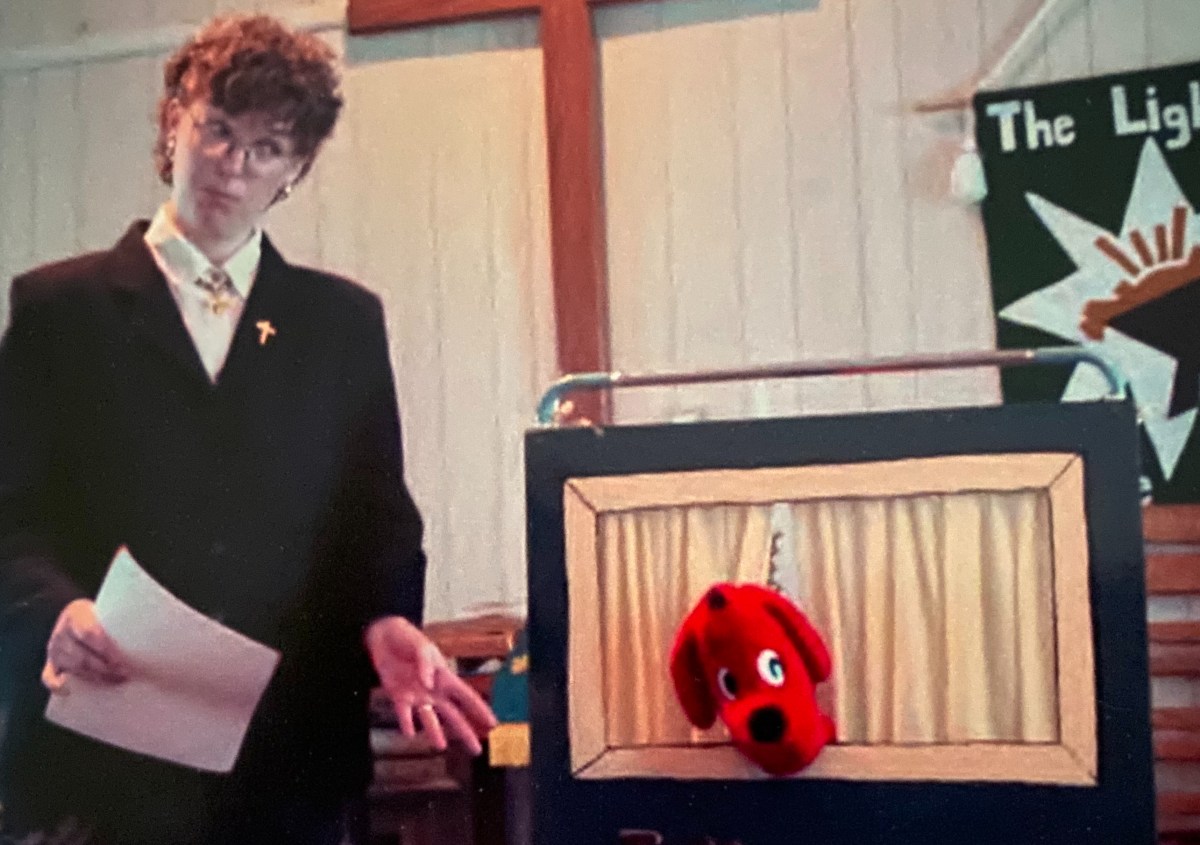
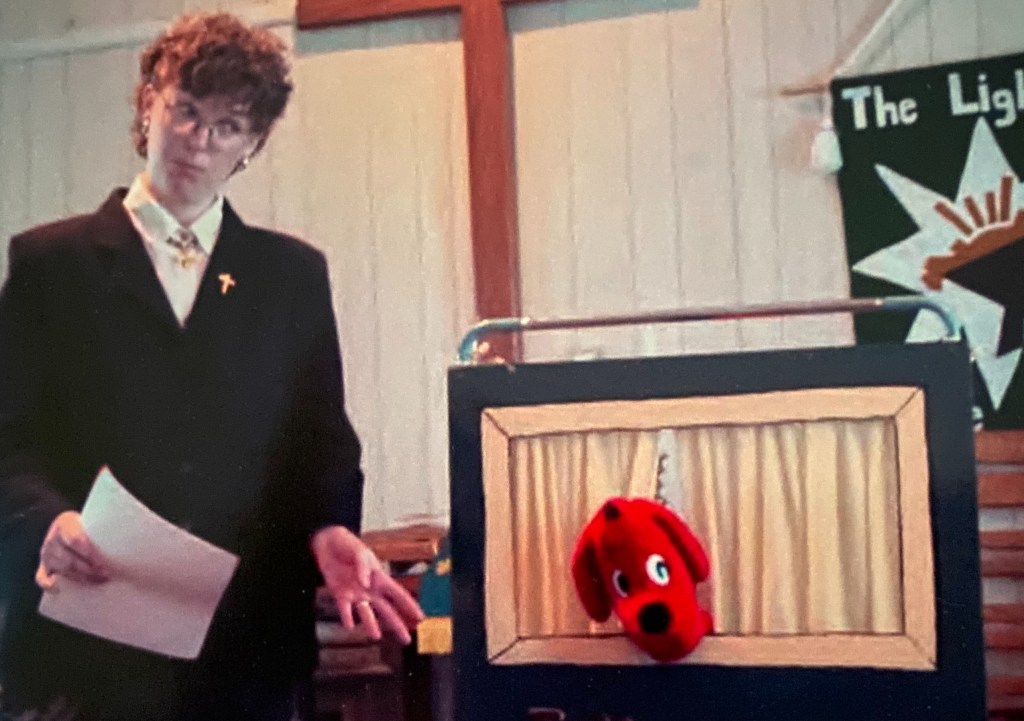
That dry sense of humor and sense of timing would serve him well as a puppeteer. I planned to use the Children’s Time to both entertain and teach. We had a large red dog puppet, whom we renamed Jeffrey and whom we decided would be allowed to ask questions no one else dared ask. In his debut, our puppet first told what would become my favorite joke.
“What’s the difference between roast beef and pea soup?” he asked.
I shrugged and asked, “What?”
“Anyone can roast beef.”
It took a minute, but we both waited, expecting to hear the chuckles move across the room slowly; first, though, we heard the roar from the back pew. One of my church members, Ray, loved the joke apparently. A few months later, I would visit him in the hospital and laugh myself because nearly every person who helped me find him that day would ask, “You mean the guy with the pea soup joke?” A year later, he would succumb to the illness that had sent him to the hospital. Sitting in the visitation parlor of the funeral home, I would hear the joke enough to prompt me at the funeral service the next day to ask how many in that room knew the difference between roast beef and pea soup. Nearly everyone raised a hand.
On that first Sunday of the puppet’s debut, once the ripples of laughter had died down, Jeffrey asked me, the pastor, what I was wearing under that robe? I had not worn a robe before that, but frankly hoped the robe would solve the ever-challenging task of what to wear when preaching.
“Why, I’m glad you asked,” I said. Then, as I reached down to lift up the hem of my robe, I saw Jeffrey had covered his eyes and was exclaiming, “No, no, no…!” Jeffrey was a hit and became one of our most effective teaching tools. Using a puppet was in part a response to all I had been learning about how to help my people learn something about themselves and their God.
Lessons from the Deli
Opportunities to learn what worked for teaching and what didn’t flew at me from all directions at that church; the toughest part was catching all of them and seeing how they were related. A delicatessen menu, for example, taught me about my son, my sister, father and my church. I knew my son was smart; I just didn’t know why he was so often angry until we visited the new delicatessen in Gallatin. We met up with some friends for lunch and we were standing at the counter as a group, staring at the menu, which was written on the back wall of the restaurant behind the counter where the sandwiches, soups and salads were prepared. Usually, when we ate lunch at drive through restaurants, menus sported pictures and we all knew what they were called because we could all sing the jingles we heard during commercial breaks while we watched our favorite television shows. At the new deli, even I felt the pressure to peruse the menu quickly, so I turned to my youngest son and asked if he saw anything he might want for lunch. He looked at me, bewildered. It was a glorious moment of vulnerability; normally, he would have barked at me for singling him out for help. At that moment, though, I realized he did not see what I saw. I saw “Salads,” in larger, bold lettering, for example, then “Chicken,” “Tuna” and “Garden” salad categories in smaller lettering followed by even smaller paragraphs with descriptions for each salad. He saw lots and lots of jumbled letters.
“Want a ham sandwich?” I offered, knowing what he liked, and told him he could have it on white, wheat or rye bread and he chose rye just to be adventurous.
“Can I have mayonnaise on it?” he asked.
“Absolutely,” I said, “and no tomatoes. Chips?” He agreed to chips and soda.
I made a note, though, to visit our local library and there I was grateful to find out about different learning styles and how those often mirror and/or drive the different ways we relate socially in the world. Some of us learn just fine the way most subjects are taught in school; others struggle. I personally learn by taking what is presented and being able to then restate it in my own words. In Chemistry in high school, for example, my teacher would walk me through the problem at hand and it always made sense to me in that moment. If I did not get a chance to retell within a short time the solution to the chemistry problem, though, it would be lost to me. I may have initially understood it but I would quickly lose grasp of the solution if I had not written it down and been able to explain it myself. Only if I wrote something down, then retold it in my own words, would I learn what had been presented. Fortunately, that was easy enough to do in most classes growing up. I personally kept great notes and studying for an exam was a matter of going over and over my notes until I could nearly recite them word for word and then recreate them for an exam. Just explain something to me orally, though, then exit and the understanding would leave the room with you.
My son, I realized, learned by watching and repeating what he’d seen as well, but by doing, not writing and reading. When he was five, we watched him recreate a rocket tower with his plastic building toys while watching one of his favorite movies about the Apollo 13 moon mission. When the rocket took off during the movie, we realized that our son’s rocket tower fell away in stages in exactly the same way the real tower did, something none of the rest of us had even noticed. I do believe that he would have been likely labeled with some sort of “learning disorder” had we not homeschooled our sons. As it was, what I read suggested he simply needed some understanding of his learning style and what might be getting in the way of his learning. He needed me to recognize, for example, that he found distracting those modern textbooks with their colorful pages and art interspersed with words. Simply placing a piece of colored plastic across a textbook page, though, rendered the colors and art less distracting. Turns out, he was among many who struggled because we as a culture had decided it was somehow helpful to readers to spice up the visuals in our textbooks and magazines. Some of us enjoyed the art; some of us were too distracted to be able to read. Different styles.
Some of us will find a page like this helpful. Others might be distracted by the art. Page from “The Way Life Works,” by Mahlon Hoagland and Bert Dodson, Times Books, 1995.
Spencer also needed information: when you read a textbook, a menu or a newspaper, you start with the largest letters. Might seem intuitive, but not everyone approaches the world in an intuitive manner and our world is richer precisely because we are not all the same. To read a newspaper, you look first at the headlines; on a menu, you choose categories like soup or sandwiches. Once you decide whether or not you want a sandwich or sports, you look to the next largest groups of letters and decide if you want a tuna sandwich or if you want to read the previous days’ scores. Smaller letters give you details about the avocado sandwich you chose, or where the baseball scores can be found. Even smaller lettering leads you to what else you could have on the sandwich or which team won the game or match.
Learning styles also affect our approach to the world and our relationships. Often, my son simply needed information to help him navigate.
Turns out, when it came to relationships, the same was true. Often, he simply needed information to help him navigate. He asked once what to do when someone was crying. Before, his tactic was to walk away and get someone to help. He wasn’t uncaring. Far from it. He was worried he’d hurt someone more by saying or doing the wrong thing when they were already vulnerable. I suggested a plan: stay close by, and, if you know them well enough, put a hand on their shoulder or arm and ask if there is anything you can do to help. He said thanks and that was that; I thought he’d forgotten about it really until a couple of years later when said he had tried that with a friend and had been relieved to find it had really worked.
What I had learned was that my son needs information while others learn visually or by hearing. Tragically, seldom do pastors learn how the people around them learn. My son taught me why so many of my family members and congregants might be frustrated. Suddenly, for example, my understanding of one member bragging that he’d finished college “without ever cracking a textbook,” changed. He’d turned that into a plus when it had actually been a hint to his learning style, one not often supported in schools then. Quickly, I understood why our children’s time was often the only part of the worship service people remembered in the beginning. The story or our puppet wasn’t teaching theology; it was just funny, but funny can be theological if you’ve let your guard down expecting a funny joke.
On one of the first Sundays using Children’s Time, I talked in the sermon about “schadenfreude,” the idea that we take some joy in others getting their due or at least not getting more than us. For the children’s time, I had brought wrapped pieces of hard candy and shared it with the children, but I only had three pieces, so the last child in line got none. When he protested, I explained, “I ran out but at least three of the children get some so we can be happy for them, right?”
“That’s not fair,” he wailed.
“Well, then, perhaps no one should have candy,” I suggested, snatching back the candies from the other children before they knew what was happening. They were, of course, bewildered by quickly changing fortunes. “Is that better?” I asked.
He grinned. “Yes!”
Of course, everyone laughed (but I immediately regretted the lesson we were all learning at his expense.) In that moment, the pastor learned to think through the children’s messages more carefully. The child felt better but the others were sad and bewildered until I said, “Wait. Look! There’s another piece of candy here after all.” All the children eagerly accepted their candy and went back to sit with their families. before their fortunes changed again.
Likely none of the children heard the sermon that day but the adults were primed to hear my sharing about my own schadenfreude.
Ironically, I admitted, I had seen this in myself that morning driving to church. I was sideswiped and nearly run off the road by a speeder. My reaction to that bit of driving aggression had been far from pastoral. To make matters worse, when I passed the same guy a little later getting a ticket just a few miles down the road, I gloated loudly! My schadenfreude, or joy, was that he was “getting his due.” The adults in the room understood the idea better and had it reinforced because of Children’s Time. They understood better then the prophet Jonah who was not happy to discover that God wanted to forgive all the sinners in Nineveh; Jonah wanted to see them “get their due.” We usually want others to get justice while we ourselves get mercy and forgiveness. That’ll preach, as they say.
Over the years, then, using all I learned, I not only used the Children’s Time and our snarky puppet, but also worked to craft sermons heavy with stories and illustrations because so many of us only remember the stories we hear or the “word pictures” we encounter. “Show. Don’t tell,” works. Maybe too well. After a couple of years of working to find and add stories to the sermons in hopes people would take something away from worship, I got one of what would feel like daily lessons in humility. At an Administrative Council meeting, a member offered the devotion before the meeting proper using a story I’d told three weeks earlier in my sermon. “Ah,” I thought, sitting back and smiling, “they DO listen.” But no. Once she’d finished her devotion, she handed me her notes.
“Feel free,” she said, “to use that in a sermon. It’s a great story.” Sigh.
Bonus free joke from the adult Spencer:
What is the difference between a tuna, a piano and a glue stick?
I don’t know. What is the difference between a tuna, a piano and a glue stick?
The last time I read the Scriptural passage about the woman who insisted Jesus heal her even after he likened her people to the dogs under the table, it made me think of my youngest son. And jails. For several reasons.
"Leaving that place, Jesus withdrew to the region of Tyre and Sidon. Just then a Canaanite woman from that region came out and started shouting, “Have mercy on me, Lord, Son of David; my daughter is tormented by a demon.”
But he did not answer her at all. And his disciples came and urged him, saying, “Send her away, for she keeps shouting after us.”
He answered, “I was sent only to the lost sheep of the house of Israel.”
But she came and knelt before him, saying, “Lord, help me.”
He answered, “It is not fair to take the children’s food and throw it to the dogs.” She said, “Yes, Lord, yet even the dogs eat the crumbs that fall from their masters’ table.”
Then Jesus answered her, “Woman, great is your faith! Let it be done for you as you wish.” And her daughter was healed instantly."  Matthew 15:21-28
First, my son is a lawyer, working as a public defender. He’s the guy who gets assigned to people who don’t have money for a private attorney when they have to appear in court. He thinks it’s a hoot that he can call his mom whenever he wants to and say he’s headed to jail. Haha.
Second, he LOVES to argue.
And third, he likes rules. To be specific, he likes knowing where the line is. When he was younger, we’d tell him the rules and he would make us hold that line. We’d tell him not to step over that line and he’d put his toe right up to it and ask, “You mean this line?” For the longest time, his constant testing of our boundaries and rules for him was frustrating. After a while though, we realized he really DID want to know where the line was because rules helped him feel safe, helped him know where he stood. That may be WHY he became a lawyer, that love of rules. He ate all that up, all those laws and statutes, just his cup of tea. So he likes being a lawyer, at least most of the time, likes helping folks who find themselves in trouble but can’t afford a private lawyer.
We’d tell him not to step over that line and he’d put his toe right up to it and ask, “You mean this line?”
So most of the folks he defends have very little means and many of them don’t get bailed out while they wait for their day in court. That’s when he calls mom and says he’s going to jail. It’s been frustrating for him often but every so often, it is also quite rewarding. For one exxample, a couple of years ago, he was visiting a young client at the jail and the client asked how old my son was. He shared that he was in fact turning 32 on that very day and the client was floored. “You mean you have to come here on your birthday?” he asked. “Are you gonna get to have a party or a cake later?” he asked. “Probably not,” my son said, shrugging it off. He didn’t think about it again until he saw the young client again a couple of weeks later and the client, in his twenties, pulled a folded up napkin from the pocket of his orange jumpsuit and unfolded it to reveal a cookie. “This is for you, man,” he said. “Because you didn’t get a birthday cake. I saved my cookie from lunch for you.” My son was speechless, which is significant for him. He’s never at a loss for words.
It’s not a stretch, though, to say that most of us are not terribly comfortable with courts and jails and prisons so I don’t feel like I’m bragging when I say my son is comfortable going to jail because his mom went to prison. No no – don’t get me wrong. I went to prison the way he goes to jail.
When I was in seminary, we were offered classes that met in Riverbend Prison, classes that were populated half by seminarians and half by inmates. We studied issues surrounding prisons, legal systems, punishment and forgiveness. I did that for the entire time I was in seminary, every week, and I can tell you I learned a great deal and came to know about a dozen of the prisoners pretty well – guys in for everything from murder to arson to rape – all of whom were taking the same graduate level classes the seminarians were taking. When it came time for me to graduate, then, I was invited to continue visiting by getting on the visitation list of one of the inmates. When you visit Riverbend, like lots of state prisons, you visit during set hours in a large open room and there might be as many as fifty inmates also having visitors in the same room, all seated on molded plastic chairs, all attached in groups of twos or threes. At the corner of many of the sets of chairs are the all-valuable tables. Tables are at a premium and desired because, all around the walls of the room are vending machines for snacks. Most of the foods in those vending machines are cheese and peanut butter crackers, tuna fish sandwiches and peanuts and candy. None of the items appealed to me much, I realized, because the daily food I had was better and more varied than those offerings. To the men who lived there, the stale hamburgers were a real treat.
Visits generally were on the weekends and lasted several hours; if an inmate had visitor privileges (and those were earned), they could possibly see family or friends who’d been approved by the prison system on Friday evening, Saturday morning and/or Sunday afternoon, for example. Visitors were subject to body searches and metal detectors and not allowed to carry in much, not even key fobs and certainly no phones. The nice thinga bout the open room was that you can easily visit with several inmates at the same time and that’s what some of us from the classes did. Usually on Friday night or Saturday morning, we’d go to visit one of the inmates who had been in the class and be able to see several of them and catch up on their lives and share about ours.
While I always visited as a friend and not as a minister, the inmates always asked about my ministry and the church I was serving and, for a couple of them, it eased the loneliness of not receiving visits from family. One thing we had learned was that inmates who served their time and then were released were 5-10 more successful staying out of trouble when they got out if they had continued to have relationships that were positive. So, we particularly focussed on being supportive of those whose families were not involved in their lives and didn’t visit or call.
Some of us spoke to one or more of the inmates by phone as well. They were allowed to have up to ten people they called and most looked forward to having someone to call on occasion to break up the monotony if nothing else. I agreed to be on the phone list of one of the inmates, who is, by the way, not eligible to be released for another decade, if he lives that long. It was safe. For an inmate to call you required a LOT of paperwork and clearances and then when they called, you heard a voice say, so and so from Riverbend Prison is calling you, do you want to accept the call? I was careful and the school and the prison were careful but I know it still made people nervous who knew me. That included, not surprisingly, my parents, who were at that time retired and who worried alot about me anyway.
Mom and Dad were especially struggling with my being friends with inmates because neither of them had ever even met someone who had gone to jail, not even for a DUI, and they didn’t even know anyone else who knew anyone who’d gone to jail. It was too foreign a concept and just not acceptable. So one weekend I went to Missouri to visit them and told them I was visiting an inmate and he was allowed to call me, they were angry. I assured them that inmates could NOT call cell phones and they only had my home phone number in Tennessee so they could not call me while I was at my parents home in Missouri.
For an inmate to call you required a LOT of paperwork and clearances and then when they called, you heard a voice say, so and so from Riverbend Prison is calling you, do you want to accept the call?
Nevertheless, while I was there with them, while we were arguing about whether or not this was acceptable behavior on my part be friends with some guy who was sitting in a prison cell, the phone rang and my mother answered, then handed me the phone angrily. It’s your criminal friend, she said. I took the phone trying to answer while also explaining to them that it couldn’t be him because he couldn’t call me at their house when I heard the voice on the other end say, “…an inmate from the Greene County, Missouri, jail is calling. Do you want to accept the call?”
I realized suddenly that call was not coming from my friend in Tennessee but rather from my brother, who apparently had been arrested the night before. And suddenly, the inmate in Tennessee – whom they were sure was dangerous and not to be trusted – was sitting on a hard metal bench next to my brother, their son, in a jail cell. And just like that, the circle of their care and compassion grew a whole lot larger.
My own circle of care and compassion grew exponentially because of my time visiting prisons. When I was sent to another church, turned out that nearly one quarter of the folks in the church had family or friends who had served or were serving time and it helped my ministry greatly that I knew first hand what it was like for them to constantly to worry about the safety of their loved one, to struggle financially because of lost income, to struggle not to be ashamed of what another person had done, to wonder how things would be when they returned home.
Those families were grateful when their pastor talked then about visiting the prison regularly. For the first time, their pastor was there with them when they sat in the visitation gallery on Christmas Day or Easter or celebrated with them when their son got his GED in prison, sharing hopes he could change the path he was on. Their pastor seemed to speak the same language and was one of their people, one who at least accepted and cared about their “kind.”
All of that is what leads me to one of the most troubling aspects of this story in Matthew 15: how the disciples AND Jesus treat this woman, who is not one of them, not one of their “kind.”
We find first that Jesus refuses even to answer the woman, then denies he has anything that she could possibly want and then even likens her to a dog. This is definitely a troubling passage.
We may believe that Jesus was “truly human,” but usually we don’t want him to be too human. So over the years, people have tried to clean up this story. But Matthew doesn’t clean up this story. He lets us see this encounter in all its unvarnished glory.
The woman is a Canaanite woman – and she is NOT one of Jesus’ “people”. But he is in her part of the world – Tyre and Sidon. This is her home.
Nevertheless, this woman seems to know who Jesus is. She has tracked him down in order to ask him – to beg him – to heal her daughter who is tormented by a demon. This is a desperate woman and apparently, comes at Jesus shouting. The disciples want nothing to do with her and want Jesus to send her packing.
She isn’t going anywhere, though. She may not be “their kind,” but she somehow knows enough about this healer to find him and call to him in the language of the Jewish prayer: “Have mercy on me, Lord, Son of David.” She has come prepared to fight for her child, it seems.
Even so, Jesus isn’t even impressed by her using the language he knows is not hers. “I was sent only to the lost sheep of Israel,” he tells her, and still she doesn’t give up.
“Lord, help me,” she begs. This is where Jesus says what we really wish he hadn’t said, “It is not fair to take the children’s food and throw it to the dogs.” But this woman is feisty and stubborn. Having a special needs grandchild, though, means there’s one thing I have learned about people who know their children’s lives are in danger – they will get in your face if necessary – they do not care if you do not like it. That’s their baby and the hair on the back of their neck stands up every time someone or something threatens that child’s safety. The life of this woman’s daughter is at stake. She does not back down at all but throws Jesus’s words right back at him: “Yes, Lord,” she says, “but even the dogs eat the crumbs that fall from their masters’ table.”
And all of a sudden, just like that, Jesus changes his tone. He says, “Woman, great is your faith!”
Interestingly, she hasn’t made any confession of faith, though. There’s no sign she’s been converted or planning to become a follower. She simply told him what she had heard – what many in the region had heard – that there had been by that time more than one instance where thousands had been fed when they came to see this healer, this rabbi called Jesus. “I’ve heard that there were enough crumbs to feed thousands,” she seems to be saying. “You can’t tell me there’s not enough for me and my daughter.”
That’s what I believe Jesus finally heard and that’s why he not only changes his mind, but he changes his mission. “For saying that,” he says, “you may go — the demon has left your daughter.” And just like that, the circle, the line, that defines his mission on earth is widened to include everyone.
It is disturbing to some folks to think of this episode, such harsh words coming out of Jesus, but one thing was clear that Matthew wanted his listeners to understand: in that encounter, Jesus was converted – he understood something he had not understood before – and the circle of his mission and ministry was much larger than he had realized before. The Kingdom of God had been revealed to him in the face of the Canaanite woman. The Canaanite woman taught Jesus that she and her daughter and so many others like her deserve more than crumbs. After this encounter Jesus went on to feed those who had not yet been fed, went on to include everyone in God’s kingdom to come.
We saw here something that ought to surprise us, certainly surprised me the first time I saw it: Jesus drew a line – as surely as if he had used a stick to draw a line in the sand and said, this, what I am sent to do, is not for you. I’ve done enough. I am tapped out. I gave at the office. I don’t have any more energy to help anyone else, to get to know anyone else, to include anyone else in my circle. He dismissed her and not in a kind way at all.
IF we are pushed, we will get ugly too, though; we’ve been known to let others see our disdain for that person who does not deserve any help or who needs to go somewhere else to find it. “WE” don’t know people who go to prison and we don’t want to….
At least not until one of them is sitting next to our child in that jail cell and suddenly our circle is a little wider than we knew. Any time this happens, it can be frightening, and it can feel like we are out there where we don’t feel so safe any more, and we might be really unsure about how this is gonna go.
If we look again, though, really look, chances are good we will see God in that cell, sitting there with all of them, sitting next to our child and all of them will be sharing cookies. Amen
4 responses to “Drawing the Circle Wider: Prison Ministry and Family”
Nancy Bradshaw
Jodi, sitting here on the deck of a cruise ship. My eyes are watering and not from the sun but from the eye opening beauty of this piece that you wrote which reminds me that Jesus was certainly human as well as divine and that the divine is also in me , in you and all humanity. We just need to be reminded. Thank you for doing just that. ❤️
Your ability to unite seemingly unrelated life experiences with a scripture and a message is your special craft, priceless. I bookmarked this weeks ago and I’m glad I came back to it. Forever faithful are we, Amen.





























 Emptying The Backpack
Leave a comment