
Free Cookies

I come for the cookies….

“Why,” I asked the woman seated next to me, both of us with arms outstretched being squeezed by thin rubber tourniquets, “would someone go to the trouble of  giving blood to that venerable institution called the Red Cross expecting that their blood would be rejected?” I kept my eyes trained on hers to avoid witnessing either needle being inserted, grateful for the distraction.

“To see if they’re still clean,” was the answer she gave that summer afternoon in the Red Cross’s makeshift donation center in our little town’s City Hall. From the looks of it, the BloodMobile staff had the travel and setup routine down and, on this particular afternoon, business was booming in that air-conditioned meeting room. Word was out and neighbors in the Highland Rim town of Portland, Tennessee, population just over 5,000, were lining up, enticed perhaps by some visiting and sharing of the cookies and orange juice handed out to donors, all playing out indoors where there was air that you could breathe in August. The tech loosened the rubber tourniquet around my arm and the young woman in the next chair leaned over and explained. “If you suspect you have AIDS, you can let the Red Cross diagnose you. They’ll only use your blood if it’s clean,” she said. “Lots cheaper than paying for a test. And no one asks you questions you don’t want to answer.” 

Plus, there are cookies.

People amaze me. I sat back as the blood flowed and reviewed how creative types could see what the rest of us cannot, who find ways to work around existing services to fit their needs, even if the services were not intended to diagnose, for example. These workarounds can be quite ingenious, but less about artistic visions and more often the child of necessity. Were folks adapting the services of the Red Cross the way others did those phone hotlines, I wondered? The ones where you could find someone to talk to you for free? Maybe not, I thought, more like 2-1-1. Used to be, if you wanted to talk to someone but you don’t want two police officers showing up at your door to do a “well check,” you could dial, or rather, punch in “2-1-1.” The idea washed over me that our culture used to, at least, have a number of systems, screenings and alert systems apparently in place. Some were designed to separate the lonely from the disturbed, some alerted us when we needed to see a doctor, still others, a process of interest to me at the time, offered to determine if you were among the “called” or simply delusional. As someone whose life path led me into ordained ministry by way of teaching, social work and writing, I was becoming familiar with this web of services. 

You’ve Got a Friend….

I was serving Neeley’s Bend UMC by this point and our proximity to Nashville meant we had access to a 211 directory. Our little town of Portland, nearer the Kentucky state line, where my son and I still lived as he finished out high school, did not have such service, a system where anyone could call and chat with another, live person for a bit at no cost and about pretty much anything. Designed to help steer local residents towards food pantries or accessible ride programs, the lines were answered by folks who became, at least for a while, the only friends some could claim. Turns out, lonely people were also creative and many of them figured out they could call every day. In fact, lonely callers so overwhelmed the 211 system that a few rules became necessary: callers were limited to one call a day per person for a limited duration. Rules ruin it for everyone, some lamented, but, then again, even if only for ten minutes a day, you still had a friend who’d listen to you, for “free.” No strings attached. The beauty for many was that there was no real effort on the caller’s part except to dial the phone; no quid pro quo was necessary and no relational reciprocation was required. Someone was always at your (beck and) call. At least once a day. Whether we were annoyed with the smell of our pet’s kitty litter or the price of avocados, we could talk to a person through 211 about anything for ten minutes and they’d listen. They could even tell you where to get free groceries and usually there’d be cookies. All for free. Not sure how many towns have those systems in place now, but they definitely serve a purpose.

Along the same vein, (pun intended), while I sat in that chair watching the bag fill with blood, I had learned that, if you believed God talked to you and you wanted to know if you were sane, there were workarounds; in particular, there were helpful gatekeepers. While some folks slide easily into ordained ministry, others of us step onto the path shakily, unsure for ourselves and aware that those around us will be more than a little skeptical. For me, the first step was admitting to my husband that I prayed. We had been married more than a decade when I sat on the edge of the bed we shared, clutching a lumpy pillow, cringing as I told him that swearing was not in fact the only time I used the word “God” (with a capital ‘G.”) This was the man who was outspoken about his belief that only mental weaklings believed in a deity of any kind. 

God talks to you?!?! Of all people…?

For years as a teen, long before I’d met my husband or considered turning to the church for a vocation, I had struggled with anxious thoughts, worries that felt like there was one of those old mimeograph machines in my head. Perhaps you are old enough to remember those: the kind with the drum that you cranked by hand while the paper revolved around and your words were printed on multiple pages, the precursor to a copy machine. For most of my life, I’d been trying to make decisions absent any sage advice from my parents who, when approached for advice, waved me and my siblings off, annoyed, as if to remind us they were overwhelmed enough already by our existence and life in general. My father once described to me his own anxieties by sharing that he had spent most of his adult life feeling like he was hanging dangerously onto a ledge and, above him, people were constantly stepping on his fingers to make him let go, give up, go away. He could offer no guidance or help to anyone else while he was just hanging on. 

“God grant me the serenity to accept the things I cannot change, the courage to change the things I can and the wisdom to know the difference.”

On occasion, because of my own anxieties, on the mimeograph machine in my mind, it seemed like a couple of pieces of paper would come loose and flap wildly as the drum turned. My mind was that drum and my thoughts were that paper flapping uncontrollably.  I had tried a variety of ways to ease my anxieties: visualizing silly images like a cat with a stop sign attached to its tail or locking my worries in a dumpster, but nothing helped much until I found my way into an Al-Anon meeting one day. I was nineteen and dating David, a man who shared early on that he was a member of Alcoholics Anonymous and, who, after having known my mother for a few weeks, thought he ought to tell me about Al-Anon. “I don’t know much about that group except they used the same 12 Steps we use in AA. Who knows? It might just be a lot of old women complaining about their drunk husbands, but it’s there and worth a try.” 

You could always try those meetings….

He shared this one morning over coffee; I’d sought him out, distraught after encountering my mother drunk that morning. His suggestion hit me at the right moment and I found a meeting that evening at the back of the small storefront where the AA meeting was held. I was too worn out with navigating the alcohol and moods to be nervous about walking into a room where I knew no one. What happened then was that I walked into a roomful of loving, wise, patient surrogate parents who shared with me the Twelve Steps. Members of Al-Anon are, like me, those who have lived with or currently in relationship with alcoholics. The first three steps to that philosophy are designed to help you recognize that your life is unmanageable; likely if you grew up in an alcoholic home, your life had always seemed pretty unmanageable. The Third Step talks about believing in and trusting that there was a God and that God could help. The idea of letting go of control of my life seemed dangerous but I kept going back and sharing how stressful and chaotic my family’s day to day life was.  My own life at that time was a mess as well: I couldn’t tell you what I believed or what I needed to do for my next job, let alone as a career. So, per their suggestion, I attended 90 meetings in 90 days, letting those people love on me and studying the Steps. In contrast to everything around me, the Twelve Steps were not chaotic, but rather offered a different way to make decisions and live life. Then, one afternoon, I was curled up on my bed, emotionally exhausted and lost. It seemed a voice in my head, a benevolent voice, said, “You just need to sit down and shut up.” Suddenly, it felt like I was not alone in making decisions. I took a breath and stopped asking myself or God or anyone who’d listen; I just sat quietly, suddenly reassured the answer would find me if I sat still and waited. A revelation. There would be more. Eventually. I stopped dating David, but I kept coming back to the meetings regularly for nearly two decades, wherever I lived, and I know that that program and those people saved my life and even helped me grow up, at least a bit. 

 A decade later, married and teaching with two small boys, I finally told my then husband that I prayed and, when he didn’t laugh at me, I admitted that God not only talked to me but that I believed I was meant to be involved full time in some ministry. You might think that everyone around you would celebrate if you announced your call to church ministry, and that’s true in some circles. I’d been attending a Methodist Church regularly with our sons, but most of our friends at that time were not attending any church; most were agnostic at best. Thus, I felt the need to be selective when telling anyone that I had regular conversations with God, even those that are only in my head. It didn’t help that God and I were negotiating what ministry for me might look like and I was still quite leery of admitting God wanted anything from me, of all people. If nothing else, at the time, I cussed like a sailor. I had to wonder how that would work! 

Moving forward into what would become an increasingly complicated path towards ordination, it was clear that I had to be subtle about my next steps, and at least appear sane and convincing enough to be taken seriously. The first step was to write a letter to the Methodist Superintendent of the district I lived in and declare my desire to “explore ministry.” Somewhere in there, it was necessary to admit publicly – to say out loud in front of others – that God spoke to me and told me that I was “called” to ministry. Another chance to cringe.
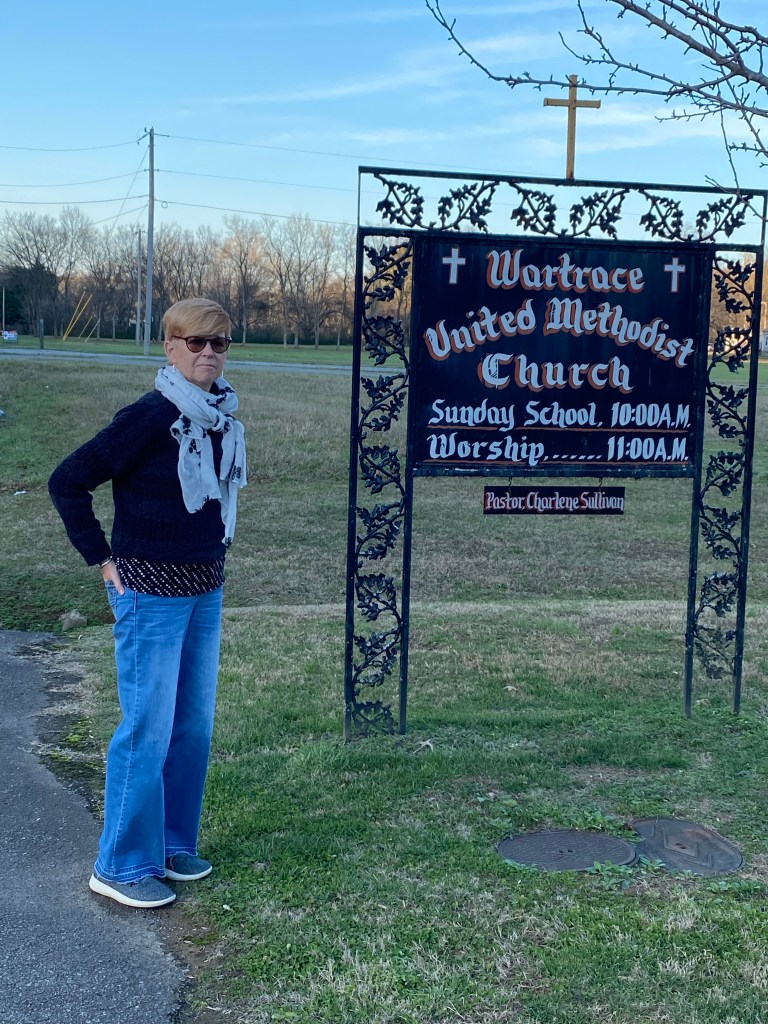
My First Church

The process of moving towards ordination (in the Methodist Church at least) had certainly been more involved than dialing 211, but it was not dissimilar. I’d written that letter and one of the first things the church did was assign me someone to be my mentor, someone who would listen to me and ask lots of questions. Kind of like a free friend, but with a purpose. From then on out, as I went through the process, there were plenty of folks who were ready and willing to swim in the deep end of thoughts and emotions with me, like those free friends, or better, like counselors I didn’t have to pay. The first thing they did, though, was send me to  a psychologist’s office because there was a test in my future. Not free, I remember thinking, but a whole lot less dramatic than calling the local hotline and telling them I talk to God, I guess. 

The psychological exam was just one of the many steps involved in becoming a Methodist minister, a process that is quite long and involved, and can become expensive for many. I had to laugh when I found out, though, that people also used this process, or at least the psychological testing, as a workaround for their own mental screening; it wasn’t free and was far more involved than a simple phone call. I had to wonder: Did they want to be stopped before they hurt someone? I remember sitting in a leather chair in a paneled office with a massive wooden desk between me and the psychologist. I will be forever grateful he started the conversation with, “First, your test reveals you are mentally strong and resilient. All good.”

Relieved, I sat back in the leather chair, and let out a laugh, then admitted, “I’ve got to ask about one of the questions in that test.”

“Sure,” he said.

“It was  something like, ‘Do you like to smell other people’s shoes? Do some people actually admit to enjoying aroma of another person’s shoes?’” 

“You’d be surprised,” the psychologist said.

“Why on earth would you do that?” 

“It’s a way to ask for help, ostensibly without actually asking. They want us to catch them before they do something dangerous,” he explained.

I sure understand that, I thought, making a mental note to be, as a minister, more focussed on the reasons behind those workarounds than the tricks themselves. The reasons were where ministry would happen, I realized. Sometimes people need someone to help them figure out if they are crazy because they talk to – and hear from – God. Just as often, though, folks need to be encouraged to share what they believe God is telling them. Walking people through that process for the United Methodist Church requires years of discernment, writing, interviews and 84 hours of seminary. In other churches, you simply walk up to the front of the sanctuary and declare that God talks to you, indeed, that God is calling you to ministry. I get why it’s so tough to get through the ordination process for the UMC, though, and, don’t get me wrong: I respect it. Even after all the schooling and the discerning and retreats and writing and interviews, after all that I learned about myself and about ministry, I still stood behind the pulpit of my first church and wondered if I was in the right place. I suspect though that God is more able to use us when we are not so sure of ourselves, when we remember we need God. And, my experience has been that, often, we learn we need God through recognizing we need one another, whether we find one another through a phone call, a church or a self-help meeting.  

 Sometimes, in perverse moments, though, I will admit, I’ve wondered if we don’t just need to suggest people start with dialing 211. It’s a whole lot faster and cheaper and they will even tell you where to get free cookies. 
Of Puppets, Delicatessens and Learning Styles

How a delicatessen menu taught me how to understand how my son – and my church members – learn.

While I was writing this, I had several conversations, mostly with my oldest son, Arlo, a college instructor, about the third grade retention law in Tennessee and how students often do well in reading or math skills but not in testing even though it is through standardized testing that it is determined whether or not they will advance or be held back to repeat third grade. The teachers I know work so very hard to help each student and if we are going to have standardized learning (i.e., all students of an age studying the same thing at the same time) then we will have standardized testing is a necessary evil. Having taught the students who ended up in Study Skills classes in a community college because after high school they were still not ready for college-level work, though, I know that brilliant people may never learn to test well. Many among us will go through life believing they are not smart when in fact it is simply because they learn differently and do not have access to the learning environment that suits them. We certainly cannot expect our teachers to be able to teach to all learning styles, but all of us can learn from those around us how they – and we – learn better, i.e., we can figure this out together.

Always Learning

No one was more surprised than I was when my youngest son – the shy one, the one who barely spoke until he was three – agreed at around age nine to be the puppeteer for our children’s time in worship. Until that point, most of the church knew him only as the child peeking out from behind the pastor. Turns out, Spencer didn’t speak much until he was three for a couple of reasons: first, he couldn’t get a word in edgewise with three non-stop talkers also at the dinner table; and second, like his older brother, he was born when we lived in Japan where he heard less English than Japanese. We moved back to the states before he was one, so he was uprooted and plopped down in Tennessee just when he was learning to speak. Changing how his brain was wired likely took a minute. The first real words he uttered came as a full sentence, though, or actually, as a question from his favorite movie: “Who ya gonna call?” 

Once he started talking, we would find out what a quick and dry wit he had developed.  I had introduced a children’s time during worship early and I was reminded regularly I was not in control, often by my own children. The morning I told the children about Jonah being swallowed by a giant fish, then “thrown up” onto the beach, Spencer jumped in with his commentary. 

“Could have been worse,” he said. “Could have come out the other end.”

He was eight when we got to the first church I served, just old enough to go to see his friend Charlie one town over for an overnight stay. Evidently, however, he could not sleep, he confessed when I picked him up the next day. Charlie’s mother was as surprised and concerned as I was; what had he done all night while everyone else slept?

“Watched infomercials,” he said. 

I looked to Charlie’s mom who seemed worried I might be upset. “Well, you’ll get a nap in the car ride home,” I offered, shrugging. 

My son said thanks and goodbye, then stopped at the back door long enough to tell Charlie’s mom, “Oh, your George Foreman grill will be here in three weeks.” Then he walked out the door, leaving both adults bewildered. 

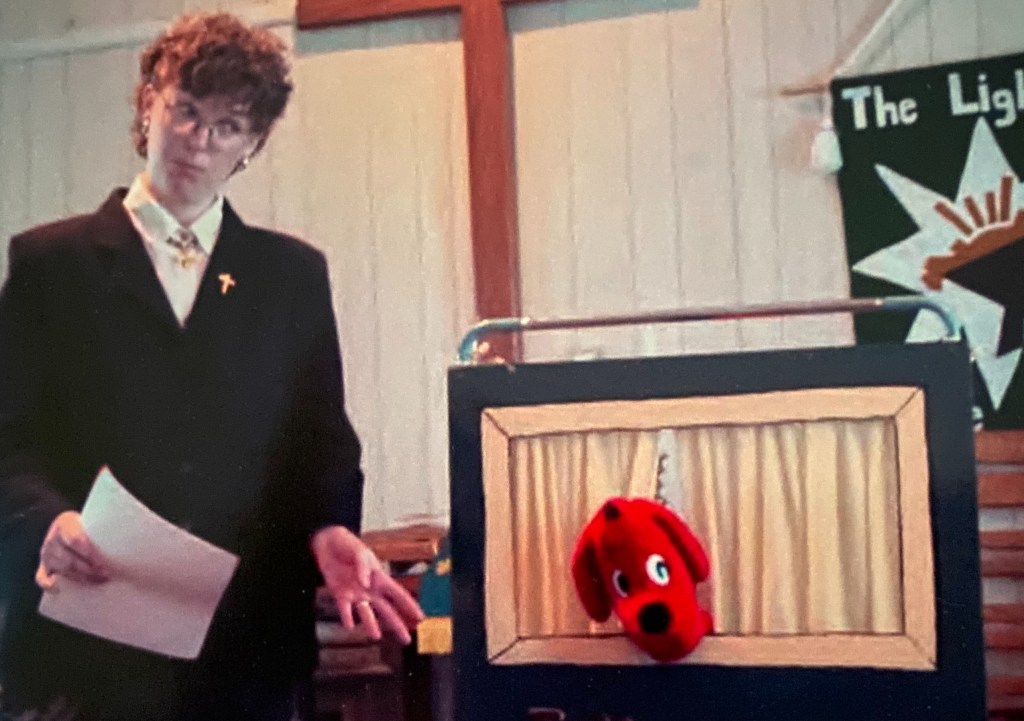
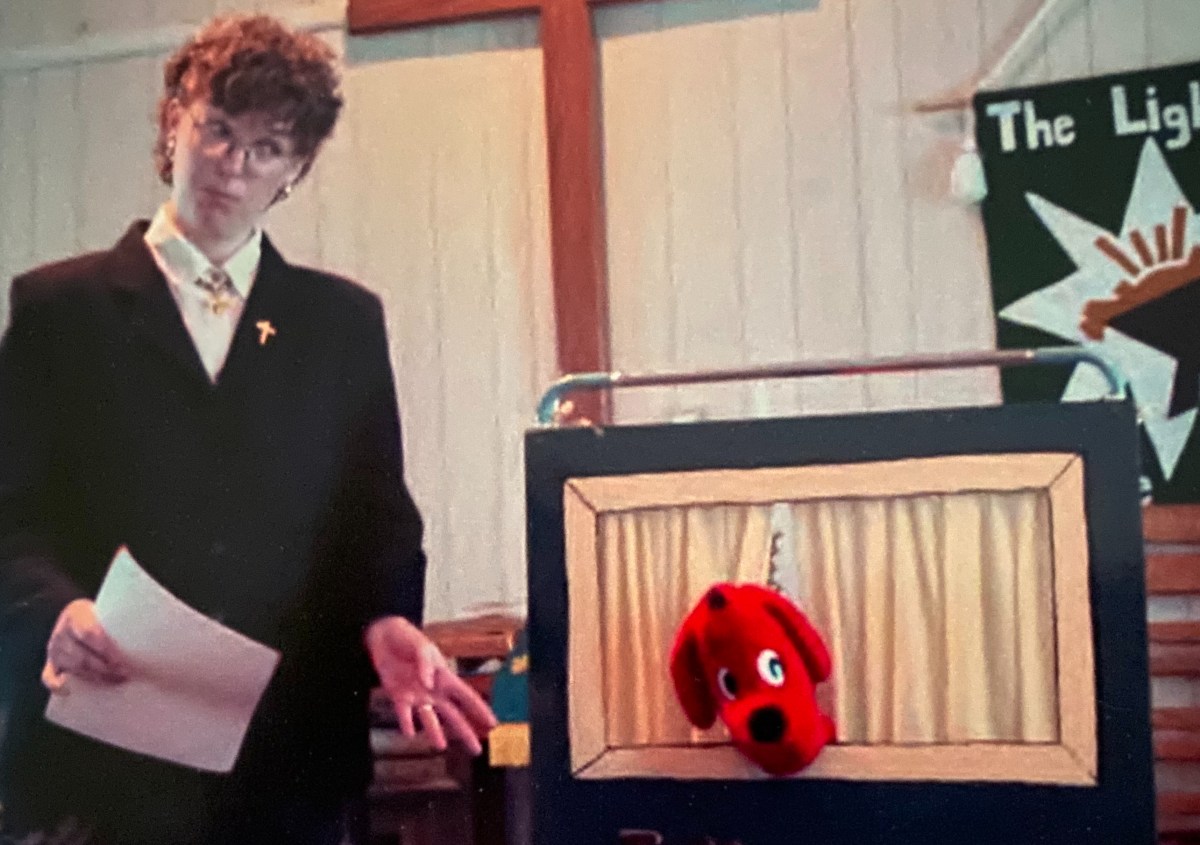
That dry sense of humor and sense of timing would serve him well as a puppeteer. I planned to use the Children’s Time to both entertain and teach. We had a large red dog puppet, whom we renamed Jeffrey and whom we decided would be allowed to ask questions no one else dared ask. In his debut, our puppet first told what would become my favorite joke.

“What’s the difference between roast beef and pea soup?” he asked. 

I shrugged and asked, “What?”

“Anyone can roast beef.”

It took a minute, but we both waited, expecting to hear the chuckles move across the room slowly; first, though, we heard the roar from the back pew. One of my church members, Ray, loved the joke apparently. A few months later, I would visit him in the hospital and laugh myself because nearly every person who helped me find him that day would ask, “You mean the guy with the pea soup joke?” A year later, he would succumb to the illness that had sent him to the hospital. Sitting in the visitation parlor of the funeral home, I would hear the joke enough to prompt me at the funeral service the next day to ask how many in that room knew the difference between roast beef and pea soup. Nearly everyone raised a hand.  

On that first Sunday of the puppet’s debut, once the ripples of laughter had died down, Jeffrey asked me, the pastor, what I was wearing under that robe? I had not worn a robe before that, but frankly hoped the robe would solve the ever-challenging task of what to wear when preaching. 

“Why, I’m glad you asked,” I said. Then, as I reached down to lift up the hem of my robe, I saw Jeffrey had covered his eyes and was exclaiming, “No, no, no…!” Jeffrey was a hit and became one of our most effective teaching tools.  Using a puppet was in part a response to all I had been learning about how to help my people learn something about themselves and their God. 

Lessons from the Deli

Opportunities to learn what worked for teaching and what didn’t flew at me from all directions at that church; the toughest part was catching all of them and seeing how they were related. A delicatessen menu, for example, taught me about my son, my sister, father and my church. I knew my son was smart; I just didn’t know why he was so often angry until we visited the new delicatessen in Gallatin. We met up with some friends for lunch and we were standing at the counter as a group, staring at the menu, which was written on the back wall of the restaurant behind the counter where the sandwiches, soups and salads were prepared. Usually, when we ate lunch at drive through restaurants, menus sported pictures and we all knew what they were called because we could all sing the jingles we heard during commercial breaks while we watched our favorite television shows. At the new deli, even I felt the pressure to peruse the menu quickly, so I turned to my youngest son and asked if he saw anything he might want for lunch. He looked at me, bewildered. It was a glorious moment of vulnerability; normally, he would have barked at me for singling him out for help. At that moment, though, I realized he did not see what I saw. I saw “Salads,” in larger, bold lettering, for example, then “Chicken,” “Tuna” and “Garden” salad categories in smaller lettering followed by even smaller paragraphs with descriptions for each salad. He saw lots and lots of jumbled letters. 

“Want a ham sandwich?” I offered, knowing what he liked, and told him he could have it on white, wheat or rye bread and he chose rye just to be adventurous. 

“Can I have mayonnaise on it?” he asked.

 “Absolutely,” I said, “and no tomatoes. Chips?” He agreed to chips and soda. 

Photo by Pixabay on Pexels.com

I made a note, though, to visit our local library and there I was grateful to find out about different learning styles and how those often mirror and/or drive the different ways we relate socially in the world. Some of us learn just fine the way most subjects are taught in school; others struggle. I personally learn by taking what is presented and being able to then restate it in my own words. In Chemistry in high school, for example, my teacher would walk me through the problem at hand and it always made sense to me in that moment. If I did not get a chance to retell within a short time the solution to the chemistry problem, though, it would be lost to me. I may have initially understood it but I would quickly lose grasp of the solution if I had not written it down and been able to explain it myself. Only if I wrote something down, then retold it in my own words, would I learn what had been presented. Fortunately, that was easy enough to do in most classes growing up. I personally kept great notes and studying for an exam was a matter of going over and over my notes until I could nearly recite them word for word and then recreate them for an exam. Just explain something to me orally, though, then exit and the understanding would leave the room with you. 

My son, I realized, learned by watching and repeating what he’d seen as well, but by doing, not writing and reading. When he was five, we watched him recreate a rocket tower with his plastic building toys while watching one of his favorite movies about the Apollo 13 moon mission. When the rocket took off during the movie, we realized that our son’s rocket tower fell away in stages in exactly the same way the real tower did, something none of the rest of us had even noticed. I do believe that he would have been likely labeled with some sort of “learning disorder” had we not homeschooled our sons. As it was, what I read suggested he simply needed some understanding of his learning style and what might be getting in the way of his learning. He needed me to recognize, for example, that he found distracting those modern textbooks with their colorful pages and art interspersed with words. Simply placing a piece of colored plastic across a textbook page, though, rendered the colors and art less distracting. Turns out, he was among many who struggled because we as a culture had decided it was somehow helpful to readers to spice up the visuals in our textbooks and magazines.  Some of us enjoyed the art; some of us were too distracted to be able to read. Different styles.

Some of us will find a page like this helpful. Others might be distracted by the art. Page from “The Way Life Works,” by Mahlon Hoagland and Bert Dodson, Times Books, 1995.

Spencer also needed information: when you read a textbook, a menu or a newspaper, you start with the largest letters. Might seem intuitive, but not everyone approaches the world in an intuitive manner and our world is richer precisely because we are not all the same. To read a newspaper, you look first at the headlines; on a menu, you choose categories like soup or sandwiches. Once you decide whether or not you want a sandwich or sports, you look to the next largest groups of letters and decide if you want a tuna sandwich or if you want to read the previous days’ scores. Smaller letters give you details about the avocado sandwich you chose, or where the baseball scores can be found. Even smaller lettering leads you to what else you could have on the sandwich or which team won the game or match. 

Learning styles also affect our approach to the world and our relationships. Often, my son simply needed information to help him navigate.

Turns out, when it came to relationships, the same was true. Often, he simply needed information to help him navigate. He asked once what to do when someone was crying. Before, his tactic was to walk away and get someone to help. He wasn’t uncaring. Far from it. He was worried he’d hurt someone more by saying or doing the wrong thing when they were already vulnerable. I suggested a plan: stay close by, and, if you know them well enough, put a hand on their shoulder or arm and ask if there is anything you can do to help. He said thanks and that was that; I thought he’d forgotten about it really until a couple of years later when said he had tried that with a friend and had been relieved to find it had really worked. 

What I had learned was that my son needs information while others learn visually or by hearing. Tragically, seldom do pastors learn how the people around them learn. My son taught me why so many of my family members and congregants might be frustrated. Suddenly, for example, my understanding of one member bragging that he’d finished college “without ever cracking a textbook,” changed. He’d turned that into a plus when it had actually been a hint to his learning style, one not often supported in schools then. Quickly, I understood why our children’s time was often the only part of the worship service people remembered in the beginning. The story or our puppet wasn’t teaching theology; it was just funny, but funny can be theological if you’ve let your guard down expecting a funny joke. 

On one of the first Sundays using Children’s Time, I talked in the sermon about “schadenfreude,” the idea that we take some joy in others getting their due or at least not getting more than us. For the children’s time, I had brought wrapped pieces of hard candy and shared it with the children, but I only had three pieces, so the last child in line got none. When he protested, I explained, “I ran out but at least three of the children get some so we can be happy for them, right?” 

“That’s not fair,” he wailed.

“Well, then, perhaps no one should have candy,” I suggested, snatching back the candies from the other children before they knew what was happening. They were, of course, bewildered by quickly changing fortunes. “Is that better?” I asked. 

He grinned. “Yes!” 

Of course, everyone laughed (but I immediately  regretted the lesson we were all learning at his expense.) In that moment, the pastor learned to think through the children’s messages more carefully. The child felt better but the others were sad and bewildered until I said,  “Wait. Look! There’s another piece of candy here after all.” All the children eagerly accepted their candy and went back to sit with their families. before their fortunes changed again.

Likely none of the children heard the sermon that day but the adults were primed to hear my sharing about my own schadenfreude. 

Ironically, I admitted, I had seen this in myself that morning driving to church. I was sideswiped and nearly run off the road by a speeder. My reaction to that bit of driving aggression had been far from pastoral. To make matters worse, when I passed the same guy a little later getting a ticket just a few miles down the road, I gloated loudly! My schadenfreude, or joy, was that he was “getting his due.” The adults in the room understood the idea better and had it reinforced because of Children’s Time. They understood better then the prophet Jonah who was not happy to discover that God wanted to forgive all the sinners in Nineveh; Jonah wanted to see them “get their due.” We usually want others to get justice while we ourselves get mercy and forgiveness. That’ll preach, as they say.

Photo by Brett Jordan on Pexels.com

Over the years, then, using all I learned, I not only used the Children’s Time and our snarky puppet, but also worked to craft sermons heavy with stories and illustrations because so many of us only remember the stories we hear or the “word pictures” we encounter. “Show. Don’t tell,” works. Maybe too well. After a couple of years of working to find and add stories to the sermons in hopes people would take something away from worship, I got one of what would feel like daily lessons in humility. At an Administrative Council meeting, a member offered the devotion before the meeting proper using a story I’d told three weeks earlier in my sermon.  “Ah,” I thought, sitting back and smiling, “they DO listen.” But no. Once she’d finished her devotion, she handed me her notes. 

“Feel free,” she said, “to use that in a sermon. It’s a great story.” Sigh.


Bonus free joke from the adult Spencer: 

What is the difference between a tuna, a piano and a glue stick?

I don’t know. What is the difference between a tuna, a piano and a glue stick?

You can tuna piano but you can’t piano a tuna.

 Okay.

But what about the glue stick? 

That’s what everybody gets stuck on.

You Can Have My Seat on the Mourner’s Bench

Rituals are meant to be the beginning of the healing process, not the end of it.

Rituals can be powerful for healing, and we need them to help us heal after loss and tragedy. That memorial service we hold when someone dies? It is for the living, not the person who died. Those impromptu memorials after shootings? They help us come together to start the healing.

Rituals are just the beginning, though. This is especially true when our own behavior is part of the problem, when we keep doing the same things and expecting different results. At that point, our rituals are pointless and empty. Visiting a shut-in about once a month for nearly a decade taught me this.

By the time I started preaching, James (I changed his name for this post.) and his wife of close to 60 years were both homebound shut-ins and so were on a rotation of homes for the pastor to visit after worship. Visiting their home was ever the adventure, though.

The entry of the home was a strange mix of antebellum and 70’s influences. A folding metal lawn chair leaned up against one of the original plaster columns that framed the ten-foot-high wooden doors, for example. Heavy enough to kill you if they fell on you, the doors were never allowed to completely close as long as I knew James; opening them would have required at least two grown men. A makeshift screen door was all that separated visitors from the cluttered yard and the porch strewn with more folded lawn chairs, some dead potted plants and a half-empty bag of mulch.

The first time I visited, after knocking several times, I gingerly pushed the screen door open and started towards the voice of a television newscaster beckoning me from the farthest end of the great entry hall. On my right, was a set of partially closed doors, and from them I could see Jame’s wife, whom I also had not met, but whom I was told was not interested in visitors. I later did manage to introduce myself and be admitted to her room but that was apparently only out of necessity: I was allowed in long enough to change the channel on her nearly-antebellum black and white television for her. I was only in her room long enough to realize that, though she was hooked up to an oxygen machine, sitting next to her on the bedside table was a pack of cigarettes and a full ashtray. I declined to empty the ashtray for her, and she waved me out of the room.

I passed two more sets of floor-to-ceiling wooden doors on either side of the great hall before arriving at what must have originally been the site of the grand staircase. Evidently, the top floor of the old home had been caving in, so James’ predecessors had lopped it off before moving it to the current site facing a four-lane highway. The opening to the old stairwell had been boarded up with thin, dark paneling, creating a wall for a now-enclosed back porch. From an opening on the far left I could see the shadows from the television news cast flickering. I peeked around the opening to see the now rather annoyingly loud black and white television, a tv tray lined with medicine bottles and half-opened packages of lemon cookies, and James in a recliner.

He looked up that first visit and asked, “You the lady preacher or are you here to check my sugar?”

“Lady Preacher,” I offered and he pointed to the ottoman next to his recliner, the only other piece of furniture I could see in the dark, enclosed porch under the stairwell. Sitting on the ottoman meant I was looking up at James as we chatted, as if I had been relegated to the children’s table at Thanksgiving.

In my eleven years serving that church, James sat in that recliner for every conversation. The trajectory of our conversations and our relationship, however, determined the seat I would be offered. My perch progressed over the years from the lowly ottoman to a metal and vinyl kitchen chair and eventually to a second recliner, the offer of which required clearing away a years’s worth of mass mailing ads and cookie wrappers. My own recliner. I though I had arrived.

Preaching “Scripturally”

Even after my graduation to adult seating, though, our struggle continued. Over the years James’ oldest son indicated that James did not believe I was preaching correctly. I was not, in James’ words, “preaching Scripturally.” Though James did not actually attend and only heard secondhand about my preaching from his son, evidently, when his son told him about my sermons, James’ complaint remained the same. “Not preaching Scripturally.”

Years would pass before I would be able to grasp the kind of preaching he would consider “Scriptural.”

Every sermon I preached began with a Scripture passage, intentionally allowing the text to speak for itself. I trust the Scripture to tell us something about God and ourselves. I didn’t always like what I learned but I respected it, so I knew James’ accusations either were incorrect or misinformed. His son had reassured me he was reporting my sermon Scripture choices and preaching points, so neither of us realized for some time exactly why James consistently was disappointed. It took me years to realize that, for James and likely for many others of his upbringing, church was supposed to “convict.”

Someone went to the mourner’s bench or church had not broken out.

From the moment you entered the sanctuary apparently, church was meant to be a frightening experience; God knew what you had done all week and before the sermon was over, an honest-to-God, bona fide pastor would have directed your miserable self to come forward and sit on the hardest bench, a single bench at the front of the sanctuary, the one without a back, the “Mourner’s Bench.” There you were expected to confess that you were a sinner – lower than a worm on really bad weeks in spite of being a baptized believer. You were directed then to confess, then you were forgiven and then the congregation would sing, “Shall We Gather at the River” or “Just As I Am” before heading home.

Take me to the real church. Find me a mourner’s bench. God knows what I did all week.

This process, I learned, what James would call “preaching Scripturally,” would render backsliding baptized members “Good-to-Go” for another week. Sadly, though, it was usually then a week of the same damn behavior that had made you feel so guilty the week before, but it was fine because you could count on the Preacher to help you confess and be forgiven all over again the next week. That was apparently how folks knew they’d been to church.

Sure, not everyone went to the mourner’s bench every week but someone did or preaching had not really broken out.

By the time I got there, it didn’t matter that there was no longer a mourner’s bench in the sanctuary; the expectation was still that sitting in the pew on a Sunday invited guilt and shame and the preacher must offer a chance to ask for forgiveness so folks could feel better about themselves for at least a few days.

Full disclaimer: this is not Methodist theology.

For James to feel like he’d “been to church,” he would need to go through the whole ritual, to confess and be forgiven before he was good to go. Then, though, he apparently felt that he would be free to live his life however he wanted…until he needed to come back and do it again.

Nothing in his life changed after that ritual. It was empty. This is the kind of empty ritual that God does not want, we are told in our Scriptures. As much as God loves a good ritual, even God does not seek or require ritual simply for ritual’s sake without any change in behavior. 

In Isaiah 58, “God mocks people who seek God as if they were ‘a nation that acted righteously.’  God accuses them of saying they want to be close to God, but ‘you do whatever you want…oppress all your workers… quarrel and brawl…hit each other violently.’  In classic Hebrew style, [Isaiah makes God sound] like a Yiddish grandmother saying, ‘Oy vey! You call this a fast? Enough with the thoughts and prayers, already!’ (58:5)”

Harnish, Jim, https://jimharnish.org/2022/05/26/is-god-fed-up-with-our-prayers/

Isaiah 58 is tough to read.  God rejects empty piety. God rejects our “lying down in the mourning clothing and ashes” while we still oppress, quarrel and brawl, rejects us going through the rituals but then continuing the behavior that caused us to need to mourn in the first place. More to the point today, God calls us to concrete actions, not simply thoughts and prayers:

“Isn’t this the fast I choose:

releasing wicked restraints, untying the ropes of a yoke,

setting free the mistreated, and breaking every yoke?

Isn’t it sharing your bread with the hungry

and bringing the homeless poor into your house,

covering the naked when you see them,

 and not hiding from your own family?

With God’s command comes God’s promise:

Then your light will break out like the dawn,

and you will be healed quickly….

Then you will call, and the Lord will answer;

you will cry for help, and God will say, I’m here.

Isaiah 58

God loves a good ritual, but even God does not seek ritual simply for ritual’s sake without any change in behavior. 

A few weeks ago, a second-grader fell at a school in the Nashville area, less than an hour from the Covenant School. She stumbled and fell, sadly, during an active shooter drill, cutting her knee and scraping her elbows, after the teacher had screamed at the children to “Run!” A sweet gesture from another child helped ease the pain and panic in that moment: one of her classmates stopped, helped the distraught child get back up and ran with her to the safe gathering spot.

The good news: her friend didn’t leave her behind.

The horrible terrible very sad news: our response to people who take AR-15’s into schools is to step up active shooter drills.

For God, our rituals mourning all of these shootings are empty and meaningless if we continue to do what we do and wonder why things never get better.  As a nation, we’ve gotten pretty good at this, though, acting as if our stint on the mourner’s bench is sufficient.

After the Covenant shooting, a large number of Nashville neighbors including many clergy colleagues participated in actions beyond candlelight vigils and prayers and leaving stuffed animals and flowers and balloons at an impromptu memorial. Thousands staged a sit-in and even marched on the state capitol. The overwhelming message to the politicians who would not consider bans on assault weapons was “Save your ‘thoughts and prayers.'”

With no apparent policy changes, though, the best efforts are still empty rituals, something we are sadly proficient at in this country.

We mourn, but we still can legally purchase an AR-15 and make up for it by telling our children to learn to run faster.

The horrible terrible very sad news is we still think the best response is teaching children to run faster and hide better.

Maybe you believe the problem is guns. Maybe you believe the problem is certain types of guns.

Maybe you support more police in school or arming teachers.

I know I want people to understand there can never be enough equipment for any SRO to combat an 18-year-old in a Kevlar vest and a helmet with an assault rifle. 

Maybe you believe the problem is broken families, no prayer in schools, the lack of mental health care, or children who come to school having never sat down with an adult to read a story book. The truth is, it’s likely some of all of these but focussing only on mental health care without limiting access to the weapons that leave small bodies in shreds is mourners’ bench behavior. That renders our thoughts and prayers empty.

What is critical here is that we do not make our rituals empty, that we do not sit on the mourner’s bench and cry and pray and then go home and keep doing what we have been doing. Because that is making a mockery of our faith and rituals.

Whichever side you fall on, God asks what are you doing to help fix it? Are you just making more room on the bench?

To lament, to pray, to mourn, and then to change nothing is to miss the point.  It is, in fact, to fail–to fail our children and to fail our God.

At the very least, educate yourself. And by that I don’t mean just read what people write who agree with you. Read what people write who don’t agree with you. Learn the actual issues in your area. Every state has different issues and different laws. More than anything, listen to people who disagree with you.

Everyone of us is afraid and sad and none of us has answers that will work for each situation, but God calls us to work together to keep our children safe. Look up your community’s Peace and Justice Center and join in. No Center? Look into starting one.

Grieve, pray, then do something that shows you have truly taken in the gravity of the situation; but for God’s sake, let us not keep acting as if nothing has happened.   

Our children

need us to

figure it out.

  1. Nancy Bradshaw Avatar
    Nancy Bradshaw

    Challenging piece about an horrific plague on our land. What are our lawmakers thinking? They hear the voices of the people and yet do little to address the problem. I need to do more, I know. Letter writing is just not getting it either. Thanks for your focus on what’s going wrong in our world.

    Like

  2. Martha Ann Pilcher Avatar
    Martha Ann Pilcher

    Amen!

    Like

  3. D-Day Promises, Guilt and Forgiveness – Emptying The Backpack Avatar

    […] a previous post, (“You Can Have My Seat on the Mourner’s Bench,”) I introduced James, (not his real name), who struggled mightily with ongoing guilt and grief […]

    Like

  4. D-Day Promises, Guilt and Forgiveness – Eighty Years Later – Emptying The Backpack Avatar

    […] a previous post, (“You Can Have My Seat on the Mourner’s Bench,”) I introduced James, (not his real name), who struggled mightily with ongoing guilt and grief […]

    Liked by 1 person