Thanksgiving is next week. Not this week. Nevertheless, at least a handful of folks will show up at Aunt Frankie’s door, cranberry jello mold and Mrs.Schubert’s rolls in hand this Thursday, convinced that holiday we set aside for football and eating is indeed upon us.
I believe we can blame the whole “4th Thursday” rule. That formula for football and the fixins’ was reportedly set by Franklin Delano Roosevelt in order that retailers could establish a set shopping schedule.
Good for them. For us, it may be too complicated. It reminds me of that strange game we played on our knuckles that was supposed to help us remember which months have 30 days, not 31. Even if we take the time to look at a calendar and count, well, it’s math. In our heads.
Find a calendar (hint – might be a handy one on your phone). Find the 1st Thursday of November 2025, which is the 6th, then count…so 13th, 20th, oops, yeah, Thanksgiving is the 28th. Not this week.
Given half a chance, some of us still standing on the stoop might try to convince Aunt Frankie. She has, by this time, rummaged around and found an actual paper calendar to prove to us how wrong we are.
Maybe we would cajole her while the jello mold wiggled in our hands. “How do you feel about two celebrations? I mean, here we are on the stoop, maybe a fresh pie in hand. You know those pumpkin pies don’t keep well.”
Sadly, we’re probably not the only idiots who didn’t show up for work…on the wrong holiday.
Getting the day right for Thanksgiving is not as easy as if the date were set, like how Christmas is December 25. Nevertheless, having a set day doesn’t guarantee a stressless holiday either. Just ask any pastor or priest.
When I served a church, I was swept up into a fierce debate more than once because, that year, Christmas fell on a Sunday. Gasp!
“You’re not planning on having Church on Christmas, are you Pastor?”
“You’re not planning on having Church on Christmas, are you Pastor?”
“Well, it is a Sunday. And we would be celebrating Christ’s birth in worship. Wouldn’t that be great?”
“We can celebrate the baby Jesus the week before” was the retort.
“Let me get this straight. You want to celebrate the baby Jesus, the birth of Jesus, a week early so it won’t interfere with Christmas?”
“Precisely. All the grandchildren will be waking up at our house and running downstairs to open presents on Christmas morning!”
“How about you come after opening the presents?”
“I’ll be cooking the Christmas meal.”
“But it’s Sunday.”
“Right. It’s Sunday AND Christmas. You cannot expect us to come to church on Christmas.”
The logic still escapes me.
I personally have been needing to remind myself for two weeks now to hold off on the turkey because I keep wanting to make crescent rolls a week early. Actually, the whole confusing holiday discussion started in my home this year at the beginning of November when I explained to my husband that, while we often remember veterans on the Sunday before the actual day, Veterans Day is always on 11/11. November 11. Always. Actually at 11 a.m. on 11/11. This discussion quickly devolved, though, into the confusing world of holiday “days versus dates, fixed days versus floating dates.”
Fixed date holidays occur on the same calendar date every year regardless of the day of the week: New Year’s is always January 1 and Independence Day is always July 4. We generally don’t mess with those.
“Labor Day is always a Monday but it’s the first Monday, just like Halloween is the last Friday in October,” my husband offered.
Actually, the holiday of Halloween is always October 31st, but that’s really confusing because sometimes the day is celebrated earlier to allow kids to “trick or treat” when it isn’t a school night. That can be especially confusing, though and I suspect we’re not the only family who has had people show up on a random day in the week of Halloween annoyed when we didn’t have candy to offer them.
“One way we can mark Thanksgiving might be to remember it comes the day before Black Friday,” my husband suggested, “except now Black Friday sales start before Halloween, so there’s that.”
As if the whole fourth Thursday thing isn’t complicated enough, our son is playing fast and loose with the need for a set calendar date for his wedding anniversary (2nd one coming up soon). Our daughter-in-law points out it is November 17, but our son suggests it’s easier for him to remember to celebrate on the Friday before Thanksgiving, since that was when they got married. Granted that’d be easier in some respects since this year the anniversary is on a Monday, but, in the future, that’s gonna make things even more complicated because they’ll be figuring out the 4th Thursday then back tracking 6 days! And if he gets Thanksgiving wrong….
Maybe we just all need Alexa to tell us-like those white boards do in eldercare facilities. We used one during COVID when we did not leave home or see another soul for days. We wrote on it every evening before we went to sleep and kept it posted on the refrigerator. We relied on that white board all those mornings when the calendar and days seemed to just float all around us without any tether. Our trusty, dusty white board told us the day of the week, the date and month and any upcoming holidays. Sometimes we even reminded ourselves the forecast was for rain or that supper would be chicken. The calendar and especially the upcoming holiday reminders mattered during COVID because it kept us oriented, kept us from flying off into holiday madness or forgetting an important birthday.
We just finished the daylight savings debates, so, maybe we need the date versus day of the week/month debate for holidays. I could make that argument for pastors and priests, for sure. Those among us who don’t attend church and even a few churchgoers have no idea how complicated it is for pastors to plan some of the holidays. Take Easter, for example. Pastors and priests must first find Easter on the calendar which means finding the first Sunday after the first full moon after the spring equinox. From there they count back the six weeks prior to mark Ash Wednesday and Maundy Thursday. And yes, these occur on a Wednesday and a Thursday. People really do ask. Fewer still seem to realize that there is counting involved before you can start lighting Advent candles on Sundays in Advent.
Perhaps we just need to copy Advent calendars and eat a piece of chocolate each day to lead us up to any given holiday. Or see if Alexa has a countdown to holidays application?
Better yet, maybe we need to go back to the Town Crier who would walk through the streets of European villages, ringing a bell and shouting, “Oyez, oyez, oyez!” That’s French for “Hear ye, Hear ye, Hear ye!” People in the community would recognize that the bell ringing and the crying of those words would warn us that the crier brought us big news. Or perhaps told us of an impending holiday.
I’m certain a town crier ringing a bell, waking us in the early hours to warn us that “Today is NOT Thanksgiving!” might have saved a few of us some time, money and embarrassment.
My paternal grandmother, Arbaleta (Grandma Leta), and maternal grandmother, Marie (Grandma Ree), could not have been more different creatures, and this was never more obvious than at Christmas. At first glance, it seemed to me that they were polar opposites when it came to wintry holidays especially; in retrospect, it is evident they were each on opposite points of the pendulum that has come to symbolize Christmas for me. Generation after generation on both sides of my family seemed to be unconsciously caught up by the wild swings of this holiday pendulum, a reactionary arc between a resounding “Yes!” to Christmas and its counterpart, an adamant “Hell, no!”
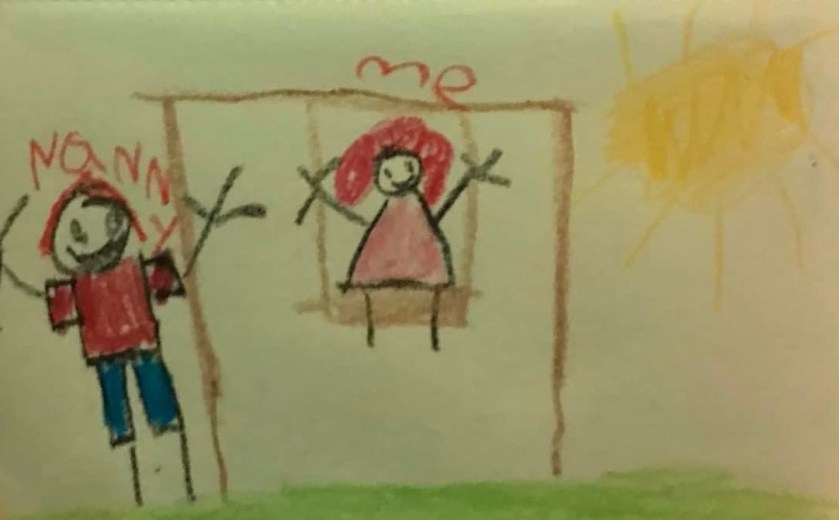
My Granddaughter’s depiction of our favorite activity: swinging. She is so wise….
Finding Healing Around Christmas
Maybe your family needs some healing around holidays as well. Sure, it seems strange to talk about Christmas amidst all the paper and ribbon and cookies and tinsel, but it is, in fact, the best time to step back, recognize struggles and disappointment and start our families on paths to peace with Christmas; maybe along the way we could even figure out what’s “enough” for joy. I offer this reflection then to all our families because we cannot find healing if we do not know our family’s wounds. Here’s hope for discussions about upcoming celebrations: may they be intentional, loving and truly joyful for all.
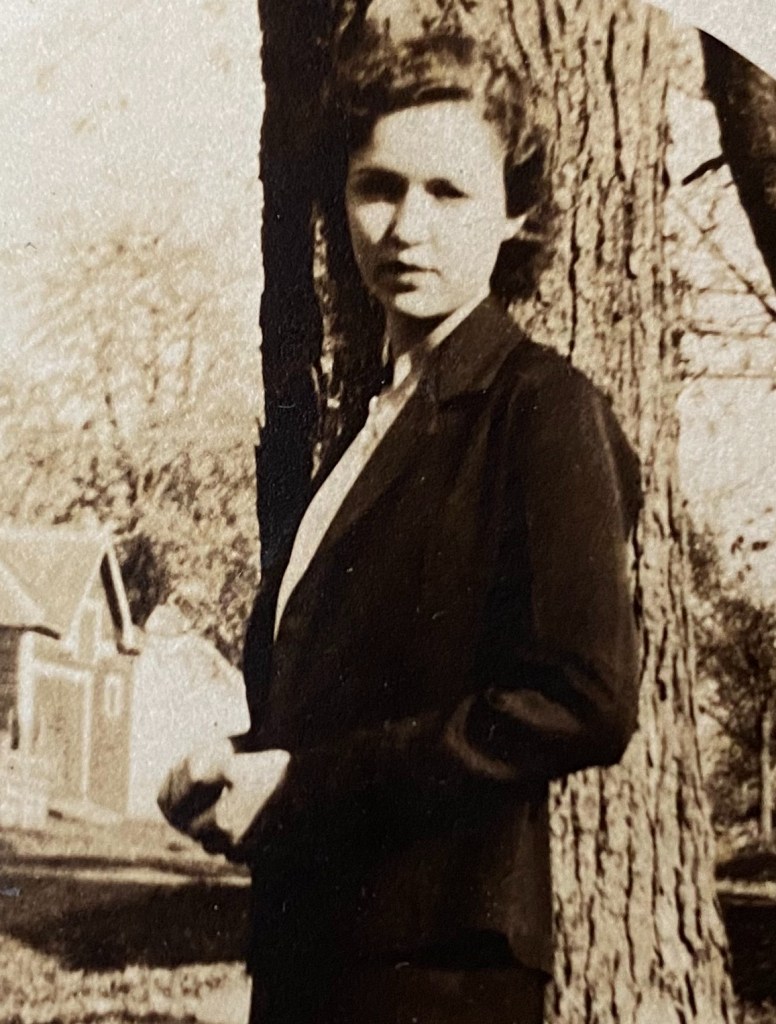
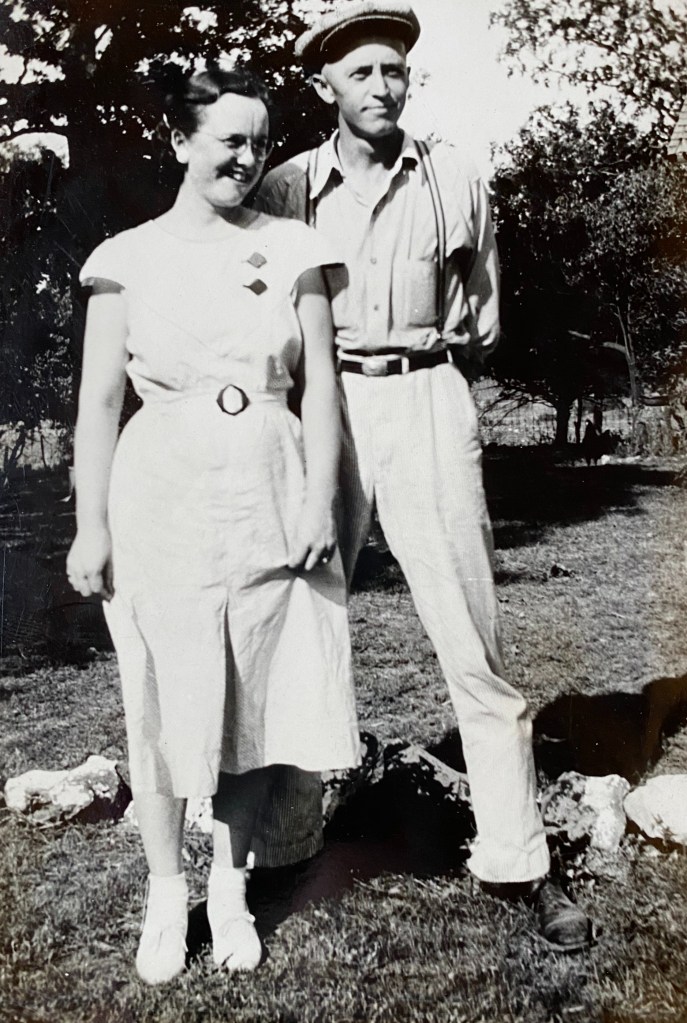
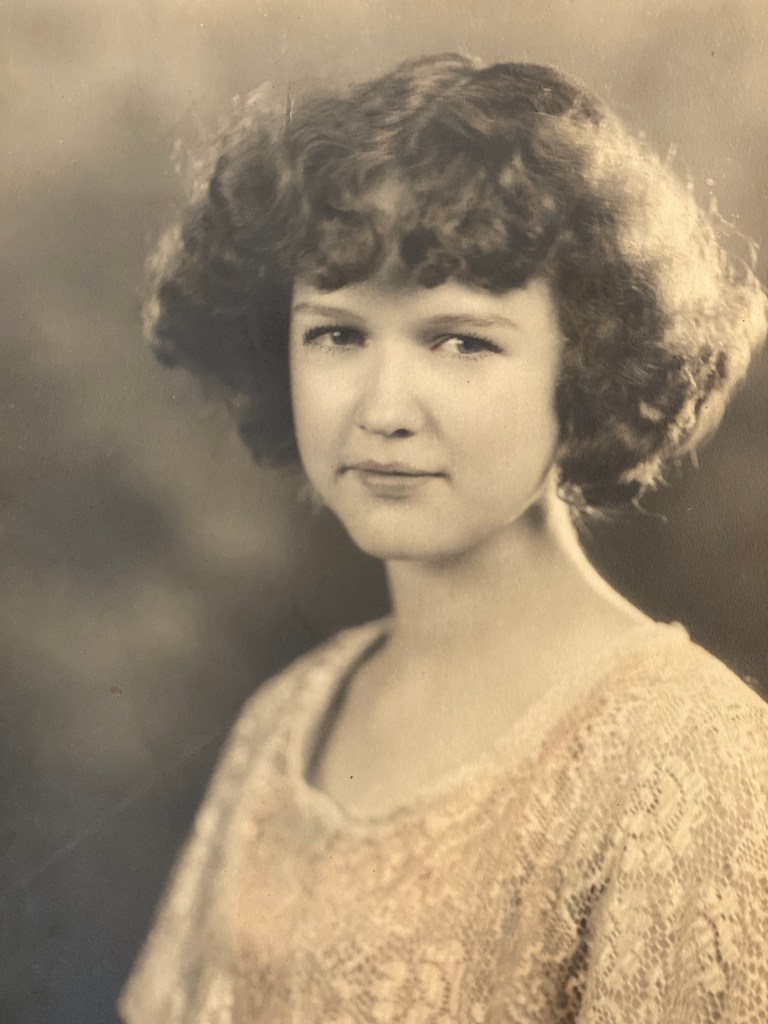
Marie as a young woman.Marie, George, & their three daughters, 1940’sArbaleta and husband, Freeman (Mac)
For me, it seems the best place to start is with the grandmothers. Both of my grandmothers were born around WWI; each married during the Great Depression. Neither had, as they say, “a pot to piss in,” not while they were growing up and not while they were young mothers. Both worked hard to support their families outside the home as well as in. Dad’s mom, Arbaleta, had two children, a boy and a girl, nine years apart. Mom’s mother, Marie, had three daughters all close in age.
Arbaleta’s husband, my Grandpa Mac, fell from an electric pole when he was young and wasn’t supposed to ever walk again, but did, in great part because Arbaleta would not let him not walk. She reportedly insisted he move his legs and even moved them for him for months as physical therapy until he could walk and work again. While I was never close to Grandma Leta, I have always admired the steely determination that these actions showed.
Marie had a husband who was always on the road as a truck driver, mostly because the bus or truck driver jobs close to town weren’t well-paying. He died of a massive heart attack at age 50; she lived another 30-plus years and married her high school sweetheart, then outlived him and married another kind man when she was eighty. At that wedding, the minister declared what we all knew, “Marie is a hopeful woman!” Grandma Ree, as we called her, was the quintessential kindergarten teacher when teachers still had time for nature walks, ironing leaves between sheets of waxed paper, and silly songs. Thus, she was the kind of grandmother I aspired to be: she played games with us, prayed for us, encouraged us and defended us when necessary. For most of her life, she modeled a love of learning: she earned a master’s degree, helped “plant” two churches, became an accomplished painter and was memorizing her favorite Bible verses in her seventies because she was losing her eyesight.
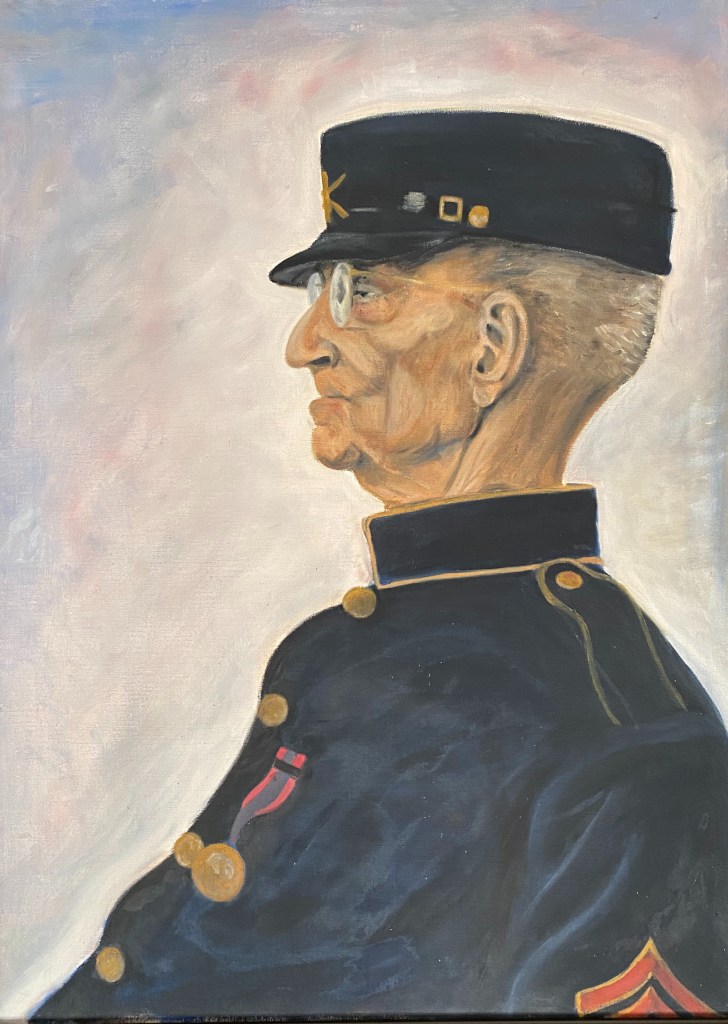
Marie as a teen.A painting by Marie for an art class while working on her Master’s. A local Spanish-American War vet sat for the class.
While I know little of Arbaleta’s childhood except poverty and hardship, I know Marie helped her mother run a boarding house after her chiropractor father divorced her mother, something which mortified both women.
That I’m aware of, Arbaleta seldom left her home after we were born. At least we never saw her leave her home, though, as far as we knew, she was perfectly capable. Our collective memory of her is of her seated on the sofa in her silk pajamas. Every time we visited her, we would wave to her from a few feet away as she perched on the sectional sofa in the corner, surrounded by shelves of various sizes and shapes of cacti. In one hand she held a lit cigarette, ashes threatening to crumble onto the silk, and the other hand held the ever-present bean bag ashtray (you know, the kind that has the bean bag on the bottom and the colorful aluminum tin bowl on the top.) That I can remember, she never once kissed, hugged or touched us in any way, shape or form. And, though she was pleasant, there were no memorable conversations, just the cloud of cigarette smoke that circled above her.
As for Christmas, well, I can’t remember there being much of it in their home at the edge of a Kansas golf course where she and Grandpa had retired. Ironically, I’m not aware Grandpa played golf, though my Dad did well into his eighties. As far as Christmas goes, Arbaleta represented the point in the arc where celebration was merely tolerated. Every few years, our parents would tote our gifts to their house to open on that rare occasion we woke up there on a Christmas morning, but the mood in the house was that Christmas decoration was, well, perfunctory. There was a tree and maybe a wreath, but evidently, for Grandpa and Arbaleta, a tree and some lights outside were “just enough,” though I suspect they were only put up to satisfy us. If overcoming poverty was Arbaleta’s life goal, she met it, thus the home on the golf course as well as the purchase of a new Lincoln every year. Secular or religious, it didn’t matter; Christmas was a formality, expected, tolerated for the children. Christmas dinner involved polished silver and store bought sweets, if any. “Please wait until you have permission to touch.”
Arbaleta died when I was seven and, suddenly, the focus of Christmas on my father’s side of the family shuddered and swung hard to the opposite extreme. Her daughter brought in Christmas every year from then on with a vengeance, lovingly, but with an overwhelming force. Every year, my aunt seemed to be competing for best Christmas ever, ostensibly in response to her own mother’s lackadaisical attempts.
While certain treasured and expensive statuary graced my aunt’s mantle for Christmas, for example, every year, the Christmas tree itself, usually the biggest tree I’d ever seen, sported a different theme with new, all handmade ornaments. I often asked when she started making them, sure she must have begun the previous New Year’s Day. She also made most of our gifts; they were always of Pinterest quality and I treasured several sweaters she knitted for me, for example.
As if it were necessary, she also became an amazing cook and thus, Christmas visits always involved impressing us with recipes for new dishes. Ironically, my mother didn’t want the recipes and my mother’s mother, Marie, didn’t need them; my mother was too busy leaning into that dysfunctional pendulum that was swinging back to the starker side, likely in reaction to her mother’s seasonal excess.
Marie, my mother’s mother, was on that same swing of the pendulum as my aunt, though I believe Grandma Ree went all out for her Christmas celebration for different reasons. Her husband, Grandpa George, also died when I was seven, but that did not slow Marie down in life or around the holidays. From the moment you opened the door into her home at Christmas, the scent of pine and wild berry candles carried you through room after room of greenery, holly, bells, poinsettias and new figurines or miniatures each year. Also new each year were the sweetbreads and cookies and homemade candies, all awaiting our discovery after hugs and kisses were exchanged and the coats and mittens and caps were piled onto a bed in the back of the house.
Grandma Ree with her brother, Mother and Sister, c. 1960’s.
A Family Nightmare
While Marie’s response seemed to me to somewhat resemble that of Arbaleta’s daughter, the driving force behind Marie’s likely unconscious Christmas reverie gone amuck was a well-kept secret, a family nightmare. On two separate Christmas Eves, during her childhood and youth, Grandma Ree had lost family members to suicide. I was, of course, an adult before I was made aware of that history or the details: one drank poisoned alcohol and one shot himself, both on separate Christmas Eves. Of course, the grief and shock of their actions was complicated by their (conscious or unconscious) efforts to ruin Christmas forever for some of their family.
How painful were their memories of the holidays?
Before we assume that Marie’s attempts to reclaim Christmas was the reason for the pendulum’s extreme movements, though, we need to recognize that some calamity in earlier generations drove those men to choose Christmas Eve to end their lives; we have to ask how painful were their memories of the holidays that drove them to risk also ruining the holiday for their spouses and children? How far back did the pain begin and what don’t we know about that?
In other words, it’s not likely either man, both of whom must have been suffering and feeling hopeless, started the family on that path.
The result, though, seems to have been an unconscious struggle to compensate. Those grand swings between holiday excess and hopelessness left subsequent generations still unconsciously at a loss to figure out what’s enough celebration. Further, while we can understand what might have spurred Marie’s need to excel at Christmas, I’ll likely never know what caused Arbaleta’s lack of enthusiasm for the holidays, and so I’m left simply to marvel at the overwhelming force of her daughter’s frenzied Christmas efforts. Sadly, or thankfully, no one now has picked up that mantle and the extended family is so fractured as to make these discussions nearly impossible.
I offer these reflections then to my nuclear family as the beginning of some discussions around conscious choices rather than wild reactions.
How does a family figure out what’s enough Christmas when the family’s history is, well, fractured? My own efforts were often emotionally unsatisfying; not only were my mother’s Christmas efforts headed for the stark extreme in reaction to her mother’s and her sister-in-law’s excesses, but they were complicated by my general lack of interest in cooking or baking except when absolutely necessary.
It was my ex-husband who started me thinking about some of our responses to holidays years ago: he protested the idea of Valentines’ Day for example, saying we could and should give one another cards or flowers or candy at anytime of the year and not just one day chosen by candy and card companies and florists. Yes, we can, I agreed wholeheartedly. But do we? Of course not, I pointed out. To his credit, he came by his dislike and struggle with holidays honestly and thus brought his own reactions to our holiday table: his birthday is the day after Christmas, and he was one of six children. His Christmas gift always came with a declaration that, “Oh-that’s your birthday gift too.”
Over the years, I certainly have struggled with holidays, whether it’s decorating or preparing a feast or just planning. Don’t get me started on birthdays for children; too many of those ended in my tears from exhaustion and a sense of failure. Did I tell you about all the “Pinterest Fails?”
All these things and more (all these things and more) that’s what Christmas means to me, my love….)
Stevie Wonder
Plenty of us struggle with the holidays, though, whether because of grieving a loss or knowing you’re the only one who can’t afford the gift exchange. I’ve tried over the years to make our gifts for Christmas but again, I know too many of my family members and friends were less than thrilled with the results. Mea culpa. We tried spreading the Christmas holiday over several days to lessen the wild two-minute frenzy of Christmas morning. We tried taking Christmas to the mountains; we tried staying home. We wondered what would happen if our family just gave up one Christmas and had lots of little ones? Could that not translate into lots of chances to do or give or be kind to one another? So many of our attempts at intentional Christmases revolved around not expecting one or two people to create a magical holiday that only left them in tears and exhausted.
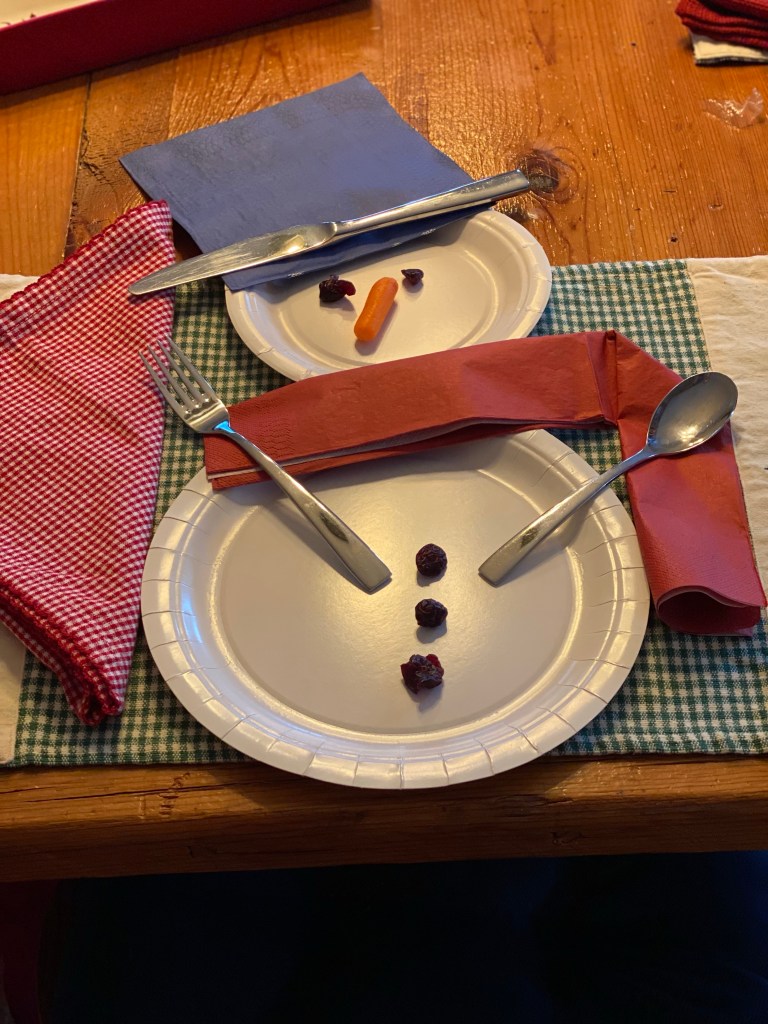
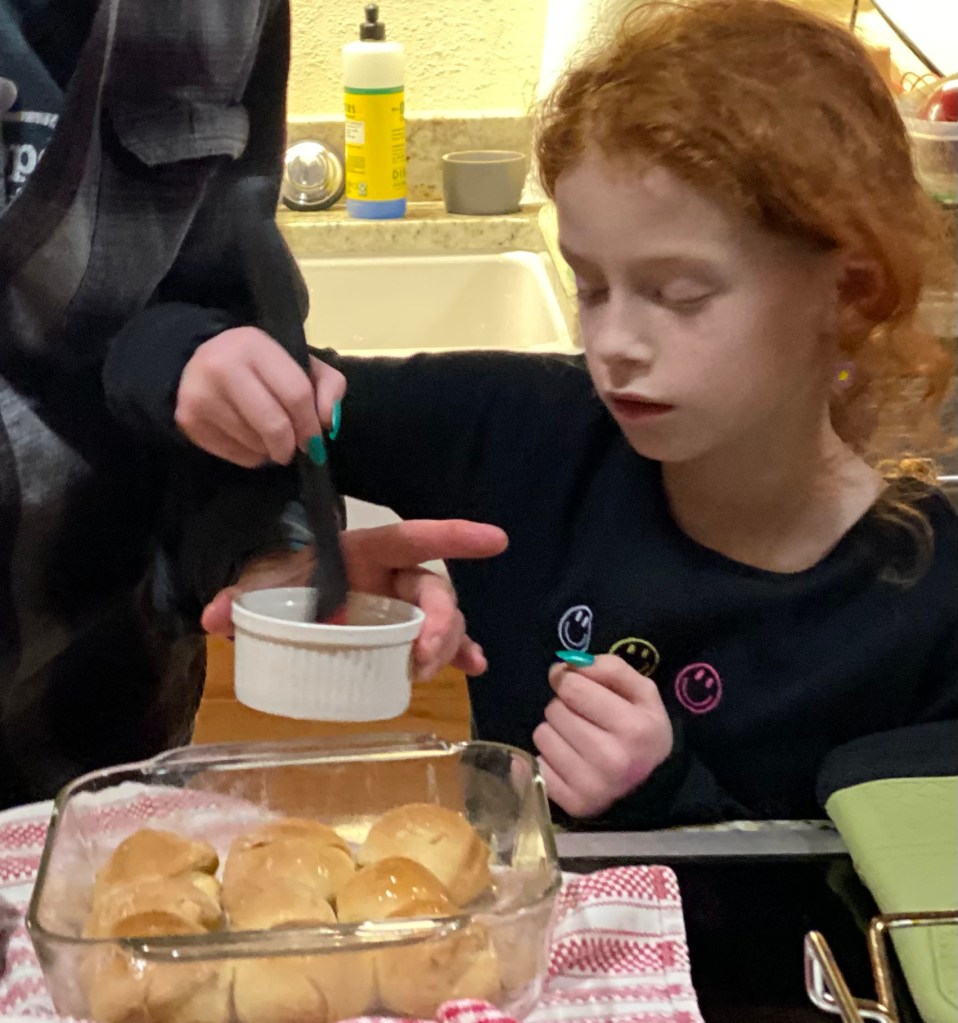
We’ve finally begun to incorporate some activities intentionally. Instead of china and crystal, we copied someone else’s snowman place settings, something the granddaughter and I could share. Last year, we started some silly story telling. This year, we introduced Karaoke and I am trying to reclaim the joy of baking by helping my granddaughter learn; watching her “knead” the goop she bought at the store made me think. Lo and behold, she discovered the joy of yeast and how it rises and how the baker must punch down the dough, then knead it. Her eyes grew wide after she made a fist and punched away. “That is soooo satisfying,” she said. A keeper.
In case you’re wondering, religion did not seem to figure at all in the wild reactions to the holiday through the years for my extended family. While Arbaleta was, as far as I know, agnostic, and Marie was a strong Christian, neither of them addressed or seemed to include the religious holiday in their efforts to reclaim or dismiss Christmas. For our family, that’s a different pendulum altogether. I personally love a good candlelight Christmas eve service singing and the idea that God came to be with us as an infant. Nevertheless, culturally we continue to struggle with all that Christmas celebrations have become for generations and we cannot heal from pain we do not acknowledge.
For our family, the faith and religious rituals are different pendulum altogether. I will never know why my Grandma Ree did not incorporate more of her personal faith into the celebration. Personal experience suggests she was treading lightly with agnostic family members and, as is true for many families, also celebrated on different days with different parts of the family, balancing church events with home. Nevertheless, culturally, we continue to struggle with all that our secular celebrations of Christmas have become for generations, often leaving us to begin another year frustrated, sad, discouraged. That is where we can start, but we must look collectively at this because we cannot heal from pain we do not acknowledge.
The best time, I believe, to reflect on how we celebrate Christmas is when we are all together…and we’ll before Christmas comes around-unexamined-again.
For my family, I continue to try to reframe Christmas in light of the history I bring to the holiday. I guess I hope through reflections and questions to step completely back from that wild, reactionary swinging between excessive celebration to indifference and even disdain.
I think one key is that we focus on the children, but with respect for their needs and not our own needs to give them the best holiday ever!
They get tired; we pay attention. They want to dress up; they don’t want to dress up. Quiet time, dancing in the kitchen time, gifts that involve us engaging with them. I’m not saying we’re the best with children ever or that ours are happier than any other. What I am saying is that like in so much of life, the children around me ground me. What they need is so often what I need. Let’s sing Jingle Bells, yes, at a gathering, but we mustn’t forget the bells themselves and our need to jingle them to make the song come to life.
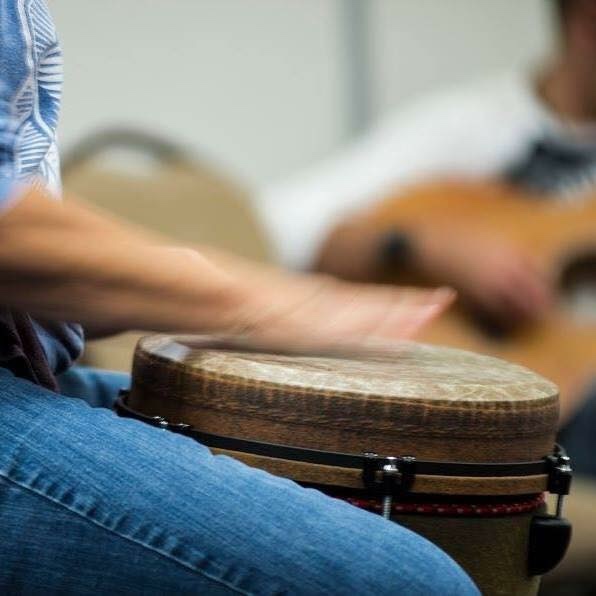
A little percussion goes a long way and when we sing “Jingle Bells” there need to be jingling bells….A five-year-old taught me that.
Music must also be a source of holiday joy for many families. I’m jealous of those who manage a musical gathering but hopeful that might be in our future as well. Certainly with percussion everyone can participate! The idea of introducing music brings us back, though, both to the need for sensory awareness and to the idea of joy and reverie throughout the year. In order for there to be music next year, we need to practice throughout the year – often and, by practicing, remember the things that do bring us joy without wearing us out. I write this and share it now, after the holiday blitz, planning to share it with my family, to start the conversation we can have in anticipation of next year. I am curious to hear from them, and find out if they are aware of, or experiencing their own pendulum of Christmases, maybe even unknowingly riding that pendulum right now. I’m hopeful that with some lowered expectations of ourselves and a little yeast, we just might be able to rescue the holidays from the extremes of that dysfunctional pendulum my family rode for far too long AND decide for ourselves what is “enough Christmas.”
For several months last year, I was invited to join a group of women from all over western and middle Tennessee, some clergywomen, some lay leaders in their churches. We gathered virtually because we shared a sad truth: a colleague and friend had been taken from us suddenly, shot in her own driveway during a carjacking.
I had not known any of these women before this group convened, but I am so very grateful that they all agreed to convene for those few months – and to invite me – to share our grief and pain and try to make some, any, if possible, sense of this tragedy. Some of the participants had known this woman for years; others of us had only known her a short while, but we all grieved what felt like a future filled with hope and ministry. She was likely going to be a Bishop some day, not because she was someone who was well-loved but because she was someone who loved well. That future was denied suddenly not by someone who had judged her ministry or intentions or love as lacking, but by a total stranger, someone who never had and now never would feel the love she had to offer him.
Within just a few weeks following her murder, we stepped into a virtual room, and invoked the words so many of us had shared in the funerals we had presided over. We affirmed that we had come together in our grief, acknowledging our human loss and praying that God would grant us grace. We also prayed that, in our pain we may find comfort, and in our sorrow, we might find hope. We especially, collectively, wanted to find ways to honor our friend.
It’s not necessarily a new idea to say we are called to honor those who are now gone who’ve loved, nurtured, forgiven or supported and encouraged us by doing the same. It just may be a bit tougher to process our emotions after the loss is a shock or especially an act of violence, because violence always leaves in its wake more victims than are seen by the naked eye. Be assured, most of us could acknowledge our privilege in not facing this kind of loss before; we also recognized what a gift it was that we could take the needed time to grieve and to find some guidance and companions for this process. Plenty of folks do not share that luxury, we knew.
Nevertheless, to say the sheer aggression and randomness of this event knocked us down is insufficient. We all know that bad things happen to even the best of people, but somehow some of us thought – hoped – there was a line the people of God would not cross. I mean, if you’re willing to kill a preacher, who stands a chance? We were shaken individually and collectively and so I am grateful that our colleague’s legacy brought us together. A few of the women realized that, if our friend had been the one left in shock and pain, this is what she’d do. She would gather us all in. She was all about sharing, listening, reflecting and holding hands in our fear and our pain. Over the next few months, then, we talked about how this trauma affected us, mentally, spiritually, emotionally and theologically. We seemed to know that she would encourage us to ask our questions, something most of us in this world have been conditioned to avoid, even if we do have the time. Through our theological and faith journeys, though, through pursuing our callings, many of us in the group had been exposed to and become somewhat practiced in reflection, in the art of asking questions, and, perhaps most importantly, in sitting with questions that are not accompanied by satisfying answers.
Aggressive, blunt, unanswered and unanswerable questions most definitely were part of these group meetings; they sat next to us, sometimes gently nudging us, sometimes poking us with bony fingers, often angering and annoying us, always taking up space and reminding us they were not going away. So, we chose to embrace them, to welcome them into our space, albeit a bit begrudgingly, buoyed by the fact that we were not alone.
“After all these years I have begun to wonder if the secret of living well is not in having all the answers but in pursuing unanswerable questions in good company.”
Remen, Rachel Naomi. My Grandfather’s Blessings: Stories of Strength, Refuge, and Belonging . Penguin Publishing Group. Kindle Edition.
We shared from various resources: prayers, poems, stories, theological pieces and we asked ourselves, How then shall we live?
To get there, we shared questions about our colleague like: How can one person be someone whom everyone felt like they knew? This woman saw you. I could easily spend the rest of my life trying to see every person that I encounter as well as she did; it is a spiritual practice that I will likely never master but one that she embodied. She saw each of us and even if you only met her once, you left her presence knowing she still somehow held you as tightly and lovingly as she did everyone she saw. I would have liked to ask her more about this; how did she manage it? Did she consciously focus only on who was right in front of her? How was she able to tune out the rest of the world so successfully as to make you feel like not so much the center of the universe but seen. And heard. She saw you. Most of us go through life not feeling truly seen or heard and yet, sadly, that is often all we want. Many an argument or estrangement likely would be quelled or mended if each participant were able to take a turn seeing and hearing the other fully. She seemed to know that.
How Then Shall We Live?
Throughout the sessions over last fall, I found myself counting how many people who were now missing from my life after this year: friends, colleagues, family members.
Sadly, I am grateful that a couple of them are no longer here to harm others. I spent a great deal of my life learning how NOT to follow in those footsteps. I also, though, came to recognize them as human beings, not monsters, and to acknowledge I have my own failings. I hate knowing that. I hate knowing I am capable of being ugly and of wounding others. I hate knowing that too often what annoys me in others is what annoys me about myself. All of that knowledge means I must go forward with self-assessment that is as rigorous as my judgment of others AND I must offer grace that is as unearned as the grace I receive. The question there was what did I learn about myself from that person?
I am grateful though to declare that most of those whom I have lost have blessed me. All of those I lost this past twelve months, including my colleague, I now realize, left me with the question on my life: how will I live going forward so as to reflect how I have been changed by their influence on my life? How, then, will I live now in light of what they taught me, whether it be because I want to honor them or because I want to never fall into their footsteps: what gift will I give the world now that they are no longer here?
Questions, then, I thought, might be the answer, if that’s possible. I shared with the group one of the understandings of a Scripture passage that another colleague had helped me to see differently years ago. The Scripture was about the widow and the judge in Luke 18:1-8. The story is often interpreted that the judge is God and the widow has to badger God – the judge – to get heard and to receive justice. Another colleague years ago saw the story differently and preached that the widow in the story instead was God and God (the widow) would continue to beseech the powers that be (the judges) in our world to do the right thing. God would continue to be the pebble in the shoe, she preached, that made us stop in our tracks and take care of that annoying pain that we feel every step we take. God will continue to try to make us stop long enough perhaps to think, to listen, to pray, to see one another. The story when I read it now reminds me, calls me, to be the pebble, to keep the hard, stony, annoying truths in front of folks I know.
God calls us to BE the pebble. Ask – lovingly – the difficult questions. Keep the hard, stony, annoying truthsin front of the folks we know.
We lamented that there was no going back to our blissful ignorance, no chance now we could pretend we or those whom we loved were safe. One thing that is certain about hatred, ugliness, violence, is that once you know, you can’t “unknow.” Most of us in our world today learn at such early ages that violence and meanness and the ability to harm others is part of our world but being the target or even knowing the target of someone else’s violent behavior, even and maybe especially if that target appears random, moves us into darker places emotionally, spiritually, mentally.
One of the toughest conversations was, no surprise, about guns and gun violence. I do not believe I am breaking confidence to say that we were keenly aware of the difficulty we live into everyday in our country of how to deal with what has become an epidemic.
He was just a child still himself who pulled the trigger and took this life. In light of how much gun violence has become part of so many children’s lives, I offered the image of our society as a body where this bullet’s wound was not the only injury or illness that needed to be addressed in this tragedy. The image of a body with multiple system failures came to mind for me as we talked about how we had failed this child as well, the child who had murdered her, lamenting how he had gotten to that place, into that car, with that gun. The questions became: What had gotten him to the point where another human being was worth less than that car? Don’t we need to know that process? Where in his young life was he ever seen?
The questions we all needed to ask ourselves and one another became: What had gotten him to the point where another human being was worth less than a car? Don’t we need to know that process? Where in his young life was he ever seen?
For help with tough questions, I suggested this resource: “When Thoughts and Prayers Aren’t Enough: A Shooting Survivor’s Journey into the Realities of Gun Violence,” by Taylor Schumann, a victim of gun violence, a Christian and a strong advocate for the right to own and bear arms. Her offering in this book is as honest a discussion of faith and firearms as I have seen thus far and it is a true gift to those who do not know what to say but feel called to participate in reflection and discussion. We put seatbelts in our cars to help protect our children when auto accidents were the number one killer; we need to stop the yelling and figure this out for our children’s sake. Schumann offers intelligent, faith-led, personal and compelling points to add to the discussion, pebbles, if you will, that we can cast into our collective path.
Moving Forward
How then would we go forward was the overarching question. How we each had thought we would be going forward in our lives was mostly changed but not canceled, we realized, but this sudden loss. I grieved having postponed working together until after my retirement. I had so many questions I was looking forward to asking her when we would be working together. Each of us was challenged to ask ourselves, “How will I live now?” We realized we had already started moving forward and had chosen to live differently by simply inviting and agreeing to meet over the course of those months, by sharing and holding one another in grief, by sharing resources that inspired us (and often which we hoped might answer some of those pesky questions). Already we were living with intention, living in response to this trauma and tragedy, living in a way that would honor her (and more importantly we knew to her,) living in a way that recognized the power and gift of connecting. We would commit each of us to continue using our platforms (sermons, Bible studies, book clubs) to replicate these conversations, to offer them to others, to hold hands with, to sit with, to see each person who came before us and to ask the questions.
For myself, I believe my beloved colleague would encourage me this Christmas and every Christmas going forward to seek to “Be that pebble in the shoes of those who are in power and ask the questions that need asking.” No question, my friend saw me or you like she saw everyone, it seemed; she made each of us feel seen. Spending time in her presence, though, also meant you had to keep stooping down to remove the occasional pebble from your shoe because it was either that or limp forever. She did this lovingly and you knew as you stooped down to scoop out that pebble that she meant to be loving to you and to everyone else who might be affected. “It’s all right,” she seemed to be saying in a loving and gentle way, “I’ll wait while you tend to that.”
Who knew that a handful of pebbles could be such a sacred Christmas gift?
















 Emptying The Backpack
Leave a comment