Wait! Which day is Thanksgiving?

Nov 17, 2025

Photo by Nancy Zjaba on Pexels.com

Thanksgiving is next week. 

Not this week. 

Thanksgiving is next week. Not this week. Nevertheless, at least a handful of folks will show up at Aunt Frankie’s door, cranberry jello mold and Mrs.Schubert’s rolls in hand this Thursday, convinced that holiday we set aside for football and eating is indeed upon us.

I believe we can blame the whole “4th Thursday” rule. That formula for football and the fixins’ was reportedly set by Franklin Delano Roosevelt in order that retailers could establish a set shopping schedule. 

Good for them. For us, it may be too complicated. It reminds me of that strange game we played on our knuckles that was supposed to help us remember which months have 30 days, not 31. Even if we take the time to look at a calendar and count, well, it’s math. In our heads. 

Find a calendar (hint – might be a handy one on your phone). Find the 1st Thursday of November 2025, which is the 6th, then count…so 13th, 20th, oops, yeah, Thanksgiving is the 28th.  Not this week. 

Given half a chance, some of us still standing on the stoop might try to convince Aunt Frankie. She has, by this time, rummaged around and found an actual paper calendar to prove to us how wrong we are. 

Maybe we would  cajole her while the jello mold wiggled in our hands. “How do you feel about two celebrations? I mean, here we are on the stoop, maybe a fresh pie in hand. You know those pumpkin pies don’t keep well.”

Sadly, we’re probably not the only idiots who didn’t show up for work…on the wrong holiday.

Getting the day right for Thanksgiving is not as easy as if the date were set, like how Christmas is December 25. Nevertheless, having a set day doesn’t guarantee a stressless holiday either. Just ask any pastor or priest. 

When I served a church, I was swept up into a fierce debate more than once because, that year, Christmas fell on a Sunday. Gasp!

“You’re not planning on having Church on Christmas, are you Pastor?”

“You’re not planning on having Church on Christmas, are you Pastor?”

“Well, it is a Sunday. And we would be celebrating Christ’s birth in worship. Wouldn’t that be great?”

“We can celebrate the baby Jesus the week before” was the retort. 

“Let me get this straight. You want to celebrate the baby Jesus, the birth of Jesus, a week early so it won’t interfere with Christmas?”

“Precisely. All the grandchildren will be waking up at our house and running downstairs to open presents on Christmas morning!”

“How about you come after opening the presents?”

“I’ll be cooking the Christmas meal.”

“But it’s Sunday.”

“Right. It’s Sunday AND Christmas. You cannot expect us to come to church on Christmas.”

The logic still escapes me.

I personally have been needing to remind myself for two weeks now to hold off on the turkey because I keep wanting to make crescent rolls a week early. Actually, the whole confusing holiday discussion started in my home this year at the beginning of November when I explained to my husband that, while we often remember veterans on the Sunday before the actual day, Veterans Day is always on 11/11. November 11. Always. Actually at 11 a.m. on 11/11. This discussion quickly devolved, though, into the confusing world of holiday “days versus dates, fixed days versus floating dates.”   

Fixed date holidays occur on the same calendar date every year regardless of the day of the week: New Year’s is always January 1 and Independence Day is always July 4. We generally don’t mess with those. 

“Labor Day is always a Monday but it’s the first Monday, just like Halloween is the last Friday in October,” my husband offered. 

Actually, the holiday of Halloween is always October 31st, but that’s really confusing because sometimes the day is celebrated earlier to allow kids to “trick or treat” when it isn’t a school night. That can be especially confusing, though and I suspect we’re not the only family who has had people show up on a random day in the week of Halloween annoyed when we didn’t have candy to offer them.  

“One way we can mark Thanksgiving might be to remember it comes the day before Black Friday,” my husband suggested, “except now Black Friday sales start before Halloween, so there’s that.”

As if the whole fourth Thursday thing isn’t complicated enough, our son is playing fast and loose with the need for a set calendar date for his wedding anniversary (2nd one coming up soon). Our daughter-in-law points out it is November 17, but our son suggests it’s easier for him to remember to celebrate on the Friday before Thanksgiving, since that was when they got married. Granted that’d be easier in some respects since this year the anniversary is on a Monday, but, in the future, that’s gonna make things even more complicated because they’ll be figuring out the 4th Thursday then back tracking 6 days! And if he gets Thanksgiving wrong….

Maybe we just all need Alexa to tell us-like those white boards do in eldercare facilities. We used one during COVID when we did not leave home or see another soul for days. We wrote on it every evening before we went to sleep and kept it posted on the refrigerator. We relied on that white board all those mornings when the calendar and days seemed to just float all around us without any tether. Our trusty, dusty white board told us the day of the week, the date and month and any upcoming holidays. Sometimes we even reminded ourselves the forecast was for rain or that supper would be chicken.  The calendar and especially the upcoming holiday reminders mattered during COVID because it kept us oriented, kept us from flying off into holiday madness or forgetting an important birthday.

We just finished the daylight savings debates, so, maybe we need the date versus day of the week/month debate for holidays. I could make that argument for pastors and priests, for sure. Those among us who don’t attend church and even a few churchgoers have no idea how complicated it is for pastors to plan some of the holidays. Take Easter, for example. Pastors and priests must first find Easter on the calendar which means finding the first Sunday after the first full moon after the spring equinox. From there they count back the six weeks prior to mark Ash Wednesday and Maundy Thursday. And yes, these occur on a Wednesday and a Thursday. People really do ask. Fewer still seem to realize that there is counting  involved before you can start lighting Advent candles on Sundays in Advent.

Perhaps we just need to copy Advent calendars and eat a piece of chocolate each day to lead us up to any given holiday.  Or see if Alexa has a countdown to holidays application?

Better yet, maybe we need to go back to the Town Crier who would walk through the streets of European villages, ringing a bell and shouting, “Oyez, oyez, oyez!” That’s French for “Hear ye, Hear ye, Hear ye!” People in the community would recognize that the bell ringing and the crying of those words would warn us that the crier brought us big news. Or perhaps told us of an impending holiday. 

I’m certain a town crier ringing a bell, waking us in the early hours to warn us that “Today is NOT Thanksgiving!” might have saved a few of us some time, money and embarrassment.


Sacred Bears

When I shared the following events with my writer’s group and asked them to put a timeline on them, most guessed the 1950’s. Learning this occurred in 2002 disturbed them. Truly disturbing, though, is that, sadly, no one in this country right now would be surprised to enter a town square in nearly any southern state in the US and see again today what I saw then.

Black and White Teddy Bear on overturned children's chair

Sacred Bears

“Some old lady got my buddy in trouble!” was what I heard another pastor declare as I sat down at the weekly lunch of local United Methodist pastors in the county. (“Local Pastors” do not attend seminary but rather several years’ worth of courses in order to be allowed to preach from United Methodist pulpits.) I was running late, but I knew immediately what he was complaining about and I was annoyed to realize quickly he had only heard part of the story. “He was at the weekend school…”

“Course of Study,” I offered.

“Yeah. The Course of Study. Anyway, there was this festival on the square down there in Pulaski….”

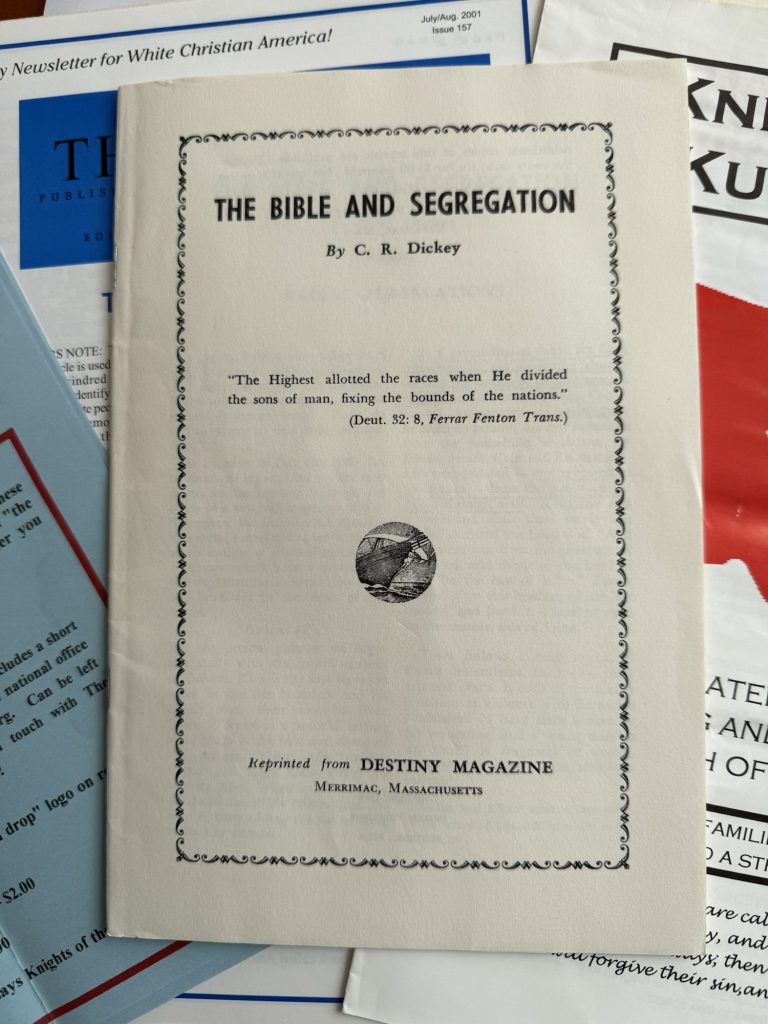
“They called it ‘White Christian Heritage Festival’ but they were handing out KKK literature,” I added. He frowned.

“Okay…. so, this old lady just took what my buddy said all wrong. Then…then, she told the guy in charge.”

“Grady?” 

My colleague stared at me, determined to finish the story. “That old lady told Grady my buddy was part of the KKK!”

“Actually,” I said after I ordered my chicken salad with ranch on the side, “that ‘old lady’ told Grady that your buddy confessed to her that he could see where their teachings made sense. He said they made sense.’  So, since he is allowed to preach at a United Methodist church and to teach children and youth….”

“She probably just misunderstood.” 

Surely, I thought, this guy will catch on soon. I sighed. “So, I shoulda just let that slide?”  

The others at our table were clearly amused that my colleague didn’t get why I knew the story so well. In his defense, he attended a different Course of Study, lasting four weeks, in Atlanta for full time pastors in the United Methodist Church. His buddy and I were part time, which meant only 60 hours a week of work. Our Course of Study classes met over eight weekends a year with reading and papers in between those weekends, sometimes in Jackson and other times at Martin Methodist College in Pulaski. Pulaski, if you aren’t aware, is known for being home to some members  of the Mars candy family (think Milky Way) and is also generally credited with being the birthplace of the Knights of the Ku Klux Klan, the KKK.  

I especially hated the overnight stays at these weekend schools. That particular weekend, I do not remember another woman in attendance. Not only was I away from my sons, but I was alone. In a motel room. In a strange town. A single woman.  Newly in recovery from trauma. In other words, someone who knew bad people did lurk in the shadows. Assuming all the men around were trustworthy was a luxury. So, I slept not at all. I took to wedging whatever chairs were in the room in front of the door in an effort to at least rest. 

On one particular Saturday, several of us left class to make a lap around the nearby downtown square on our lunch break only to encounter what was that day touted as a “Celebration of Southern Culture.” Displayed on the assorted tables were handtooled leather goods, canned peaches, okra and pickles. A brochure I found had previously invited area residents to join in the “family fun,” including a cakewalk.

Pretty quickly, though, I was stopped, jolted a stuffed teddy bear sitting among the books and maps under the magnolia trees. I believe God created Teddy Bears to provide a tactile reminder of love and affection, of comfort. This bear, though, had, through no fault of his own, become aligned with pure evil: he wore a white cotton robe and a white pointed cap that covered his face. This child’s toy was disguised, as if he, too, needed to hide his collusion with evil, like the men who had donned those robes and hoods in the night for so long. I thought they were a thing of our past and yet there they were, not hiding their affiliation at all and they had brochures, newsletters, books and even maps, the texts and visual aids to present these “Southern” beliefs. The first murmurs from the other pastors with me were indignant: how did these folks get to determine the definition of what was “southern”?

Eager to share with us about how God meant to order society, one of the men began to carefully explain the rationale for hatred, including their understanding that God, of course, looked just like them. In that moment,  the inference was that God most resembled a skinny, pasty middle-aged man in black slacks, a white shirt and a decades-old tie. A couple of pastors seemed interested in engaging. I was far from confident in my ability to face evil head on though; I, instead, focused on the contents of the tables.

Besides books and t-shirts, decals, key rings, watches, pins and flags, there were maps. I would not give them my money for books but I did consider buying one of the maps, a large laminated wall map designed to settle once and for all the mystery of the disappearance of the two “Lost Tribes” of Israel. Finally, I chuckled. They’d migrated, it seemed, from the Middle East and crossed over the Caucasus Mountains, stopping, of course,  in Scotland before heading into North America.  My ancestors were among those Scots who came through the Cumberland Gap and moved on into Kentucky, Tennessee, Missouri. I hadn’t known, however, that we were either lost or a tribe of Israelites. This journey was credited with solving the mystery: the Lost Tribes were now known as “Caucasians,” according to the map, by virtue of having traversed the Caucasus Mountains. I kick myself now for not purchasing that map, but, at the time, I could not stomach giving these people my money.

I did try to offer them money for the Teddy Bear, for the sake of the children these men likely influenced, for the sake of the legacy of Teddy Bears the world over, and for the comfort and benevolence children had so long depended on them to provide, I wanted to scream, “How dare you?!” 

Gotta hand it to the KKK, though. Aligning an innocent source of comfort and safety with the evil of the KKK, twisting what a child loves and trusts and using it to promote hatred and exclusion is socially and theologically powerful. Teddy Bears are bordering on sacred, as far as I’m concerned, objects that carry children through those times when the adults are absent or preoccupied or already asleep.

The Teddy Bear in the hood and robe makes more sense when you recognize how much of the most destructive theology through the ages has been born out of childhood pain. We may never know who was the child who’d been hurt enough that he grew up and somehow chose to cover himself and his head and face with a white hood so his grandmother or his neighbors or his children did not see him when he was cruel and ugly. I wanted so badly to rescue that child, or at least rescue the Teddy Bear, to allow God to do what God does best: redeem both that Teddy Bear and whomever it was who dressed him up. 

I wanted so badly to rescue that child, or at least rescue the Teddy Bear, to allow God to do what God does best: redeem both that Teddy Bear and whomever it was who dressed him up. 

“He is not for sale” was the response, though, and so I left behind that embodiment of evil and prayed for the trust and spirits of all the children these pasty white men were teaching or had taught so far. 

I did pick up some brochures and printed newsletters and walked away before they realized I did not, in fact, agree with their understanding that our country was designed as a White Christian nation or that we ought to somehow respect men who hid behind masks to terrorize others. Later, I would discover the literature went so far as to advocate for internment facilities for those who had contracted AIDS, for example, or that we all were invited to a worship service that night, complete with “great white Christian fellowship” and a “brilliant cross-burning!” 

I was no longer hungry, so I walked back with one of the younger pastors. After a few moments’ walk in silence, I said simply, “I was not expecting that.” I was feeling shaken that this evil was so openly displayed and discussed; I’d been blissfully ignorant, I realized. I had honestly thought these clowns in hoods were anachronisms, relics of a bygone era, that they were no longer active, like the sundown signs I would later learn sat as sentinels along the highways at the edges of the town where I preached. Those signs–simple painted sunsets on road signs–were nonverbal warnings: if you were a person of color, you’d best not be found in this town after sunset. The signs had been taken down, but the sentiments, fears and prejudices were not so deeply buried. I would later be disturbed to find out, for example, that two members of my congregation had been “card-carrying” KKK members while  I was pastor there. As a white woman, I had been ignorant and thus, negligent.

As we walked back to classes that weekend, though, my companion, a pastor who was about 15 years my junior, pointed out that “southern culture” was his culture. Then he added, “They did make some valid points. Did you realize they’re Christian?” 

The hair on the back of my neck stood up.

“If you listen to what they are saying,” he went on, “you will discover that they make a lot of sense.” 

He was a pastor. 

He taught a children’s Sunday School class, too, and he seemed interested, not disturbed, but interested in the Teddy Bear in the robe and hood.

“How,” I asked as calmly as I could while placing one foot in front of another, “would you go about teaching this to children?” I wanted him to clarify, to make me realize I’ve misunderstood, to tell me he wasn’t teaching ‘southern culture’ to the children, but he didn’t say any more. As we approached the classroom for our last afternoon that weekend, I wondered what the other pastors might say. Turns out, very little. I remember watching the others in the rest of the day’s lecture and discussion, wondering why no one mentioned what we’d seen. Had they debated at lunch? Had they discovered  others open to these ideas? No one seemed angry, at least not that they’d admit. I felt like I was playing a game my sons liked where you had to pretend that the floor was lava, so don’t dare put your feet down; it was dangerous. I hoped that the overt racism we’d witnessed had shocked them too. I feared, though, they knew from experience not to admit out loud they “got” where these guys were coming from, that, like my walking companion, they knew to simply shut down the conversation if they thought they’d shown their own hood to the wrong person. 

Once we’d finished for the day and each of the pastors was headed home to prepare to preach the next morning, I found Grady, the professor in charge. I explained I did not want to cause an issue for a colleague but I was disturbed about what this pastor might be teaching, especially in Sunday school for children. I wasn’t sure what to do and had not felt safe addressing him directly. Grady listened, got the particulars, then told me it was his place to address it. 

I heard nothing else for a month until I received an email from Grady; he’d spoken to the younger pastor’s District Superintendent, who evidently had found “no reason to believe such reports” and had never even spoken to the guy. This information hit my inbox just before leaving for the next weekend class. Once there, I was dismayed to find that the young pastor was there before me, annoyed, and looking for me. He was pretty sure I was the one who had ratted him out. I was the only “old lady” there. 

He greeted me with “I got called on the carpet by my DS,” which was a stark departure from what my professor had been told.  “When can we talk about this alone?” he wanted to know. 

“Excuse me,” I said, walking away; that was as much as he got for the rest of the weekend from me.

I still count that entire episode a disappointing failure, though I didn’t know how to do anything differently at the time. Not tossing my books and overnight bag in my car and leaving right away seemed the best I could manage for the time being. Clearly, I needed to learn how to counter this twisting of theology openly, to be prepared to teach the children and youth in the churches I served that Jesus really meant it when He said He loved every body. So I stayed. For the rest of that weekend, I kept my distance. I kept my guard up. I didn’t sleep.

I wasn’t surprised then a few weeks later at lunch, though, when this “old lady” was being castigated and labelled a busybody sticking her nose in other people’s business. 

Just to be clear, I asked my angry colleague, “That old lady ought to have simply looked the other way?” 

“Exactly!” he said. “It was none of her…your business.”

Free Cookies

I come for the cookies….

“Why,” I asked the woman seated next to me, both of us with arms outstretched being squeezed by thin rubber tourniquets, “would someone go to the trouble of  giving blood to that venerable institution called the Red Cross expecting that their blood would be rejected?” I kept my eyes trained on hers to avoid witnessing either needle being inserted, grateful for the distraction.

“To see if they’re still clean,” was the answer she gave that summer afternoon in the Red Cross’s makeshift donation center in our little town’s City Hall. From the looks of it, the BloodMobile staff had the travel and setup routine down and, on this particular afternoon, business was booming in that air-conditioned meeting room. Word was out and neighbors in the Highland Rim town of Portland, Tennessee, population just over 5,000, were lining up, enticed perhaps by some visiting and sharing of the cookies and orange juice handed out to donors, all playing out indoors where there was air that you could breathe in August. The tech loosened the rubber tourniquet around my arm and the young woman in the next chair leaned over and explained. “If you suspect you have AIDS, you can let the Red Cross diagnose you. They’ll only use your blood if it’s clean,” she said. “Lots cheaper than paying for a test. And no one asks you questions you don’t want to answer.” 

Plus, there are cookies.

People amaze me. I sat back as the blood flowed and reviewed how creative types could see what the rest of us cannot, who find ways to work around existing services to fit their needs, even if the services were not intended to diagnose, for example. These workarounds can be quite ingenious, but less about artistic visions and more often the child of necessity. Were folks adapting the services of the Red Cross the way others did those phone hotlines, I wondered? The ones where you could find someone to talk to you for free? Maybe not, I thought, more like 2-1-1. Used to be, if you wanted to talk to someone but you don’t want two police officers showing up at your door to do a “well check,” you could dial, or rather, punch in “2-1-1.” The idea washed over me that our culture used to, at least, have a number of systems, screenings and alert systems apparently in place. Some were designed to separate the lonely from the disturbed, some alerted us when we needed to see a doctor, still others, a process of interest to me at the time, offered to determine if you were among the “called” or simply delusional. As someone whose life path led me into ordained ministry by way of teaching, social work and writing, I was becoming familiar with this web of services. 

You’ve Got a Friend….

I was serving Neeley’s Bend UMC by this point and our proximity to Nashville meant we had access to a 211 directory. Our little town of Portland, nearer the Kentucky state line, where my son and I still lived as he finished out high school, did not have such service, a system where anyone could call and chat with another, live person for a bit at no cost and about pretty much anything. Designed to help steer local residents towards food pantries or accessible ride programs, the lines were answered by folks who became, at least for a while, the only friends some could claim. Turns out, lonely people were also creative and many of them figured out they could call every day. In fact, lonely callers so overwhelmed the 211 system that a few rules became necessary: callers were limited to one call a day per person for a limited duration. Rules ruin it for everyone, some lamented, but, then again, even if only for ten minutes a day, you still had a friend who’d listen to you, for “free.” No strings attached. The beauty for many was that there was no real effort on the caller’s part except to dial the phone; no quid pro quo was necessary and no relational reciprocation was required. Someone was always at your (beck and) call. At least once a day. Whether we were annoyed with the smell of our pet’s kitty litter or the price of avocados, we could talk to a person through 211 about anything for ten minutes and they’d listen. They could even tell you where to get free groceries and usually there’d be cookies. All for free. Not sure how many towns have those systems in place now, but they definitely serve a purpose.

Along the same vein, (pun intended), while I sat in that chair watching the bag fill with blood, I had learned that, if you believed God talked to you and you wanted to know if you were sane, there were workarounds; in particular, there were helpful gatekeepers. While some folks slide easily into ordained ministry, others of us step onto the path shakily, unsure for ourselves and aware that those around us will be more than a little skeptical. For me, the first step was admitting to my husband that I prayed. We had been married more than a decade when I sat on the edge of the bed we shared, clutching a lumpy pillow, cringing as I told him that swearing was not in fact the only time I used the word “God” (with a capital ‘G.”) This was the man who was outspoken about his belief that only mental weaklings believed in a deity of any kind. 

God talks to you?!?! Of all people…?

For years as a teen, long before I’d met my husband or considered turning to the church for a vocation, I had struggled with anxious thoughts, worries that felt like there was one of those old mimeograph machines in my head. Perhaps you are old enough to remember those: the kind with the drum that you cranked by hand while the paper revolved around and your words were printed on multiple pages, the precursor to a copy machine. For most of my life, I’d been trying to make decisions absent any sage advice from my parents who, when approached for advice, waved me and my siblings off, annoyed, as if to remind us they were overwhelmed enough already by our existence and life in general. My father once described to me his own anxieties by sharing that he had spent most of his adult life feeling like he was hanging dangerously onto a ledge and, above him, people were constantly stepping on his fingers to make him let go, give up, go away. He could offer no guidance or help to anyone else while he was just hanging on. 

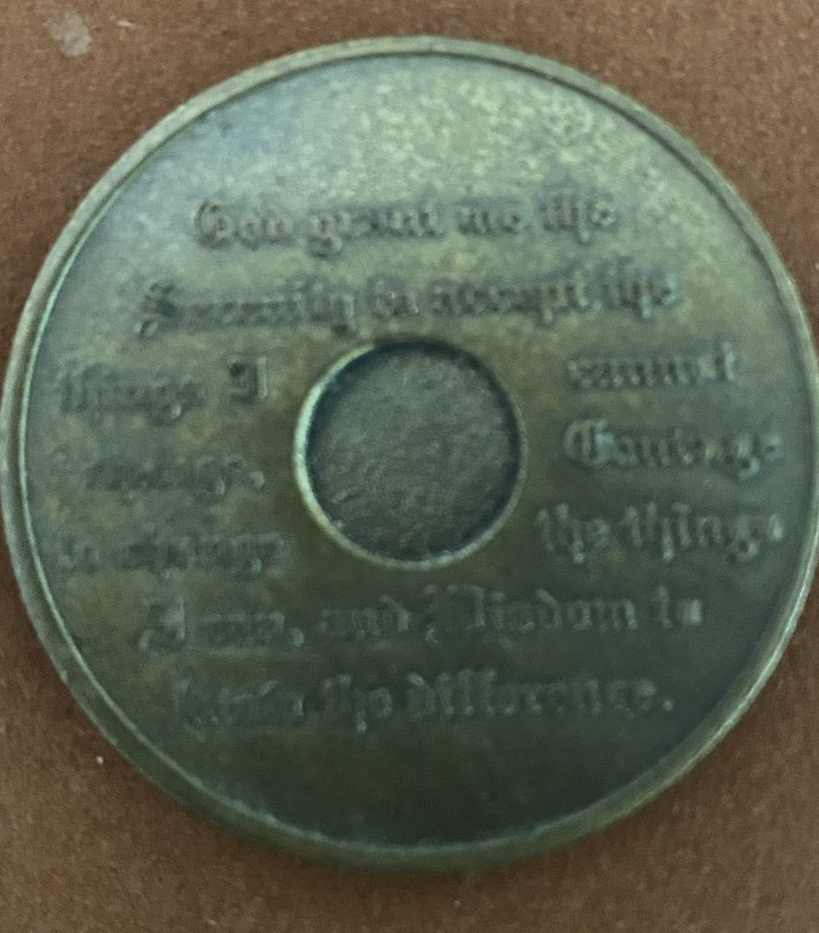
“God grant me the serenity to accept the things I cannot change, the courage to change the things I can and the wisdom to know the difference.”

On occasion, because of my own anxieties, on the mimeograph machine in my mind, it seemed like a couple of pieces of paper would come loose and flap wildly as the drum turned. My mind was that drum and my thoughts were that paper flapping uncontrollably.  I had tried a variety of ways to ease my anxieties: visualizing silly images like a cat with a stop sign attached to its tail or locking my worries in a dumpster, but nothing helped much until I found my way into an Al-Anon meeting one day. I was nineteen and dating David, a man who shared early on that he was a member of Alcoholics Anonymous and, who, after having known my mother for a few weeks, thought he ought to tell me about Al-Anon. “I don’t know much about that group except they used the same 12 Steps we use in AA. Who knows? It might just be a lot of old women complaining about their drunk husbands, but it’s there and worth a try.” 

You could always try those meetings….

He shared this one morning over coffee; I’d sought him out, distraught after encountering my mother drunk that morning. His suggestion hit me at the right moment and I found a meeting that evening at the back of the small storefront where the AA meeting was held. I was too worn out with navigating the alcohol and moods to be nervous about walking into a room where I knew no one. What happened then was that I walked into a roomful of loving, wise, patient surrogate parents who shared with me the Twelve Steps. Members of Al-Anon are, like me, those who have lived with or currently in relationship with alcoholics. The first three steps to that philosophy are designed to help you recognize that your life is unmanageable; likely if you grew up in an alcoholic home, your life had always seemed pretty unmanageable. The Third Step talks about believing in and trusting that there was a God and that God could help. The idea of letting go of control of my life seemed dangerous but I kept going back and sharing how stressful and chaotic my family’s day to day life was.  My own life at that time was a mess as well: I couldn’t tell you what I believed or what I needed to do for my next job, let alone as a career. So, per their suggestion, I attended 90 meetings in 90 days, letting those people love on me and studying the Steps. In contrast to everything around me, the Twelve Steps were not chaotic, but rather offered a different way to make decisions and live life. Then, one afternoon, I was curled up on my bed, emotionally exhausted and lost. It seemed a voice in my head, a benevolent voice, said, “You just need to sit down and shut up.” Suddenly, it felt like I was not alone in making decisions. I took a breath and stopped asking myself or God or anyone who’d listen; I just sat quietly, suddenly reassured the answer would find me if I sat still and waited. A revelation. There would be more. Eventually. I stopped dating David, but I kept coming back to the meetings regularly for nearly two decades, wherever I lived, and I know that that program and those people saved my life and even helped me grow up, at least a bit. 

 A decade later, married and teaching with two small boys, I finally told my then husband that I prayed and, when he didn’t laugh at me, I admitted that God not only talked to me but that I believed I was meant to be involved full time in some ministry. You might think that everyone around you would celebrate if you announced your call to church ministry, and that’s true in some circles. I’d been attending a Methodist Church regularly with our sons, but most of our friends at that time were not attending any church; most were agnostic at best. Thus, I felt the need to be selective when telling anyone that I had regular conversations with God, even those that are only in my head. It didn’t help that God and I were negotiating what ministry for me might look like and I was still quite leery of admitting God wanted anything from me, of all people. If nothing else, at the time, I cussed like a sailor. I had to wonder how that would work! 

Moving forward into what would become an increasingly complicated path towards ordination, it was clear that I had to be subtle about my next steps, and at least appear sane and convincing enough to be taken seriously. The first step was to write a letter to the Methodist Superintendent of the district I lived in and declare my desire to “explore ministry.” Somewhere in there, it was necessary to admit publicly – to say out loud in front of others – that God spoke to me and told me that I was “called” to ministry. Another chance to cringe.

My First Church

The process of moving towards ordination (in the Methodist Church at least) had certainly been more involved than dialing 211, but it was not dissimilar. I’d written that letter and one of the first things the church did was assign me someone to be my mentor, someone who would listen to me and ask lots of questions. Kind of like a free friend, but with a purpose. From then on out, as I went through the process, there were plenty of folks who were ready and willing to swim in the deep end of thoughts and emotions with me, like those free friends, or better, like counselors I didn’t have to pay. The first thing they did, though, was send me to  a psychologist’s office because there was a test in my future. Not free, I remember thinking, but a whole lot less dramatic than calling the local hotline and telling them I talk to God, I guess. 

The psychological exam was just one of the many steps involved in becoming a Methodist minister, a process that is quite long and involved, and can become expensive for many. I had to laugh when I found out, though, that people also used this process, or at least the psychological testing, as a workaround for their own mental screening; it wasn’t free and was far more involved than a simple phone call. I had to wonder: Did they want to be stopped before they hurt someone? I remember sitting in a leather chair in a paneled office with a massive wooden desk between me and the psychologist. I will be forever grateful he started the conversation with, “First, your test reveals you are mentally strong and resilient. All good.”

Relieved, I sat back in the leather chair, and let out a laugh, then admitted, “I’ve got to ask about one of the questions in that test.”

“Sure,” he said.

“It was  something like, ‘Do you like to smell other people’s shoes? Do some people actually admit to enjoying aroma of another person’s shoes?’” 

“You’d be surprised,” the psychologist said.

“Why on earth would you do that?” 

“It’s a way to ask for help, ostensibly without actually asking. They want us to catch them before they do something dangerous,” he explained.

I sure understand that, I thought, making a mental note to be, as a minister, more focussed on the reasons behind those workarounds than the tricks themselves. The reasons were where ministry would happen, I realized. Sometimes people need someone to help them figure out if they are crazy because they talk to – and hear from – God. Just as often, though, folks need to be encouraged to share what they believe God is telling them. Walking people through that process for the United Methodist Church requires years of discernment, writing, interviews and 84 hours of seminary. In other churches, you simply walk up to the front of the sanctuary and declare that God talks to you, indeed, that God is calling you to ministry. I get why it’s so tough to get through the ordination process for the UMC, though, and, don’t get me wrong: I respect it. Even after all the schooling and the discerning and retreats and writing and interviews, after all that I learned about myself and about ministry, I still stood behind the pulpit of my first church and wondered if I was in the right place. I suspect though that God is more able to use us when we are not so sure of ourselves, when we remember we need God. And, my experience has been that, often, we learn we need God through recognizing we need one another, whether we find one another through a phone call, a church or a self-help meeting.  

 Sometimes, in perverse moments, though, I will admit, I’ve wondered if we don’t just need to suggest people start with dialing 211. It’s a whole lot faster and cheaper and they will even tell you where to get free cookies. 

D-Day Promises, Guilt and Forgiveness – Eighty Years Later

Because coming home is just the beginning….

In a previous post, (“You Can Have My Seat on the Mourner’s Bench,”) I introduced James, (not his real name), who struggled mightily with ongoing guilt and grief about his past actions. For years, I didn’t have a clue what those might be.

I did not know what troubled James, only that he was miserable, but when the Lady Preacher came by, he focussed on how I wasn’t preaching or leading worship in a way that would help him feel like he’d “been to church.” Apparently, as I explained in that eariler post, he was convinced that IF that Lady Preacher could dish up some good old-fashioned confession, that would fix things for him, at least temporarily.

My job, as he saw it, was to offer him a chance to relieve his guilt (for at least a week) through confession and some time on that mourner’s bench. There was no mourner’s bench at Wartrace UMC by the time I was sent there as pastor, though, and, unfortunately for James, I was not on board with the kind of spiritual bloodletting he seemed to want.

Wartrace United Methodist Church circa 1850
where a split log bench wih no back was reportedly the “mourner’s bench.”

Sadly, though, James, perhaps more than anyone at Wartrace needed his Preacher to see how guilty he believed he was, to convict him and then to help him leave that guilt on there, even if he never actually graced the church with his presence. I tried a few times to reprise my sermon from my perch on a sticky metal kitchen chair on his back porch, but the sad truth was that even if James had been able to feel forgiven by God every week, even if he had felt Scriptural preaching wash over him every Sabbath morning, he was in grave danger of never being able to forgive himself.

For years, I was unaware this was what he felt he needed. I would visit him regularly but we were not speaking the same spiritual language for the longest time. Until I preached about D-Day.

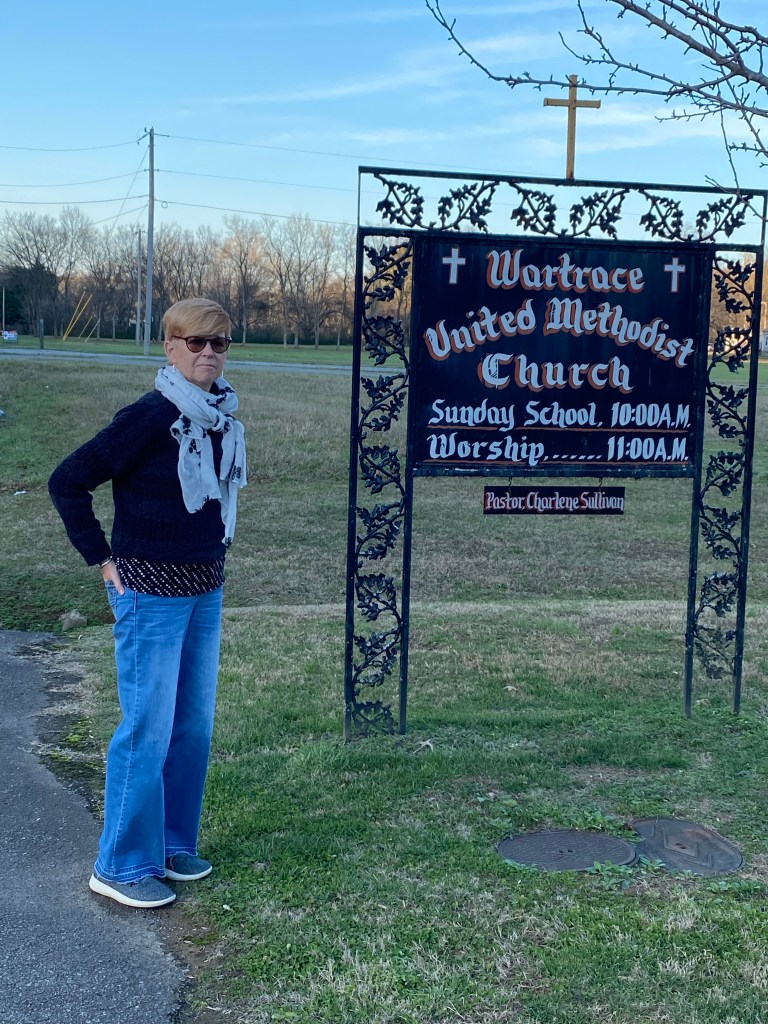
Wartrace United Methodist Church,
Greenbrier, Tennessee
(Photo Property of Rev Jodi McCullah) 2023

I finally learned why James was continually unhappy with my preaching on a sticky Sunday afternoon in June when I was directed to lift some old blankets and newspapers and take a seat on a sagging recliner in the corner of the porch at James’ house, a corner too dark and hidden even to be seen before. James had decided I was to be trusted finally, not because I had finally made him feel like the worm he thought he was; rather, on that sweltering Sunday in June, his son had called right after worship let out to tell Daddy that the Preacher Lady had shared a D-Day story in her sermon.

D-Day Promises

I had told the story of Rev. Herman Yates, a retired pastor connected to the church; he and his wife had moved there a few months earlier. He had never preached at Wartrace, not even in revivals, and he and his wife were homebound, too, but Wartrace claimed him because he’d grown up in the area. He was on my list of shut-ins to visit, and he had given me permission to share his story on the first Sunday in June. Herman, a sergeant in the United States Army on D-Day sixty years before, had joined other NCO’s who strapped on flimsy orange and white vests with large crosses on them in order to lead their platoons’ landing crafts and soldiers onto the shore. Eyes and throat burning from the acrid smoke, trying to drown out the screams, they were halted time and time again by the force of nearby explosions. Herman and the other Sergeants moved methodically forward, though, careful to move slowly enough for their men to follow and, of course, he said, slowly enough to be a perfect target. When I met him, Herman was able to tell the story calmly after relating it hundreds of times from pulpits across the area. He told powerfully of how he had bargained with God that day that, should he survive, he would dedicate the rest of his life to preaching. God took him up on the deal.

For those unfamiliar with World War II, “The D-Day operation of June 6, 1944, brought together the land, air, and sea forces of the allied armies in what became known as the largest amphibious invasion in military history,” according to the Eisenhower Presidential Library. “The operation, given the codename OVERLORD, delivered five naval assault divisions to the beaches of Normandy, France. The beaches were given the code names UTAH, OMAHA, GOLD, JUNO, and SWORD. The invasion force included 7,000 ships and landing craft manned by over 195,000 naval personnel from eight allied countries. Almost 133,000 troops from the United States, the British Commonwealth, and their allies, landed on D-Day. Casualties from these countries during the landing numbered 10,300.” Combat would continue for nearly another year in Europe. (eisenhowerlibrary.gov)

Knowing what little I do about the massive undertaking that was D-Day, I have long been amazed at the instructions Herman received that morning before the terrifying landing began. “If you make it to the beach,” Herman’s orders had been to “go to the ‘big’ tree, turn right and meet up a mile down.” Herman and at least a few of his platoon somehow safely made their way onto the beach, somehow found some trees still standing on that battlefield, and somehow chose the right big tree from among many. Herman always knew how all that happened and how he had survived the rest of the war. He went on to serve churches for some forty years.

James was proud, he said that Sunday, proud I’d shared Herman’s story. For the first time since I’d arrived at Wartrace, sitting in the old recliner, I did the math and realized James was shaking because he’d been there as well. Tragically, though, James’ story was neither heroic nor admirable.

“I sent them all out there,” he said with litte introduction, “out there to die.” He paused and looked at the flickering television screen, his only constant companion for years. “One by one,” he continued, “the boats went out. We heard and we knew. We were wishing them a safe journey. We knew though. We didn’t know how many, but we knew, we knew. We were safe, right where we were.” He wasn’t in danger but he was painfully certain that his actions were killing soldiers – his own soldiers – on that beachhead as brutally as any bullet or exploding shell. After he shared his story, his voice trailed off and he mumbled to himself for a bit before I made a pitiful attempt to be helpful.

An estimated 20 percent of all combatants historically suffer from the effects of “combat trauma.”

Soldier’s Heart

nostalgia

“to be broken”

shell shock

“The affliction (Post-Traumatic Stress Disorder) has had many names over the centuries, demonstrating that it is a condition accompanying not just modern wars but all wars. Its cluster of symptoms was first diagnosed as ‘nostalgia’ among Swiss soldiers in 1678. German doctors at that time called the condition Heimweh, and the French called it maladie du pays; both mean homesickness. The Spanish called it estar roto, ‘to be broken.’ Civil War Americans called it soldier’s heart, irritable heart, or nostalgia. In World War I, it was called shell shock; in World War II and Korea, combat fatigue. ‘Soldier’s heart’ indicates that the heart has been changed by war. ‘Nostalgia’ and ‘homesickness’ bespeak the soldier’s anguished longing to escape from the combat zone and return home. Estar roto describes the psyche’s condition after war—broken.”

(War and the Soul: Healing our Nation’s Veterans from Post-Traumatic Stress Disorder, by Edward Tick, Ph.D, p. 99)

I doubt James heard anything I said that afternoon. I’d like to believe I offered him some kind of relief from his guilt but I’m pretty sure my words were wasted. I couldn’t do what he wanted, couldn’t agree with him that he should feel guilty, couldn’t acknowledge that he was indeed as guilty of killing Allied soldiers as any German bullet, bomb or soldier. I toyed with the idea of offering him one of the confessions we regularly used from the hymnal on Communion Sunday, but not one word I could think of was gonna do.

In every house of worship in the nation, veterans of wars are in the pews. Many have spent decades grappling with grief from their wartime experiences. Few of them feel like their part was heroic or admirable. Maybe they “won,” but too often, they are leary of telling us how ugly the “winning” was.

Evidently, James had been needing to visit that mourner’s bench for decades, so maybe telling Herman’s D-Day story created a space for James, as if we gave him permission to risk sharing the shame he felt. Perhaps being able finally to tell his story out loud was the confession James craved. Like too many combat veterans, though, he needed not only to share but also to not be shunned.

Years later, I would sit in a veteran’s retreat and listen to veteran after veteran tell their combat stories, usually with trepidation. So many were like the Iraq war veteran who shared his story of killing “anything that moved” from the helicoptor he piloted. That veteran believed himself to be a “monster” and was certain he should no longer be allowed in our midst. Like this combat veteran and so many others, James needed to tell his story and not have anyone, as one veteran feared, “run screaming from the room.” He needed to know I didn’t see him as a monster and that I would still visit, still speak to him, still consider him part of the flock. He had been needing to visit that mourner’s bench for decades, and telling Herman’s D-Day story gave him permission, at least in his mind, to risk telling his story out loud. Maybe Herman knew what would happen when I shared his D-Day story. God certainly did.

Leave a comment