Sacred Bears

When I shared the following events with my writer’s group and asked them to put a timeline on them, most guessed the 1950’s. Learning this occurred in 2002 disturbed them. Truly disturbing, though, is that, sadly, no one in this country right now would be surprised to enter a town square in nearly any southern state in the US and see again today what I saw then.

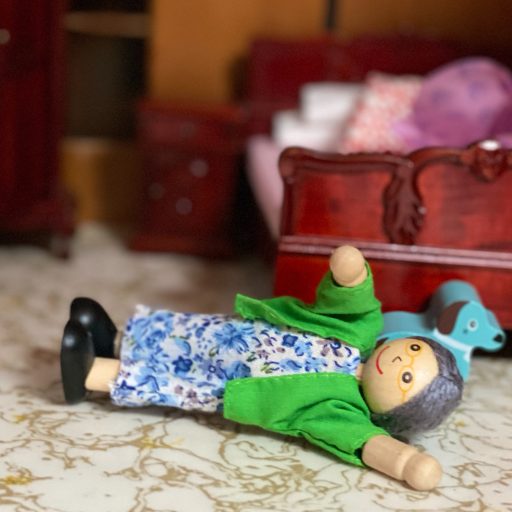
Black and White Teddy Bear on overturned children's chair

Sacred Bears

“Some old lady got my buddy in trouble!” was what I heard another pastor declare as I sat down at the weekly lunch of local United Methodist pastors in the county. (“Local Pastors” do not attend seminary but rather several years’ worth of courses in order to be allowed to preach from United Methodist pulpits.) I was running late, but I knew immediately what he was complaining about and I was annoyed to realize quickly he had only heard part of the story. “He was at the weekend school…”

“Course of Study,” I offered.

“Yeah. The Course of Study. Anyway, there was this festival on the square down there in Pulaski….”

“They called it ‘White Christian Heritage Festival’ but they were handing out KKK literature,” I added. He frowned.

“Okay…. so, this old lady just took what my buddy said all wrong. Then…then, she told the guy in charge.”

“Grady?” 

My colleague stared at me, determined to finish the story. “That old lady told Grady my buddy was part of the KKK!”

“Actually,” I said after I ordered my chicken salad with ranch on the side, “that ‘old lady’ told Grady that your buddy confessed to her that he could see where their teachings made sense. He said they made sense.’  So, since he is allowed to preach at a United Methodist church and to teach children and youth….”

“She probably just misunderstood.” 

Surely, I thought, this guy will catch on soon. I sighed. “So, I shoulda just let that slide?”  

The others at our table were clearly amused that my colleague didn’t get why I knew the story so well. In his defense, he attended a different Course of Study, lasting four weeks, in Atlanta for full time pastors in the United Methodist Church. His buddy and I were part time, which meant only 60 hours a week of work. Our Course of Study classes met over eight weekends a year with reading and papers in between those weekends, sometimes in Jackson and other times at Martin Methodist College in Pulaski. Pulaski, if you aren’t aware, is known for being home to some members  of the Mars candy family (think Milky Way) and is also generally credited with being the birthplace of the Knights of the Ku Klux Klan, the KKK.  

I especially hated the overnight stays at these weekend schools. That particular weekend, I do not remember another woman in attendance. Not only was I away from my sons, but I was alone. In a motel room. In a strange town. A single woman.  Newly in recovery from trauma. In other words, someone who knew bad people did lurk in the shadows. Assuming all the men around were trustworthy was a luxury. So, I slept not at all. I took to wedging whatever chairs were in the room in front of the door in an effort to at least rest. 

On one particular Saturday, several of us left class to make a lap around the nearby downtown square on our lunch break only to encounter what was that day touted as a “Celebration of Southern Culture.” Displayed on the assorted tables were handtooled leather goods, canned peaches, okra and pickles. A brochure I found had previously invited area residents to join in the “family fun,” including a cakewalk.

Pretty quickly, though, I was stopped, jolted a stuffed teddy bear sitting among the books and maps under the magnolia trees. I believe God created Teddy Bears to provide a tactile reminder of love and affection, of comfort. This bear, though, had, through no fault of his own, become aligned with pure evil: he wore a white cotton robe and a white pointed cap that covered his face. This child’s toy was disguised, as if he, too, needed to hide his collusion with evil, like the men who had donned those robes and hoods in the night for so long. I thought they were a thing of our past and yet there they were, not hiding their affiliation at all and they had brochures, newsletters, books and even maps, the texts and visual aids to present these “Southern” beliefs. The first murmurs from the other pastors with me were indignant: how did these folks get to determine the definition of what was “southern”?

Eager to share with us about how God meant to order society, one of the men began to carefully explain the rationale for hatred, including their understanding that God, of course, looked just like them. In that moment,  the inference was that God most resembled a skinny, pasty middle-aged man in black slacks, a white shirt and a decades-old tie. A couple of pastors seemed interested in engaging. I was far from confident in my ability to face evil head on though; I, instead, focused on the contents of the tables.

Besides books and t-shirts, decals, key rings, watches, pins and flags, there were maps. I would not give them my money for books but I did consider buying one of the maps, a large laminated wall map designed to settle once and for all the mystery of the disappearance of the two “Lost Tribes” of Israel. Finally, I chuckled. They’d migrated, it seemed, from the Middle East and crossed over the Caucasus Mountains, stopping, of course,  in Scotland before heading into North America.  My ancestors were among those Scots who came through the Cumberland Gap and moved on into Kentucky, Tennessee, Missouri. I hadn’t known, however, that we were either lost or a tribe of Israelites. This journey was credited with solving the mystery: the Lost Tribes were now known as “Caucasians,” according to the map, by virtue of having traversed the Caucasus Mountains. I kick myself now for not purchasing that map, but, at the time, I could not stomach giving these people my money.

I did try to offer them money for the Teddy Bear, for the sake of the children these men likely influenced, for the sake of the legacy of Teddy Bears the world over, and for the comfort and benevolence children had so long depended on them to provide, I wanted to scream, “How dare you?!” 

Gotta hand it to the KKK, though. Aligning an innocent source of comfort and safety with the evil of the KKK, twisting what a child loves and trusts and using it to promote hatred and exclusion is socially and theologically powerful. Teddy Bears are bordering on sacred, as far as I’m concerned, objects that carry children through those times when the adults are absent or preoccupied or already asleep.

The Teddy Bear in the hood and robe makes more sense when you recognize how much of the most destructive theology through the ages has been born out of childhood pain. We may never know who was the child who’d been hurt enough that he grew up and somehow chose to cover himself and his head and face with a white hood so his grandmother or his neighbors or his children did not see him when he was cruel and ugly. I wanted so badly to rescue that child, or at least rescue the Teddy Bear, to allow God to do what God does best: redeem both that Teddy Bear and whomever it was who dressed him up. 

I wanted so badly to rescue that child, or at least rescue the Teddy Bear, to allow God to do what God does best: redeem both that Teddy Bear and whomever it was who dressed him up. 

“He is not for sale” was the response, though, and so I left behind that embodiment of evil and prayed for the trust and spirits of all the children these pasty white men were teaching or had taught so far. 

I did pick up some brochures and printed newsletters and walked away before they realized I did not, in fact, agree with their understanding that our country was designed as a White Christian nation or that we ought to somehow respect men who hid behind masks to terrorize others. Later, I would discover the literature went so far as to advocate for internment facilities for those who had contracted AIDS, for example, or that we all were invited to a worship service that night, complete with “great white Christian fellowship” and a “brilliant cross-burning!” 

I was no longer hungry, so I walked back with one of the younger pastors. After a few moments’ walk in silence, I said simply, “I was not expecting that.” I was feeling shaken that this evil was so openly displayed and discussed; I’d been blissfully ignorant, I realized. I had honestly thought these clowns in hoods were anachronisms, relics of a bygone era, that they were no longer active, like the sundown signs I would later learn sat as sentinels along the highways at the edges of the town where I preached. Those signs–simple painted sunsets on road signs–were nonverbal warnings: if you were a person of color, you’d best not be found in this town after sunset. The signs had been taken down, but the sentiments, fears and prejudices were not so deeply buried. I would later be disturbed to find out, for example, that two members of my congregation had been “card-carrying” KKK members while  I was pastor there. As a white woman, I had been ignorant and thus, negligent.

As we walked back to classes that weekend, though, my companion, a pastor who was about 15 years my junior, pointed out that “southern culture” was his culture. Then he added, “They did make some valid points. Did you realize they’re Christian?” 

The hair on the back of my neck stood up.

“If you listen to what they are saying,” he went on, “you will discover that they make a lot of sense.” 

He was a pastor. 

He taught a children’s Sunday School class, too, and he seemed interested, not disturbed, but interested in the Teddy Bear in the robe and hood.

“How,” I asked as calmly as I could while placing one foot in front of another, “would you go about teaching this to children?” I wanted him to clarify, to make me realize I’ve misunderstood, to tell me he wasn’t teaching ‘southern culture’ to the children, but he didn’t say any more. As we approached the classroom for our last afternoon that weekend, I wondered what the other pastors might say. Turns out, very little. I remember watching the others in the rest of the day’s lecture and discussion, wondering why no one mentioned what we’d seen. Had they debated at lunch? Had they discovered  others open to these ideas? No one seemed angry, at least not that they’d admit. I felt like I was playing a game my sons liked where you had to pretend that the floor was lava, so don’t dare put your feet down; it was dangerous. I hoped that the overt racism we’d witnessed had shocked them too. I feared, though, they knew from experience not to admit out loud they “got” where these guys were coming from, that, like my walking companion, they knew to simply shut down the conversation if they thought they’d shown their own hood to the wrong person. 

Once we’d finished for the day and each of the pastors was headed home to prepare to preach the next morning, I found Grady, the professor in charge. I explained I did not want to cause an issue for a colleague but I was disturbed about what this pastor might be teaching, especially in Sunday school for children. I wasn’t sure what to do and had not felt safe addressing him directly. Grady listened, got the particulars, then told me it was his place to address it. 

I heard nothing else for a month until I received an email from Grady; he’d spoken to the younger pastor’s District Superintendent, who evidently had found “no reason to believe such reports” and had never even spoken to the guy. This information hit my inbox just before leaving for the next weekend class. Once there, I was dismayed to find that the young pastor was there before me, annoyed, and looking for me. He was pretty sure I was the one who had ratted him out. I was the only “old lady” there. 

He greeted me with “I got called on the carpet by my DS,” which was a stark departure from what my professor had been told.  “When can we talk about this alone?” he wanted to know. 

“Excuse me,” I said, walking away; that was as much as he got for the rest of the weekend from me.

I still count that entire episode a disappointing failure, though I didn’t know how to do anything differently at the time. Not tossing my books and overnight bag in my car and leaving right away seemed the best I could manage for the time being. Clearly, I needed to learn how to counter this twisting of theology openly, to be prepared to teach the children and youth in the churches I served that Jesus really meant it when He said He loved every body. So I stayed. For the rest of that weekend, I kept my distance. I kept my guard up. I didn’t sleep.

I wasn’t surprised then a few weeks later at lunch, though, when this “old lady” was being castigated and labelled a busybody sticking her nose in other people’s business. 

Just to be clear, I asked my angry colleague, “That old lady ought to have simply looked the other way?” 

“Exactly!” he said. “It was none of her…your business.”
Of Puppets, Delicatessens and Learning Styles

How a delicatessen menu taught me how to understand how my son – and my church members – learn.

While I was writing this, I had several conversations, mostly with my oldest son, Arlo, a college instructor, about the third grade retention law in Tennessee and how students often do well in reading or math skills but not in testing even though it is through standardized testing that it is determined whether or not they will advance or be held back to repeat third grade. The teachers I know work so very hard to help each student and if we are going to have standardized learning (i.e., all students of an age studying the same thing at the same time) then we will have standardized testing is a necessary evil. Having taught the students who ended up in Study Skills classes in a community college because after high school they were still not ready for college-level work, though, I know that brilliant people may never learn to test well. Many among us will go through life believing they are not smart when in fact it is simply because they learn differently and do not have access to the learning environment that suits them. We certainly cannot expect our teachers to be able to teach to all learning styles, but all of us can learn from those around us how they – and we – learn better, i.e., we can figure this out together.

Always Learning

No one was more surprised than I was when my youngest son – the shy one, the one who barely spoke until he was three – agreed at around age nine to be the puppeteer for our children’s time in worship. Until that point, most of the church knew him only as the child peeking out from behind the pastor. Turns out, Spencer didn’t speak much until he was three for a couple of reasons: first, he couldn’t get a word in edgewise with three non-stop talkers also at the dinner table; and second, like his older brother, he was born when we lived in Japan where he heard less English than Japanese. We moved back to the states before he was one, so he was uprooted and plopped down in Tennessee just when he was learning to speak. Changing how his brain was wired likely took a minute. The first real words he uttered came as a full sentence, though, or actually, as a question from his favorite movie: “Who ya gonna call?” 

Once he started talking, we would find out what a quick and dry wit he had developed.  I had introduced a children’s time during worship early and I was reminded regularly I was not in control, often by my own children. The morning I told the children about Jonah being swallowed by a giant fish, then “thrown up” onto the beach, Spencer jumped in with his commentary. 

“Could have been worse,” he said. “Could have come out the other end.”

He was eight when we got to the first church I served, just old enough to go to see his friend Charlie one town over for an overnight stay. Evidently, however, he could not sleep, he confessed when I picked him up the next day. Charlie’s mother was as surprised and concerned as I was; what had he done all night while everyone else slept?

“Watched infomercials,” he said. 

I looked to Charlie’s mom who seemed worried I might be upset. “Well, you’ll get a nap in the car ride home,” I offered, shrugging. 

My son said thanks and goodbye, then stopped at the back door long enough to tell Charlie’s mom, “Oh, your George Foreman grill will be here in three weeks.” Then he walked out the door, leaving both adults bewildered. 
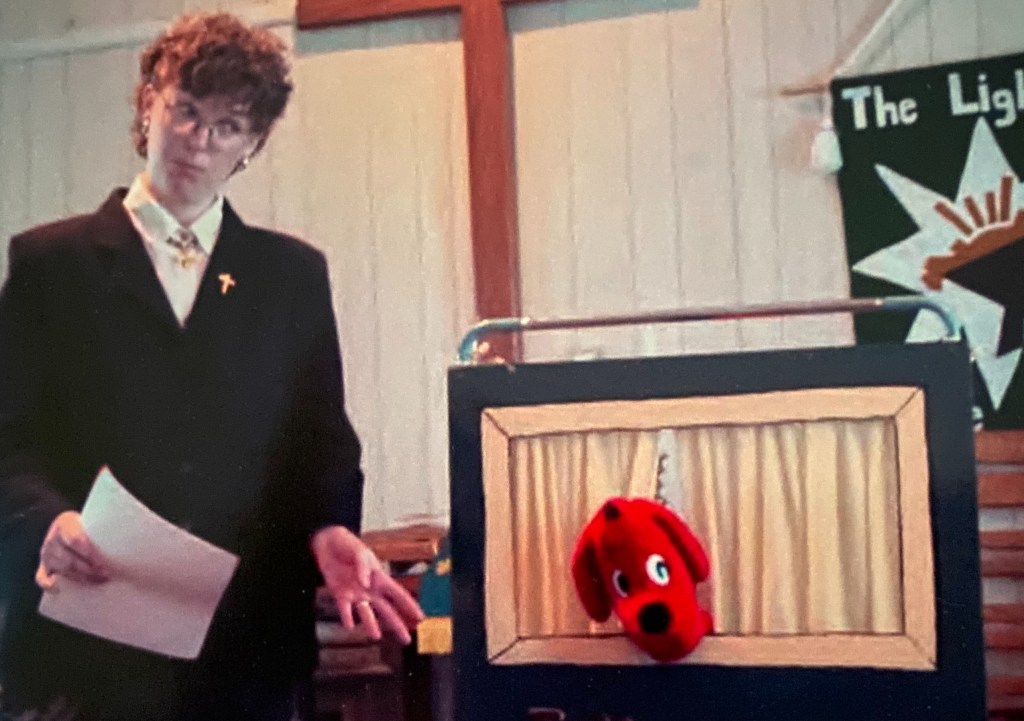
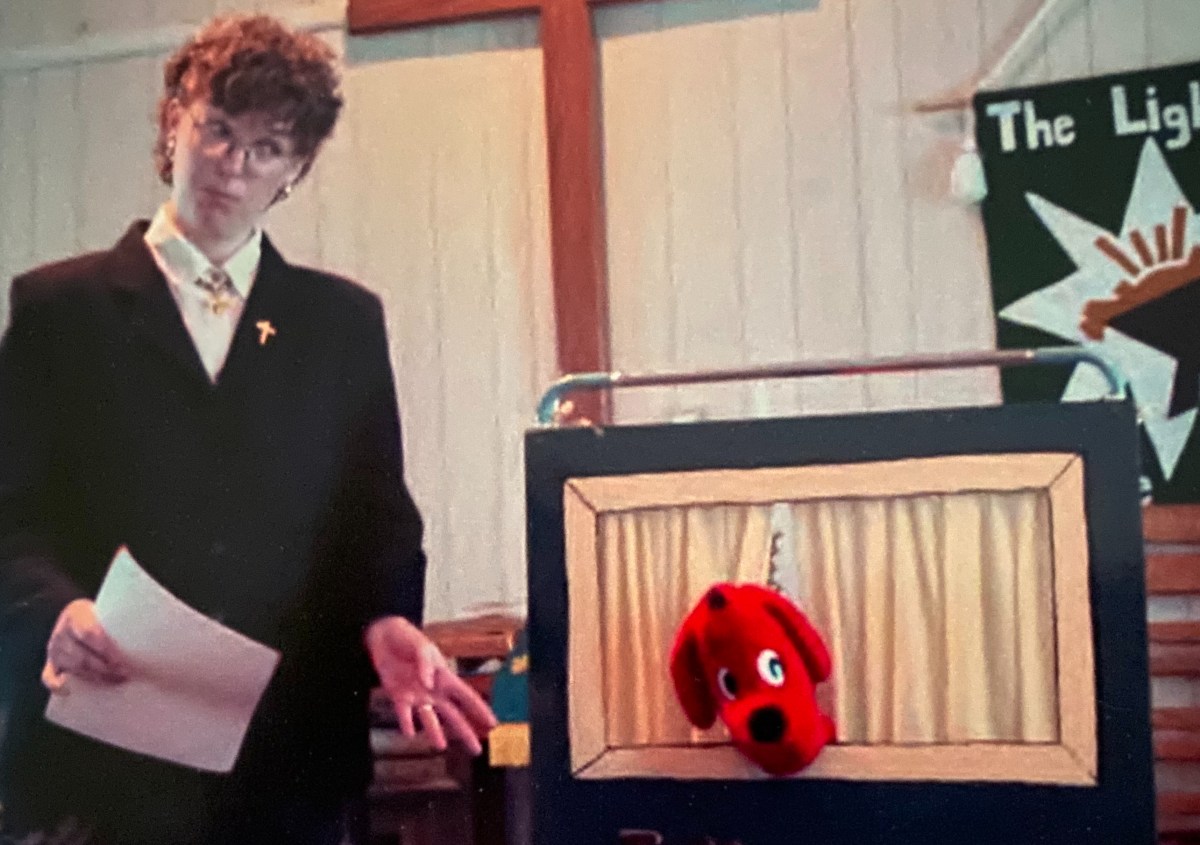
That dry sense of humor and sense of timing would serve him well as a puppeteer. I planned to use the Children’s Time to both entertain and teach. We had a large red dog puppet, whom we renamed Jeffrey and whom we decided would be allowed to ask questions no one else dared ask. In his debut, our puppet first told what would become my favorite joke.

“What’s the difference between roast beef and pea soup?” he asked. 

I shrugged and asked, “What?”

“Anyone can roast beef.”

It took a minute, but we both waited, expecting to hear the chuckles move across the room slowly; first, though, we heard the roar from the back pew. One of my church members, Ray, loved the joke apparently. A few months later, I would visit him in the hospital and laugh myself because nearly every person who helped me find him that day would ask, “You mean the guy with the pea soup joke?” A year later, he would succumb to the illness that had sent him to the hospital. Sitting in the visitation parlor of the funeral home, I would hear the joke enough to prompt me at the funeral service the next day to ask how many in that room knew the difference between roast beef and pea soup. Nearly everyone raised a hand.  

On that first Sunday of the puppet’s debut, once the ripples of laughter had died down, Jeffrey asked me, the pastor, what I was wearing under that robe? I had not worn a robe before that, but frankly hoped the robe would solve the ever-challenging task of what to wear when preaching. 

“Why, I’m glad you asked,” I said. Then, as I reached down to lift up the hem of my robe, I saw Jeffrey had covered his eyes and was exclaiming, “No, no, no…!” Jeffrey was a hit and became one of our most effective teaching tools.  Using a puppet was in part a response to all I had been learning about how to help my people learn something about themselves and their God. 

Lessons from the Deli

Opportunities to learn what worked for teaching and what didn’t flew at me from all directions at that church; the toughest part was catching all of them and seeing how they were related. A delicatessen menu, for example, taught me about my son, my sister, father and my church. I knew my son was smart; I just didn’t know why he was so often angry until we visited the new delicatessen in Gallatin. We met up with some friends for lunch and we were standing at the counter as a group, staring at the menu, which was written on the back wall of the restaurant behind the counter where the sandwiches, soups and salads were prepared. Usually, when we ate lunch at drive through restaurants, menus sported pictures and we all knew what they were called because we could all sing the jingles we heard during commercial breaks while we watched our favorite television shows. At the new deli, even I felt the pressure to peruse the menu quickly, so I turned to my youngest son and asked if he saw anything he might want for lunch. He looked at me, bewildered. It was a glorious moment of vulnerability; normally, he would have barked at me for singling him out for help. At that moment, though, I realized he did not see what I saw. I saw “Salads,” in larger, bold lettering, for example, then “Chicken,” “Tuna” and “Garden” salad categories in smaller lettering followed by even smaller paragraphs with descriptions for each salad. He saw lots and lots of jumbled letters. 

“Want a ham sandwich?” I offered, knowing what he liked, and told him he could have it on white, wheat or rye bread and he chose rye just to be adventurous. 

“Can I have mayonnaise on it?” he asked.

 “Absolutely,” I said, “and no tomatoes. Chips?” He agreed to chips and soda. 

Photo by Pixabay on Pexels.com

I made a note, though, to visit our local library and there I was grateful to find out about different learning styles and how those often mirror and/or drive the different ways we relate socially in the world. Some of us learn just fine the way most subjects are taught in school; others struggle. I personally learn by taking what is presented and being able to then restate it in my own words. In Chemistry in high school, for example, my teacher would walk me through the problem at hand and it always made sense to me in that moment. If I did not get a chance to retell within a short time the solution to the chemistry problem, though, it would be lost to me. I may have initially understood it but I would quickly lose grasp of the solution if I had not written it down and been able to explain it myself. Only if I wrote something down, then retold it in my own words, would I learn what had been presented. Fortunately, that was easy enough to do in most classes growing up. I personally kept great notes and studying for an exam was a matter of going over and over my notes until I could nearly recite them word for word and then recreate them for an exam. Just explain something to me orally, though, then exit and the understanding would leave the room with you. 

My son, I realized, learned by watching and repeating what he’d seen as well, but by doing, not writing and reading. When he was five, we watched him recreate a rocket tower with his plastic building toys while watching one of his favorite movies about the Apollo 13 moon mission. When the rocket took off during the movie, we realized that our son’s rocket tower fell away in stages in exactly the same way the real tower did, something none of the rest of us had even noticed. I do believe that he would have been likely labeled with some sort of “learning disorder” had we not homeschooled our sons. As it was, what I read suggested he simply needed some understanding of his learning style and what might be getting in the way of his learning. He needed me to recognize, for example, that he found distracting those modern textbooks with their colorful pages and art interspersed with words. Simply placing a piece of colored plastic across a textbook page, though, rendered the colors and art less distracting. Turns out, he was among many who struggled because we as a culture had decided it was somehow helpful to readers to spice up the visuals in our textbooks and magazines.  Some of us enjoyed the art; some of us were too distracted to be able to read. Different styles.

Some of us will find a page like this helpful. Others might be distracted by the art. Page from “The Way Life Works,” by Mahlon Hoagland and Bert Dodson, Times Books, 1995.

Spencer also needed information: when you read a textbook, a menu or a newspaper, you start with the largest letters. Might seem intuitive, but not everyone approaches the world in an intuitive manner and our world is richer precisely because we are not all the same. To read a newspaper, you look first at the headlines; on a menu, you choose categories like soup or sandwiches. Once you decide whether or not you want a sandwich or sports, you look to the next largest groups of letters and decide if you want a tuna sandwich or if you want to read the previous days’ scores. Smaller letters give you details about the avocado sandwich you chose, or where the baseball scores can be found. Even smaller lettering leads you to what else you could have on the sandwich or which team won the game or match. 

Learning styles also affect our approach to the world and our relationships. Often, my son simply needed information to help him navigate.

Turns out, when it came to relationships, the same was true. Often, he simply needed information to help him navigate. He asked once what to do when someone was crying. Before, his tactic was to walk away and get someone to help. He wasn’t uncaring. Far from it. He was worried he’d hurt someone more by saying or doing the wrong thing when they were already vulnerable. I suggested a plan: stay close by, and, if you know them well enough, put a hand on their shoulder or arm and ask if there is anything you can do to help. He said thanks and that was that; I thought he’d forgotten about it really until a couple of years later when said he had tried that with a friend and had been relieved to find it had really worked. 

What I had learned was that my son needs information while others learn visually or by hearing. Tragically, seldom do pastors learn how the people around them learn. My son taught me why so many of my family members and congregants might be frustrated. Suddenly, for example, my understanding of one member bragging that he’d finished college “without ever cracking a textbook,” changed. He’d turned that into a plus when it had actually been a hint to his learning style, one not often supported in schools then. Quickly, I understood why our children’s time was often the only part of the worship service people remembered in the beginning. The story or our puppet wasn’t teaching theology; it was just funny, but funny can be theological if you’ve let your guard down expecting a funny joke. 

On one of the first Sundays using Children’s Time, I talked in the sermon about “schadenfreude,” the idea that we take some joy in others getting their due or at least not getting more than us. For the children’s time, I had brought wrapped pieces of hard candy and shared it with the children, but I only had three pieces, so the last child in line got none. When he protested, I explained, “I ran out but at least three of the children get some so we can be happy for them, right?” 

“That’s not fair,” he wailed.

“Well, then, perhaps no one should have candy,” I suggested, snatching back the candies from the other children before they knew what was happening. They were, of course, bewildered by quickly changing fortunes. “Is that better?” I asked. 

He grinned. “Yes!” 

Of course, everyone laughed (but I immediately  regretted the lesson we were all learning at his expense.) In that moment, the pastor learned to think through the children’s messages more carefully. The child felt better but the others were sad and bewildered until I said,  “Wait. Look! There’s another piece of candy here after all.” All the children eagerly accepted their candy and went back to sit with their families. before their fortunes changed again.

Likely none of the children heard the sermon that day but the adults were primed to hear my sharing about my own schadenfreude. 

Ironically, I admitted, I had seen this in myself that morning driving to church. I was sideswiped and nearly run off the road by a speeder. My reaction to that bit of driving aggression had been far from pastoral. To make matters worse, when I passed the same guy a little later getting a ticket just a few miles down the road, I gloated loudly! My schadenfreude, or joy, was that he was “getting his due.” The adults in the room understood the idea better and had it reinforced because of Children’s Time. They understood better then the prophet Jonah who was not happy to discover that God wanted to forgive all the sinners in Nineveh; Jonah wanted to see them “get their due.” We usually want others to get justice while we ourselves get mercy and forgiveness. That’ll preach, as they say.

Photo by Brett Jordan on Pexels.com

Over the years, then, using all I learned, I not only used the Children’s Time and our snarky puppet, but also worked to craft sermons heavy with stories and illustrations because so many of us only remember the stories we hear or the “word pictures” we encounter. “Show. Don’t tell,” works. Maybe too well. After a couple of years of working to find and add stories to the sermons in hopes people would take something away from worship, I got one of what would feel like daily lessons in humility. At an Administrative Council meeting, a member offered the devotion before the meeting proper using a story I’d told three weeks earlier in my sermon.  “Ah,” I thought, sitting back and smiling, “they DO listen.” But no. Once she’d finished her devotion, she handed me her notes. 

“Feel free,” she said, “to use that in a sermon. It’s a great story.” Sigh.


Bonus free joke from the adult Spencer: 

What is the difference between a tuna, a piano and a glue stick?

I don’t know. What is the difference between a tuna, a piano and a glue stick?

You can tuna piano but you can’t piano a tuna.

 Okay.

But what about the glue stick? 

That’s what everybody gets stuck on.

What’s ‘Just enough’ Christmas?

Christmas swings like a pendulum do….

My paternal grandmother, Arbaleta (Grandma Leta), and maternal grandmother, Marie (Grandma Ree), could not have been more different creatures, and this was never more obvious than at Christmas. At first glance, it seemed to me that they were polar opposites when it came to wintry holidays especially; in retrospect, it is evident they were each on opposite points of the pendulum that has come to symbolize Christmas for me. Generation after generation on both sides of my family seemed to be unconsciously caught up by the wild swings of this holiday pendulum, a reactionary arc between a resounding “Yes!” to Christmas and its counterpart, an adamant “Hell, no!” 

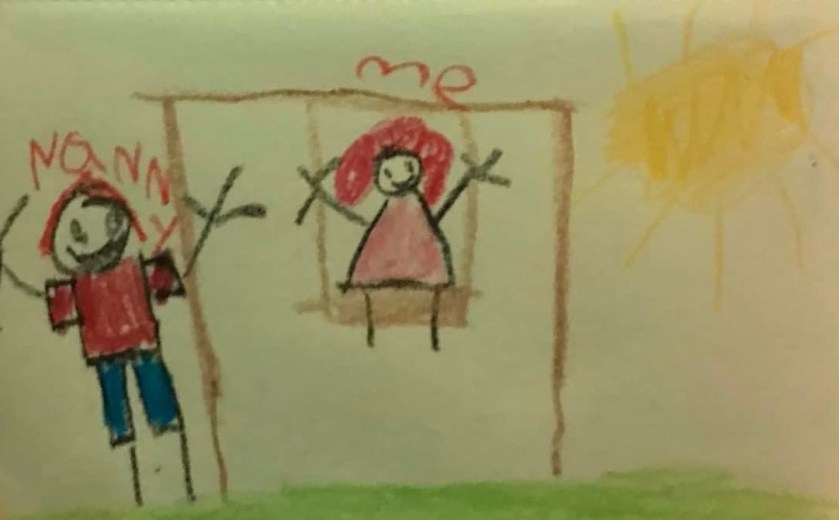
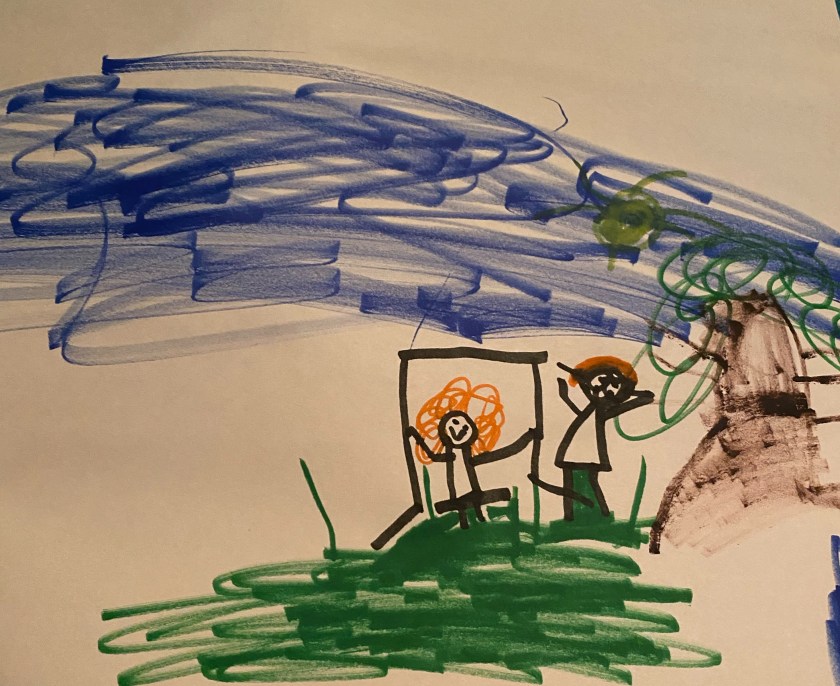
My Granddaughter’s depiction of our favorite activity: swinging. She is so wise….

Finding Healing Around Christmas

Maybe your family needs some healing around holidays as well. Sure, it seems strange to talk about Christmas amidst all the paper and ribbon and cookies and tinsel, but it is, in fact, the best time to step back, recognize struggles and disappointment and start our families on paths to peace with Christmas; maybe along the way we could even figure out what’s “enough” for joy. I offer this reflection then to all our families because we cannot find healing if we do not know our family’s wounds. Here’s hope for discussions about upcoming celebrations: may they be intentional, loving and truly joyful for all.

For me, it seems the best place to start is with the grandmothers. Both of my grandmothers were born around WWI; each married during the Great Depression. Neither had, as they say, “a pot to piss in,” not while they were growing up and not while they were young mothers. Both worked hard to support their families outside the home as well as in. Dad’s mom, Arbaleta, had two children, a boy and a girl, nine years apart. Mom’s mother, Marie, had three daughters all close in age. 

Arbaleta’s husband, my Grandpa Mac, fell from an electric pole when he was young and wasn’t supposed to ever walk again, but did, in great part because Arbaleta would not let him not walk. She reportedly insisted he move his legs and even moved them for him for months as physical therapy until he could walk and work again. While I was never close to Grandma Leta, I have always admired the steely determination that these actions showed.

Marie had a husband who was always on the road as a truck driver, mostly because the bus or truck driver jobs close to town weren’t well-paying. He died of a massive heart attack at age 50; she lived another 30-plus years and married her high school sweetheart, then outlived him and married another kind man when she was eighty. At that wedding, the minister declared what we all knew, “Marie is a hopeful woman!” Grandma Ree, as we called her, was the quintessential kindergarten teacher when teachers still had time for nature walks, ironing leaves between sheets of waxed paper, and silly songs. Thus, she was the kind of grandmother I aspired to be: she played games with us, prayed for us, encouraged us and defended us when necessary.  For most of her life, she modeled a love of learning: she earned a master’s degree, helped “plant” two churches, became an accomplished painter and was memorizing her favorite Bible verses in her seventies because she was losing her eyesight.    

While I know little of Arbaleta’s childhood except poverty and hardship, I know Marie helped her mother run a boarding house after her chiropractor father divorced her mother, something which mortified both women.

That I’m aware of, Arbaleta seldom left her home after we were born. At least we never saw her leave her home, though, as far as we knew, she was perfectly capable. Our collective memory of her is of her seated on the sofa in her silk pajamas. Every time we visited her, we would wave to her from a few feet away as she perched on the sectional sofa in the corner, surrounded by shelves of various sizes and shapes of cacti. In one hand she held a lit cigarette, ashes threatening to crumble onto the silk, and the other hand held the ever-present bean bag ashtray (you know, the kind that has the bean bag on the bottom and the colorful aluminum tin bowl on the top.) That I can remember, she never once kissed, hugged or touched us in any way, shape or form. And, though she was pleasant, there were no memorable conversations, just the cloud of cigarette smoke that circled above her. 

As for Christmas, well, I can’t remember there being much of it in their home at the edge of a Kansas golf course where she and Grandpa had retired. Ironically, I’m not aware Grandpa played golf, though my Dad did well into his eighties. As far as Christmas goes, Arbaleta represented the point in the arc where celebration was merely tolerated. Every few years, our parents would tote our gifts to their house to open on that rare occasion we woke up there on a Christmas morning, but the mood in the house was that Christmas decoration was, well, perfunctory. There was a tree and maybe a wreath, but evidently, for Grandpa and Arbaleta, a tree and some lights outside were “just enough,” though I suspect they were only put up to satisfy us. If overcoming poverty was Arbaleta’s life goal, she met it, thus the home on the golf course as well as the purchase of a new Lincoln every year. Secular or religious, it didn’t matter; Christmas was a formality, expected, tolerated for the children. Christmas dinner involved polished silver and store bought sweets, if any. “Please wait until you have permission to touch.”

Arbaleta died when I was seven and, suddenly, the focus of Christmas on my father’s side of the family shuddered and swung hard to the opposite extreme. Her daughter brought in Christmas every year from then on with a vengeance, lovingly, but with an overwhelming force. Every year, my aunt seemed to be competing for best Christmas ever, ostensibly in response to her own mother’s lackadaisical attempts.

While certain treasured and expensive statuary graced my aunt’s mantle for Christmas, for example, every year, the Christmas tree itself, usually the biggest tree I’d ever seen, sported a different theme with new, all handmade ornaments. I often asked when she started making them, sure she must have begun the previous New Year’s Day. She also made most of our gifts; they were always of Pinterest quality and I treasured several sweaters she knitted for me, for example. 

As if it were necessary, she also became an amazing cook and thus, Christmas visits always involved impressing us with recipes for new dishes. Ironically, my mother didn’t want the recipes and my mother’s mother, Marie, didn’t need them; my mother was too busy leaning into that dysfunctional pendulum that was swinging back to the starker side, likely in reaction to her mother’s seasonal excess. 

Marie, my mother’s mother, was on that same swing of the pendulum as my aunt, though I believe Grandma Ree went all out for her Christmas celebration for different reasons. Her husband, Grandpa George, also died when I was seven, but that did not slow Marie down in life or around the holidays. From the moment you opened the door into her home at Christmas, the scent of pine and wild berry candles carried you through room after room of greenery, holly, bells, poinsettias and new figurines or miniatures each year. Also new each year were the sweetbreads and cookies and homemade candies, all awaiting our discovery after hugs and kisses were exchanged and the coats and mittens and caps were piled onto a bed in the back of the house. 

Grandma Ree with her brother, Mother and Sister, c. 1960’s.

A Family Nightmare

While Marie’s response seemed to me to somewhat resemble that of Arbaleta’s daughter, the driving force behind Marie’s likely unconscious Christmas reverie gone amuck was a well-kept secret, a family nightmare. On two separate Christmas Eves, during her childhood and youth, Grandma Ree had lost family members to suicide. I was, of course, an adult before I was made aware of that history or the details: one drank poisoned alcohol and one shot himself, both on separate Christmas Eves. Of course, the grief and shock of their actions was complicated by their (conscious or unconscious) efforts to ruin Christmas forever for some of their family.

How painful were their memories of the holidays?

Before we assume that Marie’s attempts to reclaim Christmas was the reason for the pendulum’s extreme movements, though, we need to recognize that some calamity in earlier generations drove those men to choose Christmas Eve to end their lives; we have to ask how painful were their memories of the holidays that drove them to risk also ruining the holiday for their spouses and children? How far back did the pain begin and what don’t we know about that? 

In other words, it’s not likely either man, both of whom must have been suffering and feeling hopeless, started the family on that path.

The result, though, seems to have been an unconscious struggle to compensate. Those grand swings between holiday excess and hopelessness left subsequent generations still unconsciously at a loss to figure out what’s enough celebration. Further, while we can understand what might have spurred Marie’s need to excel at Christmas, I’ll likely never know what caused Arbaleta’s lack of enthusiasm for the holidays, and so I’m left simply to marvel at the overwhelming force of her daughter’s frenzied Christmas efforts. Sadly, or thankfully, no one now has picked up that mantle and the extended family is so fractured as to make these discussions nearly impossible.

I offer these reflections then to my nuclear family as the beginning of some discussions around conscious choices rather than wild reactions.

How does a family figure out what’s enough Christmas when the family’s history is, well, fractured? My own efforts were often emotionally unsatisfying; not only were my mother’s Christmas efforts headed for the stark extreme in reaction to her mother’s and her sister-in-law’s excesses, but they were complicated by my general lack of interest in cooking or baking except when absolutely necessary. 

It was my ex-husband who started me thinking about some of our responses to holidays years ago: he protested the idea of Valentines’ Day for example, saying we could and should give one another cards or flowers or candy at anytime of the year and not just one day chosen by candy and card companies and florists. Yes, we can, I agreed wholeheartedly. But do we? Of course not, I pointed out. To his credit, he came by his dislike and struggle with holidays honestly and thus brought his own reactions to our holiday table: his birthday is the day after Christmas, and he was one of six children. His Christmas gift always came with a declaration that, “Oh-that’s your birthday gift too.”

Over the years, I certainly have struggled with holidays, whether it’s decorating or preparing a feast or just planning. Don’t get me started on birthdays for children; too many of those ended in my tears from exhaustion and a sense of failure. Did I tell you about all the “Pinterest Fails?”

All these things and more (all these things and more) that’s what Christmas means to me, my love….)

Stevie Wonder

Plenty of us struggle with the holidays, though, whether because of grieving a loss or knowing you’re the only one who can’t afford the gift exchange. I’ve tried over the years to make our gifts for Christmas but again, I know too many of my family members and friends were less than thrilled with the results. Mea culpa. We tried spreading the Christmas holiday over several days to lessen the wild two-minute frenzy of Christmas morning. We tried taking Christmas to the mountains; we tried staying home. We wondered what would happen if our family just gave up one Christmas and had lots of little ones? Could that not translate into lots of chances to do or give or be kind to one another? So many of our attempts at intentional Christmases revolved around not expecting one or two people to create a magical holiday that only left them in tears and exhausted.

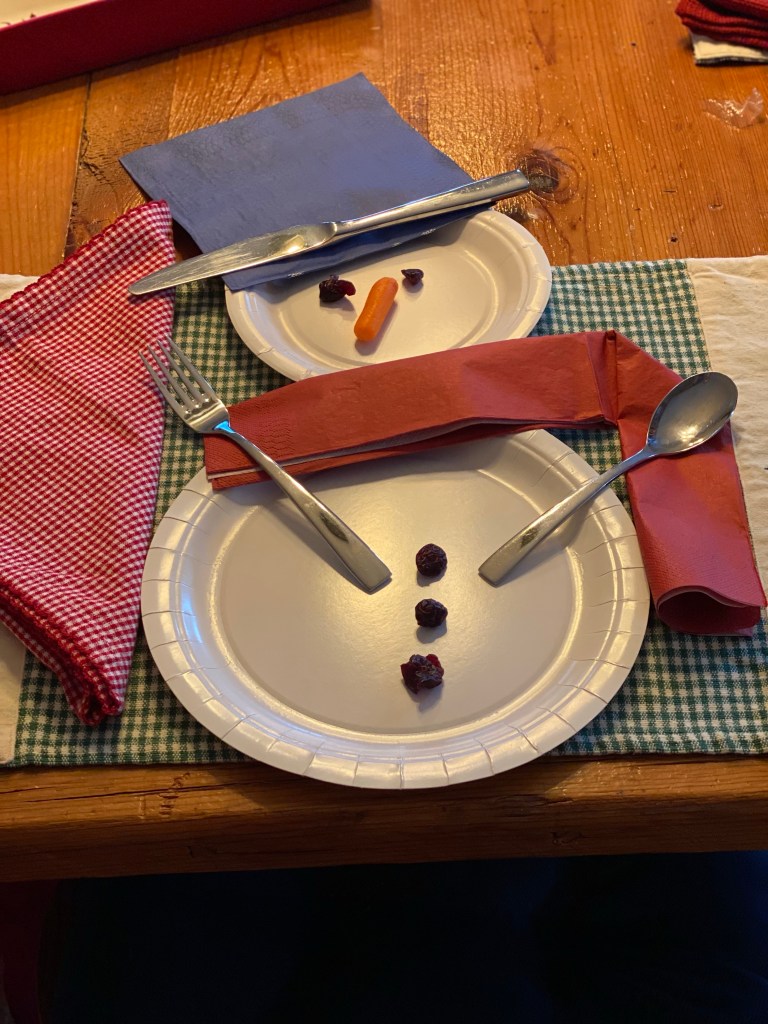
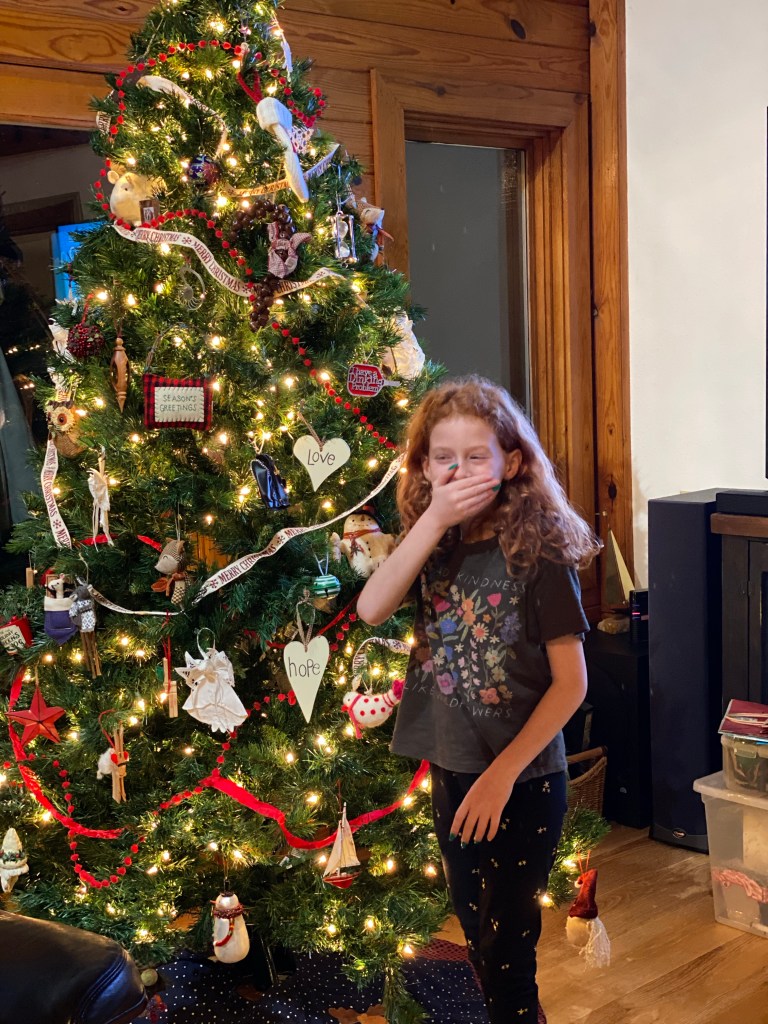
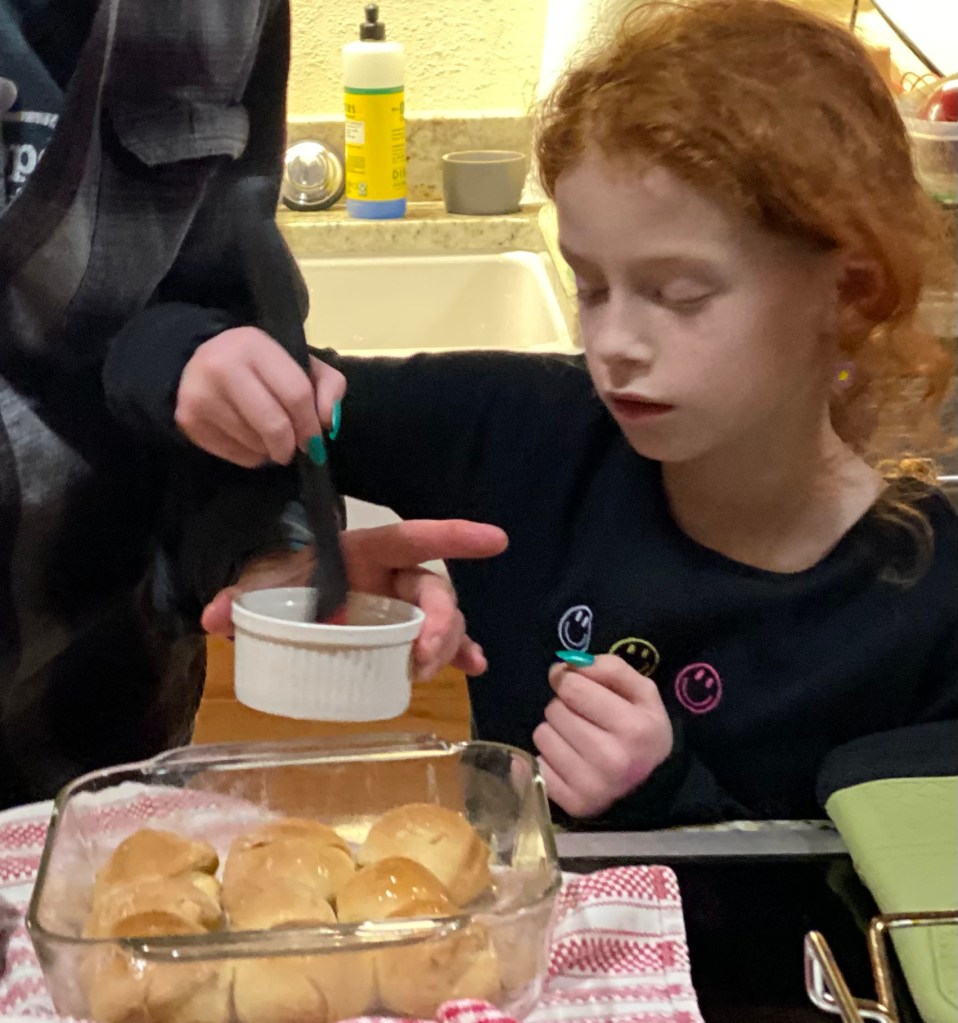
We’ve finally begun to incorporate some activities intentionally. Instead of china and crystal, we copied someone else’s snowman place settings, something the granddaughter and I could share. Last year, we started some silly story telling. This year, we introduced Karaoke and I am trying to reclaim the joy of baking by helping my granddaughter learn; watching her “knead” the goop she bought at the store made me think. Lo and behold, she discovered the joy of yeast and how it rises and how the baker must punch down the dough, then knead it. Her eyes grew wide after she made a fist and punched away. “That is soooo satisfying,” she said. A keeper. 

In case you’re wondering, religion did not seem to figure at all in the wild reactions to the holiday through the years for my extended family. While Arbaleta was, as far as I know, agnostic, and Marie was a strong Christian, neither of them addressed or seemed to include the religious holiday in their efforts to reclaim or dismiss Christmas. For our family, that’s a different pendulum altogether. I personally love a good candlelight Christmas eve service singing and the idea that God came to be with us as an infant. Nevertheless, culturally we continue to struggle with all that Christmas celebrations have become for generations and we cannot heal from pain we do not acknowledge.

For our family, the faith and religious rituals are different pendulum altogether. I will never know why my Grandma Ree did not incorporate more of her personal faith into the celebration. Personal experience suggests she was treading lightly with agnostic family members and, as is true for many families, also celebrated on different days with different parts of the family, balancing church events with home. Nevertheless, culturally, we continue to struggle with all that our secular celebrations of Christmas have become for generations, often leaving us to begin another year frustrated, sad, discouraged. That is where we can start, but we must look collectively at this because we cannot heal from pain we do not acknowledge.

The best time, I believe, to reflect on how we celebrate Christmas is when we are all together…and we’ll before Christmas comes around-unexamined-again.

For my family, I continue to try to reframe Christmas in light of the history I bring to the holiday. I guess I hope through reflections and questions to step completely back from that wild, reactionary swinging between excessive celebration to indifference and even disdain. 

I think one key is that we focus on the children, but with respect for their needs and not our own needs to give them the best holiday ever! 

They get tired; we pay attention. They want to dress up; they don’t want to dress up. Quiet time, dancing in the kitchen time, gifts that involve us engaging with them. I’m not saying we’re the best with children ever or that ours are happier than any other. What I am saying is that like in so much of life, the children around me ground me. What they need is so often what I need. Let’s sing Jingle Bells, yes, at a gathering, but we mustn’t forget the bells themselves and our need to jingle them to make the song come to life.

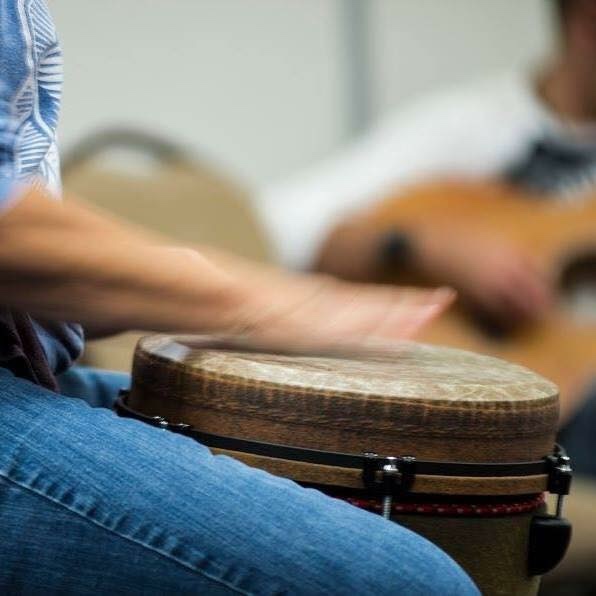
A little percussion goes a long way and when we sing “Jingle Bells” there need to be jingling bells….A five-year-old taught me that.

Music must also be a source of holiday joy for many families. I’m jealous of those who manage a musical gathering but hopeful that might be in our future as well. Certainly with percussion everyone can participate! The idea of introducing music brings us back, though, both to the need for sensory awareness and to the idea of joy and reverie throughout the year. In order for there to be music next year, we need to practice throughout the year – often and, by practicing, remember the things that do bring us joy without wearing us out. I write this and share it now, after the holiday blitz, planning to share it with my family, to start the conversation we can have in anticipation of next year. I am curious to hear from them, and find out if they are aware of, or experiencing their own pendulum of Christmases, maybe even unknowingly riding that pendulum right now. I’m hopeful that with some lowered expectations of ourselves and a little yeast, we just might be able to rescue the holidays from the extremes of that dysfunctional pendulum my family rode for far too long AND decide for ourselves what is “enough Christmas.”


Leave a comment

The First Time I Ran Away

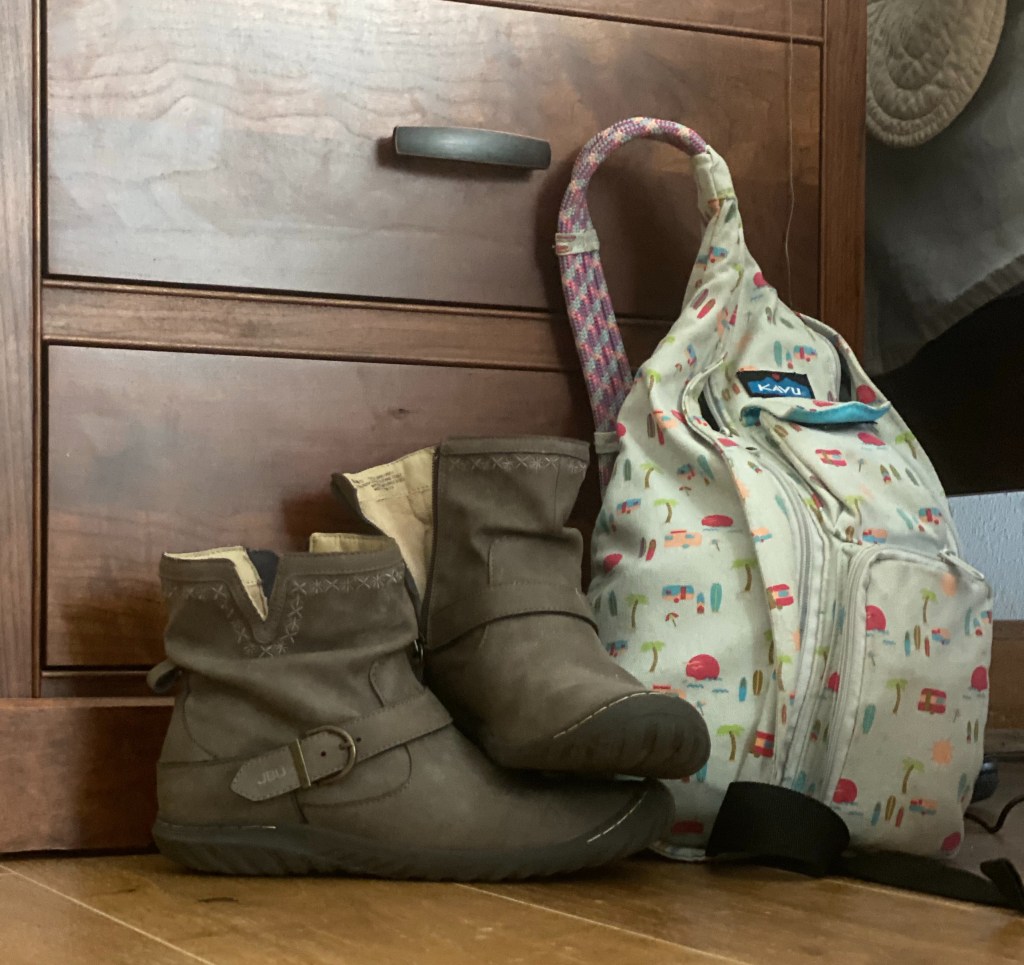
Always a Fashionista…gotta love the boots.

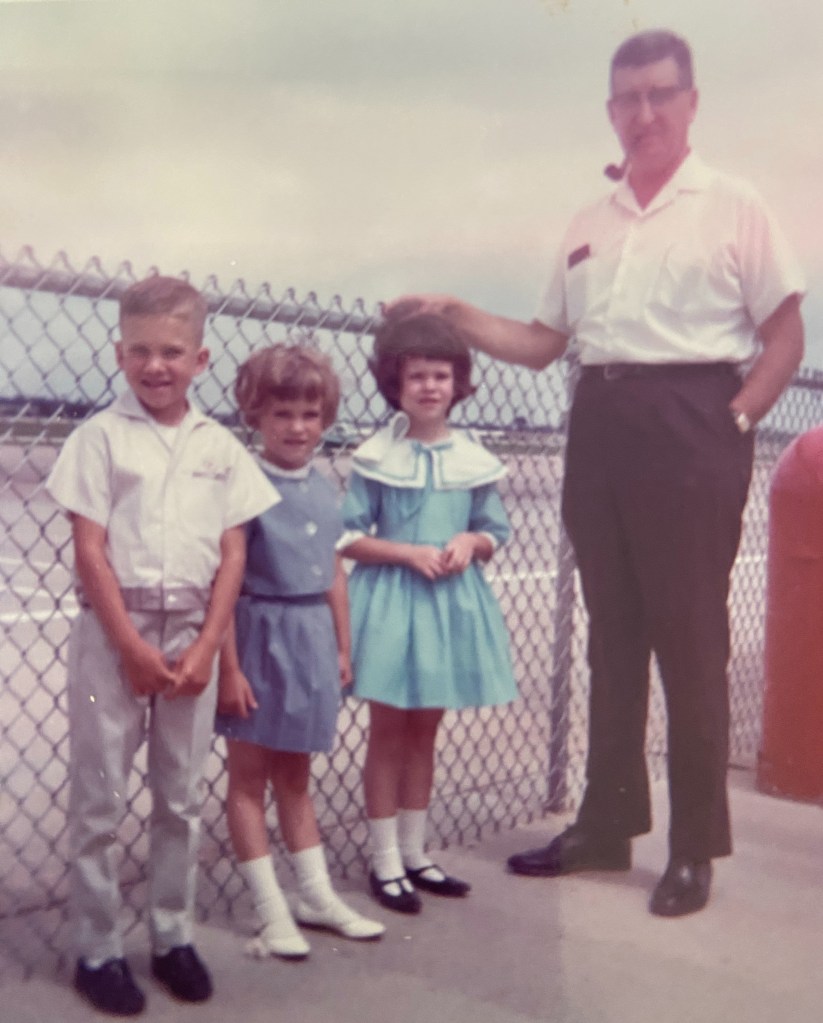
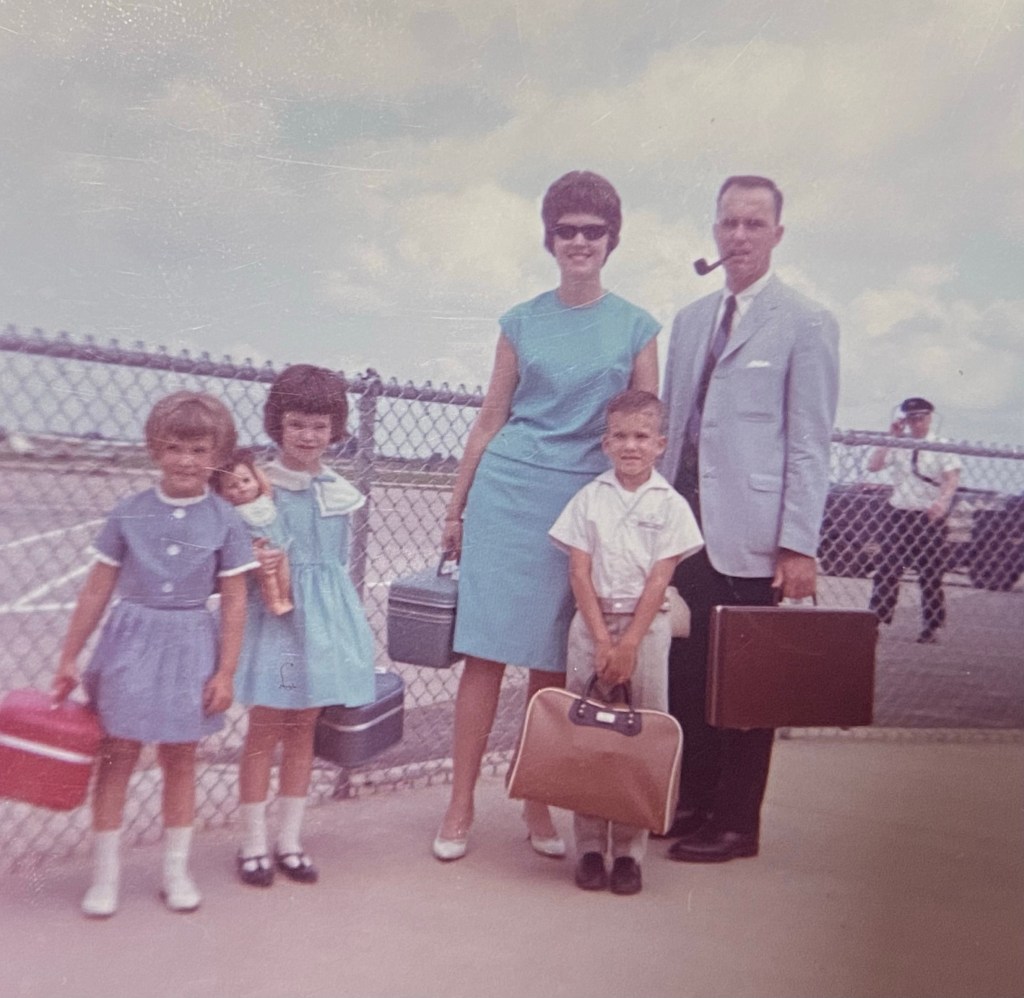
When I was five, I ran away from home. Of course I didn’t get far. My world then revolved around a quarter-acre yard in Springfield, Missouri, on a corner lot, two blocks from my elementary school. We lived a short drive away from where I was attending kindergarten at our First Baptist Church and near enough to some train tracks that I knew it was bedtime by the train whistle every night. The little three-bedroom, one bath brick house on Marlin Street had a fenced-in backyard, a sand box, a metal clothesline and a weeping willow tree, all seemingly perfect for three children under six. Its feathery leaves hung to the ground, draping around the trunk with just enough room under the canopy for a five- year-old to hide and imagine different worlds than were to be found inside the little house on Marlin. 

For the longest time, I couldn’t tell you why I ran away on that particular day. I often wondered if it hadn’t been that I didn’t want to go back to kindergarten. I went on the afternoon shift, so we basically had an hour or two of ABC’s, singing, and a snack in the gymnasium of First Baptist Church before we took a nap. I already could read and write some when I got to kindergarten, so there was no struggle for me there. 

There had been a memorable first day spent on the vinyl chair in our kitchen trying to learn to tie my shoes. “Little boys and girls who can’t tie their own shoes are not big enough to go to kindergarten,” I’d been told again and again.  “They’ll send you right home.” I had spent the morning of my first day of kindergarten tying and untying my red plaid tennis shoes, both my mother and me praying I’d avoid the shame of the teacher calling my mother to bring her little “baby” home. We needn’t have worried. Not once did I ever have to tie my shoes while at school. 

Perhaps, on that morning, I simply didn’t want another perm.

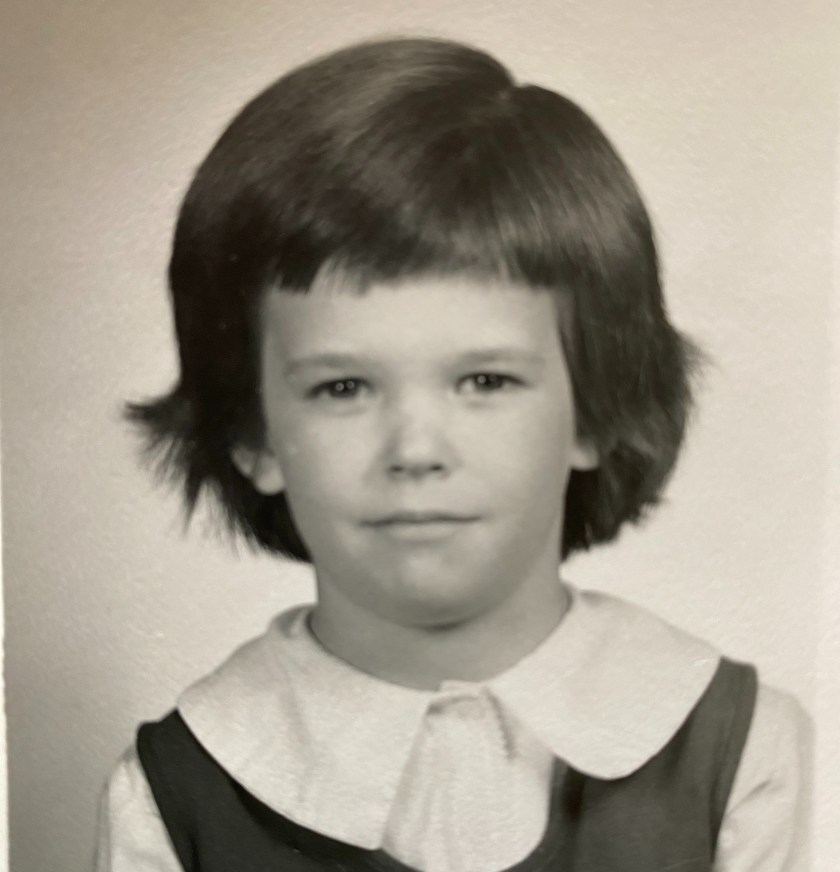
My mother struggled daily with my full head of “straight as a pencil” “dirty-brown” hair because it was constantly tangled. Every day, we’d have the same conversation about brushing the underside of my hair, that thick mat next to my neck, and every day I would stare at her as if I were hearing the laments and reprisals for the first time. My hair may have been the bane of her existence but her brushing my hair is the only physical connection with her I remember. Her brushing it angrily. Her trimming errant bangs until the top of my head was nearly visible. Her trying to make it curl. Her finally chopping the hair off rudely, at a strange angle because she was done with it, as fed up as I was with trying to tame that mane. 

Mom had been introduced that summer to the “home permanent.” I’d never been to a salon even to have my hair cut. Mom cut our hair herself with her sewing scissors, black handled shears that were never sharpened or oiled, as far as I could tell, so they’d pull when she hacked away at the thick bunch she’d grab in her left hand and chop with her right hand. I remember staring into the bathroom mirror blankly. I hadn’t cared that she cut it because of how horrid it looked, I realize now. I cared because she said, as she was sweeping up the hair from the floor, “Now you can just brush it yourself.” She would no longer brush it for me. I think I would even in that moment have agreed to another permanent like the one that had failed so miserably and sent her to her sewing basket for the shears.

I can still smell a home perm a mile away….

The day before, the permanent had required a couple of hours of me seated on that sticky vinyl chair in our kitchen while she rolled strand after strand in metal-curlers, the kind with bristles meant to grab and hold the hair long enough for the chemicals to alter the makeup of your hair and teach it to curl like those golden locks on Shirley Temple  If the rolling of the curlers wasn’t bad enough, the chemicals made my nose burn and my eyes water and the bristles on the curlers pricked my scalp. Then, once the solution had been applied and wiped off my neck and back, I was told to take my daily nap. Whether we slept or not, we “napped” every day so Mom could have time to herself, a practice I appreciated when I had children. Only on this day, because of the perm, I was relegated to a rug on the floor by the washer in our laundry room. I could have no pillow for my head because we didn’t want to ruin a pillow. Were we worried about ruining my head? Also, no pillow meant any attempts to rest my head caused dozens of tiny needles to prick my scalp, but sitting up and trying to read sent rivulets of stinky solution dripping down my neck and back. I would not rest well that afternoon. 

Sadly, the perm did not “take.” My hair rebelled. My mother was furious, disgusted, as she yanked curler after curler off only to watch the long brown strands defiantly continue to hang as straight as pencils. She was crying. I was crying. She’d been trying to prepare me to participate in a Girls’ Auxiliary ceremony at our church where her teenage cousin would be “crowned ” a princess. The Girls’ Auxiliary was the church’s alternative to the Girl Scouts, designed to encourage girls to learn Scripture, study the lives of missionaries and participate in ministries like collecting monies for children India and China. To the program’s credit, many of us certainly were inspired by godly women like Lottie Moon. My cousin had completed the requirements for attaining the “Princess” rank and there was to be a ceremony at church. I was tasked with carrying a paper gold crown on a pillow to be placed on her head. Mom wanted me to represent the family well, to look pretty and be a shining example of the next generation of princesses. 

But my shock of brown hair refused to do its part. And mom was fed up. She’d gotten the shears out just as her aunt called and offered to come over and help. Her aunt had three daughters, all teens, and somehow managed to fashion a dainty pony tail for the ceremony. 

The next day, however, the shears returned and that was all she wrote. My hair would not cover my neck again that year or the next. Not until I learned to brush it myself. I could not for my part, see the point. I didn’t care about my hair being pretty, which may seem ironic, since I was teased incessantly by my father. He was annoyed that I was so attached to my white straw hat, white gloves and white wicker purse, all gifts from grandparents the year before for Easter. He thought I wanted to be “a little lady” because I carried my purse with the gloves inside it and donned my little white straw hat with a yellow ribbon nearly every day for most of that year. I didn’t participate in outdoor activities anymore with my brother or sister that year. I preferred instead to go outside in my hat and carry my purse to sit under my tree and pretend I was somewhere else. It would be years later when I’d realize why I wanted to be anywhere else.

Of course, picture day came soon after the cut.

At the time, I just remember being grateful I could pull that straw hat over my crooked bangs. That afternoon then, while mom was sweeping my hair off of the bathroom floor, and I was supposed to be on my bed for naptime, I pulled the hat down over my ears, shoved my gloves into the purse and snuck out the screen door from the laundry room, careful not to let it creak or slam shut. 

I had left a note on my bed that I expected her to find, a note that simply said, “I am running away. Jodi.” Then I went outside and sat under my tree, my back against the trunk, legs stretched out towards the backside of the house, the branches drooping and fingering the ground as the breeze tried to cool the afternoon. Then I waited. I waited for her to find my note and come running frantically out of the laundry room into the carport, searching. I waited for her to scoop me up and hug me and exclaim how relieved she was that I was safe. I waited for her to carry me inside proclaiming she would never let me go, maybe even to bake cookies for me. Just for me. 

I waited, and, then, worried she wouldn’t be able to see me under the tree whose branches drooped to the ground, I moved to the sandbox. And waited some more. When the heat got to me, I moved to the back door that led to the laundry room and perched on the steps, clutching my purse, waiting to be found. I’ll never know how long I waited, but eventually I got tired and gave up. Then, slowly so as to not make the screen door squeak, I peered into the laundry room at the ugly rug that still stank of permanent solution. I crept past the opening to the kitchen and found no one, so I crept to the bedroom I shared at the time with my sister. She was asleep on her bed. My brother was asleep across the hall in his bedroom. Even my mother lay sleeping on her bed; drugged by the heat and disappointed by the day.

I guess I was sure Mom must have seen the note and ignored it, so, ever the quick thinker, I crossed my name off and penciled in my sister’s name on it instead, then fell asleep. It would be years before I’d wonder why I hadn’t just crumpled the note up, why it hadn’t dawned on me that my little sister couldn’t read or write at the time. As it turned out, the note was still on my bed when I awoke from the nap, so I folded it up and tucked in into my white wicker purse where I carried it for the rest of the summer. 

Shopping Cart Fiasco – Learning to Listen to Yourself

When our two adventurous boys were toddlers, their father, Mick, the bearded, brown-eyed singer I’d fallen in love with a decade before, demanded I stop being constantly worried about the survival of our off-spring.  

“They’ve made it just fine so far,” he said one warm evening outside Kroger, punctuating his point by, rather roughly, I thought, depositing our two-year-old, Spencer, into the basket of a creaky shopping cart. 

In my defense, I countered silently, we had thus far prevented any plaster casts or spidery-black sutures on those precious cheeks because of the diligence and quick reflexes of their mother and the fact that the two-year-old, in particular, bounced well.  

The first time I’d left my husband alone with Arlo, our first-born, to play at the park, I had not realized I needed to explain to him that the rubber, wraparound baby swings were for one-year-olds like our son or that he was nowhere near big enough to sit on a sagging rubber seat meant for an older child and hold onto a chain. Our beautiful brown-eyed boy got his first bloody nose that day.  My husband read my mind.  

“It’s not like he broke his nose when he fell from that swing,” Mick countered while helping the now four-year-old into the cart. Arlo wrapped his arms around his bent knees and lowered those eyes onto the patches on his jeans, happy he wasn’t going to be expected to walk but pouting because his father had said no toy aisle.

I frowned at the squeaking of the wheels as we pushed the cart towards the sliding glass doors.  I pointed to the two-year-old, and commanded, “Sit.” He sat.   

“We know better now than to leave them alone with anyone else,” he said, both of us remembering our last visit to his parents in this now well-worn argument.  His mother had suggested a fifteen minute stroll down to the dry creek for some time alone only to discover on our return to the house that Spencer had burnt the palm of his chubby little hands because no adult was paying attention. 

“I wasn’t there though,” my husband continued his line of argument.  “Even when I’m here with them, you worry.” He pointed out to the busy parking lot.  “I see,” he said, “cars and parents and grocery carts out there. You,” he said, sweeping his arm across the parking lot like Vanna White, “you see death everywhere!”   

He wasn’t exaggerating.   

I did see death everywhere, especially in parking lots.  We had spent the past four years in a small Japanese town where there were few cars and the biggest danger for a child was being smothered by too much attention. Back home, however, new dangers lurked everywhere.  

“You just go shop. Alone,” Mick suggested.  “I’ve got them and we will get home a whole lot sooner if you just pick out the apples and chicken alone. Okay?”

He abruptly parked the cart by the magazine rack.  “We’ll be right here.  We’ll be fine. We can be home soon if you don’t come looking every time you hear a child crying.” I slunk away under the weight of his disdain, clutching a plastic hand cart and  thankfully-short grocery list scribbled on the back of an envelope.  He was right. I did not need to assume every crying child was yet another example of Mick being distracted at just the wrong moment. 

I first heard the clatter of metal on the tile floor as I left the cereal aisle.  Someone has knocked one of those end displays, I told myself, honing in on the bone-in chicken breasts at the meat counter.  I chose a shrink-wrapped package whose price sticker showed it to be family-sized, then turned towards the milk display. I wrinkled my nose as a sour smell hit me: milk had been spilled at my end of the store. I skirted the spill, and reminded myself of my goal. I had focussed and was still going to focus, I told myself, pushing the cart away from the sound of a child crying at the other end of the store.  “Not all crying children are mine, not all crying children are mine,” I sang to myself to the tune of the “Wheels on the bus.”  Whoever they are, they are with their mother and my boys are fine, I reassured myself.  

One gallon of two percent secured, I headed to the express lane.  I set the items on the grocery belt and tried not to look towards the gathering crowd near the far end of the store and the self-checkout.  I smiled to myself, proud of progress, then stopped the cart abruptly, and leaned back to look around the endcap filled with M & M’s and sugar-free gum to see my husband holding our two-year old.  The four-year-old had a firm grip on his father’s thigh and a store clerk was dabbing Spencer’s face with a cloth. Leaving apples, chicken, milk where I had neatly organized them, I forced myself not to run.  Mick looked up and apologetically.  The four-year-old did run and I scooped him up without breaking stride.  I looked at the overturned cart and then at my husband in horror.


The store clerk backed up to let me assess the two-year old; he would have a bloody and swollen lip but no teeth damaged, no need for stitches and neither had broken any bones, it appeared.  A miracle. 

 “I was looking at the magazines,” Mick explained.  “Arlo must have reached over for the children’s books and made the cart fall over.  They’re okay, see?” Mick turned  Spencer’s chubby, snotty cheeks towards me.  

I set Arlo down, put the crying child on my right hip and sighed as he wiped his nose on my shirt.  Arlo grabbed onto my left hand, then looked back at his father as we started for the door.  Mick took the bags of groceries from the manager who apparently had followed me from the 10 Items or Less checkout. “Did you pay…?” Mick’s voice trailed off behind me and I heard the manager encourage him to take the bags and go, please. 

I kept walking.  

“Never.” I said, without breaking stride, not really caring if anyone heard me.

“Never tell me again how to be a mother.”

For Combat Veterans, Memorial Day is No Picnic

For those who survive combat and return home, the duty to keep the memory alive of the ‘true heroes’ can become a lifelong, sacred mission lived out daily.

Conversations with veterans of war will teach you one thing quickly: for many, the only true “hero” is the one who didn’t come home. Thus, for so many combat veterans who have lost a battle buddy, a friend, even an enemy, in war, the duty to keep the memory of the “true heroes” alive can become a lifelong, sacred mission lived out daily.

Sadly, Survivors’ Guilt is one of the main contributors to veteran suicides that continue to plague this country. Living with the fact that you survived when so many others did not then means Every Day Becomes Memorial Day. 

For many combat veterans, the survivor’s guilt, or the belief that you have done something wrong by surviving a traumatic event when others did not, can be debilitating and disturbing. Survivors of all sorts of traumas will question, feel guilty, and often even begin to believe their survival makes them somehow responsible for the other person’s death. 

“Why did I survive?” 

“I stepped one way and my buddy went another. He took the bullet.”

“I switched seats with another pilot and he was killed. It should have been me.”  

“If I’d leaned forward, I would have been the one hit, not him.” 

The grief of losing those under your command or knowing that another person died saving you is a particularly heavy burden. Especially plaguing for so many combat veterans is the reality that they were responsible for taking the life of a child, whether a combatant or just an innocent bystander.

Even just returning when so many others did not, though, can feel like too much to bear. Thus, remembering and honoring the “real” heroes with some kind of meaningful ritual or task that honors the fallen then becomes the new mission.  

Eddie G.

His Sergeant Major brought Eddie G. to my campus ministry one rainy day in 2011. He’d already deployed into combat as an engineer three times and he was only 25-years-old.

“Got any work our guy can help with?” Eddie stood by his truck across the parking lot, out of earshot.

“Well, I was needing to make this entrance accessible. Probably a ramp….” I nodded to the young vet leaning against his truck.

Seems Eddie was sleeping in that truck. He was not allowed to see his daughter or go home. Sergeant Major was running out of ideas and Eddie was not the only vet in crisis in Clarksville, which is adjacent to Fort Campbell, Kentucky, home to the 5th Special Forces Group and 101st Air Assault. At that time, the base was dealing with more active duty suicides than any other U.S. military base. Eddie was just one of many vets in crisis but he’s the one Sergeant Major brought to see me that day.

“You need something built; Eddie’s your man,” said Sergeant Major. Eddie had been building bridges for combat transport. Never having done that, I could not and did not at the time realize the frustration and grief of building a bridge to transport your unit into combat only to watch them be destroyed almost immediately. Too often at the cost of the lives of your buddies. “He just needs a task. To be useful. Helpful.”

And just like that, a hurting vet was building a ramp for our campus ministry. He showed up at an ungodly hour the next morning in the pouring rain. For the next four days, our only conversation was me asking him if he wanted a cup of coffee or needed anything. He never needed anything but the coffee. I’d stand out there with him, attempting to make some small talk but everything I said seemed pretty lame.

He worked silently. Alone. In the rain. For four days. Didn’t need any help. Didn’t want to talk to anyone much. I watched him a lot those four days, wondering about how we could help him. I called another, older veteran I knew and asked him for suggestions, ways we could help this guy who worked so methodically, silently, almost prayerfully to build a ramp to make our building accessible.

“Leave him alone, and let him build,” my friend said. “You ARE helping him.”

For four days, Eddie worked in the rain, silently, taking only the occasional break to smoke a cigarette and stare at the ramp as it took shape. The day he finished, he sat for a couple of hours, I guess, in his truck, smoking and looking at the finished ramp.

I was afraid to let him leave, afraid he needed so much more, but painfully aware I didn’t know what that might be. I went out and took some pictures and he said I could send them to Sergeant Major and he’d get them. I said thank you and he stabbed his cigarette out, then said goodbye. As he turned to leave, though, he added so quietly I almost didn’t hear it: “At least nobody is gonna blow this up.” I never saw him again. I pray he found another project.

“Survivor’s guilt is a complicated kind of grief and treating it needs to be very individual,” says counselor and combat veteran Lantz Smith, former Executive Director of Soldiers And Families Embraced (SAFE), a free counseling program near Fort Campbell.

Often, he says, the kind of complicated grief carried by war survivors is never finished. Certainly, he says, there seems to be no straight progression through the many stages of grief, and little hope of the grief ending neatly with any sense of closure.  

“Quite often,” Smith says, “survivors of combat are more afraid of forgetting than anything else. Their fear is that NOT feeling grief intensely is dangerously close to forgetting, and forgetting would be unforgivable.”   

Ask any combat veteran and they will tell you whose memories they personally are keeping alive.

In his invaluable book, “Warriors Return,” Dr. Edward Tick of Soldier’s Heart explains, “Survivors shape their lives and suffer their nightmares as ways to not break faith with the fallen. Canadian Lt. Colonel John McRae’s World War I poem, ‘In Flanders Fields,’ reads, ‘If you break faith with us who die / We shall not sleep…’” 

Poppies are still reminders of those who have fallen in conbat.

“Civilians taking oaths of military service become bound to serve and sacrifice no matter what is asked of them, even unto killing or being killed,” says Tick. “Combat also binds, producing an intense intimacy between brothers-and sisters-in-arms and with foes. Survivors often take oaths to remain loyal forever to those with whom they have shared the experience of hell. They strain to honor the memories of their fallen, prove themselves worthy of their sacrifices, and fulfill last promises, such as delivering messages home,” he explains.

Tick, Edward, PHD, Warrior’s Return: Restoring the Soul After War, Sounds True Publications, Boulder, Colorado.

Helping these survivors find ways to remember a fellow service member’s death without constantly emotionally reliving the trauma is the challenge for trauma counselors.  

The New Mission

While many combat veterans will never finish the healing process after they return home when their brother- or sister-in-arms did not, they can find ways to make peace with and live with this new mission in life. Memorializing is one effective method, says Smith. Like Eddie G., for example, they can build something that will not be destroyed.

Memorializing means creating places and activities to hold part of the grief and help the veteran find a healthy way to keep alive the memory of those who have fallen in battle.  

One veteran, a fighter pilot, was haunted by the way he could take another life while staying “above the fray,” and be an anonymous danger to those below him. His memorial? He has loaded as many pennies as he can in a large bowl; each one represents a life lost in a bombing raid.

He regularly picks up the weighty reminder because, he says, he needs to feel a physical weight to accompany the emotional burden of those whose lives he took, who shared the hell of war with him but who did not ever see him. He feels the weight of this grief and does his part to remember the weight of war.

A sailor who cannot “unhear” the voices of those who could not be saved from drowning becomes a counselor to help those who are drowning emotionally like he once was.

Some veterans find help for the guilt of surviving by sharing it in music or stories. Ancient cultures are said to have brought warriors home and, after a time of cleansing, asked them to tell the rest of the community everything they saw and felt and all that they did. When they finished, the community then helped them carry the burden of their memories and guilt. Sharing is also a way of keeping a memory alive, of honoring the fallen.

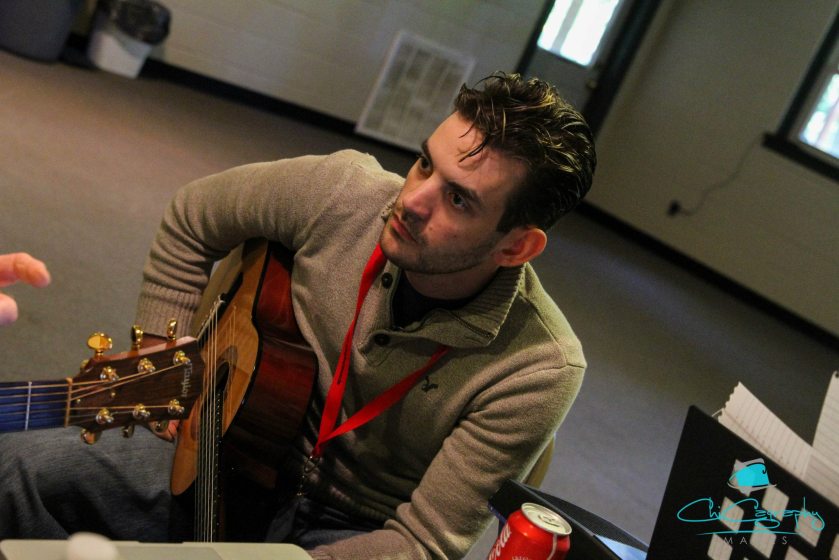
Aaron Voris, combat veteran, attending a SAFE songwriting retreat. Used with permission.

One young soldier, who was wounded himself when he returned, was haunted by the memory of having to carry the body of a small child to a burn pile after a battle. He knew nothing about her, and her family could not be found. Perhaps they did not survive either. For the longest time, that memory was disturbing and his greatest desire was to drive the pain of that moment from his mind.

With the help of a counselor, however, he chose to see the memory not as a haunting spectre but as a desire to be honored and remembered. That child – whoever she was – deserved to be honored and remembered, too, and, he realized, there might be no one else to do that. Remembering this innocent victim of war was his new mission and embracing that gave him some peace. He gave her a name and then he planted a tree dedicated to her in the field behind his home. He tends to it and hopes she is at peace as well, knowing she was remembered.

“If you break faith with us who die / We shall not sleep…’” 

Canadian Lt. Colonel John McRae’s World War I poem, “In Flanders Fields.”

These rituals will never erase the profound sense of loss or the survivors’ guilt, but they can keep the veteran from turning the grief and guilt inward in destructive ways, Smith says.

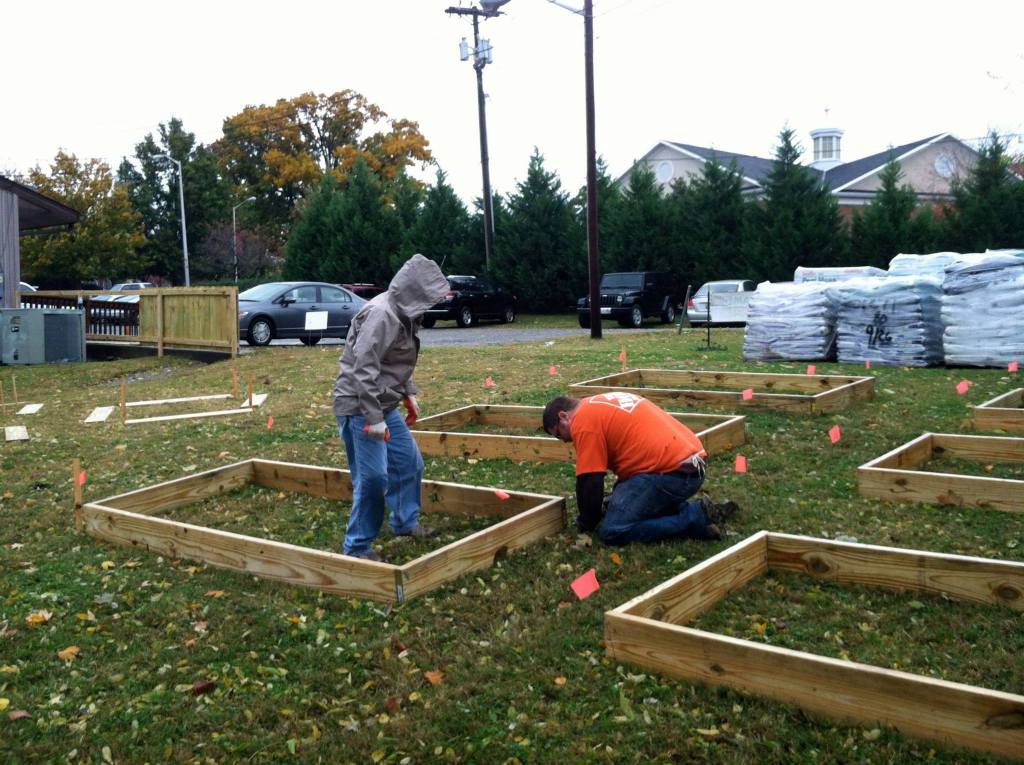
Veterans build raised gardens to provide hands on therapy “giving life,” rather than taking it .

Finding Meaning in Survival

Rituals also serve as regular reminders that survivors were likely spared for some reason. These acts and memorials become the new missions that can help combat survivors bear the duty of remembering.

I believe Eddie was deep in thought the entire time he was building our new ramp, promising his fallen buddies that each nail driven and each step taken on this ramp was a reminder that war was not all there was and that those who fell would be remembered and honored every time someone entered that campus ministry building.

Accepting their new mission, embracing this sacred duty to remember and honor, can, with the help of families, friends, counselors and ministers, ease the survivors’ guilt enough for today and help them cope with the fact that, once a combat veteran returns home from battle, every day becomes Memorial Day. 

Thank a veteran next time you see him or her but remember, they don’t think of themselves as the heroes. In fact, it may disturb them to be called a hero. “Thank you for your service” is enough. Even better, how about we all just take a minute and reflect on why we have designated a Memorial Day in the first place?


This is first of a series of posts about war, loss and healing.

I am a veteran, retired United Methodist Minister and co-founder of Soldiers And Families Embraced (SAFE), a non-profit offering free counseling to combat veterans and their families.  In 2011, at the height of the US military’s largest scale armed conflicts since the Vietnam War in Iraq and Afghanistan, I served as the campus minister at Austin Peay State University in Clarksville, Tennessee, which is adjacent to Fort Campbell, Kentucky.  At the time, more than 17,000 Soldiers were deployed into combat from the fort, which had the highest suicide rate of any other base in FORSCM.  Veterans, their spouses and their children began bringing to campus the effects of multiple, year-long combat deployments, including Post-Traumatic Stress Disorder and Traumatic Brain Injuries.  In response, with the help of a veteran studying social work, we began a free and totally confidential counseling program based on the story of Lazarus emerging from the tomb, still wrapped in the trappings of war and death.  SAFE continues today providing free counseling to those affected by all wars.

Leave a comment

You Can Have My Seat on the Mourner’s Bench

Rituals are meant to be the beginning of the healing process, not the end of it.

Rituals can be powerful for healing, and we need them to help us heal after loss and tragedy. That memorial service we hold when someone dies? It is for the living, not the person who died. Those impromptu memorials after shootings? They help us come together to start the healing.

Rituals are just the beginning, though. This is especially true when our own behavior is part of the problem, when we keep doing the same things and expecting different results. At that point, our rituals are pointless and empty. Visiting a shut-in about once a month for nearly a decade taught me this.

By the time I started preaching, James (I changed his name for this post.) and his wife of close to 60 years were both homebound shut-ins and so were on a rotation of homes for the pastor to visit after worship. Visiting their home was ever the adventure, though.

The entry of the home was a strange mix of antebellum and 70’s influences. A folding metal lawn chair leaned up against one of the original plaster columns that framed the ten-foot-high wooden doors, for example. Heavy enough to kill you if they fell on you, the doors were never allowed to completely close as long as I knew James; opening them would have required at least two grown men. A makeshift screen door was all that separated visitors from the cluttered yard and the porch strewn with more folded lawn chairs, some dead potted plants and a half-empty bag of mulch.

The first time I visited, after knocking several times, I gingerly pushed the screen door open and started towards the voice of a television newscaster beckoning me from the farthest end of the great entry hall. On my right, was a set of partially closed doors, and from them I could see Jame’s wife, whom I also had not met, but whom I was told was not interested in visitors. I later did manage to introduce myself and be admitted to her room but that was apparently only out of necessity: I was allowed in long enough to change the channel on her nearly-antebellum black and white television for her. I was only in her room long enough to realize that, though she was hooked up to an oxygen machine, sitting next to her on the bedside table was a pack of cigarettes and a full ashtray. I declined to empty the ashtray for her, and she waved me out of the room.

I passed two more sets of floor-to-ceiling wooden doors on either side of the great hall before arriving at what must have originally been the site of the grand staircase. Evidently, the top floor of the old home had been caving in, so James’ predecessors had lopped it off before moving it to the current site facing a four-lane highway. The opening to the old stairwell had been boarded up with thin, dark paneling, creating a wall for a now-enclosed back porch. From an opening on the far left I could see the shadows from the television news cast flickering. I peeked around the opening to see the now rather annoyingly loud black and white television, a tv tray lined with medicine bottles and half-opened packages of lemon cookies, and James in a recliner.

He looked up that first visit and asked, “You the lady preacher or are you here to check my sugar?”

“Lady Preacher,” I offered and he pointed to the ottoman next to his recliner, the only other piece of furniture I could see in the dark, enclosed porch under the stairwell. Sitting on the ottoman meant I was looking up at James as we chatted, as if I had been relegated to the children’s table at Thanksgiving.

In my eleven years serving that church, James sat in that recliner for every conversation. The trajectory of our conversations and our relationship, however, determined the seat I would be offered. My perch progressed over the years from the lowly ottoman to a metal and vinyl kitchen chair and eventually to a second recliner, the offer of which required clearing away a years’s worth of mass mailing ads and cookie wrappers. My own recliner. I though I had arrived.

Preaching “Scripturally”

Even after my graduation to adult seating, though, our struggle continued. Over the years James’ oldest son indicated that James did not believe I was preaching correctly. I was not, in James’ words, “preaching Scripturally.” Though James did not actually attend and only heard secondhand about my preaching from his son, evidently, when his son told him about my sermons, James’ complaint remained the same. “Not preaching Scripturally.”

Years would pass before I would be able to grasp the kind of preaching he would consider “Scriptural.”

Every sermon I preached began with a Scripture passage, intentionally allowing the text to speak for itself. I trust the Scripture to tell us something about God and ourselves. I didn’t always like what I learned but I respected it, so I knew James’ accusations either were incorrect or misinformed. His son had reassured me he was reporting my sermon Scripture choices and preaching points, so neither of us realized for some time exactly why James consistently was disappointed. It took me years to realize that, for James and likely for many others of his upbringing, church was supposed to “convict.”

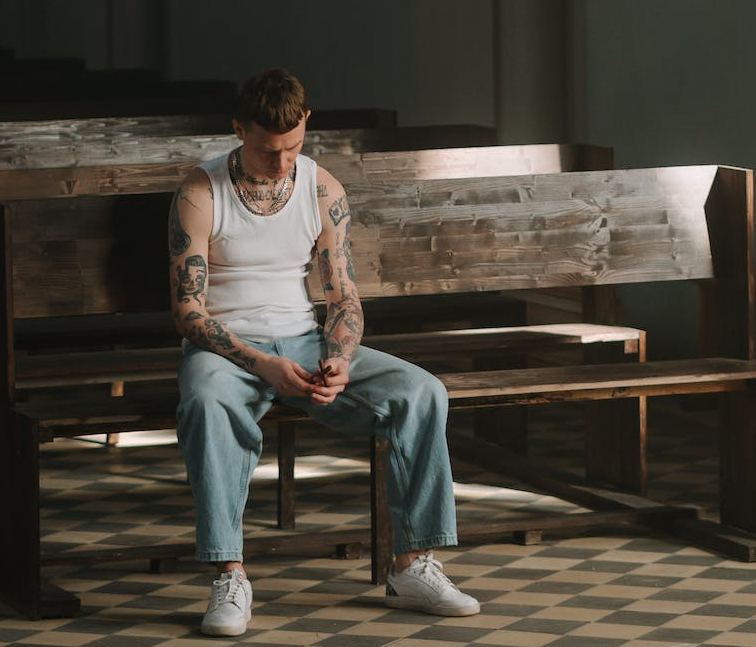
Someone went to the mourner’s bench or church had not broken out.

From the moment you entered the sanctuary apparently, church was meant to be a frightening experience; God knew what you had done all week and before the sermon was over, an honest-to-God, bona fide pastor would have directed your miserable self to come forward and sit on the hardest bench, a single bench at the front of the sanctuary, the one without a back, the “Mourner’s Bench.” There you were expected to confess that you were a sinner – lower than a worm on really bad weeks in spite of being a baptized believer. You were directed then to confess, then you were forgiven and then the congregation would sing, “Shall We Gather at the River” or “Just As I Am” before heading home.

Take me to the real church. Find me a mourner’s bench. God knows what I did all week.

This process, I learned, what James would call “preaching Scripturally,” would render backsliding baptized members “Good-to-Go” for another week. Sadly, though, it was usually then a week of the same damn behavior that had made you feel so guilty the week before, but it was fine because you could count on the Preacher to help you confess and be forgiven all over again the next week. That was apparently how folks knew they’d been to church.

Sure, not everyone went to the mourner’s bench every week but someone did or preaching had not really broken out.

By the time I got there, it didn’t matter that there was no longer a mourner’s bench in the sanctuary; the expectation was still that sitting in the pew on a Sunday invited guilt and shame and the preacher must offer a chance to ask for forgiveness so folks could feel better about themselves for at least a few days.

Full disclaimer: this is not Methodist theology.

For James to feel like he’d “been to church,” he would need to go through the whole ritual, to confess and be forgiven before he was good to go. Then, though, he apparently felt that he would be free to live his life however he wanted…until he needed to come back and do it again.

Nothing in his life changed after that ritual. It was empty. This is the kind of empty ritual that God does not want, we are told in our Scriptures. As much as God loves a good ritual, even God does not seek or require ritual simply for ritual’s sake without any change in behavior. 

In Isaiah 58, “God mocks people who seek God as if they were ‘a nation that acted righteously.’  God accuses them of saying they want to be close to God, but ‘you do whatever you want…oppress all your workers… quarrel and brawl…hit each other violently.’  In classic Hebrew style, [Isaiah makes God sound] like a Yiddish grandmother saying, ‘Oy vey! You call this a fast? Enough with the thoughts and prayers, already!’ (58:5)”

Harnish, Jim, https://jimharnish.org/2022/05/26/is-god-fed-up-with-our-prayers/

Isaiah 58 is tough to read.  God rejects empty piety. God rejects our “lying down in the mourning clothing and ashes” while we still oppress, quarrel and brawl, rejects us going through the rituals but then continuing the behavior that caused us to need to mourn in the first place. More to the point today, God calls us to concrete actions, not simply thoughts and prayers:

“Isn’t this the fast I choose:

releasing wicked restraints, untying the ropes of a yoke,

setting free the mistreated, and breaking every yoke?

Isn’t it sharing your bread with the hungry

and bringing the homeless poor into your house,

covering the naked when you see them,

 and not hiding from your own family?

With God’s command comes God’s promise:

Then your light will break out like the dawn,

and you will be healed quickly….

Then you will call, and the Lord will answer;

you will cry for help, and God will say, I’m here.

Isaiah 58

God loves a good ritual, but even God does not seek ritual simply for ritual’s sake without any change in behavior. 

A few weeks ago, a second-grader fell at a school in the Nashville area, less than an hour from the Covenant School. She stumbled and fell, sadly, during an active shooter drill, cutting her knee and scraping her elbows, after the teacher had screamed at the children to “Run!” A sweet gesture from another child helped ease the pain and panic in that moment: one of her classmates stopped, helped the distraught child get back up and ran with her to the safe gathering spot.

The good news: her friend didn’t leave her behind.

The horrible terrible very sad news: our response to people who take AR-15’s into schools is to step up active shooter drills.

For God, our rituals mourning all of these shootings are empty and meaningless if we continue to do what we do and wonder why things never get better.  As a nation, we’ve gotten pretty good at this, though, acting as if our stint on the mourner’s bench is sufficient.

After the Covenant shooting, a large number of Nashville neighbors including many clergy colleagues participated in actions beyond candlelight vigils and prayers and leaving stuffed animals and flowers and balloons at an impromptu memorial. Thousands staged a sit-in and even marched on the state capitol. The overwhelming message to the politicians who would not consider bans on assault weapons was “Save your ‘thoughts and prayers.'”

With no apparent policy changes, though, the best efforts are still empty rituals, something we are sadly proficient at in this country.

We mourn, but we still can legally purchase an AR-15 and make up for it by telling our children to learn to run faster.

The horrible terrible very sad news is we still think the best response is teaching children to run faster and hide better.

Maybe you believe the problem is guns. Maybe you believe the problem is certain types of guns.

Maybe you support more police in school or arming teachers.

I know I want people to understand there can never be enough equipment for any SRO to combat an 18-year-old in a Kevlar vest and a helmet with an assault rifle. 

Maybe you believe the problem is broken families, no prayer in schools, the lack of mental health care, or children who come to school having never sat down with an adult to read a story book. The truth is, it’s likely some of all of these but focussing only on mental health care without limiting access to the weapons that leave small bodies in shreds is mourners’ bench behavior. That renders our thoughts and prayers empty.

What is critical here is that we do not make our rituals empty, that we do not sit on the mourner’s bench and cry and pray and then go home and keep doing what we have been doing. Because that is making a mockery of our faith and rituals.

Whichever side you fall on, God asks what are you doing to help fix it? Are you just making more room on the bench?

To lament, to pray, to mourn, and then to change nothing is to miss the point.  It is, in fact, to fail–to fail our children and to fail our God.

At the very least, educate yourself. And by that I don’t mean just read what people write who agree with you. Read what people write who don’t agree with you. Learn the actual issues in your area. Every state has different issues and different laws. More than anything, listen to people who disagree with you.

Everyone of us is afraid and sad and none of us has answers that will work for each situation, but God calls us to work together to keep our children safe. Look up your community’s Peace and Justice Center and join in. No Center? Look into starting one.

Grieve, pray, then do something that shows you have truly taken in the gravity of the situation; but for God’s sake, let us not keep acting as if nothing has happened.   

Our children

need us to

figure it out.

  1. Nancy Bradshaw Avatar
    Nancy Bradshaw

    Challenging piece about an horrific plague on our land. What are our lawmakers thinking? They hear the voices of the people and yet do little to address the problem. I need to do more, I know. Letter writing is just not getting it either. Thanks for your focus on what’s going wrong in our world.

    Like

  2. Martha Ann Pilcher Avatar
    Martha Ann Pilcher

    Amen!

    Like

  3. D-Day Promises, Guilt and Forgiveness – Emptying The Backpack Avatar

    […] a previous post, (“You Can Have My Seat on the Mourner’s Bench,”) I introduced James, (not his real name), who struggled mightily with ongoing guilt and grief […]

    Like

  4. D-Day Promises, Guilt and Forgiveness – Eighty Years Later – Emptying The Backpack Avatar

    […] a previous post, (“You Can Have My Seat on the Mourner’s Bench,”) I introduced James, (not his real name), who struggled mightily with ongoing guilt and grief […]

    Liked by 1 person

Of Pakistan, Chewing Gum, Chatty Cathy Dolls & Valiant Efforts

A favorite talisman from Pakistan. I loved how all the different sizes nested one inside the other. I’ve carried this painted wooden toy with me for nearly sixty years now. Cracked and repaired, broken but still beautiful, a cradle of memories.

When I was seven, my brother, who was eight, my sister, who was six, and I got dumped in our grandparents’ laps, a harsh ending to what had begun two years earlier as a grand adventure, meant to last a lifetime.

Once it was announced that Dad had secured a coveted engineering job overseas, we had all been celebrities at one festive send off after another from Springfield, to the unknown and mysterious West Pakistan, (now Pakistan). The biggest Bon Voyage event, where each of us had been presented with brand new suitcases to go with our brand new outfits for the journey to the other side of the earth, reflected how impressed friends, coworkers and neighbors had been when Dad had secured the contract.

That the way to Pakistan involved so many shots for so many illnesses was annoying, but, for me, the memories of those jabs are overshadowed by those of international flights on Pan Am where the pilots brought all the children on the flight into the cockpit and each of us received a souvenir Pan Am flight bag and our own set of pilot’s wings. I remember buying a doll in Tokyo, where I was convinced that I could speak Japanese because I could speak to the sales clerk. I remember arriving in Karachi to be served warm milk and runny eggs and that we slept twenty-four hours before driving to our new home in a walled compound in Northern Pakistan. I remember much about our time in Pakistan, but I do not remember the trip home.

Thoughout the two years we were there, Dad was likely excelling in his work, but, before the contract was completed and we could be posted at yet another overseas project on another continent, Dad was forced to break his contract and return to the states on short notice, with little or no money, no job and much anger.

So, just a few days after boarding a plane for home, the three of us children found ourselves seated in a row on the edge of the bed in a motel halfway between our grandparents’ home in the little town of Waynesville, Missouri, and wherever Dad had found a job. The motel bed was low to the ground; our toes just touched the linoleum and we were each individually toeing the floor and pushing the old bed up and down, causing the box springs to creak softly. Next door, we could hear our parents and grandparents arguing loudly. We did not know then the three of us would not be going to the tiny apartment Dad had managed to find. 

I clutched my Chatty Cathy doll. Bless her heart, she’d stayed with me throughout our time overseas in spite of looking like she had mange because my little sister had taken a pair of scissors to her black hair. My sister clutched a stuffed monkey who had a permanent grip on a plastic banana. She had already given up the doll she’d been given, one who giggled when her arms were squeezed, and who likely ended up in another child’s arms, looking like she was just out of the box with that curly, blond hairdo intact. Don’t think it didn’t cross my mind, though, to experiment on her with scissors. Maybe my sister was just more angry at that time than I was. 

“Say goodbye to your children!” my father had hissed moments before all three of us climbed in the back of our grandparents’ sedan. Mom’s eyes were already glazed over though; she wasn’t responding. She had said nothing while my father had been yelling for weeks, it seemed, most recently in the next motel room, in front of her parents, who also were silent. We couldn’t hear any of those angry words at all, only loud voices, then we each flinched as the door to our motel room had swung open and we saw our parents standing there.  “Say goodbye!” 

Grandma Ree and Grandpa George seemed just as dumbfounded as we were, I think, and were really in no financial position to take on more, but to their credit, they put the three of us into the back of their tiny dark blue sedan anyway.  Driving away from that motel, each of us rode silently, wide-eyed, tacitly agreeing it was better not to ask. 

His Adventure; Her Nightmare

On our way home from Pakistan, we’d each been wearing a new pair of leather shoes made from a cobbler in Pakistan. Even finding shoes while we were there became an adventure for my father who savored every side trip to a bazaar and whose shopping addiction devoured cameras and jewelry and handmade rugs and carved tables with ivory inlay for playing chess. Being there while the country was at war with India was a nightmare for our mother, though; after my parents ventured to the bazaars, she had nightmares about the children who had been purposely maimed in order to make their begging more lucrative. By the time we left Pakistan, Mom had begun obsessing about keeping the windows covered with foil for nighttime blackouts, long after it was necessary. 

The civil engineering position Dad had secured with this company overseas was his dream and meant to last his whole career; he had not planned to have to return to southwest Missouri with his family at all, certainly not as a quitter. This contract was his chance to escape small towns and small minds, and that dream was not meant to die a quick death because his young wife discovered the balm of alcohol and realized that some men could be sweet. Mom, bless her heart, had been thrust into a world she had never contemplated and one she was vastly unprepared to engage, understand or master. Dad, on the other hand, had served overseas in the Air Force and, when he returned, he invested in National Geographic in order to know more about the world he had only tasted in his two years in Puerto Rico. This job had been his chance to immerse himself in adventure and travel.

A small-town girl who had never left Missouri before, Mom continued dutifully each day to don a crisply ironed dress and heels while struggling to learn to oversee servants, like the first one, a “Bearer.” The Pakistani manservant who did not speak any English was in the house all day, and ironed and cooked unrecognizable meals for us.  He didn’t last long. A gardener, a “Mali,” was required, if only to keep up appearances in the European-style neighborhoods built by the company that had brought so many engineers and families from all over the world. We knew, though, that walking outside one morning to find the gardener, proudly holding up the cobra he’d caught in the yard where her children played was too much for Mom. She began to unravel. Our father held out, though, and doubled down on social activities, including starting a Boy Scout troop, in hopes Mom would adjust. Instead, she discovered the alcohol that had never been allowed in her home growing up. She found the mathematics of rum, to be precise. One drink made her feel good, two made the barbed wire on the compound walls fade, and four drinks made all the lizards and maimed children and strange men in the house just slip away for hours and hours. 

We never saw Mom drink, though. We were in bed every night by seven p.m. We never saw her drink and we never saw our father much at all.  For the two years we lived in Pakistan, our father kept twelve-hour work days and so our paths did not cross for two years, except on the occasional family shopping outing. During those two years was the only time we had allowances and every few weeks, the family would venture to the compound’s shopping area where we could find a Pakistani furniture store, a European-style restaurant complete with a dessert cart filled with petit-fours, and a toy store, where we were happy to spend our allowances, most often on comic books since there were no Saturday morning cartoons. We had no television at all in our home there, in fact, so by the time we left after two years, we had amassed more than three hundred Archie, Superman and Richie Rich comic books and often participated in a robust trading circle with other neighborhood children. Once, though, we all three saved our allowance to buy a pale blue scooter that we could see high up on a corner shelf in the toy store. We visited that store several times without buying any new toys or comics, simply to be sure no other children had purchased that little scooter high up in the corner.  We were struggling not to run or pull on our father’s hand to get to the store when the day for purchase finally arrived. Together, the three of us proudly plunked down our rupees onto the counter and watched, holding our breath, as the store owner pulled the scooter down and dusted it off.  When he rolled it around the corner of the counter, however, to present that blue beauty to us, my older brother and I realized that the scooter, heretofore only viewed from afar, was too small for either of us. Only our little sister would be able to enjoy it. There was no going back, however. The store owner was beaming at having sold the toy that had taken up his store’s top shelf for months and our father would have been too embarrassed to halt the purchase. Typical of our relationship, though, my brother and I did not commiserate; we were silent as our feet dragged on the dusty road going home. Our sister stayed on the sidewalks with the scooter but I do not remember her using it very often after that, which only added to our disappointment. 

Photo by Erik Mclean on Pexels.com

Other than the occasional shopping trip, church and the bowling alley, we did not see our father. Even at those venues, we did not interact with him. Our understanding was that, like the other engineers who worked long hours building that dam, our father was excused from many family activities. When we did participate as a family, like at the bowling alley, the children went off unsupervised mostly, so we still didn’t see our parents unless we were causing a problem. Dad was apparently a minor celebrity at the bowling alley, though, often bowling perfect or near perfect games. Our time there consisted of ordering tuna fish sandwiches and zombies to drink at the adjacent grill and watching, fascinated, as the Pakistani workers reset the pins after each throw of the ball.  No automated pin replacement there. 

Though I was very young, I remember a lot about when my Father was helping in the beginning years to build Mangla Dam in West Pakistan, now Pakistan (as opposed to East Pakistan, now Bangladesh.) Most of our old photos from that time, however, are lost. I do remember that strange juxtaposition of Western and Pakistani. We attended a British school where I learned some Urdu and to add an “e” in the middle of judgment, (i.e., British spelling) a bowling alley and we enjoyed a wonderful series of public pools. We also explored some historic sites and went to school with children from all over the world, including Pakistan. (See Wikipedia, Mangla Dam and Mangla Dam Memories on Facebook.)

Otherwise, the three of us were on our own outside of school hours. The compound was large with an American side and a European side and a bus that drove around both sides all day.  On any particularly boring day, the three of us would simply climb onto the old, repainted school bus and ride down all the streets of both sides of the compound, cooled by the hot wind coming through the open windows and fascinated by what our neighbors might be up to that day. I am still amazed that we were simply allowed to wander at five, six and seven years old. In Pakistan.

The entire adventure seemed a contradiction in terms, characterized for me by the fact that we lived in a compound surrounded by a stone wall with barbed wire and cut glass on the top but where the gates were always open and unguarded.

There was an open gate at the back of our own yard, in fact, and from it, we could see a small village where, we were told, women slapped cow dung onto the walls of the homes to dry to be later used as fuel for the fire. Every day, we could hear the calls to worship; they were haunting and beautiful, a call to an Islamic understanding of God that serenaded us as we walked to our Christian church potluck supper. For some of the year, the dust on the side of the road was a fine and deep silt and we would slide our feet through it as if it were snow; other times, during monsoon season, there seemed to be nothing that was dry.

Unsupervised. In Pakistan. At age 7.

That we were largely unsupervised outside of school hours made sense to someone I guess. Until the injuries began. First, my five-year-old sister got stitches trying to climb up a ladder to dive off of the high dive at the crowded community pool. Then, I nearly drowned just a few feet from my mother in the same pool; another mother noticed me struggling to keep my head above water and grabbed me. Mom was busy chatting. There was a broken arm, then stitches for me. Twice. This time, however, neglect was not the problem. I had become the target of choice for my older brother who gleefully ran his bicycle into mine, causing the pedal to tear into the fleshy part of my lower right leg, leaving white tissue oozing down my shin. He later threw a cutting board at me, just missing my eye socket but also requiring stitches. We may never know if another parent intervened or if our father walking into the living room to see our mother kissing the neighbor, but there came a day when Dad sat all three of us down on the edge of a bed in our shared bedroom to tell us our mother was ill and would be “going away” for six months or more. It had been decided we three would wait for her there, in Pakistan.

That’s when the wailing began. Paid mourners could not have been louder or more dramatic. At the time, we were terrified, but we were also resolute, huddled together eyeing that dark and dangerous chasm that seemed to open up before us. We did not know this man. No way were we letting Mom go quietly. We did not stop crying until Dad returned to the room hours later to tell us we were all going home. 

Our relief was short-lived, though; once my father dragged Mom away from that motel, we did not see or hear from our parents for months and months. The timeline is vague for me but I remember attending three schools in second grade. So, once we were settled in my grandparents’ two-bedroom duplex in Waynesville, I took to running away, searching for her. From school, from my grandparents’ home, even from church services, I escaped, watching for unsupervised moments and unlocked doors, taking advantage of crowds and distracted adults, always looking for my mother. 

More than once, because Grandma Ree was exasperated, I was simply allowed to stay home from school on my grandfather’s day off and we watched cartoons and ate Oreos while he ironed the work shirts he wore driving trucks. Grandpa George seemed to me to be the only adult who was not angry with me; I remain convinced that was because he understood my quest. 

Once, after I’d run away from school, the school principal found me. He and a teacher picked me up in a car after they’d driven all over that little town looking for this wayward seven-year-old. 

“There, there,” he said, offering me a piece of gum in a green wrapper folded around shiny foil, very much a treat then.  Defeated for the moment, I cooperated and got into the old car, only because I’d been wandering for hours and it was getting dark. Offering me a stick of gum, though? Did the adults around me really think that would fix this? I remember looking at him as if he were clueless. It would be years later, though, before I could be proud of that seven-year-old slapping that piece of gum from the principal’s hand in the back of that car, and even longer before I could appreciate the courage it had taken for the three of us to stand up to our father. 

We all paid a price, though; we would never have back the mother we had known. When we saw her again, she was subdued, defeated. She had endured shame, therapy, even, we were told later, shock treatments, all because her dream was not his dream. She was not unlike many women of her day, praised for obedience like a child. For the rest of his life, though, my father was on notice. I’m not certain to this day that we accomplished much, but our little rebellion was uncharacteristic of us and I am proud to be able to look back and say that those three little souls refused to go quietly into the darkness. 

.

Drawing the Circle Wider: Prison Ministry and Family

The last time I read the Scriptural passage about the woman who insisted Jesus heal her even after he likened her people to the dogs under the table, it made me think of my youngest son. And jails.  For several reasons.

"Leaving that place, Jesus withdrew to the region of Tyre and Sidon. Just then a Canaanite woman from that region came out and started shouting, “Have mercy on me, Lord, Son of David; my daughter is tormented by a demon.” 
But he did not answer her at all. And his disciples came and urged him, saying, “Send her away, for she keeps shouting after us.” 
He answered, “I was sent only to the lost sheep of the house of Israel.” 
But she came and knelt before him, saying, “Lord, help me.” 
He answered, “It is not fair to take the children’s food and throw it to the dogs.” She said, “Yes, Lord, yet even the dogs eat the crumbs that fall from their masters’ table.” 
Then Jesus answered her, “Woman, great is your faith! Let it be done for you as you wish.” And her daughter was healed instantly."  Matthew 15:21-28 

First, my son is a lawyer, working as a public defender.  He’s the guy who gets assigned to people who don’t have money for a private attorney when they have to appear in court.  He thinks it’s a hoot that he can call his mom whenever he wants to and say he’s headed to jail.  Haha.  

Second, he LOVES to argue.

And third, he likes rules. To be specific, he likes knowing where the line is.  When he was younger, we’d tell him the rules and he would make us hold that line.  We’d tell him not to step over that line and he’d put his toe right up to it and ask, “You mean this line?”  For the longest time, his constant testing of our boundaries and rules for him was frustrating. After a while though, we realized he really DID want to know where the line was because rules helped him feel safe, helped him know where he stood.  That may be WHY he became a lawyer, that love of rules.  He ate all that up, all those laws and statutes, just his cup of tea.  So he likes being a lawyer, at least most of the time, likes helping folks who find themselves in trouble but can’t afford a private lawyer.  

We’d tell him not to step over that line and he’d put his toe right up to it and ask, “You mean this line?”

So most of the folks he defends have very little means and many of them don’t get bailed out while they wait for their day in court.  That’s when he calls mom and says he’s going to jail.  It’s been frustrating for him often but every so often, it is also quite rewarding.  For one exxample, a couple of years ago, he was visiting a young client at the jail and the client asked how old my son was.  He shared that he was in fact turning 32 on that very day and the client was floored. “You mean you have to come here on your birthday?” he asked. “Are you gonna get to have a party or a cake later?” he asked. “Probably not,” my son said, shrugging it off. He didn’t think about it again until he saw the young client again a couple of weeks later and the client, in his twenties, pulled a folded up napkin from the pocket of his orange jumpsuit and unfolded it to reveal a cookie.  “This is for you, man,” he said.  “Because you didn’t get a birthday cake.  I saved my cookie from lunch for you.”  My son was speechless, which is significant for him. He’s never at a loss for words.  

Photo by RODNAE Productions on Pexels.com

It’s not a stretch, though, to say that most of us are not terribly comfortable with courts and jails and prisons so I don’t feel like I’m bragging when I say my son is comfortable going to jail because his mom went to prison.  No no – don’t get me wrong.  I went to prison the way he goes to jail.  

When I was in seminary, we were offered classes that met in Riverbend Prison, classes that were populated half by seminarians and half by inmates.  We studied issues surrounding prisons, legal systems, punishment and forgiveness.  I did that for the entire time I was in seminary, every week, and I can tell you I learned a great deal and came to know about a dozen of the prisoners pretty well – guys in for everything from murder to arson to rape – all of whom were taking the same graduate level classes the seminarians were taking.  When it came time for me to graduate, then, I was invited to continue visiting by getting on the visitation list of one of the inmates.  When you visit Riverbend, like lots of state prisons, you visit during set hours in a large open room and there might be as many as fifty inmates also having visitors in the same room, all seated on molded plastic chairs, all attached in groups of twos or threes. At the corner of many of the sets of chairs are the all-valuable tables.  Tables are at a premium and desired because, all around the walls of the room are vending machines for snacks. Most of the foods in those vending machines are cheese and peanut butter crackers, tuna fish sandwiches and peanuts and candy. None of the items appealed to me much, I realized, because the daily food I had was better and more varied than those offerings. To the men who lived there, the stale hamburgers were a real treat.

Visits generally were on the weekends and lasted several hours; if an inmate had visitor privileges (and those were earned), they could possibly see family or friends who’d been approved by the prison system on Friday evening, Saturday morning and/or Sunday afternoon, for example. Visitors were subject to body searches and metal detectors and not allowed to carry in much, not even key fobs and certainly no phones.  The nice thinga bout the open room was that you can easily visit with several inmates at the same time and that’s what some of us from the classes did.  Usually on Friday night or Saturday morning, we’d go to visit one of the inmates who had been in the class and be able to see several of them and catch up on their lives and share about ours. 

While I always visited as a friend and not as a minister, the inmates always asked about my ministry and the church I was serving and, for a couple of them, it eased the loneliness of not receiving visits from family.  One thing we had learned was that inmates who served their time and then were released were 5-10 more successful staying out of trouble when they got out if they had continued to have relationships that were positive.  So, we particularly focussed on being supportive of those whose families were not involved in their lives and didn’t visit or call. 

Some of us spoke to one or more of the inmates by phone as well.  They were allowed to have up to ten people they called and most looked forward to having someone to call on occasion to break up the monotony if nothing else.  I agreed to be on the phone list of one of the inmates, who is, by the way, not eligible to be released for another decade, if he lives that long.  It was safe.  For an inmate to call you required a LOT of paperwork and clearances and then when they called, you heard a voice say, so and so from Riverbend Prison is calling you, do you want to accept the call?   I was careful and the school and the prison were careful but I know it still made people nervous who knew me. That included, not surprisingly, my parents, who were at that time retired and who worried alot about me anyway. 

Mom and Dad were especially struggling with my being friends with inmates because neither of them had ever even  met someone who had gone to jail, not even for a DUI, and they didn’t even know anyone else who knew anyone who’d gone to jail.  It was too foreign a concept and just not acceptable. So one weekend I went to Missouri to visit them and told them I was visiting an inmate and he was allowed to call me, they were angry.  I assured them that inmates could NOT call cell phones and they only had my home phone number in Tennessee so they could not call me while I was at my parents home in Missouri.

For an inmate to call you required a LOT of paperwork and clearances and then when they called, you heard a voice say, so and so from Riverbend Prison is calling you, do you want to accept the call?  

Nevertheless, while I was there with them, while we were arguing about whether or not this was acceptable behavior on my part be friends with some guy who was sitting in a prison cell, the phone rang and my mother answered, then handed me the phone angrily.  It’s your criminal friend, she said. I took the phone trying to answer while also explaining to them that it couldn’t be him because he couldn’t call me at their house when I heard the voice on the other end say, “…an inmate from the Greene County, Missouri, jail is calling.  Do you want to accept the call?”

I realized suddenly that call was not coming from my friend in Tennessee but rather from my brother, who apparently had been arrested the night before.  And suddenly, the inmate in Tennessee – whom they were sure was dangerous and not to be trusted – was sitting on a hard metal bench next to my brother, their son, in a jail cell. And just like that, the circle of their care and compassion grew a whole lot larger.  

My own circle of care and compassion grew exponentially because of my time visiting prisons. When I was sent to another church, turned out that nearly one quarter of the folks in the church had family or friends who had served or were serving time and it helped my ministry greatly that I knew first hand what it was like for them to constantly to worry about the safety of their loved one, to struggle financially because of lost income, to struggle not to be ashamed of what another person had done, to wonder how things would be when they returned home.  

Those families were grateful when their pastor talked then about visiting the prison regularly. For the first time, their pastor was there with them when they sat in the visitation gallery on Christmas Day or Easter or celebrated with them when their son got his GED in prison, sharing hopes he could change the path he was on.   Their pastor seemed to speak the same language and was one of their people, one who at least accepted and cared about their “kind.”

All of that is what leads me to one of the most troubling aspects of this story in Matthew 15: how the disciples AND Jesus treat this woman, who is not one of them, not one of their “kind.”

We find first that Jesus refuses even to answer the woman, then denies he has anything that she could possibly want and then even likens her to a dog.  This is definitely a troubling passage.

 We may believe that Jesus was “truly human,” but usually we don’t want him to be too human. So over the years, people have tried to clean up this story. But Matthew doesn’t clean up this story.  He lets us see this encounter in all its unvarnished glory.   

The woman is a Canaanite woman – and she is NOT one of Jesus’ “people”. But he is in her part of the world –  Tyre and Sidon. This is her home.  

Nevertheless, this woman seems to know who Jesus is. She has tracked him down in order to ask him –  to beg him –  to heal her daughter who is tormented by a demon. This is a desperate woman and apparently,  comes at Jesus shouting. The disciples want nothing to do with her and want Jesus to send her packing. 

She isn’t going anywhere, though. She may not be “their kind,” but she somehow knows enough about this healer to find him and call to him in the language of the Jewish prayer: “Have mercy on me, Lord, Son of David.” She has come prepared to fight for her child, it seems. 

Even so, Jesus isn’t even impressed by her using the language he knows is not hers. “I was sent only to the lost sheep of Israel,” he tells her, and still she doesn’t give up.

 “Lord, help me,” she begs. This is where Jesus says what we really wish he hadn’t said, “It is not fair to take the children’s food and throw it to the dogs.” But this woman is feisty and stubborn.   Having a special needs grandchild, though, means there’s one thing I have learned about people who know their children’s lives are in danger –  they will get in your face if necessary – they do not care if you do not like it.  That’s their baby and the hair on the back of their neck stands up every time someone or something threatens that child’s safety.  The life of this woman’s daughter is at stake. She does not back down at all but throws Jesus’s words right back at him: “Yes, Lord,” she says, “but even the dogs eat the crumbs that fall from their masters’ table.”  

And all of a sudden, just like that, Jesus changes his tone. He says, “Woman, great is your faith!” 

Interestingly, she hasn’t made any confession of faith, though. There’s no sign she’s been converted or planning to become a follower. She simply told him what she had heard – what many in the region had heard – that there had been by that time more than one instance where thousands had been fed when they came to see this healer, this rabbi called Jesus.  “I’ve heard that there were enough crumbs to feed thousands,” she seems to be saying.  “You can’t tell me there’s not enough for me and my daughter.” 

That’s what I believe Jesus finally heard and that’s why he not only changes his mind,  but he changes his mission. “For saying that,” he says, “you may go — the demon has left your daughter.”  And just like that, the circle, the line, that defines his mission on earth is widened to include everyone.

It is disturbing to some folks to think of this episode, such harsh words coming out of Jesus, but one thing was clear that Matthew wanted his listeners to understand: in that encounter, Jesus was converted – he understood something he had not understood before – and the circle of his mission and ministry was much larger than he had realized before.  The Kingdom of God had been revealed to him in the face of the Canaanite woman. The Canaanite woman taught Jesus that she and her daughter and so many others like her deserve more than crumbs. After this encounter Jesus went on to feed those who had not yet been fed, went on to include everyone in God’s kingdom to come.

We saw here something that ought to surprise us, certainly surprised me the first time I saw it: Jesus drew a line – as surely as if he had used a stick to draw a line in the sand and said, this, what I am sent to do, is not for you.  I’ve done enough. I am tapped out. I gave at the office.  I don’t have any more energy to help anyone else, to get to know anyone else, to include anyone else in my circle.  He dismissed her and not in a kind way at all.    

IF we are pushed, we will get ugly too, though; we’ve been known to let others see our disdain for that person who does not deserve any help or who needs to go somewhere else to find it.  “WE” don’t know people who go to prison and we don’t want to….

At least not until one of them is sitting next to our child in that jail cell and suddenly our circle is a little wider than we knew.  Any time this happens, it can be frightening, and it can feel like we are out there where we don’t feel so safe any more, and we might be really unsure about how this is gonna go.

If we look again, though, really look, chances are good we will see God in that cell, sitting there with all of them, sitting next to our child and all of them will be sharing cookies.  Amen

4 responses to “Drawing the Circle Wider: Prison Ministry and Family”

  1. Nancy Bradshaw Avatar
    Nancy Bradshaw

    Jodi, sitting here on the deck of a cruise ship. My eyes are watering and not from the sun but from the eye opening beauty of this piece that you wrote which reminds me that Jesus was certainly human as well as divine and that the divine is also in me , in you and all humanity. We just need to be reminded. Thank you for doing just that. ❤️

    Like

    1. Jodi McCullah Avatar

      You are a poet, dear friend. Thank you.

      Like

  2. a. getty Avatar
    a. getty

    Amen.

    Like

  3. Nancy Avatar
    Nancy

    Your ability to unite seemingly unrelated life experiences with a scripture and a message is your special craft, priceless. I bookmarked this weeks ago and I’m glad I came back to it. Forever faithful are we, Amen.

    Liked by 1 person

Leave a comment

Boots in the Trunk

Some of the greatest moments in life, I believe, are when you find out you are not the only one who does “that.” You’re not the only kid in class who likes to blow bubbles in her chocolate milk or the only student who questions why you should wear a dress to school on picture day when you hate wearing dresses and no one ever sees your dress because you’re always in the back row for pictures. Once, on a phone interview for a job in Florida, I mentioned that most of my friends “up here in the north” seemed to believe that living in colder climates builds character and people who want to live in warmer places are just lazy. The employer simply said, “Come on down; you’ll find plenty of hardworking folks here; they just happen to like burying their toes in the warm sand.” I remember thinking, “I’ve found my people.”

One of my most affirming moments occurred a few years ago while watching a movie that was set in southern California. A woman was sitting in heavy Los Angeles traffic on her way to work when the road began to shake and seemed to begin rolling. Her first response, once all the motion ceased, was to pop open her trunk and change from her fashionable black pumps into a pair of hiking boots. She evidently kept in her trunk for just such an emergency, or at least the character did. She must have known she’d likely have to walk through streets filled with debris, and the boots were just one of the survival tactics she’d either learned firsthand or been taught. She was prepared.

I remember nothing else now about the movie except that I wondered if she also kept some water and maybe a first aid kit and snacks in her trunk. What I loved was that she wasn’t some hiker out on the Appalachian Trail for weeks; the character must have been created by someone familiar with earthquakes who understood that we never know when or where we’ll need to run for our lives. It would be several years later before I would learn that boots in the trunk was a common response for survivors of trauma and abuse. I don’t know if the woman in the movie was supposed to have grown up with a scoutmaster for a father, or if she was a trauma survivor, but she embraced the boots in the trunk. She didn’t think it was weird.

Boots in the trunk, a “go” bag by the bed…

I was a teen when I realized not everyone slept with a “go bag” next to the bed in case a speedy escape became necessary in the middle of the night. After five decades of being teased by others for it, though, I was especially grateful to finally learn that lots of other trauma survivors sleep with shoes under the bed, a wallet or purse with meds, money and that handy Swiss Army knife by the bed, so that in an emergency, they do not waste precious survival and escape time locating footwear or a flashlight. Finally, I could stop being embarrassed that I preferred to sleep in something I knew I could wear outdoors in case of a fire or an earthquake or tornado. I could stop hiding the fact that I think about not wanting to have to run into the dark barefoot and thus be even more vulnerable in a crisis. My “go bag” has been a reasonable and healthy response to the lessons of my childhood where I was taught to be afraid of the dark and it is also a reflection of a strong instinct to survive. Instead of being embarrassed that I startled so easily, I became proud of my Swiss Army knife and I became grateful for those survival instincts. Plenty of children do not get out.

Escape Artists

I know some people who were abused or whose childhood was traumatic seek vengeance and long to hurt the one hurting them, and even hurt others in an attempt to ease their own pain, but my instinct has always been to escape. When my siblings and I were young, they seemed unaware that following the rules meant escaping the belt or the hair brush.  As we grew older and taller, I knew to stay well away from my parents’ and even my siblings’ arguments because they so easily slid into the violent responses we’d seen modeled. I mostly escaped broken bones and stitches by escaping as a child and teen. Later, I applied the same tactics to job losses and failures and broken relationships because I knew when to escape, and how to – most of the time – make an exit before the explosions.

Because I could escape, none of their crazy dust landed on me. I know without a doubt that is one reason I survived and got this far. Too many children who grew up like we did never get very far from the crazy, never get too many steps out the door.  Maybe that is because they had not managed to stay arm’s lengths away as children and teens; maybe their scars left them less equipped to walk away when they were old enough; maybe their backpacks were just too heavy to carry another step.

Sadly, few if any adults were able back then to recognize this behavior as a survival technique and, thus, necessary. I once attended a junior high church retreat.  Our parents sent us away to every camp and retreat that was offered. My brother and sister hated those camps. In contrast, I eagerly grabbed a bag and hopped into whatever car was taking us away from whatever house we were living in at the time. At that particular junior high retreat, though, the girls’ leader accused me of being like a “wolf.” Because I was being quiet, she accused me of preparing to “pounce, to attack,” when the opportunity arrived.  I’m really not sure what kind of attack she thought I was planning. I remember just staring at her while she accused me of cooperating with some kind of evil. She was only half wrong, though, which meant, of course, that she was half right. I wasn’t preparing to pounce, though; I was preparing to escape, trying to figure out when that might be necessary.  Sadly, it felt like escape was too often necessary and, after a while, became a way of life.

I wasn’t preparing to pounce, though; I was preparing to escape. Sadly, it felt like escape was too often necessary and, after a while, became a way of life. Photo, 1964.

A counselor once asked me how I had survived the turmoil, upheaval, illnesses and chaos of my home. Since I’d already told her about how often I had simply walked away, I was confused. I know now she wanted me to relate to her how I knew when to get the hell away from my mom or dad or brother or sister or myriad boyfriends. The fact is, in the beginning, I became a girl scout. Well, actually a boy scout. Okay, both.  Being a “girl scout” meant being good. Being good meant usually no one noticed me and, if I followed the rules, usually no one would hit me.  I would certainly never give them a reason to hit me.

Being a “boy scout” meant being prepared. Since we had moved so many times before I was sixteen, it wasn’t like we didn’t have practice packing. I kept my bag and shoes by the bed because they kept me feeling like I had some power to escape if I needed. I knew when to leave because I was what counselors called “hypervigilant.” I watched folks around me like a hawk. That was what concerned the youth leader at the junior high retreat; she did not recognize the behavior as a survival tactic developed over time in response to threats; it was somehow easier for her to imagine a teen as evil than to consider one of the parents in the church might be a predator, I guess.

Live Like a Refugee

The more I worked to find healing over the years after I finally escaped my family home, the more I found like-minded souls who also seemed to move about more than others. My first husband and I were both nomads when we met. “You Don’t Have to Live Like a Refugee” by Tom Petty was the soundtrack of both of our lives at the time. We had both been traveling quite a bit when we separately landed in a writing class and met; even nomads and escape artists settle down for the odd semester. By then, we’d both traveled all over the US and overseas and had both served in the military. We decided to settle down together, to create an alliance, to have each others’ backs; we might have imagined at the time that we’d be more settled, but we found then there were some things about being nomads we still liked and so we promptly moved to California, then to Japan, then to Tennessee, anywhere but where we grew up. So much for no longer being refugees.

Changing Tactics

There came a time, however, when I no longer had the luxury of escape, of running, because our two sons meant there were others I needed to protect and escaping might mean leaving them behind and that was not going to happen. Needing to protect others complicated escape plans, for sure. We taught our boys never to climb up a play structure if they could not make it down without help, to meet up at the back gate if there was ever a fire and we would not let them sleep upstairs until they were big enough to climb out a second story window onto a porch roof and then jump down to safety. Protecting them changed everything. I’d explain it by talking about driving over the huge bridges spanning the Ohio and Missississippi Rivers. We had to drive over both of them at the confluence of the rivers near Cairo, Illinois, every time we went north. Driving over those bridges was frightening enough for me personally but became hellish when I had children and their safety became most important. For myself, to calm my fears as I drove into the monstrous structures crossing those wide and churning rivers, I had developed a bridge survival plan in case the car somehow went into the water: wait for the car to fill up, open the window to swim up and then try to float on the current until I could get to land. With two small children, however, that plan would no longer work. Suddenly, I would need to take two precious little persons with me through that drill and, well, there was not a good time to try to talk to them about that plan and besides, it would most assuredly traumatize them so I prayed extra hard instead that the bridge engineers had done their jobs well and other drivers would keep their distances as we crossed over those bridges.

I still slept with my shoes next to the bed AND I taught my boys as much as possible about safety, but the reality was that escape to survive was no longer always an option. I often still “see death everywhere” as my ex-husband used to say, meaning I am one of those safety-conscious folks that drive some folks crazy. Loving children has helped me learn to stay connected rather than seek escape, though, to find trustworthy people, to ask for help and to allow trustworthy others to help me. Over the years there were a number of folks who definitely helped me when I needed it; reminding myself of their support and encouragement has helped me trust that I can find others and allow them to help, too, if necessary. I needed to learn to choose relationships with trustworthy people and to develop alliances, to stop just trying to survive. I needed to open myself to the possibility that there might be more.

Getting older helped: I started wearing more sensible shoes all the time so boots in the car weren’t major safety concerns anymore!

(Photo by Jodi McCullah, 2023. All rights reserved.)

Why, though?

Watching my responses over the years, though, I know, has perhaps caused some folks who know me to think I’m just paranoid or hypersensitive for no good reason. This blog is, in part, an attempt to explain that behavior to those who do not understand. Writing about what has been in that backpack for so long is also for my tribe, for all those other folks who also were awakened in the night by a touch that taught us to be afraid of touch. We share this because we know “just in case” has come before.

I still struggle to say I am proud of all of this. I wish we were still innocents. I wish we did not know what we know. I wish we had different stories to tell. The things we feared, though, were real for us and we did not have the luxury of going through a day without being hypervigilant, without knowing firsthand that sometimes the unthinkable does happen. Sometimes, for some people, the darkness IS dangerous. To survive then, sometimes you do what you gotta do for the time being and, once it’s safer, you can work on growing, healing and learning other ways to take care of yourself. I am grateful, then, for all of you with boots in your car and a pack slung over your shoulder. Maybe it wasn’t always pretty, but we made it.

Because we were prepared, and we escaped, we can live into new possibilities; we can embrace the reality that the frightening place we came from is not all there is out there. (Photo by Jodi McCullah, 2023. All rights reserved.)

As I was writing this, I wondered why the photo below spoke to me and now I realize it’s because what’s around that corner in Venice promises to be beautful and hopeful and exciting. I celebrate all those survival skills, including learning over time that we will find what we need, AND learning to let ourselves ask for and accept help. Good news: there ARE others who do “that.” We are not alone and there are those who love us anyway. Embrace your backpack then or your boots until you don’t need them, then thank them for getting you this far and go see what’s around that next corner! You’ve got this!

Venice, Italy, 2022, photo by Jodi McCullah. All rights reserved.

Leave me a comment: what was in your survival kit?

Leave a comment