Just Gotta Write

What I realized years ago is that writing is how to scream in a socially acceptable way.

I’ve been thinking of late that I need to write a book where every entry begins with, “I Am Not A Nice Person.”

It seems I frequently wake up thinking of starting an entry with that statement, followed by lots of annoying thoughts that have been buzzing about my head like nasty little kamikaze planes. I wake up certain that, if anyone heard all the complaining and frustrations clogging my poor little brain, they’d agree wholeheartedly that I’m not so nice. Sadly, much of my writing through the years has been nothing more than me complaining. What I have figured out, though, (through writing, thank you) is that dumping all those complaints onto paper for all these years has done me – and everyone around me – some good.

Honestly, I write because I too often wake up wanting to scream.

So, perhaps more accurately: a blog entry today should read simply, “Gotta write.” It will do me (and the people around me) some good.

Seriously, if you know me, you should count yourself fortunate that most of my furiously scribbled pages and pages have been purges no one else will ever read. I’ve spent the majority of my writing time getting my frustrations or anger or complaints off my chest, out of my mouth and thus, (mostly) out of the earshot of those around me. My husband has learned that my being in a bad mood and complaining is quite often a sign I am not writing. 

So maybe, I thought, instead, a blog entry today should read simply, “Gotta write.” It could do you (and the people around you) some good. Perhaps you – or someone you work or live with – is simply a frustrated writer.  

Writing is simply therapeutic.

Let’s be clear, though, there’s being a writer and there’s being an author.

Writing for therapy isn’t the same as writing because you might want to share your stories. The first is for your eyes only, a way to get all those thoughts and frustrations and even giggles out of your head to make room for some clarity or joy or discovery or a story to share. The second is a craft, i.e., what you do to the rare few of those rants and raves that warrant a second glance. Some will be worth a second look and perhaps the effort to fashion them into something another person might be keen to read or gain a personal benefit from the effort. This doesn’t matter as much because there’s honestly great overlap there.

Lots of people around me tell me (now that I’ve published a book and they’ve read it, thank you) they also have stories they love to share over meals, on the bus or while waiting in line, but are stopped by the thought of sitting and typing or writing them out. Simple enough, I tell them, use those easily available programs or apps that allow you to dictate, then go back and edit. For myself, I truly prefer the feel of graphite on paper, I explain, but that means I have to then go back and type up what I’ve written. So I have been using a Remarkable, an electronic pad that lets me use what genuinely feels like a pencil, then converts my scribbles to text. “Oh, my writing is too sloppy,” is the excuse most folks offer for why that method won’t work for them. I write quickly and in cursive on mine and, yes, some editing is necessary but the system works pretty darn well and I’m nearly finished with a second memoir written on the tablet.

“I can’t seem to find the time,” I hear. Years ago, though, I read about how helpful it could be for writers to simply buy some cheap spiral bound notebooks and every morning with coffee just scribble three pages. There’s a book and workshops and support for folks who want to use this method and I recommend them, but the gist is simply to write. You can start every morning with “I am so mad at….” or “I cannot understand….” or “I remember….” Just write is the idea. Write the first sentence over and over if you need but fill up three pages. You may not ever look at those pages again but your purpose is not to write the great American novel. It is simply to write. To get what’s in your head on paper. To grease the wheels. To make it easier and easier and more and more addictive to write than to not write. And to get whatever is annoying you off your chest.

This follows the discipline suggested by the writer and teacher Natalie Goldberg of writing three pages a day- scribbling, really, without allowing my brain to edit while I dump what’s on my mind. “Writing Down the Bones,” by Natalie Goldberg .(https://nataliegoldberg.com/books/writing-down-the-bones/.)

Goldberg teaches about getting those “first thoughts” on paper by keeping your hand moving and not letting yourself have time to edit, not stopping to criticize yourself or correct your feelings, simply to get those thoughts out of my head. The process is similar to keeping the wheels of a wagon greased. Whether you write for yourself or for others, this or some kind of discipline that involves putting pencil or pen to paper is, in my opinion, the place to start. Goldberg also points out the act of writing regularly teaches us to listen to ourselves, can help us overcome our doubts and affirms for each of us the value of our lives.

Often what I end up with after scribbling as quickly as possible in a cheap notebook  amounts to nothing more than a jumble of frustrations but that allows me to get it out of my system. That way, I don’t bore others around me with complaint after complaint and I don’t repeat myself all day because, I suppose, my subconscious knows it’s out of me. This is similar to writing lists for myself. I can go to sleep at night without worrying about what I need to do tomorrow because I’ve deposited those tasks onto a written list that’ll be waiting for me by the side of the bed when the alarm rings.

I also know where I can find it if I need to complain more. Again with the complaining. In all seriousness, writing out what I think helps me know what I think, discover how I feel, remember better, understand myself better and even uncover ideas about how to actually do something about what makes me so angry and frustrated, something more than simply grousing.

Whatever helps you write helps you write.

I read a quote some years ago declaring that the best discipline for any writer is to read. Gonna have to disagree. I respectfully disagree. The best discipline for a writer is to write. If you want to be an author, there are further steps. Find a continuing education course on the craft of writing or poetry or songs or memoirs. Next best: get your butt into a writer’s group. Writing to be an author is after all a craft and the steps to any kind of writing you want to publish are many. There is nothing to be brought to the crafter in you, though, if you don’t actually write. I don’t manage three pages everyday but I scribble enough to provide fodder for all kinds of stories if I want to use them.

Seriously, writing is simply therapeutic.

More critically, writing saves my friendships, my marriage and my sanity and, on occasion, helps me figure out how to help.

Last week, my furiously scrawling carried me back to those “Weekly Readers,” those newspapers designed for school-children. You remember? Where we learned about preventing forest fires, about how littering made others so sad, especially that American Indian chief with one single tear rolling down his cheek? Remember trying to wait patiently as the copies were passed out. Remember how we eagerly but gingerly turned each page to learn about how seatbelts saved lives, about the Civil Rights Movement or Rachel Carson or the value of community service?


Those little newspapers were both welcome departures from math problems and verbs and adverbs AND they presented as gentle guides to create better neighbors and friends. Through them, we all became more aware of poverty, child labor, the dangers of tobacco smoking, and racism, among so many other issues.

Why do I find myself remembering and writing about Weekly Readers? You know why. Because so much of the progress we were inspired to help bring about over the past 50 years has simply been erased or rolled back at a terrifying speed.

Good God, if we keep going, the next logical outcome will be another Executive Order banning handicap accessible restrooms because they discriminate against the “able-bodied.”

You remember what things were like back then, before so many of the “woke” ideas helped make our world a better place, don’t you? My mother could not get a job, a bank account or rent an apartment without her husband’s or her father’s permission, for just one example. Um, not willing to go back.

Today, those newspapers would likely be considered anti-American. How dare they, for example, teach us about global warming, slavery or trying to normalize women and minorities in leadership, business or science roles?

The power of the Weekly Readers was they helped turn us into informed and empathic citizens, people who cared about one another and who recognized that we needed one another to be the best we each could be.

I am wondering now, if there isn’t some way to bring those back and deliver them right to the children at their homes? How subversive is that? Maybe Dolly would help. That’s the kind of idea that surfaces when I write. I want to know what comes to mind for you? Share. Let’s collaborate.

For now, next time you – or someone you know – thinks all you do is complain, go to the corner store and buy a cheap notebook. Choose a pen or pencil that feels good in your grip and start writing. Every morning. Only, make yourself a deal. Just write and know that most of what you write for a while, maybe for a long while, will just lay there scrawled in cheap notebooks. Don’t expect great things. Just write about all the things that you can’t stand – you may never get it all out of your system but you and everyone around you will thank you for leaving it on the page. You may not ever want to use any of that but, then again, you might.

Maybe you will be the one who come up with some ideas about how we can stop what appears to be a national temper tantrum. 

Ever notice how our leader always SCREAMS his posts on social media? What if we could get him to write BEFORE he shared?

Seriously, doesn’t it lately feel like so many people are simply pouting because they don’t want to share anymore or be nice or take turns? Faithfully writing out my three pages has helped me share with others what I think without screaming at them.

What I realized years ago is that writing is how to scream in a socially acceptable way.

I too often wake up needing to express my frustrations with the world, perhaps now more than ever. So, I am convinced the world is a better place because I leave most of it on the page. Less anger is spewed, less frustration gets passed along, less whining and complaining and criticism.

I DO think more about how to take action, though, and I’m a bit clearer on what and why. I remain certain that if people in my life knew how much I spewed, well, they’d be sure I wasn’t such a nice person. Because I write, though, at least some people like me most of the time. And occasionally, I figure out something to say that is helpful, useful, perhaps even wise. Through writing, I am learning that my superpower may be that I see and feel and cannot pretend the emperor is dressed. That’s what writing does. Honestly, it’s subversive.

And that’s what so many of us need right now to help us keep our sanity.

Now more than ever. I saw a meme last week that showed a woman holding up a sign that read, “We should all receive Oscars for acting like everything is okay.”

Every damn thing is not okay, let me assure you, and, depending upon where you live and who populates your family, maybe it never has been. So start writing about it. Get the screaming out in a way that doesn’t hurt anyone else. Figure out what you think. Let the rest of us know you’re with us, that you see, too, and especially, share any ideas. I’m seriously considering a Weekly Reader reboot and I’m gonna ask Dolly to help. 

Leave a comment

My Alamo

Individually, collectively, as a nation, there have been times when we’ve needed to draw a line. This is one of those times.

“Those who would give up essential Liberty, to purchase a little temporary Safety, deserve neither Liberty nor Safety.” Benjamin Franklin

Much of the time when any of us need to draw a line in the sand, as they say, I suspect it is a surprise. I say that because we are often not expecting the person moving aggressively towards us; thus, we are not prepared to mark any line. When we do draw a boundary, when we insist that the next step the person in front of us takes will be too far and we will stand in their way, it can feel jarring and aggressive, like we are the ones being combative. We are simply not prepared to counter aggression or abuse, individually or collectively. 

This is somewhat ironic, at least in the United States, though. Remember the Alamo? Legend has it that when Lieutenant-Colonel William “Buck” Travis, Texian Army officer and his fighters faced overwhelming forces at the famed fort, Travis drew a line in the sand with his sword and told his fighters to cross it if they were willing to stay and fight. Nearly all of them did. While that story is possibly more fiction than fact, it is nevertheless the lore many of us were inspired by, taught to emulate, part of the “GIve me liberty or give me death!” understanding of the cost of freedom of speech, freedom of religion, freedom from tyranny. We know what’s right. We know abuse when we see it. We know when someone is trying to frighten us into not fighting for those freedoms. We know and yet we are reticent, loathe to draw our line in the sand, whether personally, as a family or as a community and nation. We want it to all go away. But it won’t.

Years ago, an experience from the first church I served paved the way for an extended family finally to take a stance, to draw their line in the sand to stop the abuse that had been harming women in that family for at least a generation. In this case, what had been a family secret became quite public because the abuser got reckless and over-confident and, in some ways, that arrogance made taking a stand easier for the family.

“Herb” (name changed to protect his victims) wasn’t a regular attendee at the church I served, so my radar was not pinging when I greeted him that Sunday morning. He was a 60-something married man who always dressed in seersucker and bow ties and prided himself still sporting a full head of hair, even if it was graying. I’d brushed off his previous suggestions about how my congregation would like it, he was sure, if I wore more colorful outfits when I stood in the pulpit. I glared at him and walked away when he suggested I unbutton a button or two on my blouse, but nowhere was there any guidance on responding to such behavior from this man whose family members occupied nearly one-third of the pews. I wondered why his wife never attended with him and started avoiding him, thinking he would remember he was talking to the preacher. Turns out, I should have opted for outrage from the beginning. At least I might have been prepared for battle when I walked out of the little white building one Sunday afternoon to see him seated in his big old Buick in the parking lot across the road. I waited for two cars to speed by, then crossed the two-lane blacktop warily, my chest tightening. My arms were full with my Bible, sermon notes, my purse and some funeral home fans that I’d grabbed off the table in the back of the sanctuary. The cardboard fans helped you breathe on the days when the humidity was looking for an excuse to break into a summer shower. 

Already sweaty, and looking forward to an afternoon of visiting the shut-ins, I moved cautiously across the road, hoping he would stay in his car. I had been headed to the fellowship hall to lock up before I started the afternoon’s visits. Herb exited his car and was next to me nearly as soon as I stepped off the highway onto the parking lot. I had to stop mid-stride to avoid running into him; I was off-balance as I tried to look behind me before stepping back because that would put me back onto the highway. 

Turning towards him, I stumbled to my right just in time to miss him grabbing my arm. I looked at him in confusion as he reached out again and said, “Why don’t we go inside?” 

In an uncharacteristic flash of assertiveness, I shoved him with my books. He stumbled back a bit, startled. I darted as quickly as I could around to the passenger side of his car. Did he really just grab at me? Herb started around the side of the car and reached for me again, so I threw my books at the ground near his feet to stop him long enough for me to move around the car until I was back on the driver’s side. I know my hands would have been shaking if I had not been clutching my black leather purse, instinctively wrapping the strap around my hand in case I needed to use it as a weapon. 

I would never have expected a man from my church to be bold enough to try to grab me in the church parking lot in broad daylight. That simply was not something I expected. Worse, he acted with such confidence, as if he would face no opposition.

Herb laughed. “Don’t be so silly,” he said, putting one hand on the trunk of the car as he slowly headed back around towards me. He seemed quite amused, at first, that I managed to run around his car—a rather large late model car–but all I could think about was the fact that, thank God, he could not reach across. When he snatched his hand back quickly in pain because the metal was hot enough to sting his hand, I bolted. 

He was moving around the car towards me again; I managed to dart into the fellowship hall, drop my purse and the ridiculous fans, and turn the lock on the wooden door. Maybe it was the sound of the door locking–maybe something else–but, apparently something brought Herb back to reality; he “came to himself,” like the prodigal son in Luke, and stopped grinning. Unlike the repentant son who asks forgiveness of the father, though, Herb stood before me, his fist raised, threatening to bust through the window of what seemed suddenly like a very flimsy door. I tried to breathe. Even though he was a member of my church with a large and influential family and now he was angry, I had clearly—finally—drawn a line in the sand. 

When he finally got back into his car and drove away, I leaned against the wall and let out a scream, then frantically ran to the other door, grateful to find it was locked. He hadn’t tried opening it anyway. He’d just driven off. 

I couldn’t catch my breath.

I gave myself the afternoon off from visiting parishioners. I did not let myself cry until I got home; navigating back roads is difficult enough when you’re watching the rearview mirror for a Buick the whole time.

The next Sunday, and for several Sundays after that, I was greatly relieved that Herb did not return to the church. For months, I would imagine his hand grabbing for me. While I was grateful not to see Herb for a while, I also felt quite alone and indulged in some hefty self-pity as I pondered how large a contingent his family was in our congregation. His wife, for example, was one of several sisters, many of whom attended the church. Herb had married the oldest sister when most of the sisters were still children. At least his wife was not attending our church. A few months later, though, his wife was scheduled for surgery and the prognosis was not good. A pastoral visit to the hospital was in order, if only to console her sisters.

I arrived at the hospital intentionally late. Even after the family was sent to the waiting room before surgery, nursing staff was willing to allow clergy in to pray. I smacked the oversized button to open the doors just in time to go back into the surgical prep area to see her alone. She was still awake and aware enough and thanked me for praying with her. Then I made my way through the winding hallways to the family waiting room. 

Nearly every seat was taken by a sister, but I spotted Herb on a chair in the far corner. I took a breath, said a silent prayer, and walked over to him. I leaned down to offer him my hand in greeting but, before I knew it, he was laughing because he’d managed to pull me onto his lap and wrap his arms around me. Even now when I think about how shamelessly he seemed to operate, how little he feared anyone’s disapproval, how brazenly he disregarded the line I had drawn, I want to scream. I’d been pretty damn clear, I thought, that his behavior was not welcome.

I jumped up as quickly as I could and found a chair on the other side of the room, next to one of the sisters. I did not look at anyone for several minutes; I was afraid they would have seen how hot my cheeks were with anger and embarrassment. I was grateful, finally, to look up and notice that sister number two, one of my regular members, was sitting next to me. Voices soft, we chatted quietly about how long the surgery was expected to last. I was grateful she quickly offered to call me when the surgery was over. “We know you have other calls to make, Pastor,” she offered. I thanked her, chose the fastest way out of the room and made it to my car before the tears began. 

I drove home discouraged. How could I keep being the pastor at that church? Even if they wanted me to continue, could I keep dealing with this man and his aggressive behavior? I could not shrug it off, and I did not find it amusing, like he did. Worse, I feared other congregation members might also find it amusing. 

Everyone in that waiting room had seen Herb pull me onto his lap and me pushing his arms off of me and jumping up but no one had said a word. I’d not received help when I’d spoken to my mentor: “It’s part of the job,” I was told. I did not sleep well that night; I was drafting my letter of resignation from the ministry and imagining the sensation that would ensue within the church once it was made public.  

The next morning, I was praying about the letter when sister number two called me, I assumed, to tell me how recovery was going. The conversation was so short I almost didn’t remember it.  

“You need to know,” she said quietly but deliberately, “Bobby has spoken to Herb,” she said. “He won’t be bothering you anymore.” She paused. “He won’t be bothering anyone any more.” She paused again. “We’ll see you Sunday.” 

Suddenly, I was not alone. One of the other men in the church had stood up to Herb. Sadly, though, slowly, I began to imagine several young women standing next to me with tears in their eyes. I had not considered how many others Herb probably had “bothered” over the years but they were suddenly standing next to me.  

All those younger sisters and their daughters would have been easy targets. No one had stood up to him before then. Evidently, no one had even spoken in any voice louder than a whisper about his behavior for decades until that day in the waiting room when he accosted the preacher. The family finally found the line they would not let him cross.   

Likely, in the past, the family had hoped Herb’s behavior, something most of them could not even fathom, would have just gone away on its own. Challenging one of the patriarchs of the family had been too painful and even frightening for them to consider. What would they do if he said “she” initiated it? Who might he go after next? What if he suddenly turned the tables and claimed he was a victim? How many of the neighbors might take his side because THEY were already victims and afraid or feared becoming targets? 

Because they had never expected to even contemplate such abuse from one of their own, the family could not choose a line. 

Because they were afraid to talk to one another about what was going on, no line was drawn.

Because no line was drawn, the abuse continued, unchecked.

Trouble is, this is a common pattern. Whether the abuse is of a person or a group of persons, though, not wanting to talk about it only aids and abets the abuser. Not wanting to talk about what we know is wrong because we are afraid or because it is not our family or because we’re not sure the child maybe “deserved” some punishment or worst of all because we simply don’t want to believe what is happening only emboldens and strengthens the aggressor.

Do not be fooled. These lessons apply to us—to our families and our nation. 

We know in our guts how this goes. We know but we are hoping we won’t be asked to draw any lines ourselves.

We wish some people would stop constantly reminding us how more and more boundaries are being crossed every day, how free speech and due process, decency and respect for others are being blatantly, publicly disregarded, then even applauded. We are afraid and tired. Didn’t we move past this decades ago? 

Are we waiting for another Colonel Travis to draw the lines for us? Have you admitted you need to think about those now, like it or not?

Are we waiting for another Colonel Travis to draw the lines for us? Have you admitted you need to think about those now, like it or not?

A public school teacher told me today she had decided she would obstruct any immigration authorities who tried to take her students – children – from their classroom. She has admitted to herself what is possible, even as horrific as it sounds, and she decided where to draw her line.

Where is your line?


Free Cookies

I come for the cookies….

“Why,” I asked the woman seated next to me, both of us with arms outstretched being squeezed by thin rubber tourniquets, “would someone go to the trouble of  giving blood to that venerable institution called the Red Cross expecting that their blood would be rejected?” I kept my eyes trained on hers to avoid witnessing either needle being inserted, grateful for the distraction.

“To see if they’re still clean,” was the answer she gave that summer afternoon in the Red Cross’s makeshift donation center in our little town’s City Hall. From the looks of it, the BloodMobile staff had the travel and setup routine down and, on this particular afternoon, business was booming in that air-conditioned meeting room. Word was out and neighbors in the Highland Rim town of Portland, Tennessee, population just over 5,000, were lining up, enticed perhaps by some visiting and sharing of the cookies and orange juice handed out to donors, all playing out indoors where there was air that you could breathe in August. The tech loosened the rubber tourniquet around my arm and the young woman in the next chair leaned over and explained. “If you suspect you have AIDS, you can let the Red Cross diagnose you. They’ll only use your blood if it’s clean,” she said. “Lots cheaper than paying for a test. And no one asks you questions you don’t want to answer.” 

Plus, there are cookies.

People amaze me. I sat back as the blood flowed and reviewed how creative types could see what the rest of us cannot, who find ways to work around existing services to fit their needs, even if the services were not intended to diagnose, for example. These workarounds can be quite ingenious, but less about artistic visions and more often the child of necessity. Were folks adapting the services of the Red Cross the way others did those phone hotlines, I wondered? The ones where you could find someone to talk to you for free? Maybe not, I thought, more like 2-1-1. Used to be, if you wanted to talk to someone but you don’t want two police officers showing up at your door to do a “well check,” you could dial, or rather, punch in “2-1-1.” The idea washed over me that our culture used to, at least, have a number of systems, screenings and alert systems apparently in place. Some were designed to separate the lonely from the disturbed, some alerted us when we needed to see a doctor, still others, a process of interest to me at the time, offered to determine if you were among the “called” or simply delusional. As someone whose life path led me into ordained ministry by way of teaching, social work and writing, I was becoming familiar with this web of services. 

You’ve Got a Friend….

I was serving Neeley’s Bend UMC by this point and our proximity to Nashville meant we had access to a 211 directory. Our little town of Portland, nearer the Kentucky state line, where my son and I still lived as he finished out high school, did not have such service, a system where anyone could call and chat with another, live person for a bit at no cost and about pretty much anything. Designed to help steer local residents towards food pantries or accessible ride programs, the lines were answered by folks who became, at least for a while, the only friends some could claim. Turns out, lonely people were also creative and many of them figured out they could call every day. In fact, lonely callers so overwhelmed the 211 system that a few rules became necessary: callers were limited to one call a day per person for a limited duration. Rules ruin it for everyone, some lamented, but, then again, even if only for ten minutes a day, you still had a friend who’d listen to you, for “free.” No strings attached. The beauty for many was that there was no real effort on the caller’s part except to dial the phone; no quid pro quo was necessary and no relational reciprocation was required. Someone was always at your (beck and) call. At least once a day. Whether we were annoyed with the smell of our pet’s kitty litter or the price of avocados, we could talk to a person through 211 about anything for ten minutes and they’d listen. They could even tell you where to get free groceries and usually there’d be cookies. All for free. Not sure how many towns have those systems in place now, but they definitely serve a purpose.

Along the same vein, (pun intended), while I sat in that chair watching the bag fill with blood, I had learned that, if you believed God talked to you and you wanted to know if you were sane, there were workarounds; in particular, there were helpful gatekeepers. While some folks slide easily into ordained ministry, others of us step onto the path shakily, unsure for ourselves and aware that those around us will be more than a little skeptical. For me, the first step was admitting to my husband that I prayed. We had been married more than a decade when I sat on the edge of the bed we shared, clutching a lumpy pillow, cringing as I told him that swearing was not in fact the only time I used the word “God” (with a capital ‘G.”) This was the man who was outspoken about his belief that only mental weaklings believed in a deity of any kind. 

God talks to you?!?! Of all people…?

For years as a teen, long before I’d met my husband or considered turning to the church for a vocation, I had struggled with anxious thoughts, worries that felt like there was one of those old mimeograph machines in my head. Perhaps you are old enough to remember those: the kind with the drum that you cranked by hand while the paper revolved around and your words were printed on multiple pages, the precursor to a copy machine. For most of my life, I’d been trying to make decisions absent any sage advice from my parents who, when approached for advice, waved me and my siblings off, annoyed, as if to remind us they were overwhelmed enough already by our existence and life in general. My father once described to me his own anxieties by sharing that he had spent most of his adult life feeling like he was hanging dangerously onto a ledge and, above him, people were constantly stepping on his fingers to make him let go, give up, go away. He could offer no guidance or help to anyone else while he was just hanging on. 

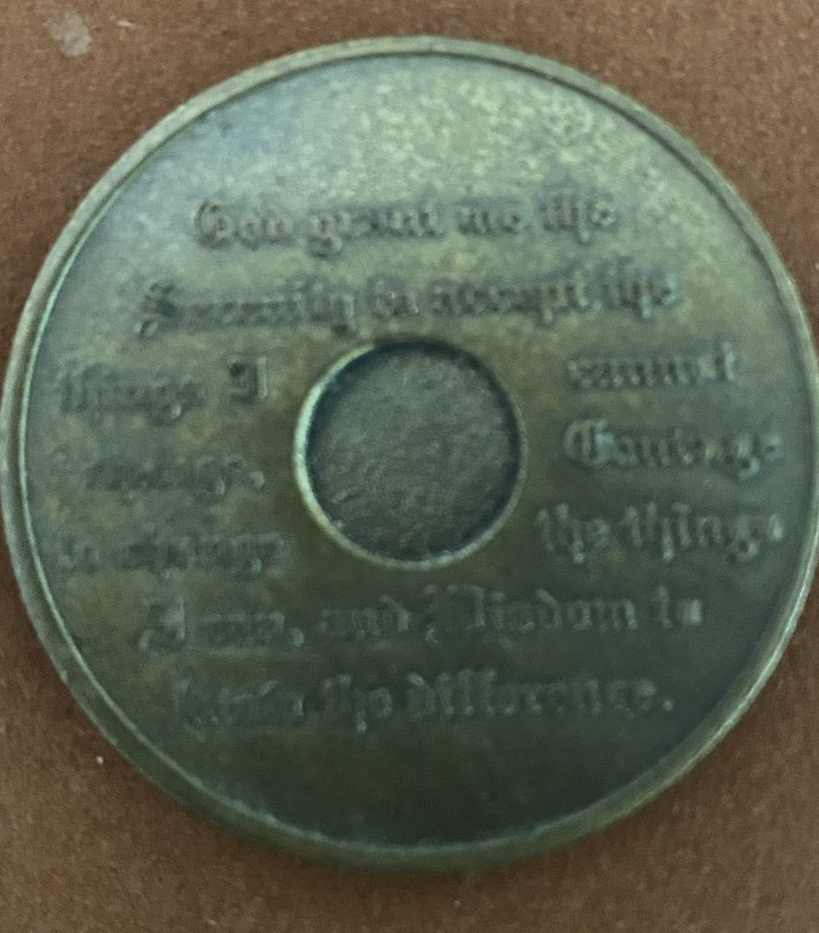
“God grant me the serenity to accept the things I cannot change, the courage to change the things I can and the wisdom to know the difference.”

On occasion, because of my own anxieties, on the mimeograph machine in my mind, it seemed like a couple of pieces of paper would come loose and flap wildly as the drum turned. My mind was that drum and my thoughts were that paper flapping uncontrollably.  I had tried a variety of ways to ease my anxieties: visualizing silly images like a cat with a stop sign attached to its tail or locking my worries in a dumpster, but nothing helped much until I found my way into an Al-Anon meeting one day. I was nineteen and dating David, a man who shared early on that he was a member of Alcoholics Anonymous and, who, after having known my mother for a few weeks, thought he ought to tell me about Al-Anon. “I don’t know much about that group except they used the same 12 Steps we use in AA. Who knows? It might just be a lot of old women complaining about their drunk husbands, but it’s there and worth a try.” 

You could always try those meetings….

He shared this one morning over coffee; I’d sought him out, distraught after encountering my mother drunk that morning. His suggestion hit me at the right moment and I found a meeting that evening at the back of the small storefront where the AA meeting was held. I was too worn out with navigating the alcohol and moods to be nervous about walking into a room where I knew no one. What happened then was that I walked into a roomful of loving, wise, patient surrogate parents who shared with me the Twelve Steps. Members of Al-Anon are, like me, those who have lived with or currently in relationship with alcoholics. The first three steps to that philosophy are designed to help you recognize that your life is unmanageable; likely if you grew up in an alcoholic home, your life had always seemed pretty unmanageable. The Third Step talks about believing in and trusting that there was a God and that God could help. The idea of letting go of control of my life seemed dangerous but I kept going back and sharing how stressful and chaotic my family’s day to day life was.  My own life at that time was a mess as well: I couldn’t tell you what I believed or what I needed to do for my next job, let alone as a career. So, per their suggestion, I attended 90 meetings in 90 days, letting those people love on me and studying the Steps. In contrast to everything around me, the Twelve Steps were not chaotic, but rather offered a different way to make decisions and live life. Then, one afternoon, I was curled up on my bed, emotionally exhausted and lost. It seemed a voice in my head, a benevolent voice, said, “You just need to sit down and shut up.” Suddenly, it felt like I was not alone in making decisions. I took a breath and stopped asking myself or God or anyone who’d listen; I just sat quietly, suddenly reassured the answer would find me if I sat still and waited. A revelation. There would be more. Eventually. I stopped dating David, but I kept coming back to the meetings regularly for nearly two decades, wherever I lived, and I know that that program and those people saved my life and even helped me grow up, at least a bit. 

 A decade later, married and teaching with two small boys, I finally told my then husband that I prayed and, when he didn’t laugh at me, I admitted that God not only talked to me but that I believed I was meant to be involved full time in some ministry. You might think that everyone around you would celebrate if you announced your call to church ministry, and that’s true in some circles. I’d been attending a Methodist Church regularly with our sons, but most of our friends at that time were not attending any church; most were agnostic at best. Thus, I felt the need to be selective when telling anyone that I had regular conversations with God, even those that are only in my head. It didn’t help that God and I were negotiating what ministry for me might look like and I was still quite leery of admitting God wanted anything from me, of all people. If nothing else, at the time, I cussed like a sailor. I had to wonder how that would work! 

Moving forward into what would become an increasingly complicated path towards ordination, it was clear that I had to be subtle about my next steps, and at least appear sane and convincing enough to be taken seriously. The first step was to write a letter to the Methodist Superintendent of the district I lived in and declare my desire to “explore ministry.” Somewhere in there, it was necessary to admit publicly – to say out loud in front of others – that God spoke to me and told me that I was “called” to ministry. Another chance to cringe.

My First Church

The process of moving towards ordination (in the Methodist Church at least) had certainly been more involved than dialing 211, but it was not dissimilar. I’d written that letter and one of the first things the church did was assign me someone to be my mentor, someone who would listen to me and ask lots of questions. Kind of like a free friend, but with a purpose. From then on out, as I went through the process, there were plenty of folks who were ready and willing to swim in the deep end of thoughts and emotions with me, like those free friends, or better, like counselors I didn’t have to pay. The first thing they did, though, was send me to  a psychologist’s office because there was a test in my future. Not free, I remember thinking, but a whole lot less dramatic than calling the local hotline and telling them I talk to God, I guess. 

The psychological exam was just one of the many steps involved in becoming a Methodist minister, a process that is quite long and involved, and can become expensive for many. I had to laugh when I found out, though, that people also used this process, or at least the psychological testing, as a workaround for their own mental screening; it wasn’t free and was far more involved than a simple phone call. I had to wonder: Did they want to be stopped before they hurt someone? I remember sitting in a leather chair in a paneled office with a massive wooden desk between me and the psychologist. I will be forever grateful he started the conversation with, “First, your test reveals you are mentally strong and resilient. All good.”

Relieved, I sat back in the leather chair, and let out a laugh, then admitted, “I’ve got to ask about one of the questions in that test.”

“Sure,” he said.

“It was  something like, ‘Do you like to smell other people’s shoes? Do some people actually admit to enjoying aroma of another person’s shoes?’” 

“You’d be surprised,” the psychologist said.

“Why on earth would you do that?” 

“It’s a way to ask for help, ostensibly without actually asking. They want us to catch them before they do something dangerous,” he explained.

I sure understand that, I thought, making a mental note to be, as a minister, more focussed on the reasons behind those workarounds than the tricks themselves. The reasons were where ministry would happen, I realized. Sometimes people need someone to help them figure out if they are crazy because they talk to – and hear from – God. Just as often, though, folks need to be encouraged to share what they believe God is telling them. Walking people through that process for the United Methodist Church requires years of discernment, writing, interviews and 84 hours of seminary. In other churches, you simply walk up to the front of the sanctuary and declare that God talks to you, indeed, that God is calling you to ministry. I get why it’s so tough to get through the ordination process for the UMC, though, and, don’t get me wrong: I respect it. Even after all the schooling and the discerning and retreats and writing and interviews, after all that I learned about myself and about ministry, I still stood behind the pulpit of my first church and wondered if I was in the right place. I suspect though that God is more able to use us when we are not so sure of ourselves, when we remember we need God. And, my experience has been that, often, we learn we need God through recognizing we need one another, whether we find one another through a phone call, a church or a self-help meeting.  

 Sometimes, in perverse moments, though, I will admit, I’ve wondered if we don’t just need to suggest people start with dialing 211. It’s a whole lot faster and cheaper and they will even tell you where to get free cookies.