Quitters, Goals and Macrame, Oh My!

On Saturday, December 31, 2022, I achieved one of my biggest goals. . .for 2022. Just in the nick of time, right? The goal was to sit in and play some kind of percussion with a group that plays every Saturday morning at the local Farmer’s Market. Anyone is invited to join in but it took several steps to get there, including: several scouting expeditions to see they really were inviting and open to new folks; lessons to learn the Congas because that’s what one of their drummers suggested; and, oh yeah, a new set of Congas provided expressly to encourage me to meet this goal.
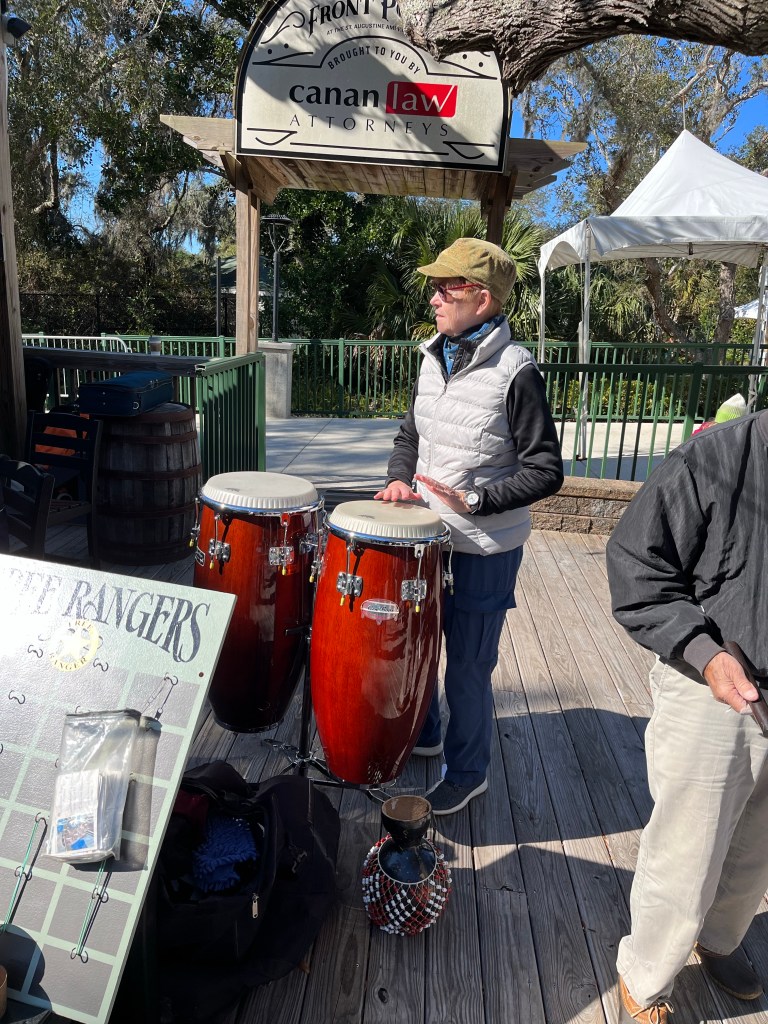
Playing at the Farmer’s Market December 31. They were welcoming but they needed to see if I could really play that drum. Next goals: working my way into the group by slowly, steadily building their trust and showing I can keep a beat and add to the music.

Working to get comfortable bringing a drum to the jam and sitting in required several more steps, actually, including sitting in with another “drop-in” jamming group where I already knew some folks. Completing the final step of this goal took several months and there were even more steps beforehand, including taking drumming lessons in general for some time, years actually. Sitting in with this well-established group whose regular jam is a performance for an audience was the final step to complete that goal and I did that on December 31. Actually that it was completed just as the year ended didn’t occur to me until a couple of days into the new year, partly because I was feeling so good about meeting the goal. I just love checking items off my list of goals.

Yes, I keep a list of goals. Specific goals, in fact. Some of them have taken years and several steps to achieve; others are quicker or easier. Full disclosure: I am a list maker and a goal setter. I have been making lists – and being made fun of for it – for years. Don’t care. I started making lists before anyone ever suggested I might have some sort of attention disorder; I just realized early on that I was easily distracted and, if I wanted to remember to do something of a day, a week or a year, I’d better write it down. I’m gonna pat myself a bit on the back here and say the practice has served me well. I’ve been asked more than a few times how I have gotten so much done and making lists has been one of my most successful tools.

Of course, the idea of setting goals is appropriate for New Year’s in general. We’ve all likely seen or heard a lot about setting goals in the past few weeks; plenty of products are being advertised on all forms of media as being willing to help us “meet our goals.” Sadly, as new tools and programs are promsing to help us finally lose weight, start exercising, further our education or learn macrame, we generally listen while surrounded by the remnants of past goals abandoned, like the macrame plant hangers on that never-used exercise bike; or worse, we consume those cigarettes or sugar or french fries while we listen to the experts tell us how to stop it now.

Sometimes it’s good to be a quitter.

One of the toughest goals I ever managed – finally- to achieve was quitting smoking. I almost wrote, “one of the biggest goals I ever managed to meet.” Ever thought about why we say we “meet” goals? I have. Other synonyms are match, satisfy, answer, comply, discharge, execute, fit, fufill and so on. To meet, though, makes me think of encountering, of running into someone on a narrow pathway and then needing to decide whether or not to hug, to join hands, to negotiate getting around one another or to bail, to jump off the path entirely to avoid the other, that goal. What if we thought of our goals as other life companions we hope one day to fully embrace, to welcome, to love and hold? How do we get to the place where we do not think of these goals as adverseries, enemies, unreachable or unloveable?

Photo by Pixabay on Pexels.com

I began smoking on the rifle range in Army basic training. That’s a story in itself. Maybe that really set up this goal of NOT smoking as an adversary? While I had never found cigarettes even tolerable before the day my company stepped onto that range with live ammunition in our rifles, I smoked half a pack of Marlboros before the day was out and then I was hooked. Smoking actually was more attractive in Basic Training for another reason. When the company took a break, the Drill Sergeants often barked: “Smok’em if you gottem! If ya don’t, you can police the area. ” (“Policing the area” meant picking up cigarette butts left by smokers who had not yet learned to field strip their cigs. Hmm…smoke…or pick up someone else’s cigarette butts. Hmm.) That was in ’78.

I smoked until 1985. July 1, 1985, to be exact. I had wanted to quit for a couple of years before that. I had even managed to ease back from a pack of regular Marlboros a day to the light version and then even managed to be able to ration them, to limit them. For a year, I smoked five or fewer cigarettes a day, but I could not let them go completely. My husband at the time and I both smoked and we had both entertained quitting but neither of us was willing to create a concrete goal at New Year’s or any other time of the year that we knew we wouldn’t achieve. Why set ourselves up for failure, we figured? Still, while I knew I wanted to be not smoking before having children, the desire to quit not as strong as the urge to have one more after supper or before bed or whenever I saw someone else light up.

Out of the mouths of babes….

We needed some help and prodding to accomplish this goal; we just didn’t know it. Perhaps the most powerful deterrent to lighting up came from a four-year-old we knew who, while we were lighting up one day at her house, asked us point-blank, “Why do you want to die?” I’m pretty sure that at the time I shrugged it off or walked outside but her question followed me everywhere. I couldn’t answer her. Neither my husband nor I could answer her because we realized this child might in fact love us more than we loved ourselves.

Neither my husband nor I could answer her because we realized she might in fact love us more than we loved ourselves.

We carried that question for weeks with no answer until we were surprised to be confronted by another couple, good friends. They wanted to know when we would stop. “You have told us before you’re gonna stop smoking. When? We’d like to know!” We were so surprised by that full-frontal assault that we threw out a date that seemed far far away. July 1, 1985, we said. Conversation over. They seemed happy. Everyone was happy.

Until July 1, 1985. Actually, June something or other. We were at their home and they reminded us of our promise months earlier. Dammit. Now we had to choose. Lose the nasty habit or lose the friends. How sad is it that too often we hold onto the nasty habit? We didn’t, though. We looked at each other and decided to go for it. It still wasn’t easy. July 1 was going to be a Monday. On Sunday around noon, we ran out of cigarettes. I argued that we had one more day. I knew I’d only have one or two more smokes before the deadline hit and that I’d have no trouble trashing the others but my husband argued we’d be too tempted to keep smoking til that pack, then the next and the next were gone. We needed to simply stop, he insisted. Really ticked me off at the time. But we quit. I took up knitting in hopes that it would help to keep my hands busy when I was sitting and agitated or bored; today it irks me to remember that I smoked sometimes out of boredom!

Quitters

We stayed quitters even after moving away to Japan where, it seemed, everyone smoked, and there weren’t even any non-smoking areas in restaurants or on trains. That was a test of our resolve. By that time, though, we had another incentive: while it had been tough to stop, it had with time become tougher to decide to start. We were not ready to tick the box that said “Smoker” again. Turns out, that’s a great way to succeed in goals – make it so you have to choose openly, publicly, to go against your goal. Or disincentivize it. Make a bet with someone that will cost real money; one suggestion I heard was make it so that you have to give money to a cause you hate if you slip and start smoking again.

I have found that not having some goals, not knowing where I’d like to be next year, next decade even, means it’ll be a surprise and often a disappointment where I am when those days arrive. There WILL be regrets. Here’s to no regrets!!

Strangely, much of what has served me well, especially as I have sought direction in life, I learned in Al-Anon, the family counterpart to Alcoholics Anonymous. I joined when I was nineteen at the suggestion of a friend. I was feeling quite lost at the time, adrift, at the mercy of the storms of those around me who were miserable and who definitely wanted some company in that. I couldn’t tell you at the time what rules or concepts or guidelines I lived by other than trying to follow the Ten Commandments and the Golden Rule.

No Regrets.

Other than that, all I could tell you was that I wanted to reach the end of my life with no regrets. It was clear at the time though that I needed more because I was so easily distracted from my personal goals and that led to regrets. I needed to know where I wanted to go, what I wanted to do with my life in general and specifically each day. I needed some worthwhile, meaningful goals and I needed to have some general life guidelines that would help me achieve those goals.

Al-Anon’s teachings suggested several really important concepts for me, like the power of having support while you learn new behaviors, (my husband I quit smoking together but goals are far more attainable when you have someone who is willing to be your support person or persons) and the importance of removing the temptations (we agreed to no cigarettes in the house and managed for a long while not to frequent places where people smoked). Perhaps the toughest concept to ingest but the most important one for me sends us back to the idea of “meeting” our goals.

What if we thought of our goals as life companions we hope one day to fully embrace, to welcome, to love and hold? How might we then see them and figure out how to embrace them? Maybe we would no longer see goals like eating healthy or quitting smoking as something keeping us from fun but rather as ways of living that help us carve out time or keep us healthy enough to do what truly brings us joy. I love walking on the beach and dancing and playing pickleball and all of those would be infinitely more difficult (or I might not even have attempted them) had I kept smoking.

Whatever goals you set or changes you make, make them for the right reasons. Make them because you love yourself as much as you love others and others as much as you love yourself. Recognize the two go hand in hand and you can’t have one without the other; if you think you can, you’ve been deceived. Make your goals because you are recognizing and honoring the fact that others love you. Make them with the understanding that your goals and life changes are companions who hope to help you live life joyfully and reach the next year and the next with fewer and fewer regrets. You can do it!

Be the pebble. One answer to the unimaginable.

For several months last year, I was invited to join a group of women from all over western and middle Tennessee, some clergywomen, some lay leaders in their churches.  We gathered virtually because we shared a sad truth: a colleague and friend had been taken from us suddenly, shot in her own driveway during a carjacking.

I had not known any of these women before this group convened, but I am so very grateful that they all agreed to convene for those few months – and to invite me – to share our grief and pain and try to make some, any, if possible, sense of this tragedy. Some of the participants had known this woman for years; others of us had only known her a short while, but we all grieved what felt like a future filled with hope and ministry. She was likely going to be a Bishop some day, not because she was someone who was well-loved but because she was someone who loved well. That future was denied suddenly not by someone who had judged her ministry or intentions or love as lacking, but by a total stranger, someone who never had and now never would feel the love she had to offer him.

Within just a few weeks following her murder, we stepped into a virtual room, and invoked the words so many of us had shared in the funerals we had presided over. We affirmed that we had come together in our grief, acknowledging our human loss and praying that God would grant us grace. We also prayed that, in our pain we may find comfort, and in our sorrow, we might find hope.  We especially, collectively, wanted to find ways to honor our friend. 

It’s not necessarily a new idea to say we are called to honor those who are now gone who’ve loved, nurtured, forgiven or supported and encouraged us by doing the same. It just may be a bit tougher to process our emotions after the loss is a shock or especially an act of violence, because violence always leaves in its wake more victims than are seen by the naked eye. Be assured, most of us could acknowledge our privilege in not facing this kind of loss before; we also recognized what a gift it was that we could take the needed time to grieve and to find some guidance and companions for this process. Plenty of folks do not share that luxury, we knew. 

Nevertheless, to say the sheer aggression and randomness of this event knocked us down is insufficient. We all know that bad things happen to even the best of people, but somehow some of us thought – hoped – there was a line the people of God would not cross. I mean, if you’re willing to kill a preacher, who stands a chance? We were shaken individually and collectively and so I am grateful that our colleague’s legacy brought us together. A few of the women realized that, if our friend had been the one left in shock and pain, this is what she’d do. She would gather us all in. She was all about sharing, listening, reflecting and holding hands in our fear and our pain. Over the next few months, then, we talked about how this trauma affected us, mentally, spiritually, emotionally and theologically.  We seemed to know that she would encourage us to ask our questions, something most of us in this world have been conditioned to avoid, even if we do have the time. Through our theological and faith journeys, though, through pursuing our callings, many of us in the group had been exposed to and become somewhat practiced in reflection, in the art of asking questions, and, perhaps most importantly, in sitting with questions that are not accompanied by satisfying answers. 

Aggressive, blunt, unanswered and unanswerable questions most definitely were part of these group meetings; they sat next to us, sometimes gently nudging us, sometimes poking us with bony fingers, often angering and annoying us, always taking up space and reminding us they were not going away.  So, we chose to embrace them, to welcome them into our space, albeit a bit begrudgingly, buoyed by the fact that we were not alone.  

“After all these years I have begun to wonder if the secret of living well is not in having all the answers but in pursuing unanswerable questions in good company.”

Remen, Rachel Naomi. My Grandfather’s Blessings: Stories of Strength, Refuge, and Belonging . Penguin Publishing Group. Kindle Edition.

We shared from various resources: prayers, poems, stories, theological pieces and we asked ourselves, How then shall we live?

To get there, we shared questions about our colleague like: How can one person be someone whom everyone felt like they knew? This woman saw you. I could easily spend the rest of my life trying to see every person that I encounter as well as she did; it is a spiritual practice that I will likely never master but one that she embodied. She saw each of us and even if you only met her once, you left her presence knowing she still somehow held you as tightly and lovingly as she did everyone she saw. I would have liked to ask her more about this; how did she manage it? Did she consciously focus only on who was right in front of her? How was she able to tune out the rest of the world so successfully as to make you feel like not so much the center of the universe but seen. And heard. She saw you. Most of us go through life not feeling truly seen or heard and yet, sadly, that is often all we want. Many an argument or estrangement likely would be quelled or mended if each participant were able to take a turn seeing and hearing the other fully. She seemed to know that.

How Then Shall We Live?

Throughout the sessions over last fall, I found myself counting how many people who were now missing from my life after this year: friends, colleagues, family members.

Sadly, I am grateful that a couple of them are no longer here to harm others. I spent a great deal of my life learning how NOT to follow in those footsteps. I also, though, came to recognize them as human beings, not monsters, and to acknowledge I have my own failings. I hate knowing that. I hate knowing I am capable of being ugly and of wounding others.  I hate knowing that too often what annoys me in others is what annoys me about myself.  All of that knowledge means I must go forward with self-assessment that is as rigorous as my judgment of others AND I must offer grace that is as unearned as the grace I receive. The question there was what did I learn about myself from that person?

I am grateful though to declare that most of those whom I have lost have blessed me.  All of those I lost this past twelve months, including my colleague, I now realize, left me with the question on my life: how will I live going forward so as to reflect how I have been changed by their influence on my life? How, then, will I live now in light of what they taught me, whether it be because I want to honor them or because I want to never fall into their footsteps: what gift will I give the world now that they are no longer here?  

Photo by Scott Webb on Pexels.com

Questions, then, I thought, might be the answer, if that’s possible.  I shared with the group one of the understandings of a Scripture passage that another colleague had helped me to see differently years ago.  The Scripture was about the widow and the judge in Luke 18:1-8.  The story is often interpreted that the judge is God and the widow has to badger God – the judge – to get heard and to receive justice.  Another colleague years ago saw the story differently and preached that the widow in the story instead was God and God (the widow) would continue to beseech the powers that be (the judges) in our world to do the right thing.  God would continue to be the pebble in the shoe, she preached, that made us stop in our tracks and take care of that annoying pain that we feel every step we take.  God will continue to try to make us stop long enough perhaps to think, to listen, to pray, to see one another.  The story when I read it now reminds me, calls me, to be the pebble, to keep the hard, stony, annoying truths in front of folks I know.  

God calls us to BE the pebble. Ask – lovingly – the difficult questions. Keep the hard, stony, annoying truths in front of the folks we know.

We lamented that there was no going back to our blissful ignorance, no chance now we could pretend we or those whom we loved were safe.  One thing that is certain about hatred, ugliness, violence, is that once you know, you can’t “unknow.” Most of us in our world today learn at such early ages that violence and meanness and the ability to harm others is part of our world but being the target or even knowing the target of someone else’s violent behavior, even and maybe especially if that target appears random, moves us into darker places emotionally, spiritually, mentally.  

One of the toughest conversations was, no surprise, about guns and gun violence. I do not believe I am breaking confidence to say that we were keenly aware of the difficulty we live into everyday in our country of how to deal with what has become an epidemic.  

He was just a child still himself who pulled the trigger and took this life. In light of how much gun violence has become part of so many children’s lives, I offered the image of our society as a body where this bullet’s wound was not the only injury or illness that needed to be addressed in this tragedy. The image of a body with multiple system failures came to mind for me as we talked about how we had failed this child as well, the child who had murdered her, lamenting how he had gotten to that place, into that car, with that gun. The questions became: What had gotten him to the point where another human being was worth less than that car?  Don’t we need to know that process? Where in his young life was he ever seen? 

The questions we all needed to ask ourselves and one another became: What had gotten him to the point where another human being was worth less than a car? Don’t we need to know that process? Where in his young life was he ever seen?

For help with tough questions, I suggested this resource:  “When Thoughts and Prayers Aren’t Enough: A Shooting Survivor’s Journey into the Realities of Gun Violence,” by Taylor Schumann, a victim of gun violence, a Christian and a strong advocate for the right to own and bear arms.  Her offering in this book is as honest a discussion of faith and firearms as I have seen thus far and it is a true gift to those who do not know what to say but feel called to participate in reflection and discussion.  We put seatbelts in our cars to help protect our children when auto accidents were the number one killer; we need to stop the yelling and figure this out for our children’s sake.  Schumann offers intelligent, faith-led, personal and compelling points to add to the discussion, pebbles, if you will, that we can cast into our collective path. 

Moving Forward

How then would we go forward was the overarching question. How we each had thought we would be going forward in our lives was mostly changed but not canceled, we realized, but this sudden loss. I grieved having postponed working together until after my retirement.  I had so many questions I was looking forward to asking her when we would be working together. Each of us was challenged to ask ourselves, “How will I live now?” We realized we had already started moving forward and had chosen to live differently by simply inviting and agreeing to meet over the course of those months, by sharing and holding one another in grief, by sharing resources that inspired us (and often which we hoped might answer some of those pesky questions). Already we were living with intention, living in response to this trauma and tragedy, living in a way that would honor her (and more importantly we knew to her,) living in a way that recognized the power and gift of connecting. We would commit each of us to continue using our platforms (sermons, Bible studies, book clubs) to replicate these conversations, to offer them to others, to hold hands with, to sit with, to see each person who came before us and to ask the questions.

Photo by Elle Hughes on Pexels.com

For myself, I believe my beloved colleague would encourage me this Christmas and every Christmas going forward to seek to “Be that pebble in the shoes of those who are in power and ask the questions that need asking.” No question, my friend saw me or you like she saw everyone, it seemed; she made each of us feel seen.  Spending time in her presence, though, also meant you had to keep stooping down to remove the occasional pebble from your shoe because it was either that or limp forever.  She did this lovingly and you knew as you stooped down to scoop out that pebble that she meant to be loving to you and to everyone else who might be affected. “It’s all right,” she seemed to be saying in a loving and gentle way, “I’ll wait while you tend to that.” 

Who knew that a handful of pebbles could be such a sacred Christmas gift? 

Asking Your Questions Before It’s Too Late

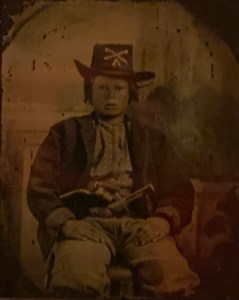
Erasmus Pershing – Civil War era Ambrotype Portrait – We have no other information about him so far.

During a visit some thirty years ago, my (now late) grandmother mentioned being descended from French Huguenots. (I had to look them up at the time: A French Protestant movement in the 16th and 17th centuries. Calvinist. Suffered persecution by the religious majority at the time and many thousands of them emigrated from France). Grandma also lamented at the time that very little of her family history was recorded anywhere. Because I was working outside the home then and raising two little boys, I could only lament with her and suggest she record some stories for us on a cassette recorder. She didn’t, though, and now she and her siblings are gone and we have lost most of that history, including any details about our little soldier in the Ambrotype portrait above.

Many family stories today go untold, or if they are told, they have gaps, and placing them in time or understanding the story is tough after all the actors have left the stage. After Grandma died, I could find no one who knew anything about Huguenots and a family connection. No one was left to rebut the rumors of our being related to President Grover Cleveland (because Grandma’s family name was Cleland, not Cleveland, that is highly unlikely.) I had known through my research that she was a cousin of Black Jack Pershing, but we had not talked about any of this and now we cannot.

Grandma lamented once that she possibly was descended from the author of the Fanny Hill: Memoirs of a Woman of Pleasure, an erotic novel that led to the arrest of author John Cleland in 1748. This particular piece of history especially mortified Grandma, which is sad because it is likely accurate, and I would love to know more about how her parents and grandparents felt then, too.

Most of my family history though has been learned through online research, which means that by itself, it is just the list of ancestors with little of the background, the scenery, or the props and, of course, no narration. The result of relying only on such research is that we get just enough of several of the stories to need and want more – context, detail, resolution – but, again, because the principals were gone, we are left to research and then try to fill in the gaps, leaving many of these rich stories to be lost forever. Needlessly.

Too many of these rich stories are lost forever. Needlessly.

I once even learned from online research that I had a great-grandmother who was alive until I was fourteen and lived an hour away, but I never met her. When I asked, I was told, “We didn’t like her very much.” I was stunned at the time and now of course totally regret that I did not press the matter and ask about what had happened, did not seek the story while there was a player still around to offer some narration.

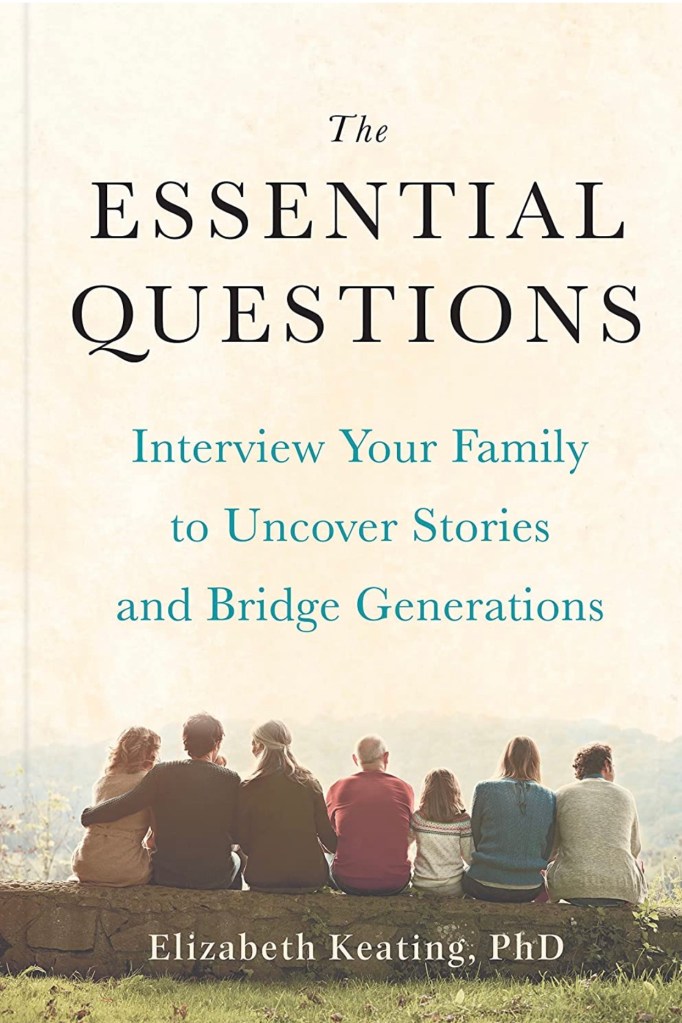
Turns out, I’m not alone. Elizabeth Keating, PH.D., is the author of The Essential Questions: Interview Your Family to Uncover Stories and Bridge Generations and writes about the loss of these stories:

“The people I interviewed knew so little about their grandparents’ or parents’ early lives, such as how they were raised and what they experienced as young people. Few could remember any personal stories about when their grandparents or parents were children. Whole ways of life were passing away unknown. A kind of genealogical amnesia was eating holes in these family histories as permanently as moths eat holes in the sweaters lovingly knitted by our ancestors.”

The Essential Questions: Interview Your Family to Uncover Stories and Bridge Generations, by Elizabeth Keating, PH.D., is available on back order if you want a hardcopy but a Kindle version is available. I think the hard copy would be a great gift for family members

Asking family members for family stories ought to be quite easy and entertaining but that doesn’t seem to be the case in our media-saturated world.

The good news is that we can use our online research and our boxes of pictures to start the conversations. Keating gives lots of examples of what to ask to flesh out your family’s tales. If there are still older family members alive, starting the storytelling can be as simply as carefully studying some of those old sepia tone family portraits.

On my father’s side of the family, most of the stories I’d learned were from online research until the day his sister asked if I’d be interested in a box of old photos. That cardboard box was a treasure chest of stories about tumult, typhoid and the kindness of strangers. The next time I saw my aunt, I came to the conversation with some specific questions and a vague feeling about why two photos in particular made no sense to me.

The photos set her memories flowing and one story in particular that she remembered as being set in the Depression but, we soon realized, could not be the case. Certainly the family, like many in the country, lived with few creature comforts even before the country was plunged into a depression. Indeed, pretty much everyone spent their lives at the mercy of the elements, epidemics and accidents with little modern health care and only the food they could plant and harvest, hunt or gain in a barter.

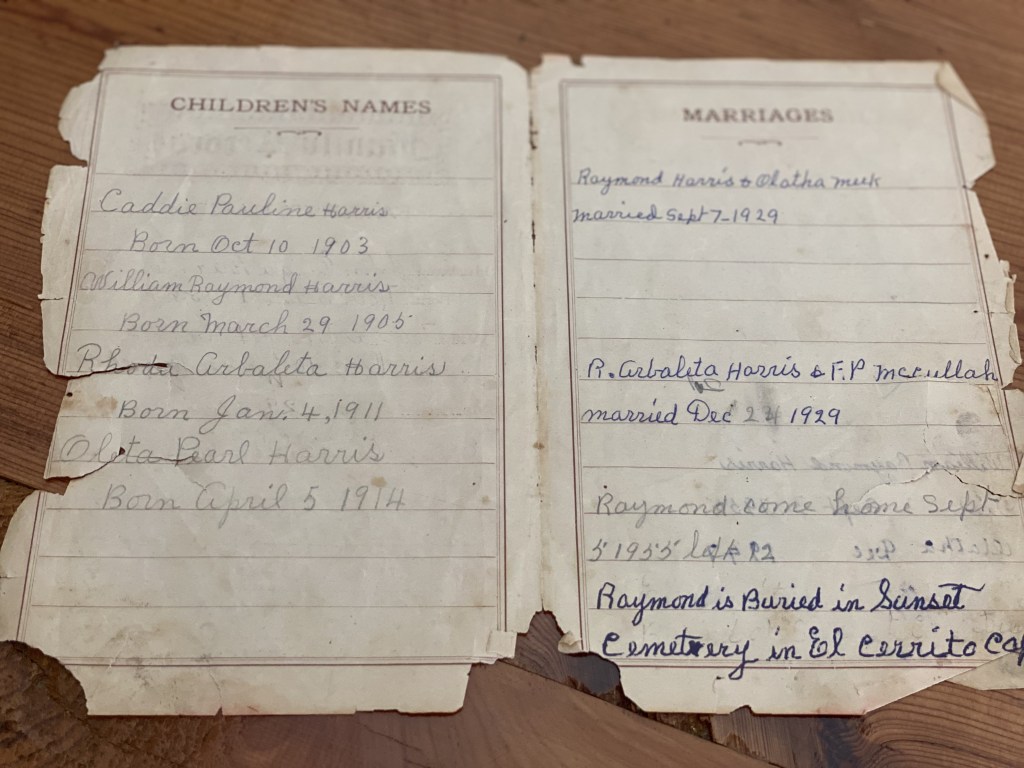
My aunt knew that the father in the family was out of the picture; he would die in a sanatorium with tuberculosis. So, at the time that this story begins, my great-grandmother was running a small farm with her children, whom records indicated were born in 1903, 1905, 1911 and 1914. My grandmother was the one born in 1911.

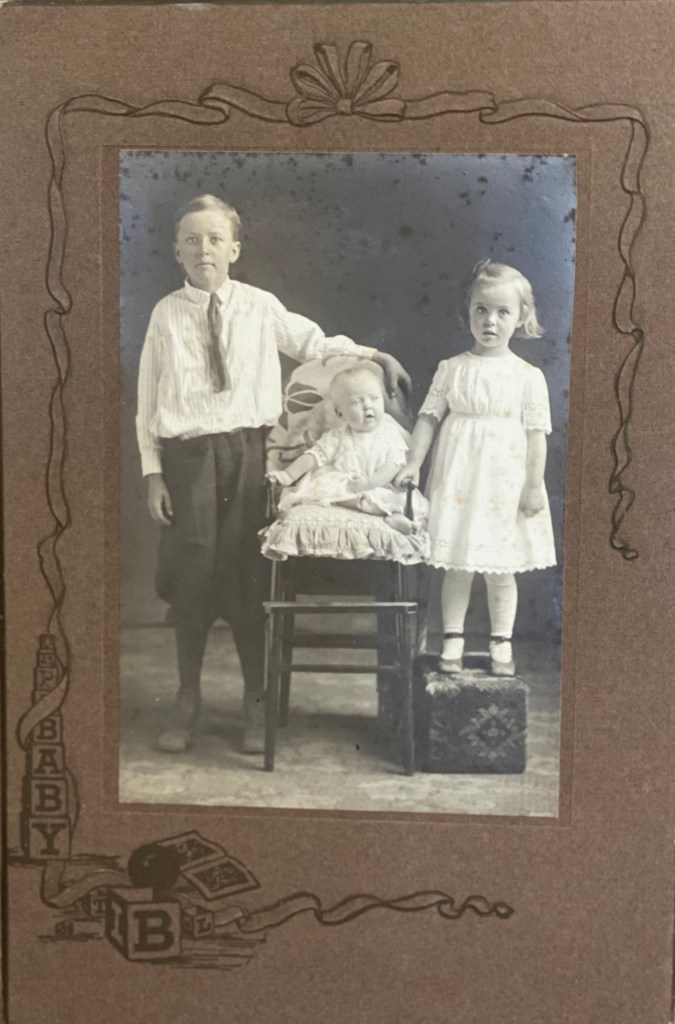
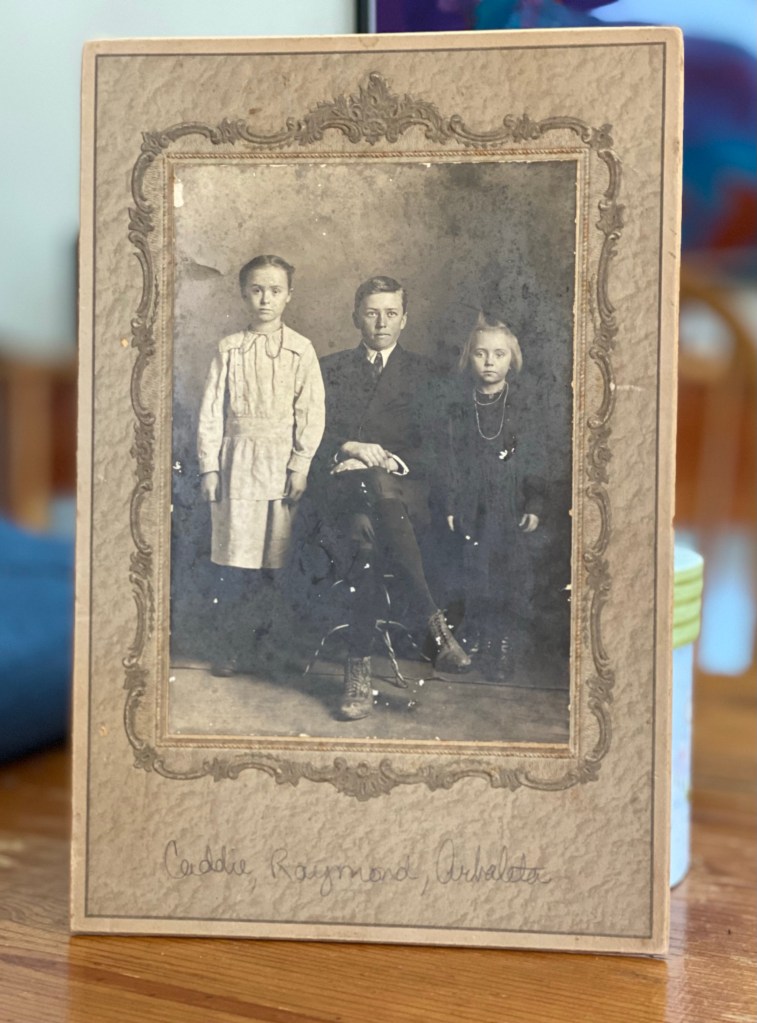
The children’s pictures below, shared with me by my aunt, were what directed my questions and, eventually, led her to remember and share the story of what she called “the family’s angel.” The configurations simply made no sense to me.

The first picture is of her (and my Dad’s) uncle Raymond (born 1905), with baby Pearl (born 1914) and my grandmother, Arbaleta, born 1911. That picture would have been taken after 1914, obviously. Love the box Grandma is standing on, by the way. The second picture would have been taken later, with Grandma Arbaleta (standing,) then Raymond and then Pearl. Even though the picture to the right says it is Caddie on the left, actually she is absent from either picture. Caddie, their older sister, was born in 1903, but died 1909. We found no pictures of her. Had she lived, there would have been a girl taller than Raymond in the picture to the left. Okay, that mystery was solved. Still, something was off.

From the family Bible

We turned to the rest of the the dates recorded in the front of the family Bible and my aunt was reminded that Pearl also had died young, and that particular tidbit of information started the memories swirling. Her memory of what happened to Pearl is the real treasure here: over the next hour, she told me about how a stranger, an “angel,” she said, kept the family together in a time that could only be described as bleak.

Evidently, Baby Pearl, (in both pictures) died in 1923 at age nine when Raymond was 18 and Grandma was 12. Their father had died three years earlier, and a typhoid epidemic took Pearl and made their mother, Mila, deathly ill.

Things would have been rough enough since Mila was trying to keep a small family farm going even before the typhoid epidemic hit the area.  When Pearl died, the fact that their mother was near death meant Raymond, 18, and Grandma Leta, 12, were left to do what most folks did back then: they had to prepare their sister’s body to be buried. Few could afford for an undertaker to come, so, typically, a coffin would be built by a friend or relative and then it would be laid upon the kitchen table so the family could prepare the body to be buried. As I sat there listening, I could not imagine how tragic and overwhelming it must have been to have a coffin for a sister laid on the kitchen table before me. I could not imagine taking a cloth and soap and water and preparing the body of someone I loved in order for them to be buried. Worse, in this case, though, was that, because the mother was so ill, two coffins were delivered, one for the little sister and one for the mother who was expected to die soon. 

The future for these two siblings looked pretty bleak, too. They likely both wondered how they’d manage, once their mother died, and how they’d find food, or pay for oil or firewood. We’re not aware if Raymond was working or at what at the time, but, for the time being, he was tasked with keeping things going and caring for their mother as well. It must have been somewhat overwhelming, but, the story goes, one day, a stranger happened by.   Travelers often stopped at farms then – there were no gas stations or Cracker Barrels – and even before the Great Depression swept across the nation, it was not at all unusual for a stranger traveling through to stop to ask for a bite of something to eat or offer to work for a day to earn a meal and a place to sleep.  

Such a traveler evidently stopped into the home of my great-grandmother Mila as she was dying of Typhoid and offered to help this young boy and girl keep the farm going. Perhaps this traveler was even hoping to stay after Mila died. 

Can you imagine standing outside the door, being told there was typhoid in the home but being so tired, destitute and hungry that you would offer to stay anyway if it meant some food for a few days?  Who knows, maybe he thought, “Either I’ll be spared this illness and have found a new home OR I’ll die soon.”  Evidently it was worth it to him because this stranger stayed.  He helped the two teens keep the farm running, helped them bury their little sister in the church cemetery and made sure they had heat, the occasional hamhock and hope while they cared for their dying mother.  

Turns out, though, Mila, my great-grandmother didn’t die.  Instead, she began to recover, and once she was able to be up and about, the traveler took his leave. When my aunt shared this rather miraculous ending, I hoped she also would share what happened to the traveler, but, alas, she said, we don’t know his name; that piece of the story was lost.  

All that my aunt remembered was that the children had a stranger willing to help to keep things going and, because of him,  the family stayed together and kept the home.  I’d love to know more about this stranger, this “angel.”

I encourage you not to rely simply on genealogical research if your desire is to know your own family’s stories. Such research is a great start, but it’s a little like being online friends: the tendency is for there to be very little face to face time or conversation, and, in the end, what you have is a more shallow, less meaningful, sanitized experience. Your interaction might be safe but not necessarily satisfying, like the “hug” emoji in place of a real hug. If you want the story, the real hug, you need to sit together and ask specific questions – about social interactions, treasured possessions, popular culture when Grandma was young, and how these all changed with historic events or her own life changes, for just a few examples.

What did you have to do to get your picture scratched off of the family record?

Of course, this is risky since the feel-good miracle stories often are right next to the bitter ones in the picture box. Potentially huge clues to family history can be found on documents that still exist but have been angrily altered like the photo below where some family member’s face has been scratched off. In a time when having even one portrait of yourself was a true luxury,  and often that picture is the only record of a family group, what did you have to do to get your picture scratched off of the family record?

What caused someone to scratch out the picture of the woman seated 2nd from right? You know there’s a story there.

In the book, Keating argues that sometimes this kind of research is touchy but NOT asking just perpetuates the pain. She talks about her own family stories and the questions she didn’t ask of her mother, for example: “Before she died, I—like many children, I suspect—avoided any potential clashes, wanting to preserve harmony rather than ask sensitive questions.” (Keating, Elizabeth. The Essential Questions, p. 2. Penguin Publishing Group. Kindle Edition.) Take the chance, she suggests, to avoid regrets.

Finally, Keating asks and I would ask too: what do you wish people knew about you? That question is one I ask myself as I write this blog. I think especially of my children and grandchildren and want to offer them some of the stories we have not shared before now. While on the one hand such explorations can feel selfish, I know how much I wish even one of my grandparents and I had sought the answers to these questions while we still could.

Go then.

Ask.

Ask specific questions.

Ask them to tell you what you don’t even know to ask. Maybe you’ll find your Huguenots before it’s too late.

War in the Second Grade

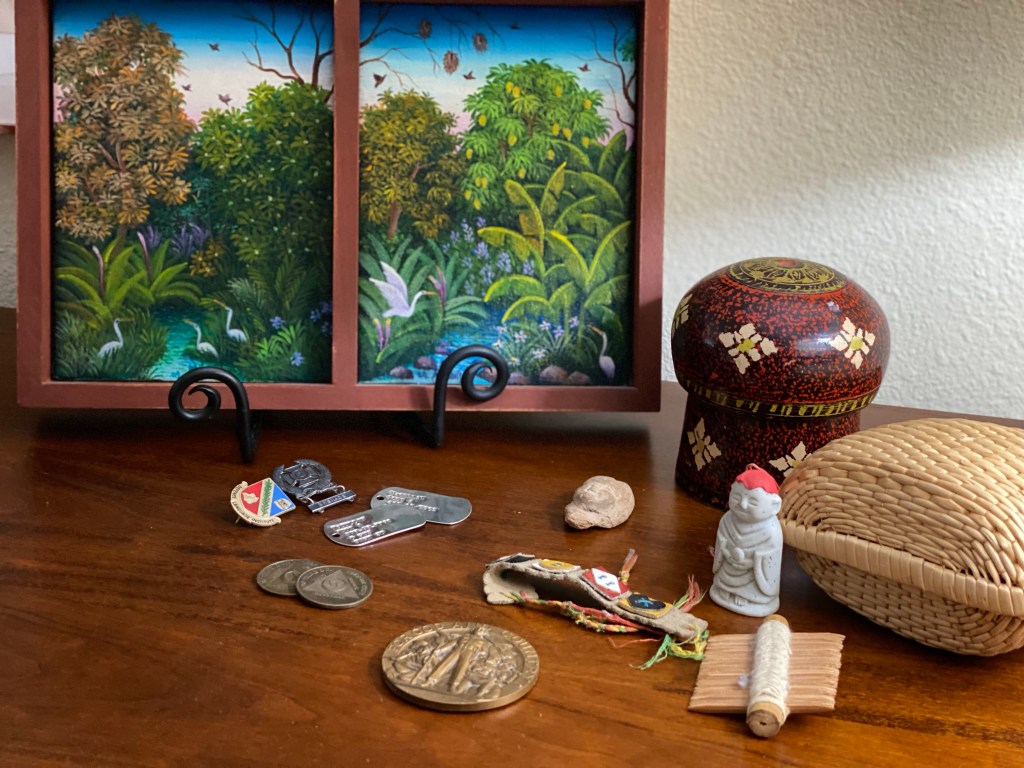
Some of the mementos from my backpack. Ever wonder why you held onto some and not others?

As stories go, this one is incomplete, like a puzzle missing some corner pieces, or a picture torn, by accident, of course. It’s my hope that through this process of unpacking my backpack of memories, I’ll locate those missing puzzle pieces or that torn corner of the picture and all – or at least more – will make sense.

Some years ago, I went looking for, or at least information about, my teacher from third grade. I’m sad to say, so far, I haven’t found her, though I am pleased to report I’ve found some folks I’d lost track of some decades ago. As the child of a father who moved us to new cities – and even new countries – at least every three years, I certainly have felt disconnected. For the longest time, because I also was estranged from my family, there existed no one in my life who could vouch for me ever existing prior to college. No one would say, for example, “You were always the tall one in the class.” No one was ready and eager to remind me that I was always late for the traffic patrol crossing guard duty – dear God, they let us do that in sixth grade then! No one would raise their hand to verify – or deny – if I were accused of being teacher’s pet (I sure wanted to be.) or if I had read every historical biography in our primary school library. (I had!)

Thorpe J. Gordon Elementary

I attended Thorpe J. Gordon Elementary School in Jefferson City, Missouri, from the last part of second grade until sixth. We arrived after living overseas for a couple of years (There’s another couple of items from the backpack and a few more stories for another cold day). Today, though, I am seriously regretting tossing all those class pictures a few years ago. You know, the ones where we all stood on those metal risers and tried to hold still long enough for the photographer who counted it a win if he could get us all looking at the camera when the bulb flashed. (If you have pictures from Thorpe J. Gordon Elementary in the mid-sixties, by the way, I’d love to see them.)

To the best of my recollection, my teacher when the year began was a Mrs. Peterson (sp?). She was young, pretty, energetic and fun, and we all loved her.

At least that’s how I remember it, but then, for the longest time, I remembered this as happening in second grade. Since I didn’t start Thorpe J. Gordon until after Christmas in the second grade, seems like some memories got fragmented and some pieces indeed might be missing. We do all have somewhat mashed up, muddled memories, don’t we? I don’t know about you, but whether they are from last week or our childhood, my memories toy with me.

In my mashed up memories, Mrs. Peterson was lively and pretty and cheerful, which was amazing because she was married to a Soldier. Mr. Peterson was, at the time, serving in Viet Nam. He was at war. We didn’t know why he had to be at war but we knew she didn’t get to see him or talk to him much and he wasn’t at home when her day was over. We knew too that he was a pretty nice guy because, every time he sent a cassette-taped message to his wife, he included a message for our class. In return, when Mrs. Peterson was preparing her own cassette message, she allowed us to add some greetings and questions. Sometimes, much to our delight, in the subsequent message, he answered those 8- and 9-year-old’s questions. We felt special and connected and heard, both from him and from her, something most children could not say in that generation, to be sure, and something that, sadly, would not last.

Christmas Corsages

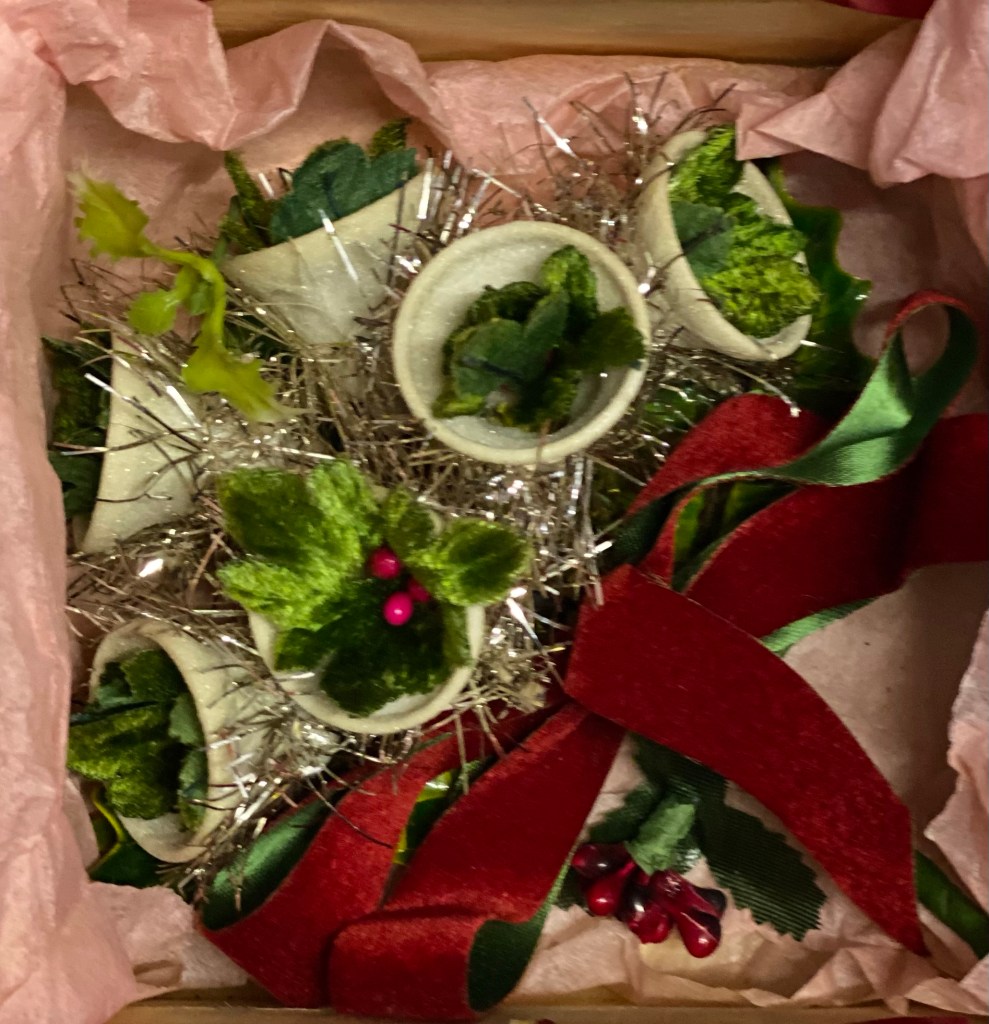
That year, just like every year I can remember, we were off of school for two or three weeks for Christmas break. Before the break, at the class Christmas party, we’d all given Mrs. Peterson our Christmas gifts. The practice in the mid-sixties in the cold, gray, windy midwest, or at least in our neighborhood, was to give your teacher a Christmas corsage; these were pretty, often fake flowers (or no flowers at all, if I remember correctly) and they were adorned with ribbons and trinkets. They certainly were festive. The trouble, as far as I could see at the time, though, was that everyone gave the teacher a corsage. How many dang corsages could one teacher wear? So, I opted that year to give the teacher something else, likely some candy or perfume; it made sense to me, but the gesture did not pass without incurring grief from several of my classmates.

A Typical Christmas Corsage

Over time, I would become more accustomed to classmates wondering what on earth I was thinking. In fifth grade, for example, a couple of us created a class-wide crisis when we did not wear dresses on picture day. Whoa. (Strangely, we were allowed to wear pants in grade school at that school; later, I’d transfer to another town where girls were required to wear dresses, no matter what the weather.) What some of us had figured out, though, was this: when we wore a dress (with nice shoes) for picture day, recess was a wash and we really, really liked running and climbing during recess. In addition, the individual pictures were only head and shoulders so a pretty blouse would serve the same purpose as a dress. Finally, at least in my case, since I was the second tallest kid in the class, I always always stood on the back row for the class picture anyway so no one ever saw what I was wearing. I could see no reason to endure the discomfort of the dress and patent-leather shoes all day when I could be in pants and tennis shoes. Sadly, I had to explain that about twenty-five times that year and, while I was annoyed at that, I was more annoyed at myself for not figuring this out in first or second grade. Still, embracing my generation’s dictim “Question Everything” was a learning curve, and the Christmas corsage might be considered the first volley in my war on ridiculous expectations.

No Questions Allowed.

Still, this post is about war, war and children.

That Christmas break, we went home a happy lot and looked forward to returning in January. When we did step back into that classroom, we did not find Mrs. Peterson at all. What we found was another teacher, an older woman whom I’m sure was a lovely and gifted teacher, but on the first day back to class that frosty January, we were told simply, “Mrs. Peterson is gone and this is your new teacher.” End of discussion. No questions allowed though you know we had plenty. In my child’s memory, our anger and questions were dismissed, sent to the corner, not allowed.

Now, if any of our parents heard about this from us or if any of them knew what had happened or reached out to the school with their own questions, I don’t know. I don’t remember if I had any conversations with my parents about this either. I can reliably tell you that they were not advocates of my budding proclivity for questioning everything.

It would be decades later when some of that memory came into focus for me; I would realize, belatedly, something must have happened to Mrs. Peterson’s husband. Perhaps he was injured, or killed; we could hope, even, he simply returned home to the states and they were transferred or moved. We never knew though and no one ever told us, which meant our imaginations would have been allowed to run wild if it hadn’t been made so clear that there was no room for that. For me, those banished questions would not surface again until, as a Campus Minister, I began working with students who were combat veterans.

(Lazarus Project, which started as The Lazarus Project, became Soldiers And Families Embraced. The free counseling program began in 2010 as a United Methodist Campus Ministry project to help combat veterans and their families who were attending Austin Peay State University in Clarksville, Tennessee, adjacent to Fort Campbell, Kentucky. By that time, the US had been at war for nearly a decade, but much of burden of fighting was borne by less than 1% of the US population and felt then quite keenly by their families.The program expanded into the entire community as we began to hear from veterans and family members from all eras who needed to process their pain, grief, anger and ask their questions.)

The name “Lazarus Project” was inspired by the idea that when the biblical Lazarus emerged from the tomb he still had the trappings and stench of war on him and the community is told by Jesus to “go to him” and unbind him that he might live again, rather than wait until he asks for help. See John 11, especially John 11:38-44. We started with peer support groups for veterans and their families and evolved into a full-fledged counseling program offering free counseling still to those affected by wars of all eras.

One part of the program for several years involved joint retreats to find healing from war, and one of the first activities in those retreats involved introducing yourself by sharing some symbol of your experience with war.

Back to the Second Grade

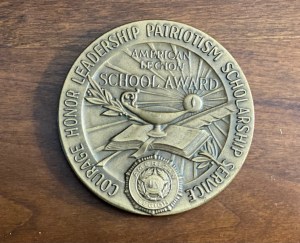
As I prepared to go to my first retreat, I was at a loss to share any personal experience with war until I was cleaning out a drawer and stumbled upon an award I received at the end of sixth grade from the American Legion. It was not until I was holding that award that I realized my own experience with war began in second grade with Mrs. Peterson.

It was not until I was holding that award that I realized my own experience with war began in second grade with Mrs. Peterson.

Certainly, this award, which, I was sure was going to my classmate, Karla, did not – in my sixth-grade mind – have anything to do with war.

American Legion Award given each year to one boy and one girl in the sixth grade of each local Elementary school for “Courage, Honor, Leadership, Patriotism, Scholarship and Service.”

Holding it all those years later, however, gave air to a mass of memories. To my surprise, the memory of Mrs. Peterson and her Soldier were near the top. Processing those memories in that retreat, sorting through the confusion and child’s anger, I am grateful to say, helped the Lazarus Project and then SAFE become community educators about the effects of war on children. The first thing we taught was that children DO know about war, whether we adults want to admit it or not, and denying their experience has both immediate and longterm consequences.

Already, one of our first clients for counseling had been an angry child, a six-year-old, who had been expelled from school for stabbing other children with pencils. Her grandmother came to us asking for help. The child’s father had been deployed into combat three times for a year at a time since she had been born and her mother had melted under the stress, grief and fear of all those long deployments. All that the child knew was that now Mommy also had “gone away.” The child was angry and she had lots of questions no one could answer. We learned quickly that she was among the many children of that war and so many other wars who wake up wondering if Daddy was still alive, if Mommy would be able to come home, and if, when they did come home, they’d be “all right.”

“You lied,” he said. “You all lied.”

A ten-year-old client of our program.

One of the saddest days of our program was when a child whose father had sustained a serious Traumatic Brain Injury declared that all the adults around him were liars because they had all told him Daddy would be okay, and he did not need to worry. You lied, he said. Like most of us adults who want to protect the children, the adults in his life underestimated his ability to grasp the seriousness of the situation and discounted his need for honesty and his right to have the chance to grieve the possibilities and air his fears, too.

All of us at Lazarus Project were amazed, though, at how much it helped the six-year-old just to have an adult hear her and assure her that of course she was angry and rightly so. She desperately needed someone to normalize that anger. Being able to ask her questions without upsetting everyone else around her didn’t fix the situation or mean she wouldn’t need more counseling to understand and name her feelings but it did help her stop stabbing other children with pencils. Allowing her space to air her questions likely had the added bonus of helping her process them before they became jumbled fragments tossed into a backpack that might not be opened for decades, if ever.

As the wars continued, more and more resources surfaced to help talk about war with children. Sadly, as those wars continued, there were children who had spent their entire school experience, twelve years or more, with one or the other parent deployed into combat zones. The questions they have and the feelings they need to process will continue throughout their lives.

Our questions don’t always need answers, just air, the air to breathe, the chance to be counted.

As I write this, I think of my granddaughter who is only seven and, while she seems quite young, she does know about death and she has dealt with the losses of animals and people she has known. Thankfully, she is blessed to be surrounded by adults who allow her to ask questions, even if they don’t have answers for her.

It’s not easy to hear her questions some times, but it IS simple. What we are learning by listening is that our questions don’t always need answers; they do need air, the air to breathe and the chance to be counted.