With your support and encouragement, Here Lies Jimmie’s Arm, my first book, is out and ready for consumption.
Click here to go to my Amazon author page. From there you can Follow the Author and be the first to hear about new books.
Or, point your phone’s camera to this QR code to be taken to the book’s page. (Available in paperback or Kindle download.)
Be sure to leave me a review if you liked what you read!
An excerpt:
From “The Women’s Kitchen Jug Band.”
Lela, Rebecca, Molly and Sally were all part of this impressive gaggle of hardy women who had lived long enough and worked hard enough to say they didn’t really care what anyone else thought any more, though they were not shy about telling you what they thought. What they “thought” often and vocally was that “Mildred was goin’ to hell.” That was because Mildred, who lived across the street from Lela, never let the shadow of the steeple at church fall across her path, even though she was mobile and still drove when she wanted.
The first time I tried to visit Mildred, I called to ask if she’d mind a visit and she proceeded to cuss me out and tell me with every imaginable expletive why I needed to leave her the #*#* alone! Then she stopped and took a breath, but before I could apologize for bothering her, she asked, “Now, who IS this?”
“Your new preacher,” I offered.
“Well, damn.”
Like many of the elderly I visited, Mildred, who was even tinier than Rebecca, and even more impatient with the younger folks around her, complained about the same issues every time. She also told me about her “constitutional.” Her need for me to know her bowel habits was, strangely, not unusual for this congregation which was, admittedly, mostly populated with folks old enough for regularity to be an issue. Nevertheless, I never knew so many people in one congregation who needed their pastor to know they were regular. I was not prepared for that. I expected they’d share what they were ashamed of or when they’d strayed from the straight and narrow, but not this. If I’d had a bingo board to take to every visit, “regular bowel movement” would have been the center spot. Mildred was no different.
I learned quickly to move to another topic in those visits. If I’d been willing, I could have shared what was working or not working for others in the congregation and even wondered if I needed to copy those old timey door-to-door peddlers and carry with me a big black valise filled with stool-softeners, laxatives and Pepto-Bismol. I decided instead that this line of conversation was simply a warped reminder of my responsibility to keep boundaries and not share what was not mine to share. I chose not to take the bait in those conversations.
All of these women, at different times, worried me to no end, and the challenge was to try to talk them down off those ladders at their age. Mildred prided herself on a perfect lawn, and no one could do it as well as she could. She was so tiny, though, that the brand new “Yardman” riding mower she bought would not start for her because she was not heavy enough for the seat to register that she was actually riding the mower. Undeterred, she doctored the spring system and drove around her steep and hilly lawn at least twice a week during the warmer months while the neighbors cringed and begged her to let one of their sons help her out. Her own son would not help, however, so she was damned if she would let someone else’s son show him or her up. She would not stop mowing, not even after she tipped the mower because she found a new gopher hole. One tire dropped into the hole but kept going even after Mildred fell off. Thankfully, it did not get far before it rested against a small tree and burned itself out. The jolt sent Mildred tumbling and she found herself stuck, headfirst, in a hole. It wasn’t a tight hole and her head had fallen into it so she hadn’t gotten hurt too badly. She would have easily been capable of extricating herself from the offending hole except she didn’t have the arm strength to push herself back upright and so she had to wait, head first in that hole, listening to her precious mower burn itself out against the silver maple tree until one of the neighbors smelled the engine burning and came over to see what was what. That neighbor got cussed out, too. Mildred was nothing if not consistent.
A couple of years later, Mildred died, still alone, and still cussing out anyone in her way, but also still quite regular. All she wanted was a short graveside service and that was certainly her choice except that she died during the coldest February I could remember. Only the Kitchen Band ladies attended and, as was to be expected, each dressed “to the nines” to send Mildred off to her fiery eternal home. Because the only people who would be attending on that frigid morning were these ladies in their nineties, I was grateful the funeral home was prepared with a small tent and some space heaters. I assured the Directors I would keep things brief, and only included a prayer and Proverbs 31. “Who can find a virtuous woman?” In retrospect, I had to admit Mildred had only sparsely shared about her past issues so talking about her as an excellent wife might have seemed disingenuous to the women who knew her well. At the time, though, we all were simply grateful to recite the 23rd Psalm and The Lord’s Prayer and be done with it. Unfortunately, as I took a flower from the pall and broke it up to crumble onto her casket, while I prayed, “Ashes to ashes,” a foul and acrid smell made me choke. I looked up to see one funeral director frantically trying to swat sparks while the other gagged. Rebecca, who’d ventured too close to the heater, had decided friends don’t die every day, so she would celebrate the occasion by resurrecting her fox fur stole, its head hanging where a nice brooch ought to have been. The beady eyes of the dead fox haunted me throughout the short service, but it was the smell that was most memorable. It was not just the smell of hair burning, which is foul enough; it was seventy-year-old fox hair we were smelling, an odor that stayed with me for days. I know, as we moved as fast as we could to get the ladies back into their cars, Mildred was either cussing up a storm or, perhaps, cackling gleefully. Maybe both.
Not convinced? How about some advance reviews?
“Here Lies Jimmie’s Arm is a treasure of a book, especially if you have ever attended a small church. The author describes her experiences growing up and becoming a pastor with much humor and great style. The reader is drawn into the dramas of small towns, small churches and in some cases small minds. How she survives and thrives and laughs along the way is truly brilliant and entertaining.” ~ Nancy B.
“Very readable. And engaging. These pieces welcome the reader into this country setting, with all its charms, peculiarities and characters. The author juxtaposes the troubled histories of her parishioners with her own, inviting readers into a novice pastor’s inner thoughts, worries and fears. Should be required reading for all would-be pastors.” ~ Charlie M
In a previous post, (“You Can Have My Seat on the Mourner’s Bench,”) I introduced James, (not his real name), who struggled mightily with ongoing guilt and grief about his past actions. For years, I didn’t have a clue what those might be.
I did not know what troubled James, only that he was miserable, but when the Lady Preacher came by, he focussed on how I wasn’t preaching or leading worship in a way that would help him feel like he’d “been to church.” Apparently, as I explained in that eariler post, he was convinced that IF that Lady Preacher could dish up some good old-fashioned confession, that would fix things for him, at least temporarily.
My job, as he saw it, was to offer him a chance to relieve his guilt (for at least a week) through confession and some time on that mourner’s bench. There was no mourner’s bench at Wartrace UMC by the time I was sent there as pastor, though, and, unfortunately for James, I was not on board with the kind of spiritual bloodletting he seemed to want.
Wartrace United Methodist Church circa 1850 where a split log bench wih no back was reportedly the “mourner’s bench.”
Sadly, though, James, perhaps more than anyone at Wartrace needed his Preacher to see how guilty he believed he was, to convict him and then to help him leave that guilt on there, even if he never actually graced the church with his presence. I tried a few times to reprise my sermon from my perch on a sticky metal kitchen chair on his back porch, but the sad truth was that even if James had been able to feel forgiven by God every week, even if he had felt Scriptural preaching wash over him every Sabbath morning, he was in grave danger of never being able to forgive himself.
For years, I was unaware this was what he felt he needed. I would visit him regularly but we were not speaking the same spiritual language for the longest time. Until I preached about D-Day.
Wartrace United Methodist Church, Greenbrier, Tennessee (Photo Property of Rev Jodi McCullah) 2023
I finally learned why James was continually unhappy with my preaching on a sticky Sunday afternoon in June when I was directed to lift some old blankets and newspapers and take a seat on a sagging recliner in the corner of the porch at James’ house, a corner too dark and hidden even to be seen before. James had decided I was to be trusted finally, not because I had finally made him feel like the worm he thought he was; rather, on that sweltering Sunday in June, his son had called right after worship let out to tell Daddy that the Preacher Lady had shared a D-Day story in her sermon.
D-Day Promises
I had told the story of Rev. Herman Yates, a retired pastor connected to the church; he and his wife had moved there a few months earlier. He had never preached at Wartrace, not even in revivals, and he and his wife were homebound, too, but Wartrace claimed him because he’d grown up in the area. He was on my list of shut-ins to visit, and he had given me permission to share his story on the first Sunday in June. Herman, a sergeant in the United States Army on D-Day sixty years before, had joined other NCO’s who strapped on flimsy orange and white vests with large crosses on them in order to lead their platoons’ landing crafts and soldiers onto the shore. Eyes and throat burning from the acrid smoke, trying to drown out the screams, they were halted time and time again by the force of nearby explosions. Herman and the other Sergeants moved methodically forward, though, careful to move slowly enough for their men to follow and, of course, he said, slowly enough to be a perfect target. When I met him, Herman was able to tell the story calmly after relating it hundreds of times from pulpits across the area. He told powerfully of how he had bargained with God that day that, should he survive, he would dedicate the rest of his life to preaching. God took him up on the deal.
For those unfamiliar with World War II, “The D-Day operation of June 6, 1944, brought together the land, air, and sea forces of the allied armies in what became known as the largest amphibious invasion in military history,” according to the Eisenhower Presidential Library. “The operation, given the codename OVERLORD, delivered five naval assault divisions to the beaches of Normandy, France. The beaches were given the code names UTAH, OMAHA, GOLD, JUNO, and SWORD. The invasion force included 7,000 ships and landing craft manned by over 195,000 naval personnel from eight allied countries. Almost 133,000 troops from the United States, the British Commonwealth, and their allies, landed on D-Day. Casualties from these countries during the landing numbered 10,300.” Combat would continue for nearly another year in Europe. (eisenhowerlibrary.gov)
Knowing what little I do about the massive undertaking that was D-Day, I have long been amazed at the instructions Herman received that morning before the terrifying landing began. “If you make it to the beach,” Herman’s orders had been to “go to the ‘big’ tree, turn right and meet up a mile down.” Herman and at least a few of his platoon somehow safely made their way onto the beach, somehow found some trees still standing on that battlefield, and somehow chose the right big tree from among many. Herman always knew how all that happened and how he had survived the rest of the war. He went on to serve churches for some forty years.
James was proud, he said that Sunday, proud I’d shared Herman’s story. For the first time since I’d arrived at Wartrace, sitting in the old recliner, I did the math and realized James was shaking because he’d been there as well. Tragically, though, James’ story was neither heroic nor admirable.
“I sent them all out there,” he said with litte introduction, “out there to die.” He paused and looked at the flickering television screen, his only constant companion for years. “One by one,” he continued, “the boats went out. We heard and we knew. We were wishing them a safe journey. We knew though. We didn’t know how many, but we knew, we knew. We were safe, right where we were.” He wasn’t in danger but he was painfully certain that his actions were killing soldiers – his own soldiers – on that beachhead as brutally as any bullet or exploding shell. After he shared his story, his voice trailed off and he mumbled to himself for a bit before I made a pitiful attempt to be helpful.
An estimated 20 percent of all combatants historically suffer from the effects of “combat trauma.”
Soldier’s Heart
nostalgia
“to be broken”
shell shock
“The affliction (Post-Traumatic Stress Disorder) has had many names over the centuries, demonstrating that it is a condition accompanying not just modern wars but all wars. Its cluster of symptoms was first diagnosed as ‘nostalgia’ among Swiss soldiers in 1678. German doctors at that time called the condition Heimweh, and the French called it maladie du pays; both mean homesickness. The Spanish called it estar roto, ‘to be broken.’ Civil War Americans called it soldier’s heart, irritable heart, or nostalgia. In World War I, it was called shell shock; in World War II and Korea, combat fatigue. ‘Soldier’s heart’ indicates that the heart has been changed by war. ‘Nostalgia’ and ‘homesickness’ bespeak the soldier’s anguished longing to escape from the combat zone and return home. Estar roto describes the psyche’s condition after war—broken.”
(War and the Soul: Healing our Nation’s Veterans from Post-Traumatic Stress Disorder, by Edward Tick, Ph.D, p. 99)
I doubt James heard anything I said that afternoon. I’d like to believe I offered him some kind of relief from his guilt but I’m pretty sure my words were wasted. I couldn’t do what he wanted, couldn’t agree with him that he should feel guilty, couldn’t acknowledge that he was indeed as guilty of killing Allied soldiers as any German bullet, bomb or soldier. I toyed with the idea of offering him one of the confessions we regularly used from the hymnal on Communion Sunday, but not one word I could think of was gonna do.
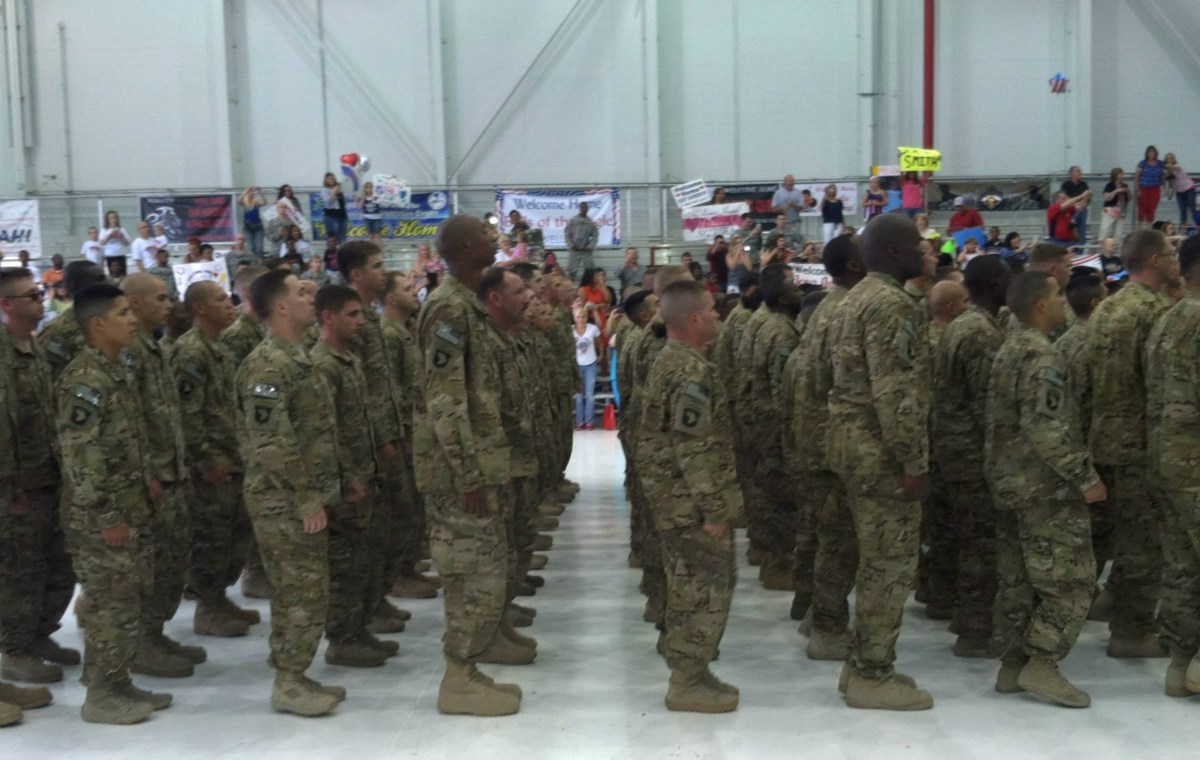
In every house of worship in the nation, veterans of wars are in the pews. Many have spent decades grappling with grief from their wartime experiences. Few of them feel like their part was heroic or admirable. Maybe they “won,” but too often, they are leary of telling us how ugly the “winning” was.
Evidently, James had been needing to visit that mourner’s bench for decades, so maybe telling Herman’s D-Day story created a space for James, as if we gave him permission to risk sharing the shame he felt. Perhaps being able finally to tell his story out loud was the confession James craved. Like too many combat veterans, though, he needed not only to share but also to not be shunned.
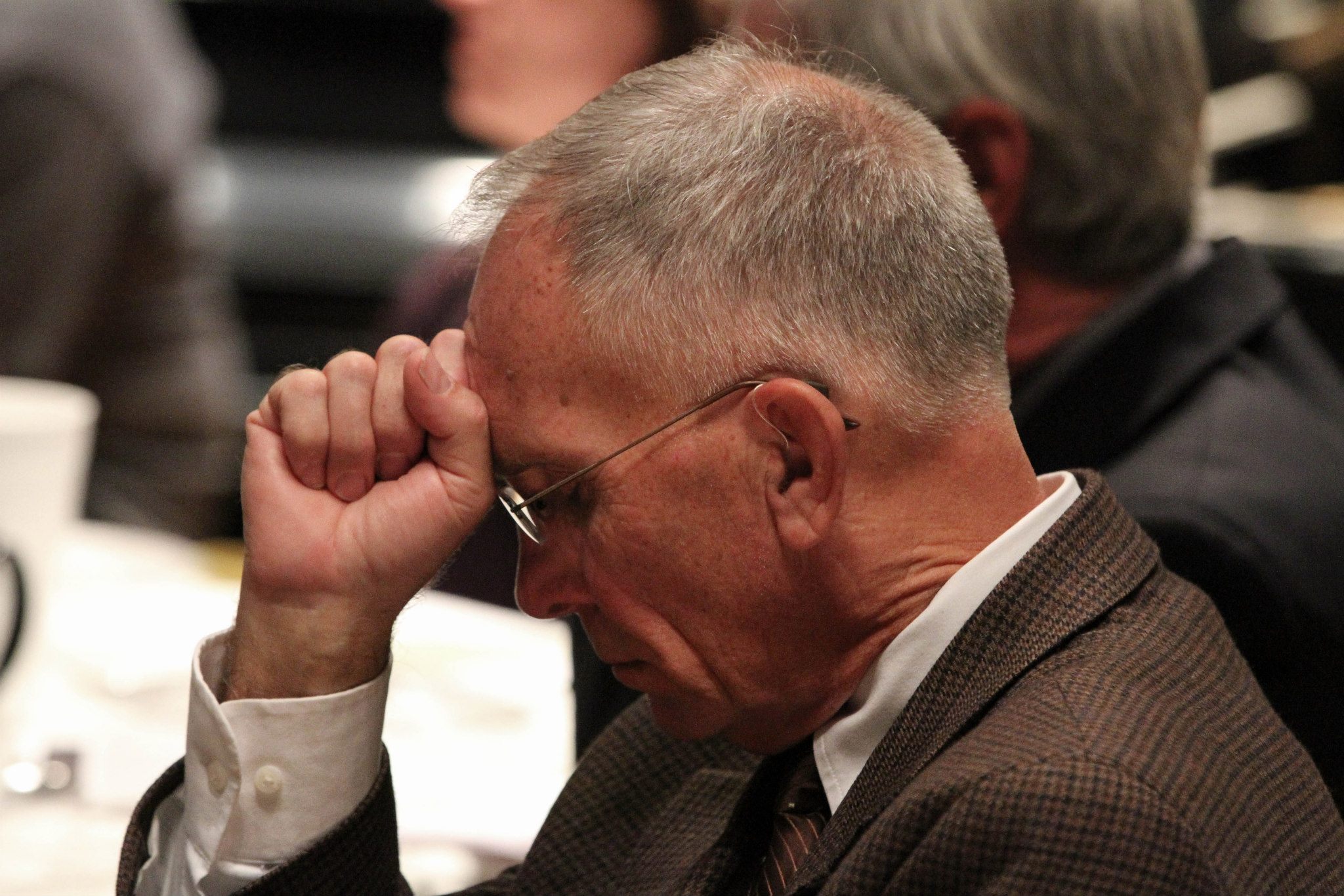
Years later, I would sit in a veteran’s retreat and listen to veteran after veteran tell their combat stories, usually with trepidation. So many were like the Iraq war veteran who shared his story of killing “anything that moved” from the helicoptor he piloted. That veteran believed himself to be a “monster” and was certain he should no longer be allowed in our midst. Like this combat veteran and so many others, James needed to tell his story and not have anyone, as one veteran feared, “run screaming from the room.” He needed to know I didn’t see him as a monster and that I would still visit, still speak to him, still consider him part of the flock. He had been needing to visit that mourner’s bench for decades, and telling Herman’s D-Day story gave him permission, at least in his mind, to risk telling his story out loud. Maybe Herman knew what would happen when I shared his D-Day story. God certainly did.
My paternal grandmother, Arbaleta (Grandma Leta), and maternal grandmother, Marie (Grandma Ree), could not have been more different creatures, and this was never more obvious than at Christmas. At first glance, it seemed to me that they were polar opposites when it came to wintry holidays especially; in retrospect, it is evident they were each on opposite points of the pendulum that has come to symbolize Christmas for me. Generation after generation on both sides of my family seemed to be unconsciously caught up by the wild swings of this holiday pendulum, a reactionary arc between a resounding “Yes!” to Christmas and its counterpart, an adamant “Hell, no!”
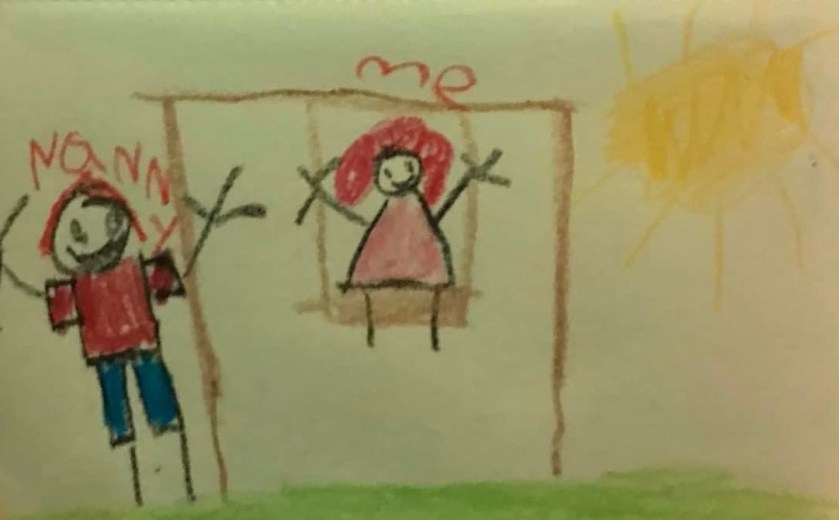
My Granddaughter’s depiction of our favorite activity: swinging. She is so wise….
Finding Healing Around Christmas
Maybe your family needs some healing around holidays as well. Sure, it seems strange to talk about Christmas amidst all the paper and ribbon and cookies and tinsel, but it is, in fact, the best time to step back, recognize struggles and disappointment and start our families on paths to peace with Christmas; maybe along the way we could even figure out what’s “enough” for joy. I offer this reflection then to all our families because we cannot find healing if we do not know our family’s wounds. Here’s hope for discussions about upcoming celebrations: may they be intentional, loving and truly joyful for all.
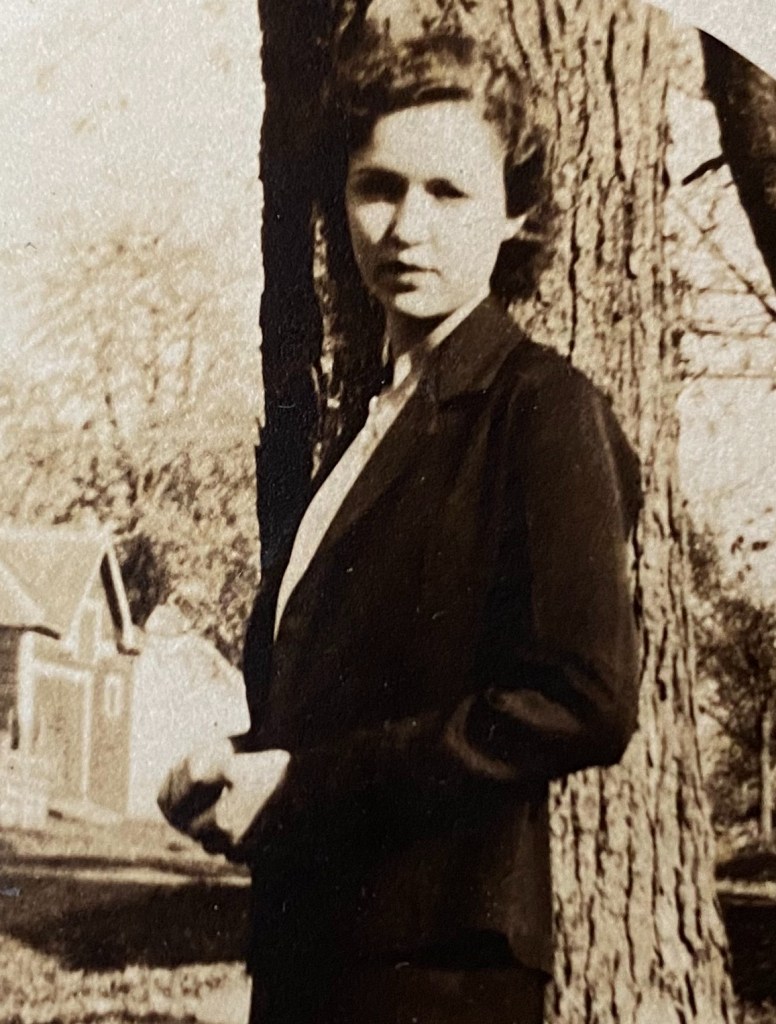
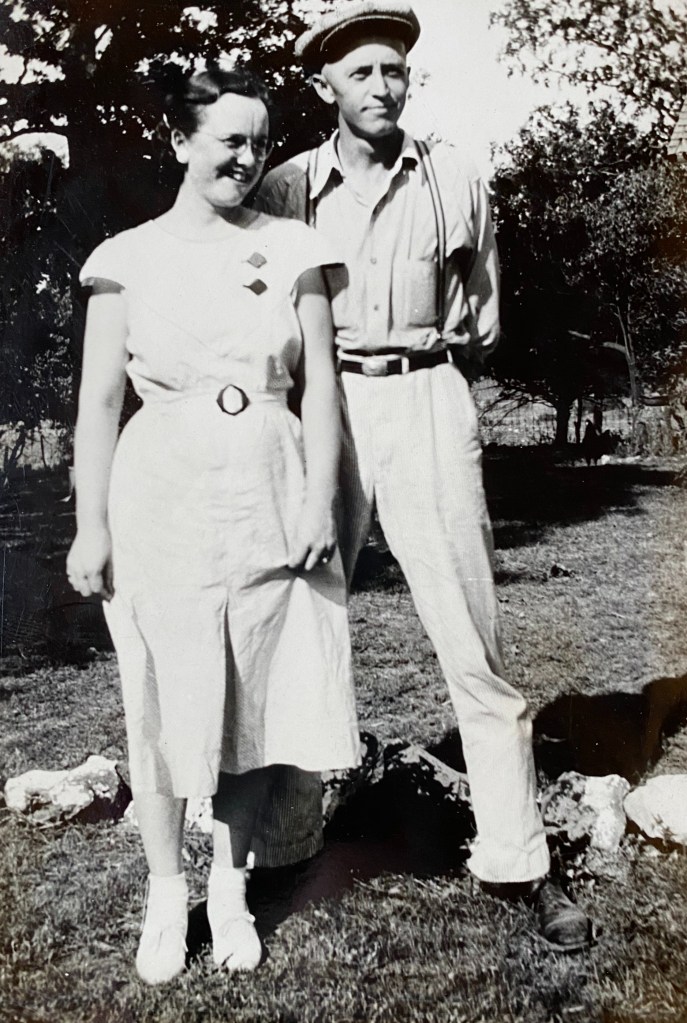
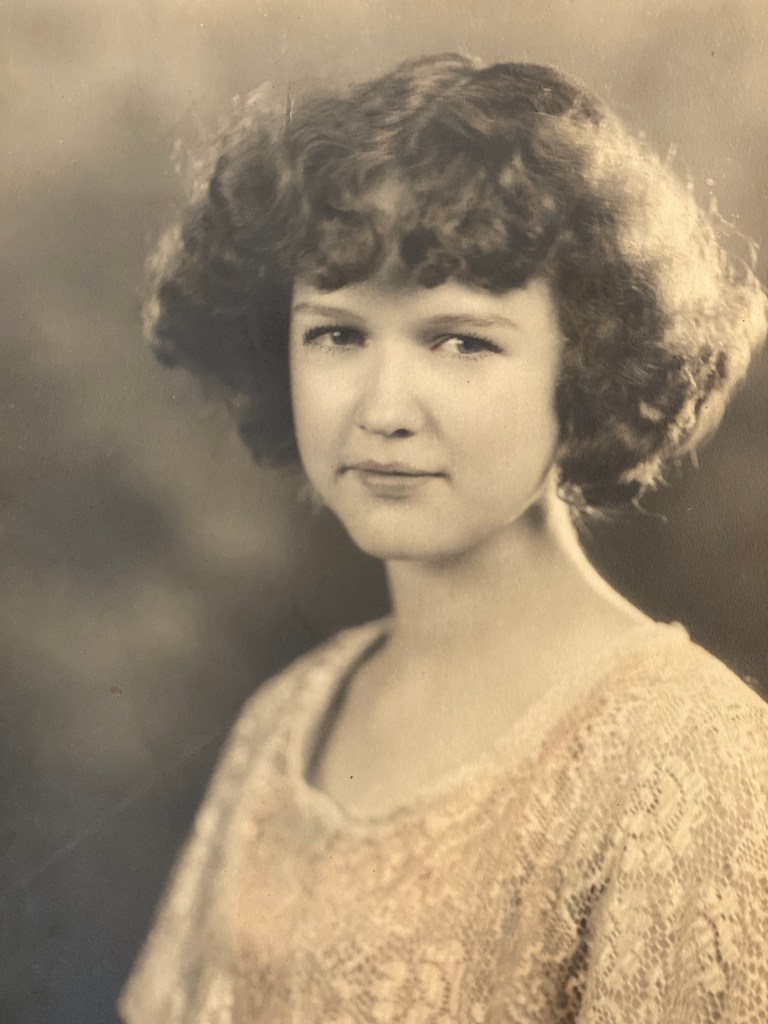
Marie as a young woman.Marie, George, & their three daughters, 1940’sArbaleta and husband, Freeman (Mac)
For me, it seems the best place to start is with the grandmothers. Both of my grandmothers were born around WWI; each married during the Great Depression. Neither had, as they say, “a pot to piss in,” not while they were growing up and not while they were young mothers. Both worked hard to support their families outside the home as well as in. Dad’s mom, Arbaleta, had two children, a boy and a girl, nine years apart. Mom’s mother, Marie, had three daughters all close in age.
Arbaleta’s husband, my Grandpa Mac, fell from an electric pole when he was young and wasn’t supposed to ever walk again, but did, in great part because Arbaleta would not let him not walk. She reportedly insisted he move his legs and even moved them for him for months as physical therapy until he could walk and work again. While I was never close to Grandma Leta, I have always admired the steely determination that these actions showed.
Marie had a husband who was always on the road as a truck driver, mostly because the bus or truck driver jobs close to town weren’t well-paying. He died of a massive heart attack at age 50; she lived another 30-plus years and married her high school sweetheart, then outlived him and married another kind man when she was eighty. At that wedding, the minister declared what we all knew, “Marie is a hopeful woman!” Grandma Ree, as we called her, was the quintessential kindergarten teacher when teachers still had time for nature walks, ironing leaves between sheets of waxed paper, and silly songs. Thus, she was the kind of grandmother I aspired to be: she played games with us, prayed for us, encouraged us and defended us when necessary. For most of her life, she modeled a love of learning: she earned a master’s degree, helped “plant” two churches, became an accomplished painter and was memorizing her favorite Bible verses in her seventies because she was losing her eyesight.
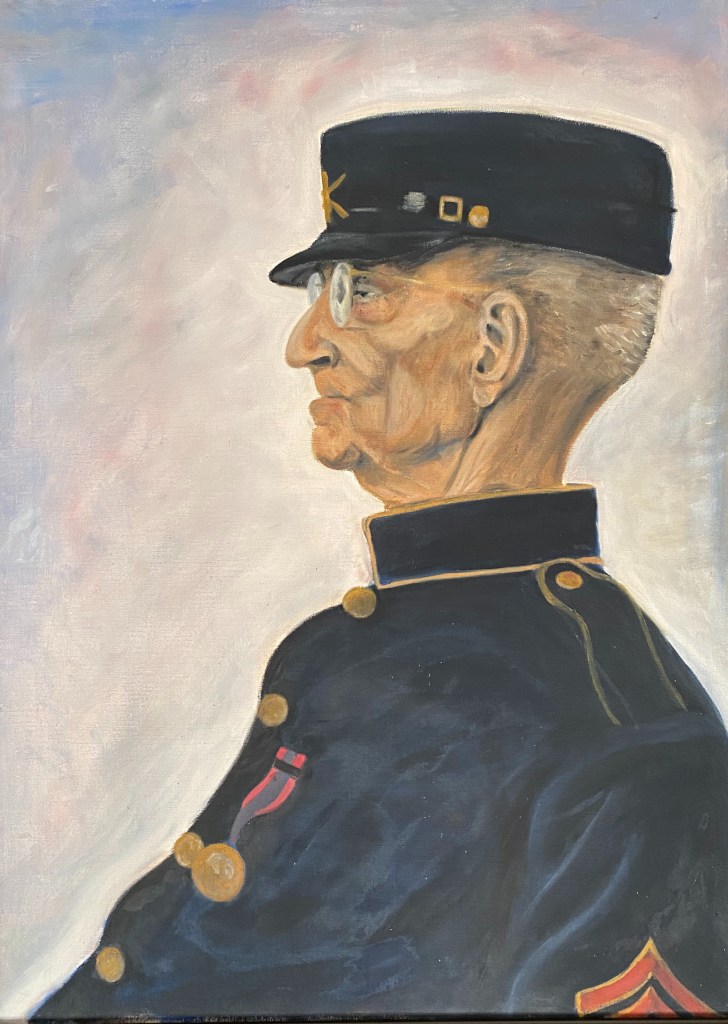
Marie as a teen.A painting by Marie for an art class while working on her Master’s. A local Spanish-American War vet sat for the class.
While I know little of Arbaleta’s childhood except poverty and hardship, I know Marie helped her mother run a boarding house after her chiropractor father divorced her mother, something which mortified both women.
That I’m aware of, Arbaleta seldom left her home after we were born. At least we never saw her leave her home, though, as far as we knew, she was perfectly capable. Our collective memory of her is of her seated on the sofa in her silk pajamas. Every time we visited her, we would wave to her from a few feet away as she perched on the sectional sofa in the corner, surrounded by shelves of various sizes and shapes of cacti. In one hand she held a lit cigarette, ashes threatening to crumble onto the silk, and the other hand held the ever-present bean bag ashtray (you know, the kind that has the bean bag on the bottom and the colorful aluminum tin bowl on the top.) That I can remember, she never once kissed, hugged or touched us in any way, shape or form. And, though she was pleasant, there were no memorable conversations, just the cloud of cigarette smoke that circled above her.
As for Christmas, well, I can’t remember there being much of it in their home at the edge of a Kansas golf course where she and Grandpa had retired. Ironically, I’m not aware Grandpa played golf, though my Dad did well into his eighties. As far as Christmas goes, Arbaleta represented the point in the arc where celebration was merely tolerated. Every few years, our parents would tote our gifts to their house to open on that rare occasion we woke up there on a Christmas morning, but the mood in the house was that Christmas decoration was, well, perfunctory. There was a tree and maybe a wreath, but evidently, for Grandpa and Arbaleta, a tree and some lights outside were “just enough,” though I suspect they were only put up to satisfy us. If overcoming poverty was Arbaleta’s life goal, she met it, thus the home on the golf course as well as the purchase of a new Lincoln every year. Secular or religious, it didn’t matter; Christmas was a formality, expected, tolerated for the children. Christmas dinner involved polished silver and store bought sweets, if any. “Please wait until you have permission to touch.”
Arbaleta died when I was seven and, suddenly, the focus of Christmas on my father’s side of the family shuddered and swung hard to the opposite extreme. Her daughter brought in Christmas every year from then on with a vengeance, lovingly, but with an overwhelming force. Every year, my aunt seemed to be competing for best Christmas ever, ostensibly in response to her own mother’s lackadaisical attempts.
While certain treasured and expensive statuary graced my aunt’s mantle for Christmas, for example, every year, the Christmas tree itself, usually the biggest tree I’d ever seen, sported a different theme with new, all handmade ornaments. I often asked when she started making them, sure she must have begun the previous New Year’s Day. She also made most of our gifts; they were always of Pinterest quality and I treasured several sweaters she knitted for me, for example.
As if it were necessary, she also became an amazing cook and thus, Christmas visits always involved impressing us with recipes for new dishes. Ironically, my mother didn’t want the recipes and my mother’s mother, Marie, didn’t need them; my mother was too busy leaning into that dysfunctional pendulum that was swinging back to the starker side, likely in reaction to her mother’s seasonal excess.
Marie, my mother’s mother, was on that same swing of the pendulum as my aunt, though I believe Grandma Ree went all out for her Christmas celebration for different reasons. Her husband, Grandpa George, also died when I was seven, but that did not slow Marie down in life or around the holidays. From the moment you opened the door into her home at Christmas, the scent of pine and wild berry candles carried you through room after room of greenery, holly, bells, poinsettias and new figurines or miniatures each year. Also new each year were the sweetbreads and cookies and homemade candies, all awaiting our discovery after hugs and kisses were exchanged and the coats and mittens and caps were piled onto a bed in the back of the house.
Grandma Ree with her brother, Mother and Sister, c. 1960’s.
A Family Nightmare
While Marie’s response seemed to me to somewhat resemble that of Arbaleta’s daughter, the driving force behind Marie’s likely unconscious Christmas reverie gone amuck was a well-kept secret, a family nightmare. On two separate Christmas Eves, during her childhood and youth, Grandma Ree had lost family members to suicide. I was, of course, an adult before I was made aware of that history or the details: one drank poisoned alcohol and one shot himself, both on separate Christmas Eves. Of course, the grief and shock of their actions was complicated by their (conscious or unconscious) efforts to ruin Christmas forever for some of their family.
How painful were their memories of the holidays?
Before we assume that Marie’s attempts to reclaim Christmas was the reason for the pendulum’s extreme movements, though, we need to recognize that some calamity in earlier generations drove those men to choose Christmas Eve to end their lives; we have to ask how painful were their memories of the holidays that drove them to risk also ruining the holiday for their spouses and children? How far back did the pain begin and what don’t we know about that?
In other words, it’s not likely either man, both of whom must have been suffering and feeling hopeless, started the family on that path.
The result, though, seems to have been an unconscious struggle to compensate. Those grand swings between holiday excess and hopelessness left subsequent generations still unconsciously at a loss to figure out what’s enough celebration. Further, while we can understand what might have spurred Marie’s need to excel at Christmas, I’ll likely never know what caused Arbaleta’s lack of enthusiasm for the holidays, and so I’m left simply to marvel at the overwhelming force of her daughter’s frenzied Christmas efforts. Sadly, or thankfully, no one now has picked up that mantle and the extended family is so fractured as to make these discussions nearly impossible.
I offer these reflections then to my nuclear family as the beginning of some discussions around conscious choices rather than wild reactions.
How does a family figure out what’s enough Christmas when the family’s history is, well, fractured? My own efforts were often emotionally unsatisfying; not only were my mother’s Christmas efforts headed for the stark extreme in reaction to her mother’s and her sister-in-law’s excesses, but they were complicated by my general lack of interest in cooking or baking except when absolutely necessary.
It was my ex-husband who started me thinking about some of our responses to holidays years ago: he protested the idea of Valentines’ Day for example, saying we could and should give one another cards or flowers or candy at anytime of the year and not just one day chosen by candy and card companies and florists. Yes, we can, I agreed wholeheartedly. But do we? Of course not, I pointed out. To his credit, he came by his dislike and struggle with holidays honestly and thus brought his own reactions to our holiday table: his birthday is the day after Christmas, and he was one of six children. His Christmas gift always came with a declaration that, “Oh-that’s your birthday gift too.”
Over the years, I certainly have struggled with holidays, whether it’s decorating or preparing a feast or just planning. Don’t get me started on birthdays for children; too many of those ended in my tears from exhaustion and a sense of failure. Did I tell you about all the “Pinterest Fails?”
All these things and more (all these things and more) that’s what Christmas means to me, my love….)
Stevie Wonder
Plenty of us struggle with the holidays, though, whether because of grieving a loss or knowing you’re the only one who can’t afford the gift exchange. I’ve tried over the years to make our gifts for Christmas but again, I know too many of my family members and friends were less than thrilled with the results. Mea culpa. We tried spreading the Christmas holiday over several days to lessen the wild two-minute frenzy of Christmas morning. We tried taking Christmas to the mountains; we tried staying home. We wondered what would happen if our family just gave up one Christmas and had lots of little ones? Could that not translate into lots of chances to do or give or be kind to one another? So many of our attempts at intentional Christmases revolved around not expecting one or two people to create a magical holiday that only left them in tears and exhausted.
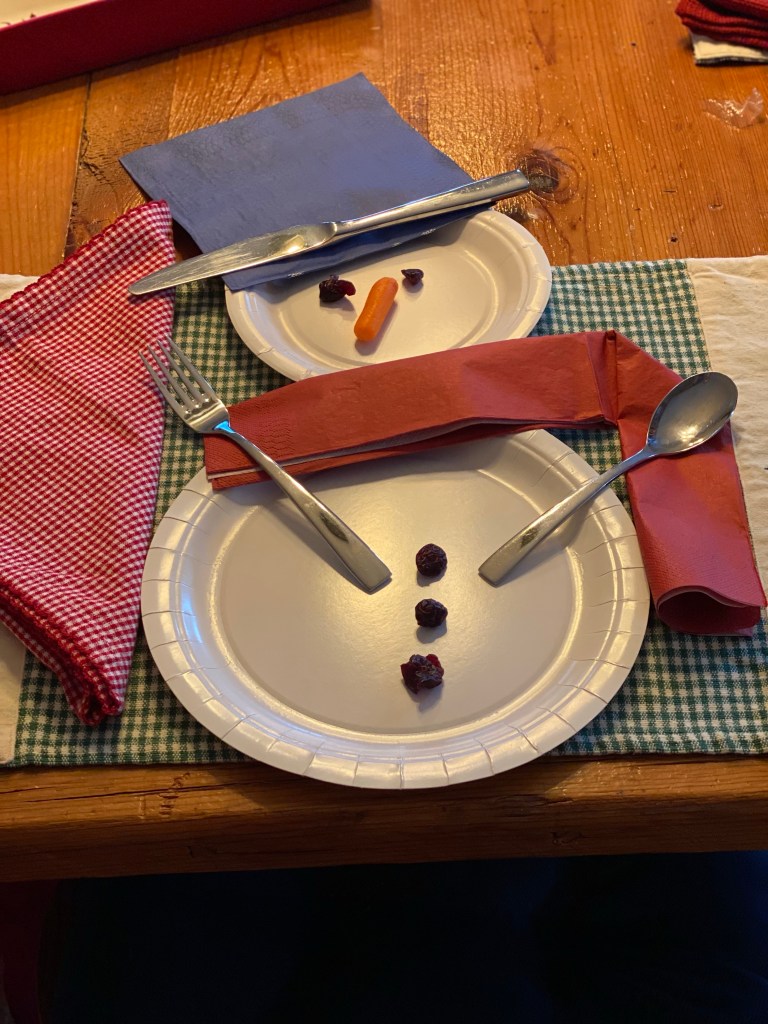
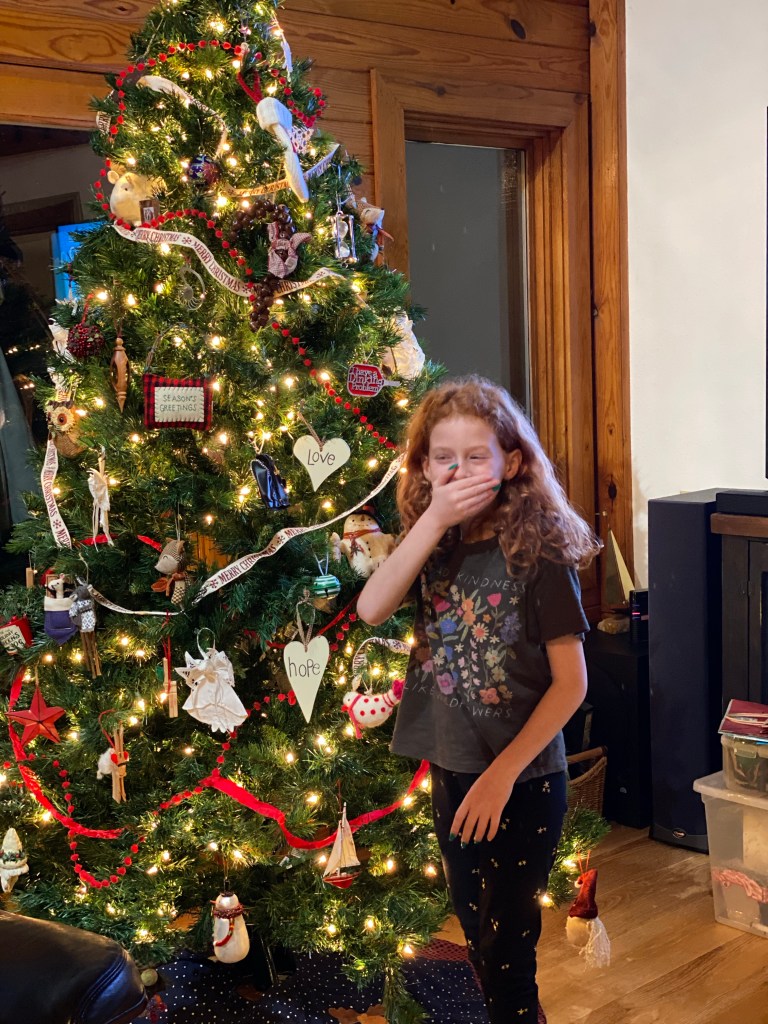
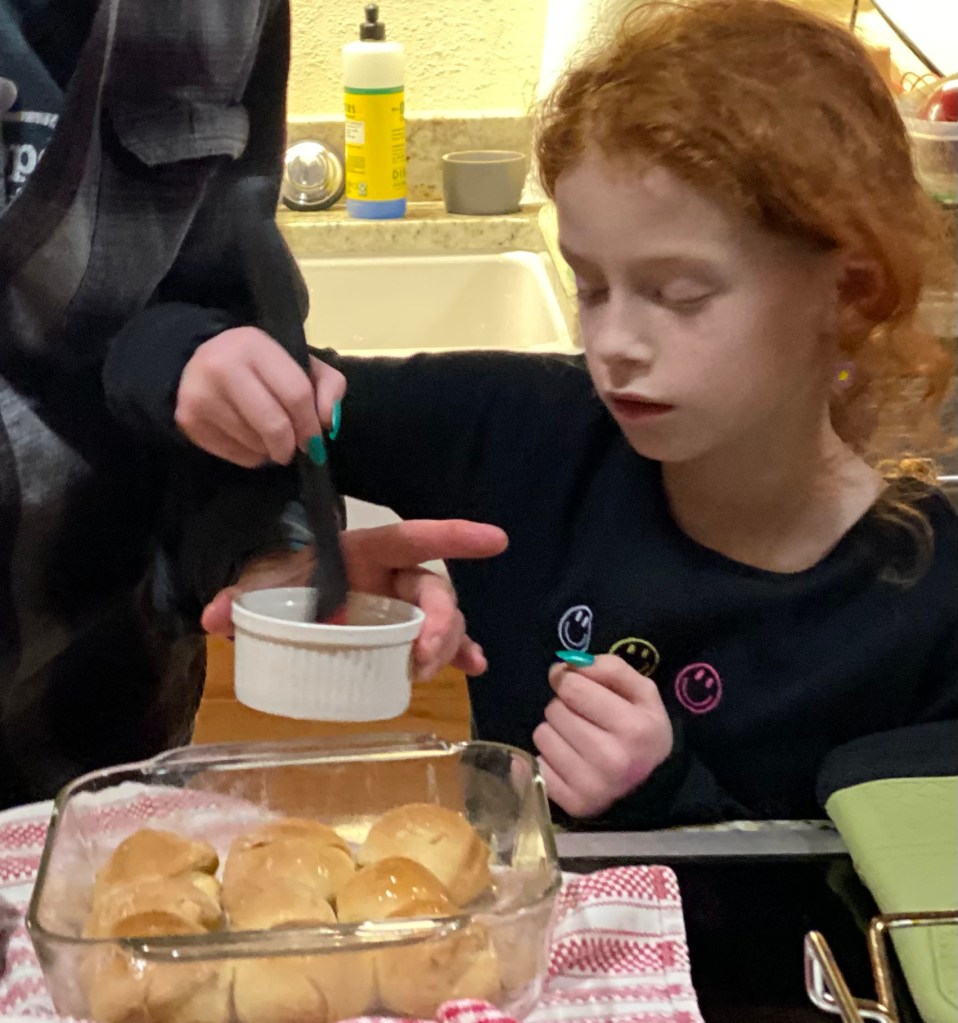
We’ve finally begun to incorporate some activities intentionally. Instead of china and crystal, we copied someone else’s snowman place settings, something the granddaughter and I could share. Last year, we started some silly story telling. This year, we introduced Karaoke and I am trying to reclaim the joy of baking by helping my granddaughter learn; watching her “knead” the goop she bought at the store made me think. Lo and behold, she discovered the joy of yeast and how it rises and how the baker must punch down the dough, then knead it. Her eyes grew wide after she made a fist and punched away. “That is soooo satisfying,” she said. A keeper.
In case you’re wondering, religion did not seem to figure at all in the wild reactions to the holiday through the years for my extended family. While Arbaleta was, as far as I know, agnostic, and Marie was a strong Christian, neither of them addressed or seemed to include the religious holiday in their efforts to reclaim or dismiss Christmas. For our family, that’s a different pendulum altogether. I personally love a good candlelight Christmas eve service singing and the idea that God came to be with us as an infant. Nevertheless, culturally we continue to struggle with all that Christmas celebrations have become for generations and we cannot heal from pain we do not acknowledge.
For our family, the faith and religious rituals are different pendulum altogether. I will never know why my Grandma Ree did not incorporate more of her personal faith into the celebration. Personal experience suggests she was treading lightly with agnostic family members and, as is true for many families, also celebrated on different days with different parts of the family, balancing church events with home. Nevertheless, culturally, we continue to struggle with all that our secular celebrations of Christmas have become for generations, often leaving us to begin another year frustrated, sad, discouraged. That is where we can start, but we must look collectively at this because we cannot heal from pain we do not acknowledge.
The best time, I believe, to reflect on how we celebrate Christmas is when we are all together…and we’ll before Christmas comes around-unexamined-again.
For my family, I continue to try to reframe Christmas in light of the history I bring to the holiday. I guess I hope through reflections and questions to step completely back from that wild, reactionary swinging between excessive celebration to indifference and even disdain.
I think one key is that we focus on the children, but with respect for their needs and not our own needs to give them the best holiday ever!
They get tired; we pay attention. They want to dress up; they don’t want to dress up. Quiet time, dancing in the kitchen time, gifts that involve us engaging with them. I’m not saying we’re the best with children ever or that ours are happier than any other. What I am saying is that like in so much of life, the children around me ground me. What they need is so often what I need. Let’s sing Jingle Bells, yes, at a gathering, but we mustn’t forget the bells themselves and our need to jingle them to make the song come to life.
A little percussion goes a long way and when we sing “Jingle Bells” there need to be jingling bells….A five-year-old taught me that.
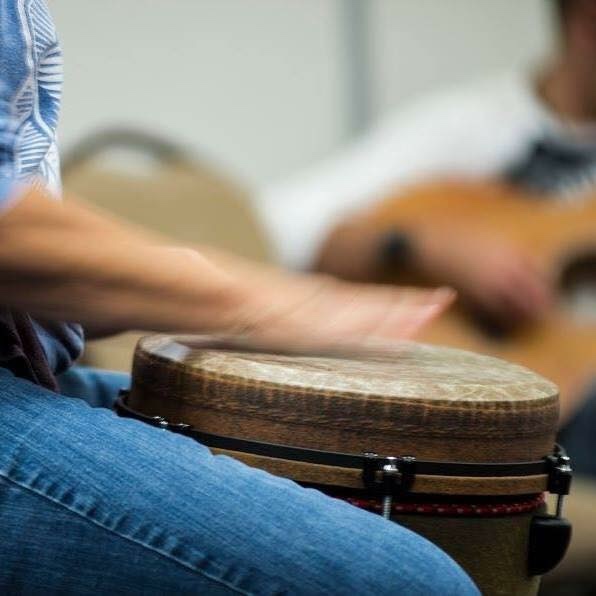
Music must also be a source of holiday joy for many families. I’m jealous of those who manage a musical gathering but hopeful that might be in our future as well. Certainly with percussion everyone can participate! The idea of introducing music brings us back, though, both to the need for sensory awareness and to the idea of joy and reverie throughout the year. In order for there to be music next year, we need to practice throughout the year – often and, by practicing, remember the things that do bring us joy without wearing us out. I write this and share it now, after the holiday blitz, planning to share it with my family, to start the conversation we can have in anticipation of next year. I am curious to hear from them, and find out if they are aware of, or experiencing their own pendulum of Christmases, maybe even unknowingly riding that pendulum right now. I’m hopeful that with some lowered expectations of ourselves and a little yeast, we just might be able to rescue the holidays from the extremes of that dysfunctional pendulum my family rode for far too long AND decide for ourselves what is “enough Christmas.”
When I was five, I ran away from home. Of course I didn’t get far. My world then revolved around a quarter-acre yard in Springfield, Missouri, on a corner lot, two blocks from my elementary school. We lived a short drive away from where I was attending kindergarten at our First Baptist Church and near enough to some train tracks that I knew it was bedtime by the train whistle every night. The little three-bedroom, one bath brick house on Marlin Street had a fenced-in backyard, a sand box, a metal clothesline and a weeping willow tree, all seemingly perfect for three children under six. Its feathery leaves hung to the ground, draping around the trunk with just enough room under the canopy for a five- year-old to hide and imagine different worlds than were to be found inside the little house on Marlin.
For the longest time, I couldn’t tell you why I ran away on that particular day. I often wondered if it hadn’t been that I didn’t want to go back to kindergarten. I went on the afternoon shift, so we basically had an hour or two of ABC’s, singing, and a snack in the gymnasium of First Baptist Church before we took a nap. I already could read and write some when I got to kindergarten, so there was no struggle for me there.
There had been a memorable first day spent on the vinyl chair in our kitchen trying to learn to tie my shoes. “Little boys and girls who can’t tie their own shoes are not big enough to go to kindergarten,” I’d been told again and again. “They’ll send you right home.” I had spent the morning of my first day of kindergarten tying and untying my red plaid tennis shoes, both my mother and me praying I’d avoid the shame of the teacher calling my mother to bring her little “baby” home. We needn’t have worried. Not once did I ever have to tie my shoes while at school.
Perhaps, on that morning, I simply didn’t want another perm.
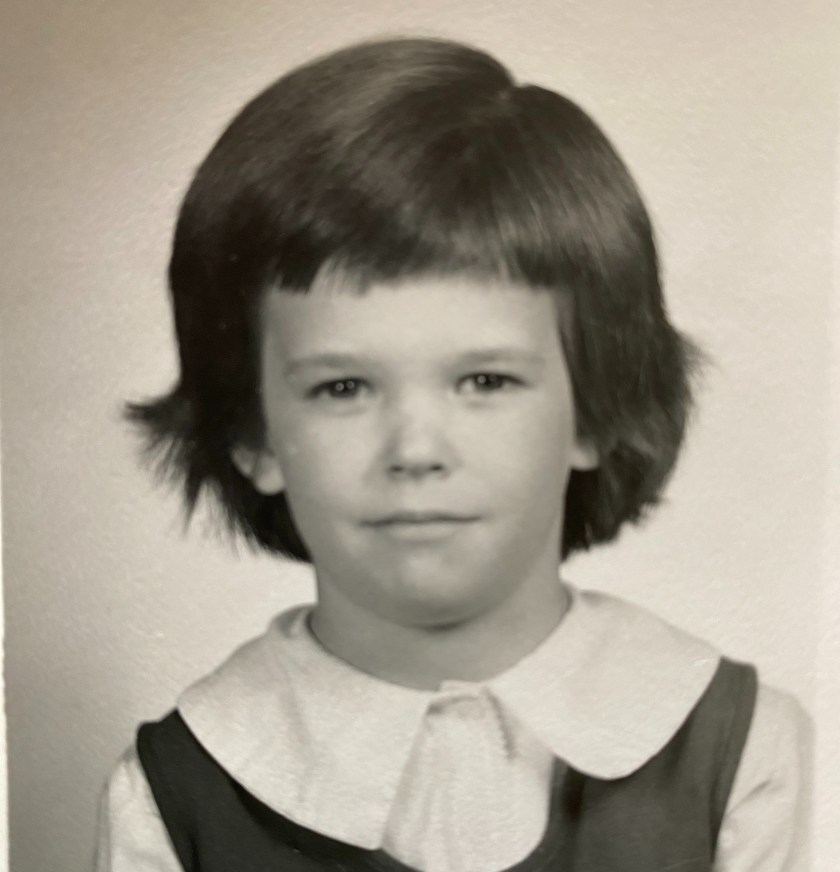
My mother struggled daily with my full head of “straight as a pencil” “dirty-brown” hair because it was constantly tangled. Every day, we’d have the same conversation about brushing the underside of my hair, that thick mat next to my neck, and every day I would stare at her as if I were hearing the laments and reprisals for the first time. My hair may have been the bane of her existence but her brushing my hair is the only physical connection with her I remember. Her brushing it angrily. Her trimming errant bangs until the top of my head was nearly visible. Her trying to make it curl. Her finally chopping the hair off rudely, at a strange angle because she was done with it, as fed up as I was with trying to tame that mane.
Mom had been introduced that summer to the “home permanent.” I’d never been to a salon even to have my hair cut. Mom cut our hair herself with her sewing scissors, black handled shears that were never sharpened or oiled, as far as I could tell, so they’d pull when she hacked away at the thick bunch she’d grab in her left hand and chop with her right hand. I remember staring into the bathroom mirror blankly. I hadn’t cared that she cut it because of how horrid it looked, I realize now. I cared because she said, as she was sweeping up the hair from the floor, “Now you can just brush it yourself.” She would no longer brush it for me. I think I would even in that moment have agreed to another permanent like the one that had failed so miserably and sent her to her sewing basket for the shears.
I can still smell a home perm a mile away….
The day before, the permanent had required a couple of hours of me seated on that sticky vinyl chair in our kitchen while she rolled strand after strand in metal-curlers, the kind with bristles meant to grab and hold the hair long enough for the chemicals to alter the makeup of your hair and teach it to curl like those golden locks on Shirley Temple If the rolling of the curlers wasn’t bad enough, the chemicals made my nose burn and my eyes water and the bristles on the curlers pricked my scalp. Then, once the solution had been applied and wiped off my neck and back, I was told to take my daily nap. Whether we slept or not, we “napped” every day so Mom could have time to herself, a practice I appreciated when I had children. Only on this day, because of the perm, I was relegated to a rug on the floor by the washer in our laundry room. I could have no pillow for my head because we didn’t want to ruin a pillow. Were we worried about ruining my head? Also, no pillow meant any attempts to rest my head caused dozens of tiny needles to prick my scalp, but sitting up and trying to read sent rivulets of stinky solution dripping down my neck and back. I would not rest well that afternoon.
Sadly, the perm did not “take.” My hair rebelled. My mother was furious, disgusted, as she yanked curler after curler off only to watch the long brown strands defiantly continue to hang as straight as pencils. She was crying. I was crying. She’d been trying to prepare me to participate in a Girls’ Auxiliary ceremony at our church where her teenage cousin would be “crowned ” a princess. The Girls’ Auxiliary was the church’s alternative to the Girl Scouts, designed to encourage girls to learn Scripture, study the lives of missionaries and participate in ministries like collecting monies for children India and China. To the program’s credit, many of us certainly were inspired by godly women like Lottie Moon. My cousin had completed the requirements for attaining the “Princess” rank and there was to be a ceremony at church. I was tasked with carrying a paper gold crown on a pillow to be placed on her head. Mom wanted me to represent the family well, to look pretty and be a shining example of the next generation of princesses.
But my shock of brown hair refused to do its part. And mom was fed up. She’d gotten the shears out just as her aunt called and offered to come over and help. Her aunt had three daughters, all teens, and somehow managed to fashion a dainty pony tail for the ceremony.
The next day, however, the shears returned and that was all she wrote. My hair would not cover my neck again that year or the next. Not until I learned to brush it myself. I could not for my part, see the point. I didn’t care about my hair being pretty, which may seem ironic, since I was teased incessantly by my father. He was annoyed that I was so attached to my white straw hat, white gloves and white wicker purse, all gifts from grandparents the year before for Easter. He thought I wanted to be “a little lady” because I carried my purse with the gloves inside it and donned my little white straw hat with a yellow ribbon nearly every day for most of that year. I didn’t participate in outdoor activities anymore with my brother or sister that year. I preferred instead to go outside in my hat and carry my purse to sit under my tree and pretend I was somewhere else. It would be years later when I’d realize why I wanted to be anywhere else.
Of course, picture day came soon after the cut.
At the time, I just remember being grateful I could pull that straw hat over my crooked bangs. That afternoon then, while mom was sweeping my hair off of the bathroom floor, and I was supposed to be on my bed for naptime, I pulled the hat down over my ears, shoved my gloves into the purse and snuck out the screen door from the laundry room, careful not to let it creak or slam shut.
I had left a note on my bed that I expected her to find, a note that simply said, “I am running away. Jodi.” Then I went outside and sat under my tree, my back against the trunk, legs stretched out towards the backside of the house, the branches drooping and fingering the ground as the breeze tried to cool the afternoon. Then I waited. I waited for her to find my note and come running frantically out of the laundry room into the carport, searching. I waited for her to scoop me up and hug me and exclaim how relieved she was that I was safe. I waited for her to carry me inside proclaiming she would never let me go, maybe even to bake cookies for me. Just for me.
I waited, and, then, worried she wouldn’t be able to see me under the tree whose branches drooped to the ground, I moved to the sandbox. And waited some more. When the heat got to me, I moved to the back door that led to the laundry room and perched on the steps, clutching my purse, waiting to be found. I’ll never know how long I waited, but eventually I got tired and gave up. Then, slowly so as to not make the screen door squeak, I peered into the laundry room at the ugly rug that still stank of permanent solution. I crept past the opening to the kitchen and found no one, so I crept to the bedroom I shared at the time with my sister. She was asleep on her bed. My brother was asleep across the hall in his bedroom. Even my mother lay sleeping on her bed; drugged by the heat and disappointed by the day.
I guess I was sure Mom must have seen the note and ignored it, so, ever the quick thinker, I crossed my name off and penciled in my sister’s name on it instead, then fell asleep. It would be years before I’d wonder why I hadn’t just crumpled the note up, why it hadn’t dawned on me that my little sister couldn’t read or write at the time. As it turned out, the note was still on my bed when I awoke from the nap, so I folded it up and tucked in into my white wicker purse where I carried it for the rest of the summer.
In the previous Post called The Boulder Fields of our Lives, about hiking Longs Peak and working at the YMCA of the Rockies, I ended by explaining that our summer work (and “Hikemaster” Course) were cut short not long after we scaled the 14,000+ foot Longs Peak because of a natural disaster in the canyon below us. A few days after the climb, a year’s worth of rain fell in 70 minutes and the Big Thompson River below our camp washed out nearly everything and everyone in its way.
For decades now, because my memories of being just above the “500-Year Flood” are so fragmented, I have not told the story of being there, which is unusual for me. Most days, I am known to bore anyone close enough to listen with a story or two; I usually can’t help myself. The stories I have not told then generally are ones I cannot remember OR ones I do not want to remember. Only after writing about climbing Longs Peak, as I looked at the photo of me and my climbing companion, did it occur to me that the story of that summer was not complete without talking about the flood.
“The chaos along an otherwise trickling Big Thompson River killed 144 people, five of whom were never found, and carved out a chapter in the history books as Colorado’s deadliest natural disaster.”
Both the hike and the flood were, for lack of a better word, watershed moments for me, but the lessons have been realized slowly and in fragments. To better remember those days, I looked at a couple of television news reports of the flood, but they were recorded decades after the flood. Strangely, the lack of technology at the time affected both the before and the after, the event and the memories. The only phones in 1976 were landlines and, so, warnings came only through emergency personnel going door-to-door; at least one first responder died trying to warn others that night. Only a few black and white photos are available as well, making attempts at remembering as cumbersome as the warning system had been. Nevertheless, I have felt driven to try to piece together a coherent memory of those days and, as I researched and read and poured over old photos online, I read the words of one Colorado disaster preparedness official. She said,”We learn the most from chaotic events.” As I have tried to remember and reflect, I think that she was right; we do learn much from chaos, but we have to work to find those lessons.
First, setting the stage for our story….
After my freshman year in college, I went to the mountains near Estes Park to work for what I thought would be a summer of fun. Once there, I was surprised to find a sense of peace that I had not expected. I was, for the first time, hopeful that I might actually be able to find a peaceful and stable home once I could support myself. I surprised myself, in fact, by making some plans to continue working at the camp in the fall.
Though I kept journals off and on, little remains of what might have been written that summer. I do remember that, on the back of placemats, during lulls in our work, I sometimes wrote letters or journal entries; most of them are lost, but the only one I have found from before the flood surprised me. I wrote:
Tuesday, July 20, 1976
“Storm clouds have mingled with the mountain peaks since sunrise; we here in the valley are enclosed, shut away from the crowds that would disturb us….peace of mind must certainly follow. Here, in my room, I am lulled into a tranquil mood by the clouds every day. Even when my work day is long and busy and even frustrating,” I wrote, “…the calm is inescapable.”
Calm was something I could not claim before that trip and safety was not a place I remembered.
At that point, the clouds covering the tops of the mountain peaks around us (The highest peak in our area was Longs Peak at more than 14,000 feet in elevation.) were benevolent. I wrote: “These clouds draw your thoughts. Constantly changing, first ringing, then entrapping the peaks, they are playing quietly and are a source of constant amusement.”
I worked days in the bakery and often used the back of placemat/maps for journal entries and letters.
Those “playful clouds” would soon turn deadly, though. During our Hikemaster classes that summer, we learned to appreciate the danger of the storm clouds that often came up quickly in the mountains. On July 20, though, I was simply calmed by their presence and movement. I needed that calm desperately; the family life I would return to was chaotic, unpredictable, traumatic. The rules changed daily and nothing that occurred in my home could surprise me anymore. The overwhelming feeling that I had carried with me when I tried to escape to the mountains from a tumultuous family life was fear. Fear and anxiety wore me out and, I know now, the trauma, fear and stress are why so many of my memories are fragmented at best.
And now, a word about trauma….
Trauma is destructive. Like the different kinds of skin cancer, trauma can create a wound that burrows deep or spreads outside of you, like when you fear for your loved ones in such a depth as to make others question you, call you hysterical even. And yet, because you have experienced trauma, you know. Accidents DO happen. People, even people you trust, DO harm one another. Your parents did not protect you. No one saved you. Nothing, not even seeing another day, was guaranteed. All the worst, all you feared, was indeed possible, did happen. And no amount of reassurance from others can repair that trust completely; we can learn to manage the fear but we never know when some sound or smell or person or newscast will bring it all rushing back.
Like a broken mirror, trauma shatters both our sense of self and our memories. Too many of my memories lie in shards on the floor and picking through them, trying to piece them together, trying to make sense, to have some timelines or events make sense is most likely why I write.
Even the effort to capture the memory of that time is fragmented: all that remains are three pages written by that seventeen-year-old me as I tried to capture what I saw and a couple of newspaper pieces I wrote after I got a job working at the local paper and my editors learned I’d been in the “500-year Flood of ’76.”
The morning of July 20, 1976, though, I was feeling calmer than I ever had, safer, more at peace and, to my surprise, I was enjoying even the colder weather on the mountains. I have long been known to dislike the cold intensely, so as I read the words I wrote, I am struck by what I believed I had found there: a home and place where I was being trained to pay attention to my surroundings, to know my own capabilities, and how to prepare for and help others in disasters. Wanting to help others is one response to trauma. I know I was hopeful that I might at the very least return the next summer to be Hikemaster and even one day make my home near the clouds.
I wasn’t able to stay, though, and thus much of what I remember, even as I try to piece it together, still seems fragmented and lost to me. Like most of my co-workers, I went home soon after the flood, and immersed myself in college classes. I never saw any of my coworkers again and I never spoke to any of them afterwards either; those relationships simply ending undoubtedly contributed to a sense of loss.
Now, as I try to access any memories of that time, I am left with the handful of days afterwards, days when all of us above the canyon were trying to figure our what was happening below us. Even though we were aware, we did not want to talk about how we ourselves inexplicably had escaped being swept up.
That first day, though, we didn’t know what was going on below us in the canyon.
Like the many campers along the river, we were enjoying the scenery. The Big Thompson River was one of the jewels of the area, a mighty source of income because of all the tourists it drew. Most of the year, “…the water runs only a few feet deep and fifteen to twenty feet wide…happily rushes over rocks and gurgles through pools as it descends 8,000 feet from the high range to the south Platte on the prairie. The water is clear, numbing cold, and playfully sparked by the sun.” (Big Thompson: Profile of a Natural Disaster by David McComb, Pruitt Publishing Company, 1980.)
Saturday, July 31, 1976
Today is unusually rainy.
Normally, storms approached Estes Park and the YMCA camp from the south; thunderstorms, while normal, are of short duration, with clouds often enveloping peaks by 10 a.m., which was why hikers needed to climb summits of the various peaks in the range in time to skedaddle back down below the treeline or risk becoming a lightning rod. Our Hikemaster course is teaching us a great deal about safety and we are training to lead hikes, which would mean teaching tourists about safety as well. Too often, though, tourists in the park dismiss any safety preparations or climbing instructions with disastrous consequences. The tourists we met traveling up to the summit the day we climbed Longs Peak weren’t interested in safety tips. As we were headed down to the timber line, we passed, for example, a woman in a summer dress, wearing tennis shoes and carrying a purse on her arm as if she were headed to a party. They would be fine, they told us, and they waved us on. They had evidently never seen a person who’d been struck by lightning. Unprepared hikers found their way to our camp often enough though and several of our coworkers are among those trained to rescue hikers.
We did not know at that time that many of our Hikemaster instructors would be called upon to help flood victims the next day.
The storm was approaching from the East, though, we noticed, and it just seemed to camp above us, a thunderhead with no high westerly winds to move it. Reports were that during that Saturday evening, twelve inches of rain fell, about the normal annual rainfall amount for the area. Estes Park and the YMCA are above Lake Estes on the Big Thompson River, but, just below us, the unrelenting water from several tributaries gathered debris and swept down the canyons, both restricted by and guided by steep walls. By the time the waters reached the North Fork and the Big Thompson, there was already enough force to destroy bridges. All along the canyon, this storm surge ripped up everything in its way, including homes and campsites, swept up by a water level estimated at nearly twenty feet above the normal. Reports I read later told of at least one emergency worker dying in his attempts to go door-to-door to warn people.
We Learn from Chaos….
One of the innovations that came out of the Big Thompson flood was a national warning system for floods and other national disasters. That, with the advent of cell phones has greatly reduced the number of deaths in floods.
Sunday, August 1, 1976
The camp is secluded from the world as usual, except for the hymns and local newscasts being broadcast on the radio in the bakery. Rain falls steadily still and a heavy fog had settled on Big Thompson Canyon. Four of us went by van higher up into the mountains to a lodge to feed some visitors. While the lodge was only thirty feet higher than the camp, it was eerily sitting just above the clouds and driving on those narrow roads on the sides of those mountains felt even more dangerous than normal.
Sitting in the lodge’s kitchen after breakfast, we listened to the radio to learn when we could expect some sunshine. Mountain thunderstorms seldom lasted even more than an hour or two, so this second day of fog and rain was disconcerting. The announcer became somber, reading a report that surprised us: “The Big Thompson River had overflowed its banks in the narrow canyon leading to the valley and four persons were reported dead.” We became quiet, not having known that the storm was dangerous. The cook was worried about his family, knowing they lived near the flooded area. The storm, we heard, was stationary, and we could look forward to more rain.
A lightning flash warned us we needed to take the van back down the mountain before trying to drive became even more treacherous AND before the van started attracting electricity. We warned the visitors in the lodge not to drive anywhere or even to go outdoors because they’d be lightning rods.
Throughout the morning, as we worked back at the bakery and kitchen, we listened to any news reports coming over the radio. We worked silently through the day as the reports began to seem unreal; the number of dead grew to more than sixty before evening. We began to slowly comprehend the devastation that was apparently just below us. No one wanted to ask if it were just dumb luck that we were above the deadly flood and others were below it. The folks in charge were not sharing much information; maybe they didn’t want us to panic. No one really was surprised to learn that our phone lines were down. That was not terribly unusual, but the announcement added to the somber mood and hushed tones all day. The frequent updates on the radio and our director forbidding us to leave the YMCA property kept us all close to the kitchen even long after our own shifts had ended. Only the maintenance crew left to take the trash but the normal 30-minute round trip took hours and they returned with widely varying reports of the flooding just 1500 feet below us. If any of my coworkers or those in charge were afraid, I did not see it.
Monday, August 2, 1976
Monday, August 2, 1976
This morning, the fog is even lower than before, which meant rescue helicopters were grounded. Several refugees have been brought into the camp in the night. So forlorn, they are wet and cold and dirty. They wait for some coffee and a blanket; dirty pillowcases in the hands hold the few belongings they were able to salvage. They are lucky, though; hundreds more are still stranded. Many more are missing and most are expected to be dead. Still there are no phone lines available and a trip to Denver, normally a couple of hours, would take six or seven and that was only if you had a four-wheel drive vehicle. Technical climbing skills are needed now for rescuers because roads are washed out in the canyon and the only way out is up over the cliffs.
Tuesday, August 3, 1976
For three days, we have heard little about what was happening below us, except by the radio. I suspect now they were trying to prevent any kind of panic; we also did not know what the rest of the world thought about our fates, either. We were surprised to find for example, that our parents had heard mostly dire reports about Estes Park and the YMCA camp above it being unreachable and even obliterated. Some men we didn’t know came to get us today and told us we were going to be calling our parents via ham radios set up. The instructions to “tell your parents you’re still alive” stopped me for a moment. I had not known nor had I had a moment to worry what they might be thinking at home.
The overriding feeling it seems was somber but also a bit bizarre. For one example, our local radio station published a newsletter/bulletin we could see every morning, and next to the names of the dead each day were that day’s baseball scores.
Rumors
Rumors abounded. One account said all manner of snakes, also apparently trying. to escape the waters, were chasing survivors up the sides of the Big Thompson River canyon.
There was one report of a baby, who became known as Baby Moses, stranded on a rock in the rushing water.
One newspaper wrote: “After it opened, the refugee center at Loveland High School became a source of personal details as survivors, some with nothing more than the clothes they had worn into the canyon, told how an evening of cards with friends was interrupted by rushing water and a mad dash to scale slippery rocks. Throughout the first days rumors were abundant. There was one report of a baby, who became known as Baby Moses, stranded on a rock in the rushing water. One national publication called to verify that the baby had been rescued by a woman who lassoed it while riding a white horse. But no one could substantiate any of it, and The Coloradoan reported it as an example of the rumors.”(Big Thompson: Profile of a Natural Disaster by David McComb, Pruitt Publishing Company, 1980.)
“We learn the most from chaotic events.”
Disaster Preparedness Official in Colorado
I Learn from Chaos
For the longest time, I realize now, I felt profoundly disillusioned after that flood; the safe home I thought I had found, in fact, was as treacherous as any place could be. I was not able to stay and create a home there that I was seeking because of the flood and damage. It took me years to acknowledge that and even longer to name the terror. I could not risk feeling that terror then; none of us could afford to name the terror that was just below us.
I certainly had seen the power and wisdom of what we had been taught while learning to hike safely on those granite peaks. I cannot necessarily agree that we “learn from chaos,” but I can admit that I learned from how others around me operated in the chaos.
Over the years since I left the camp, I know that I consciously incorporated lots of those lessons into my life. When you hike, take only pictures and leave only footsteps. When you journey, make sure someone knows where you’re going and when you should be back. When it’s cold outside, layering is the key to staying warm. If you’d asked me before what that summer taught me, I would have acknowledged all of that readily. I also spent a lot of time the next few years in jeans, hiking boots and denim shirts. I even decorated any space I inhabited with topographical maps. I started jogging in order to build up my endurance. I even tried caving because I was not near any mountains.
Mostly, trying to remember any part of that time has shown me that I had learned and incorporated lessons from the flood into my daily life much more extensively than I realized. Being just above the flood and watching how others navigated that danger, in fact, would inform and guide me for decades, if only because so much of what we’d learned in our classes had been especially effective in the midst of that chaos and tragedy.
There is wisdom and, often, survival, in choosing to be careful, and to work together. We learned to look before you step over a log or rock, make sure you pack what you need but only what you need, and, naturally, respect the power of nature and especially of water. In life lessons, those translate to being intentional, learning when enough stuff is enough and admitting to ourselves that we are not the most powerful force out there.
When my parents showed up a few days later to take me back to Missouri, they said I was different. The summer had been grueling in a number of ways, but I had learned so much that would inform every step I took from then on, would help me create the safety I craved whatever path I chose. I don’t doubt that the summer has helped me feel brave enough to continue to travel and explore new places, albeit with safety ever in mind.
Until now, I hadn’t talked or thought much about that time. I chalked it up to being forced by circumstances to abandon the path I had begun to enjoy so much. I felt for the longest time that I’d had an adventurous summer but it was over and so the memory and the possibilities were simply filed away like a summer fling; they were simply not relevant going forward. What I didn’t recognize was that I was on another trek, one that would last my lifetime and what I learned during that summer was helping me all along to find my way, help me create the safety I craved. I say “create” rather than find because all that I learned that summer helped me slowly realize that the safety I sought I had learned to carry with me. “Safety” would be wherever I found myself when I paused long enough to look up from the path.
I will continue to unpack the backpack, to try to remember the story of those days and others still dark. I can recognize one truth, though, folded neatly like a bandana in my jeans pocket: chaos and danger will be all around no matter where I travel or where I land, no matter where I make my home. Because of that training, though, I have tools, guiding principles and more confidence to continue exploring whatever path has been before me.
In a previous post, (“You Can Have My Seat on the Mourner’s Bench,”) I introduced James, (not his real name), who struggled mightily with ongoing guilt and grief about his past actions. For years, I didn’t have a clue what those might be.
I did not know what troubled James, only that he was miserable, but when the Lady Preacher came by, he focussed on how I wasn’t preaching or leading worship in a way that would help him feel like he’d “been to church.” Apparently, as I explained in that eariler post, he was convinced that IF that Lady Preacher could dish up some good old-fashioned confession, that would fix things for him, at least temporarily.
My job, as he saw it, was to offer him a chance to relieve his guilt (for at least a week) through confession and some time on that mourner’s bench. There was no mourner’s bench at Wartrace UMC by the time I was sent there as pastor, though, and, unfortunately for James, I was not on board with the kind of spiritual bloodletting he seemed to want.
Wartrace United Methodist Church circa 1850 where a split log bench wih no back was reportedly the “mourner’s bench.”
Sadly, though, James, perhaps more than anyone at Wartrace needed his Preacher to see how guilty he believed he was, to convict him and then to help him leave that guilt on there, even if he never actually graced the church with his presence. I tried a few times to reprise my sermon from my perch on a sticky metal kitchen chair on his back porch, but the sad truth was that even if James had been able to feel forgiven by God every week, even if he had felt Scriptural preaching wash over him every Sabbath morning, he was in grave danger of never being able to forgive himself.
For years, I was unaware this was what he felt he needed. I would visit him regularly but we were not speaking the same spiritual language for the longest time. Until I preached about D-Day.
Wartrace United Methodist Church, Greenbrier, Tennessee (Photo Property of Rev Jodi McCullah) 2023
I finally learned why James was continually unhappy with my preaching on a sticky Sunday afternoon in June when I was directed to lift some old blankets and newspapers and take a seat on a sagging recliner in the corner of the porch at James’ house, a corner too dark and hidden even to be seen before. James had decided I was to be trusted finally, not because I had finally made him feel like the worm he thought he was; rather, on that sweltering Sunday in June, his son had called right after worship let out to tell Daddy that the Preacher Lady had shared a D-Day story in her sermon.
D-Day Promises
I had told the story of Rev. Herman Yates, a retired pastor connected to the church; he and his wife had moved there a few months earlier. He had never preached at Wartrace, not even in revivals, and he and his wife were homebound, too, but Wartrace claimed him because he’d grown up in the area. He was on my list of shut-ins to visit, and he had given me permission to share his story on the first Sunday in June. Herman, a sergeant in the United States Army on D-Day sixty years before, had joined other NCO’s who strapped on flimsy orange and white vests with large crosses on them in order to lead their platoons’ landing crafts and soldiers onto the shore. Eyes and throat burning from the acrid smoke, trying to drown out the screams, they were halted time and time again by the force of nearby explosions. Herman and the other Sergeants moved methodically forward, though, careful to move slowly enough for their men to follow and, of course, he said, slowly enough to be a perfect target. When I met him, Herman was able to tell the story calmly after relating it hundreds of times from pulpits across the area. He told powerfully of how he had bargained with God that day that, should he survive, he would dedicate the rest of his life to preaching. God took him up on the deal.
For those unfamiliar with World War II, “The D-Day operation of June 6, 1944, brought together the land, air, and sea forces of the allied armies in what became known as the largest amphibious invasion in military history,” according to the Eisenhower Presidential Library. “The operation, given the codename OVERLORD, delivered five naval assault divisions to the beaches of Normandy, France. The beaches were given the code names UTAH, OMAHA, GOLD, JUNO, and SWORD. The invasion force included 7,000 ships and landing craft manned by over 195,000 naval personnel from eight allied countries. Almost 133,000 troops from the United States, the British Commonwealth, and their allies, landed on D-Day. Casualties from these countries during the landing numbered 10,300.” Combat would continue for nearly another year in Europe. (eisenhowerlibrary.gov)
Knowing what little I do about the massive undertaking that was D-Day, I have long been amazed at the instructions Herman received that morning before the terrifying landing began. “If you make it to the beach,” Herman’s orders had been to “go to the ‘big’ tree, turn right and meet up a mile down.” Herman and at least a few of his platoon somehow safely made their way onto the beach, somehow found some trees still standing on that battlefield, and somehow chose the right big tree from among many. Herman always knew how all that happened and how he had survived the rest of the war. He went on to serve churches for some forty years.
James was proud, he said that Sunday, proud I’d shared Herman’s story. For the first time since I’d arrived at Wartrace, sitting in the old recliner, I did the math and realized James was shaking because he’d been there as well. Tragically, though, James’ story was neither heroic nor admirable.
“I sent them all out there,” he said with litte introduction, “out there to die.” He paused and looked at the flickering television screen, his only constant companion for years. “One by one,” he continued, “the boats went out. We heard and we knew. We were wishing them a safe journey. We knew though. We didn’t know how many, but we knew, we knew. We were safe, right where we were.” He wasn’t in danger but he was painfully certain that his actions were killing soldiers – his own soldiers – on that beachhead as brutally as any bullet or exploding shell. After he shared his story, his voice trailed off and he mumbled to himself for a bit before I made a pitiful attempt to be helpful.
An estimated 20 percent of all combatants historically suffer from the effects of “combat trauma.”
Soldier’s Heart
nostalgia
“to be broken”
shell shock
“The affliction (Post-Traumatic Stress Disorder) has had many names over the centuries, demonstrating that it is a condition accompanying not just modern wars but all wars. Its cluster of symptoms was first diagnosed as ‘nostalgia’ among Swiss soldiers in 1678. German doctors at that time called the condition Heimweh, and the French called it maladie du pays; both mean homesickness. The Spanish called it estar roto, ‘to be broken.’ Civil War Americans called it soldier’s heart, irritable heart, or nostalgia. In World War I, it was called shell shock; in World War II and Korea, combat fatigue. ‘Soldier’s heart’ indicates that the heart has been changed by war. ‘Nostalgia’ and ‘homesickness’ bespeak the soldier’s anguished longing to escape from the combat zone and return home. Estar roto describes the psyche’s condition after war—broken.”
(War and the Soul: Healing our Nation’s Veterans from Post-Traumatic Stress Disorder, by Edward Tick, Ph.D, p. 99)
I doubt James heard anything I said that afternoon. I’d like to believe I offered him some kind of relief from his guilt but I’m pretty sure my words were wasted. I couldn’t do what he wanted, couldn’t agree with him that he should feel guilty, couldn’t acknowledge that he was indeed as guilty of killing Allied soldiers as any German bullet, bomb or soldier. I toyed with the idea of offering him one of the confessions we regularly used from the hymnal on Communion Sunday, but not one word I could think of was gonna do.
In every house of worship in the nation, veterans of wars are in the pews. Many have spent decades grappling with grief from their wartime experiences. Few of them feel like their part was heroic or admirable. Maybe they “won,” but too often, they are leary of telling us how ugly the “winning” was.
Evidently, James had been needing to visit that mourner’s bench for decades, so maybe telling Herman’s D-Day story created a space for James, as if we gave him permission to risk sharing the shame he felt. Perhaps being able finally to tell his story out loud was the confession James craved. Like too many combat veterans, though, he needed not only to share but also to not be shunned.
Years later, I would sit in a veteran’s retreat and listen to veteran after veteran tell their combat stories, usually with trepidation. So many were like the Iraq war veteran who shared his story of killing “anything that moved” from the helicoptor he piloted. That veteran believed himself to be a “monster” and was certain he should no longer be allowed in our midst. Like this combat veteran and so many others, James needed to tell his story and not have anyone, as one veteran feared, “run screaming from the room.” He needed to know I didn’t see him as a monster and that I would still visit, still speak to him, still consider him part of the flock. He had been needing to visit that mourner’s bench for decades, and telling Herman’s D-Day story gave him permission, at least in his mind, to risk telling his story out loud. Maybe Herman knew what would happen when I shared his D-Day story. God certainly did.
















 Emptying The Backpack
Leave a comment