What’s ‘Just enough’ Christmas?

Christmas swings like a pendulum do….

My paternal grandmother, Arbaleta (Grandma Leta), and maternal grandmother, Marie (Grandma Ree), could not have been more different creatures, and this was never more obvious than at Christmas. At first glance, it seemed to me that they were polar opposites when it came to wintry holidays especially; in retrospect, it is evident they were each on opposite points of the pendulum that has come to symbolize Christmas for me. Generation after generation on both sides of my family seemed to be unconsciously caught up by the wild swings of this holiday pendulum, a reactionary arc between a resounding “Yes!” to Christmas and its counterpart, an adamant “Hell, no!” 
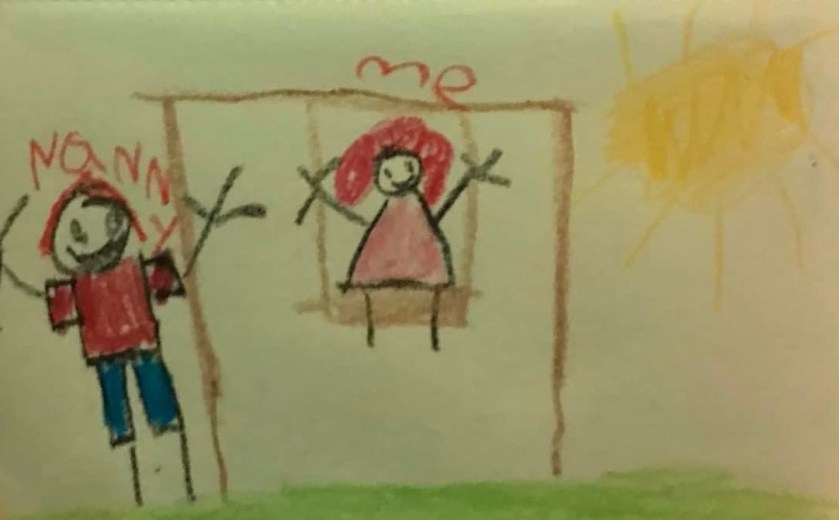
My Granddaughter’s depiction of our favorite activity: swinging. She is so wise….

Finding Healing Around Christmas

Maybe your family needs some healing around holidays as well. Sure, it seems strange to talk about Christmas amidst all the paper and ribbon and cookies and tinsel, but it is, in fact, the best time to step back, recognize struggles and disappointment and start our families on paths to peace with Christmas; maybe along the way we could even figure out what’s “enough” for joy. I offer this reflection then to all our families because we cannot find healing if we do not know our family’s wounds. Here’s hope for discussions about upcoming celebrations: may they be intentional, loving and truly joyful for all.
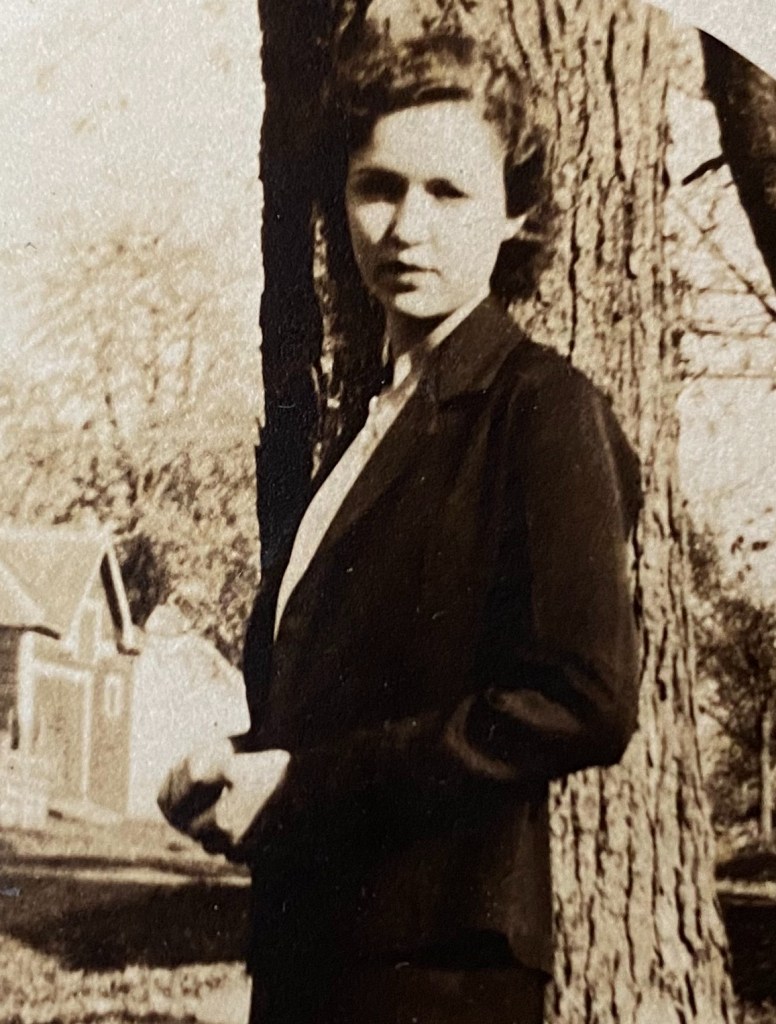
For me, it seems the best place to start is with the grandmothers. Both of my grandmothers were born around WWI; each married during the Great Depression. Neither had, as they say, “a pot to piss in,” not while they were growing up and not while they were young mothers. Both worked hard to support their families outside the home as well as in. Dad’s mom, Arbaleta, had two children, a boy and a girl, nine years apart. Mom’s mother, Marie, had three daughters all close in age. 

Arbaleta’s husband, my Grandpa Mac, fell from an electric pole when he was young and wasn’t supposed to ever walk again, but did, in great part because Arbaleta would not let him not walk. She reportedly insisted he move his legs and even moved them for him for months as physical therapy until he could walk and work again. While I was never close to Grandma Leta, I have always admired the steely determination that these actions showed.

Marie had a husband who was always on the road as a truck driver, mostly because the bus or truck driver jobs close to town weren’t well-paying. He died of a massive heart attack at age 50; she lived another 30-plus years and married her high school sweetheart, then outlived him and married another kind man when she was eighty. At that wedding, the minister declared what we all knew, “Marie is a hopeful woman!” Grandma Ree, as we called her, was the quintessential kindergarten teacher when teachers still had time for nature walks, ironing leaves between sheets of waxed paper, and silly songs. Thus, she was the kind of grandmother I aspired to be: she played games with us, prayed for us, encouraged us and defended us when necessary.  For most of her life, she modeled a love of learning: she earned a master’s degree, helped “plant” two churches, became an accomplished painter and was memorizing her favorite Bible verses in her seventies because she was losing her eyesight.    
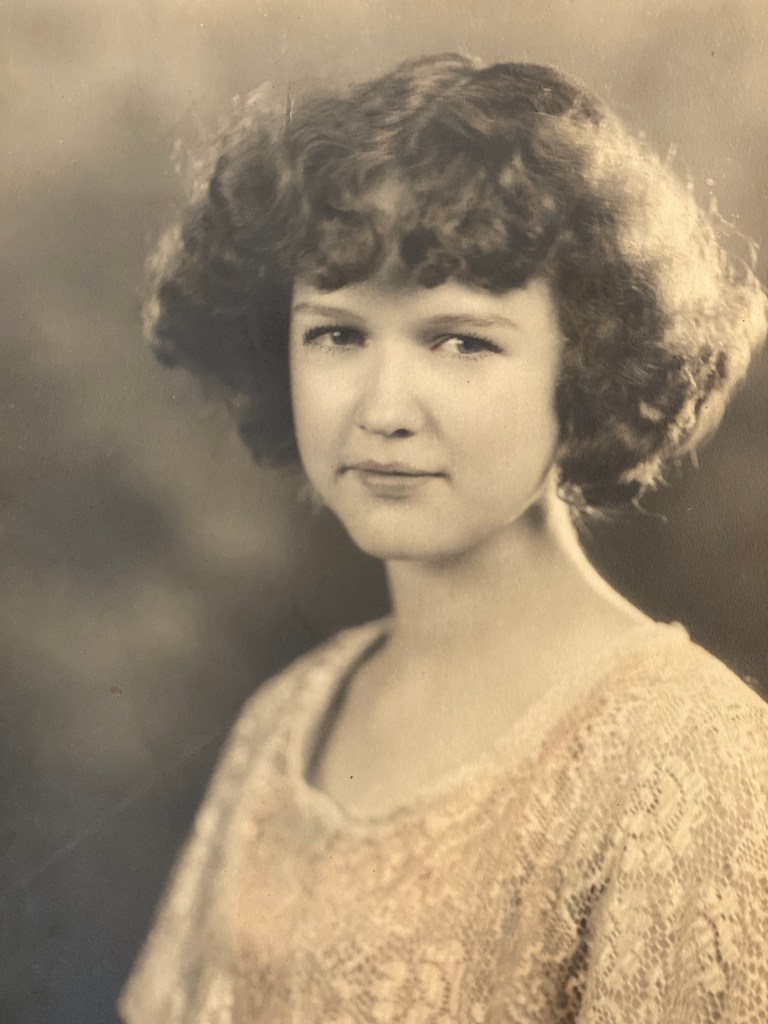
While I know little of Arbaleta’s childhood except poverty and hardship, I know Marie helped her mother run a boarding house after her chiropractor father divorced her mother, something which mortified both women.

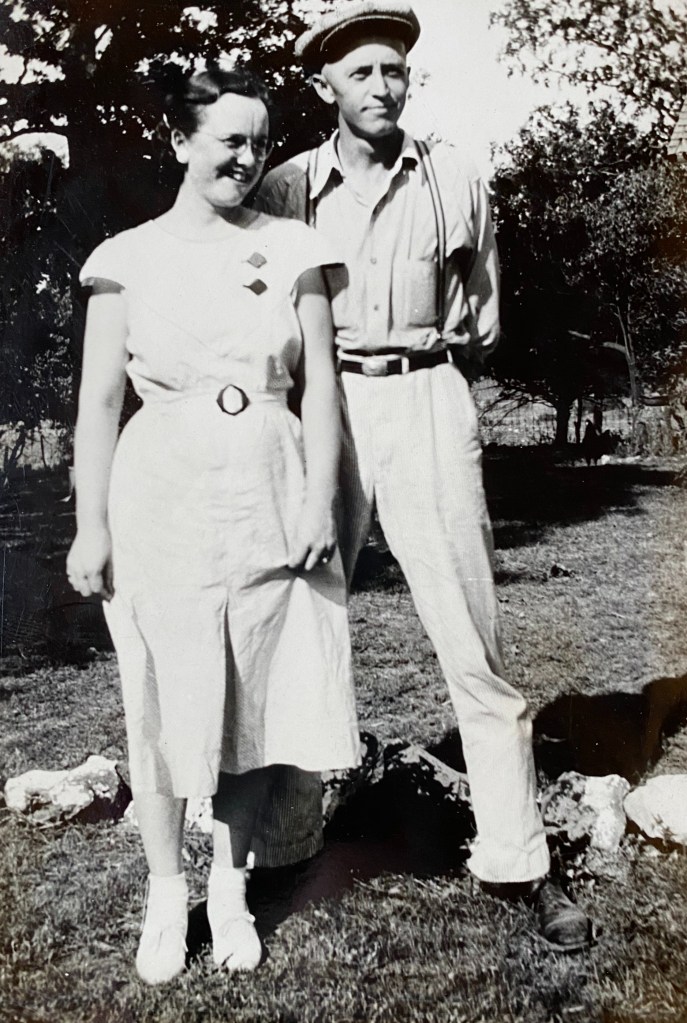
That I’m aware of, Arbaleta seldom left her home after we were born. At least we never saw her leave her home, though, as far as we knew, she was perfectly capable. Our collective memory of her is of her seated on the sofa in her silk pajamas. Every time we visited her, we would wave to her from a few feet away as she perched on the sectional sofa in the corner, surrounded by shelves of various sizes and shapes of cacti. In one hand she held a lit cigarette, ashes threatening to crumble onto the silk, and the other hand held the ever-present bean bag ashtray (you know, the kind that has the bean bag on the bottom and the colorful aluminum tin bowl on the top.) That I can remember, she never once kissed, hugged or touched us in any way, shape or form. And, though she was pleasant, there were no memorable conversations, just the cloud of cigarette smoke that circled above her. 

As for Christmas, well, I can’t remember there being much of it in their home at the edge of a Kansas golf course where she and Grandpa had retired. Ironically, I’m not aware Grandpa played golf, though my Dad did well into his eighties. As far as Christmas goes, Arbaleta represented the point in the arc where celebration was merely tolerated. Every few years, our parents would tote our gifts to their house to open on that rare occasion we woke up there on a Christmas morning, but the mood in the house was that Christmas decoration was, well, perfunctory. There was a tree and maybe a wreath, but evidently, for Grandpa and Arbaleta, a tree and some lights outside were “just enough,” though I suspect they were only put up to satisfy us. If overcoming poverty was Arbaleta’s life goal, she met it, thus the home on the golf course as well as the purchase of a new Lincoln every year. Secular or religious, it didn’t matter; Christmas was a formality, expected, tolerated for the children. Christmas dinner involved polished silver and store bought sweets, if any. “Please wait until you have permission to touch.”

Arbaleta died when I was seven and, suddenly, the focus of Christmas on my father’s side of the family shuddered and swung hard to the opposite extreme. Her daughter brought in Christmas every year from then on with a vengeance, lovingly, but with an overwhelming force. Every year, my aunt seemed to be competing for best Christmas ever, ostensibly in response to her own mother’s lackadaisical attempts.

While certain treasured and expensive statuary graced my aunt’s mantle for Christmas, for example, every year, the Christmas tree itself, usually the biggest tree I’d ever seen, sported a different theme with new, all handmade ornaments. I often asked when she started making them, sure she must have begun the previous New Year’s Day. She also made most of our gifts; they were always of Pinterest quality and I treasured several sweaters she knitted for me, for example. 

As if it were necessary, she also became an amazing cook and thus, Christmas visits always involved impressing us with recipes for new dishes. Ironically, my mother didn’t want the recipes and my mother’s mother, Marie, didn’t need them; my mother was too busy leaning into that dysfunctional pendulum that was swinging back to the starker side, likely in reaction to her mother’s seasonal excess. 

Marie, my mother’s mother, was on that same swing of the pendulum as my aunt, though I believe Grandma Ree went all out for her Christmas celebration for different reasons. Her husband, Grandpa George, also died when I was seven, but that did not slow Marie down in life or around the holidays. From the moment you opened the door into her home at Christmas, the scent of pine and wild berry candles carried you through room after room of greenery, holly, bells, poinsettias and new figurines or miniatures each year. Also new each year were the sweetbreads and cookies and homemade candies, all awaiting our discovery after hugs and kisses were exchanged and the coats and mittens and caps were piled onto a bed in the back of the house. 

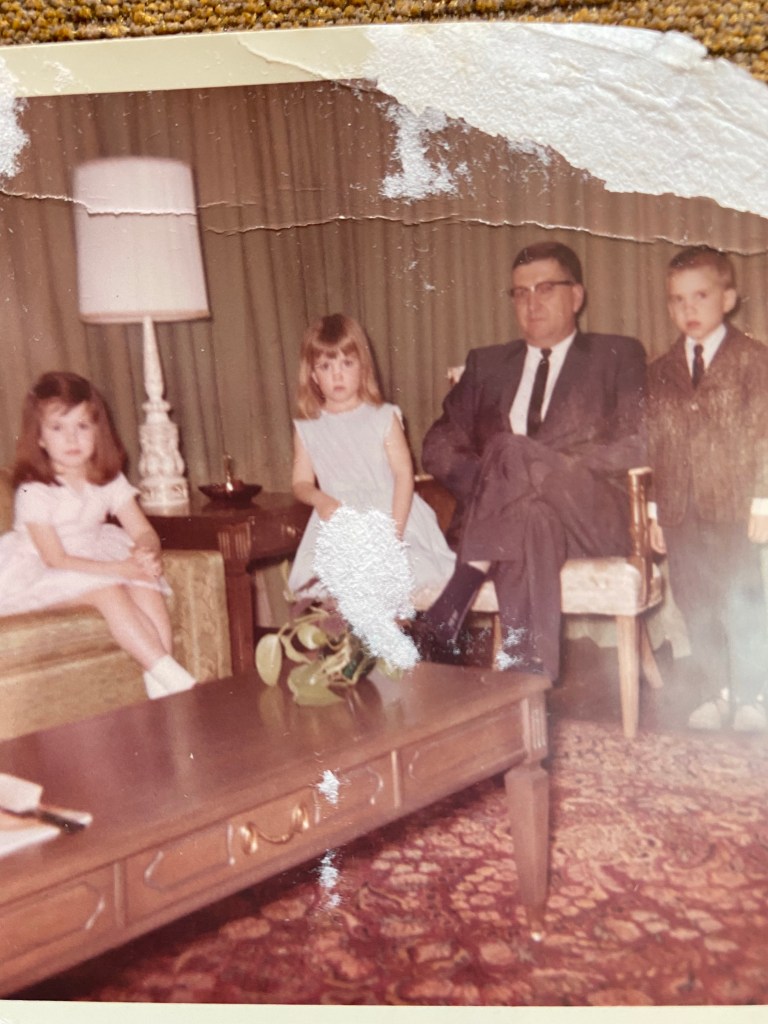
Grandma Ree with her brother, Mother and Sister, c. 1960’s.

A Family Nightmare

While Marie’s response seemed to me to somewhat resemble that of Arbaleta’s daughter, the driving force behind Marie’s likely unconscious Christmas reverie gone amuck was a well-kept secret, a family nightmare. On two separate Christmas Eves, during her childhood and youth, Grandma Ree had lost family members to suicide. I was, of course, an adult before I was made aware of that history or the details: one drank poisoned alcohol and one shot himself, both on separate Christmas Eves. Of course, the grief and shock of their actions was complicated by their (conscious or unconscious) efforts to ruin Christmas forever for some of their family.

How painful were their memories of the holidays?

Before we assume that Marie’s attempts to reclaim Christmas was the reason for the pendulum’s extreme movements, though, we need to recognize that some calamity in earlier generations drove those men to choose Christmas Eve to end their lives; we have to ask how painful were their memories of the holidays that drove them to risk also ruining the holiday for their spouses and children? How far back did the pain begin and what don’t we know about that? 

In other words, it’s not likely either man, both of whom must have been suffering and feeling hopeless, started the family on that path.

The result, though, seems to have been an unconscious struggle to compensate. Those grand swings between holiday excess and hopelessness left subsequent generations still unconsciously at a loss to figure out what’s enough celebration. Further, while we can understand what might have spurred Marie’s need to excel at Christmas, I’ll likely never know what caused Arbaleta’s lack of enthusiasm for the holidays, and so I’m left simply to marvel at the overwhelming force of her daughter’s frenzied Christmas efforts. Sadly, or thankfully, no one now has picked up that mantle and the extended family is so fractured as to make these discussions nearly impossible.

I offer these reflections then to my nuclear family as the beginning of some discussions around conscious choices rather than wild reactions.

How does a family figure out what’s enough Christmas when the family’s history is, well, fractured? My own efforts were often emotionally unsatisfying; not only were my mother’s Christmas efforts headed for the stark extreme in reaction to her mother’s and her sister-in-law’s excesses, but they were complicated by my general lack of interest in cooking or baking except when absolutely necessary. 

It was my ex-husband who started me thinking about some of our responses to holidays years ago: he protested the idea of Valentines’ Day for example, saying we could and should give one another cards or flowers or candy at anytime of the year and not just one day chosen by candy and card companies and florists. Yes, we can, I agreed wholeheartedly. But do we? Of course not, I pointed out. To his credit, he came by his dislike and struggle with holidays honestly and thus brought his own reactions to our holiday table: his birthday is the day after Christmas, and he was one of six children. His Christmas gift always came with a declaration that, “Oh-that’s your birthday gift too.”

Over the years, I certainly have struggled with holidays, whether it’s decorating or preparing a feast or just planning. Don’t get me started on birthdays for children; too many of those ended in my tears from exhaustion and a sense of failure. Did I tell you about all the “Pinterest Fails?”

All these things and more (all these things and more) that’s what Christmas means to me, my love….)

Stevie Wonder

Plenty of us struggle with the holidays, though, whether because of grieving a loss or knowing you’re the only one who can’t afford the gift exchange. I’ve tried over the years to make our gifts for Christmas but again, I know too many of my family members and friends were less than thrilled with the results. Mea culpa. We tried spreading the Christmas holiday over several days to lessen the wild two-minute frenzy of Christmas morning. We tried taking Christmas to the mountains; we tried staying home. We wondered what would happen if our family just gave up one Christmas and had lots of little ones? Could that not translate into lots of chances to do or give or be kind to one another? So many of our attempts at intentional Christmases revolved around not expecting one or two people to create a magical holiday that only left them in tears and exhausted.

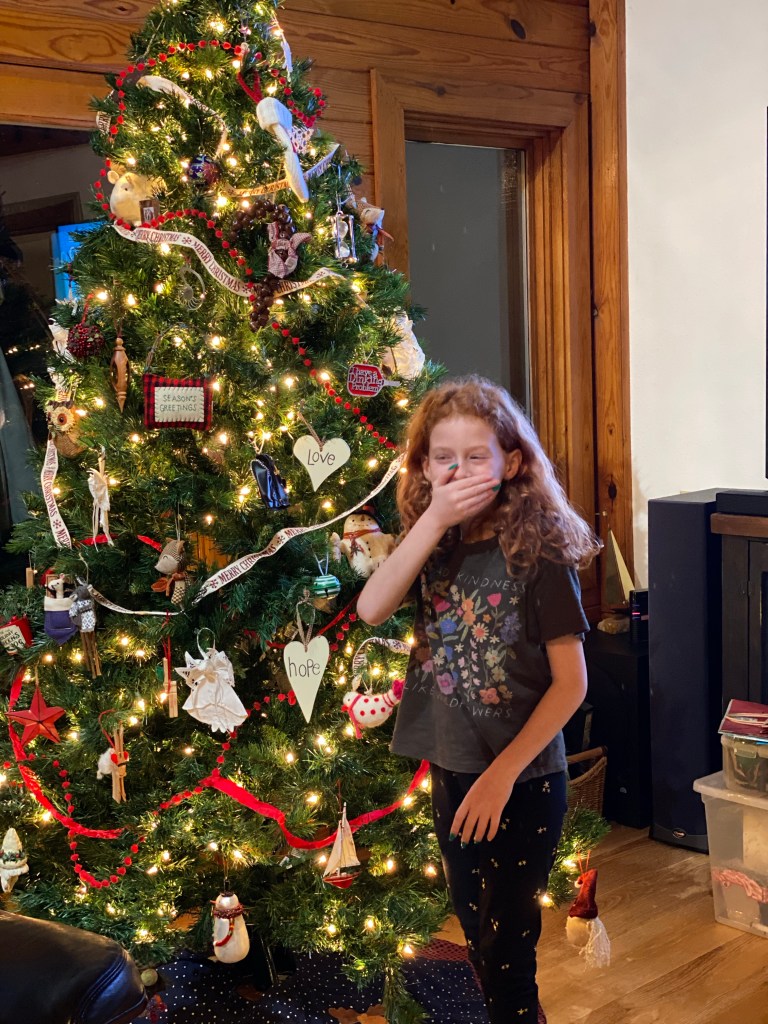
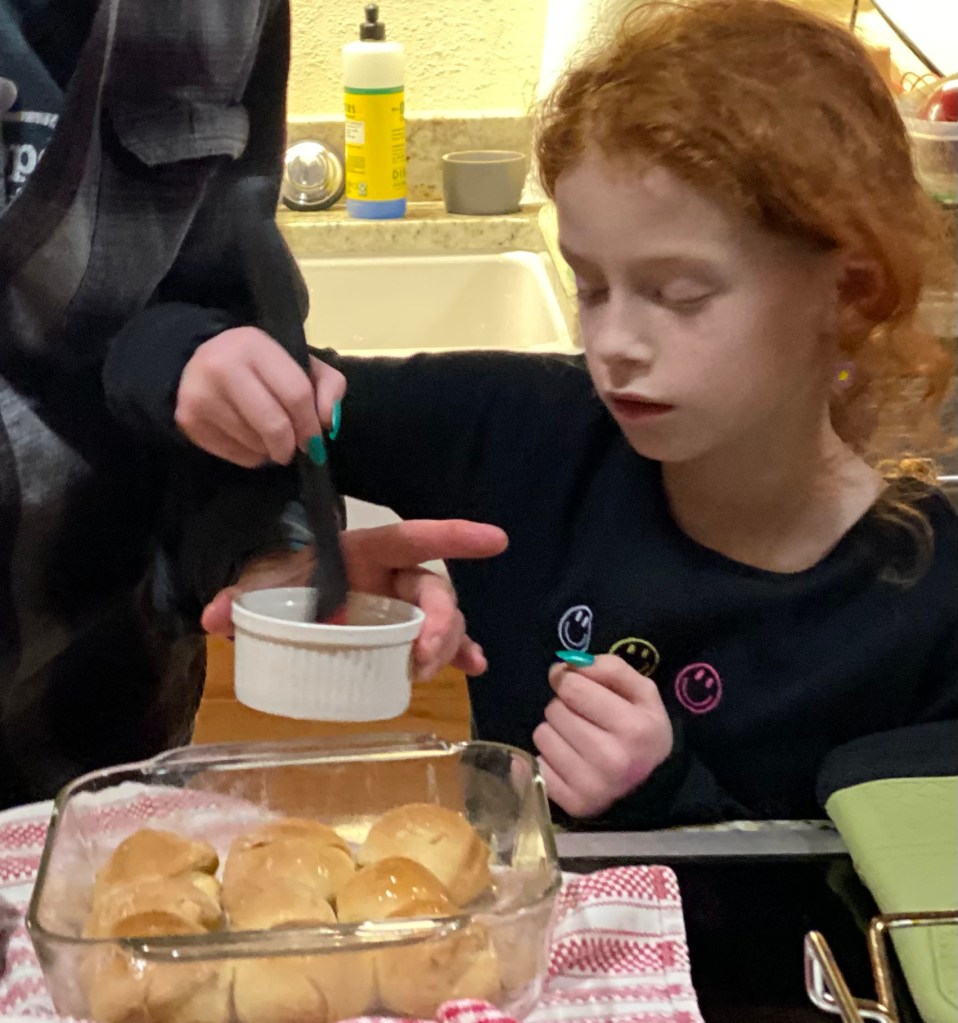
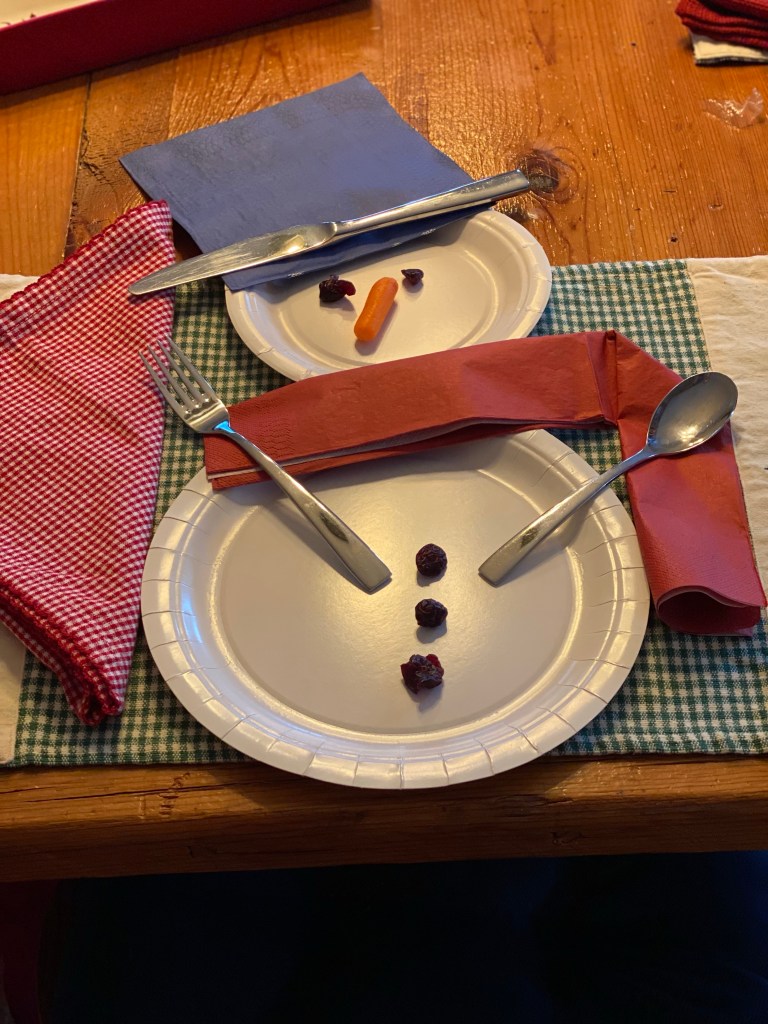
We’ve finally begun to incorporate some activities intentionally. Instead of china and crystal, we copied someone else’s snowman place settings, something the granddaughter and I could share. Last year, we started some silly story telling. This year, we introduced Karaoke and I am trying to reclaim the joy of baking by helping my granddaughter learn; watching her “knead” the goop she bought at the store made me think. Lo and behold, she discovered the joy of yeast and how it rises and how the baker must punch down the dough, then knead it. Her eyes grew wide after she made a fist and punched away. “That is soooo satisfying,” she said. A keeper. 
In case you’re wondering, religion did not seem to figure at all in the wild reactions to the holiday through the years for my extended family. While Arbaleta was, as far as I know, agnostic, and Marie was a strong Christian, neither of them addressed or seemed to include the religious holiday in their efforts to reclaim or dismiss Christmas. For our family, that’s a different pendulum altogether. I personally love a good candlelight Christmas eve service singing and the idea that God came to be with us as an infant. Nevertheless, culturally we continue to struggle with all that Christmas celebrations have become for generations and we cannot heal from pain we do not acknowledge.

For our family, the faith and religious rituals are different pendulum altogether. I will never know why my Grandma Ree did not incorporate more of her personal faith into the celebration. Personal experience suggests she was treading lightly with agnostic family members and, as is true for many families, also celebrated on different days with different parts of the family, balancing church events with home. Nevertheless, culturally, we continue to struggle with all that our secular celebrations of Christmas have become for generations, often leaving us to begin another year frustrated, sad, discouraged. That is where we can start, but we must look collectively at this because we cannot heal from pain we do not acknowledge.

The best time, I believe, to reflect on how we celebrate Christmas is when we are all together…and we’ll before Christmas comes around-unexamined-again.

For my family, I continue to try to reframe Christmas in light of the history I bring to the holiday. I guess I hope through reflections and questions to step completely back from that wild, reactionary swinging between excessive celebration to indifference and even disdain. 

I think one key is that we focus on the children, but with respect for their needs and not our own needs to give them the best holiday ever! 

They get tired; we pay attention. They want to dress up; they don’t want to dress up. Quiet time, dancing in the kitchen time, gifts that involve us engaging with them. I’m not saying we’re the best with children ever or that ours are happier than any other. What I am saying is that like in so much of life, the children around me ground me. What they need is so often what I need. Let’s sing Jingle Bells, yes, at a gathering, but we mustn’t forget the bells themselves and our need to jingle them to make the song come to life.
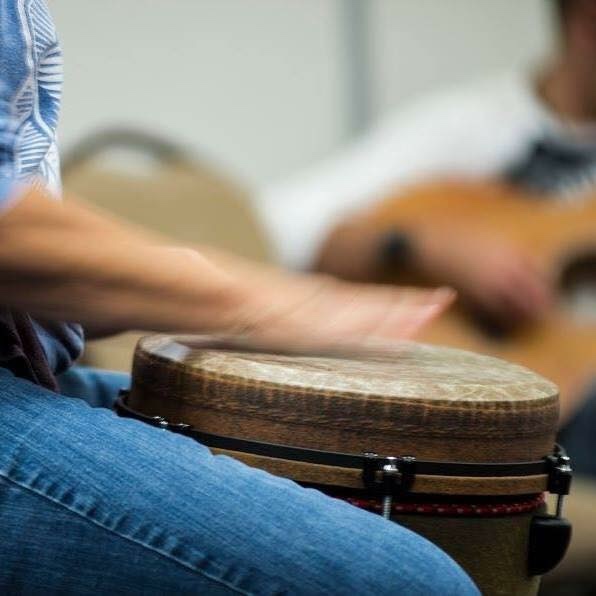
A little percussion goes a long way and when we sing “Jingle Bells” there need to be jingling bells….A five-year-old taught me that.

Music must also be a source of holiday joy for many families. I’m jealous of those who manage a musical gathering but hopeful that might be in our future as well. Certainly with percussion everyone can participate! The idea of introducing music brings us back, though, both to the need for sensory awareness and to the idea of joy and reverie throughout the year. In order for there to be music next year, we need to practice throughout the year – often and, by practicing, remember the things that do bring us joy without wearing us out. I write this and share it now, after the holiday blitz, planning to share it with my family, to start the conversation we can have in anticipation of next year. I am curious to hear from them, and find out if they are aware of, or experiencing their own pendulum of Christmases, maybe even unknowingly riding that pendulum right now. I’m hopeful that with some lowered expectations of ourselves and a little yeast, we just might be able to rescue the holidays from the extremes of that dysfunctional pendulum my family rode for far too long AND decide for ourselves what is “enough Christmas.”
 

Leave a comment

What Tolstoy Said….

All happy families are alike, but every unhappy family is unhappy in its own way.

Leo Tolstoy, Anna Karenina, 1878

People who are happy are not paying attention. And probably stupid.

Me, 2005 in a seminary class (Yeah, I’m not proud of that.)

We all learn lessons growing up. Some friends tell me today about learning how to hold their own in a fist fight or how to plait hair or how to make a decent pie crust. Those tend to be the friends whose families do not match the same clinical dysfunction criteria mine did. Warning: some of this post might be triggering for readers. Take care of yourself, please.

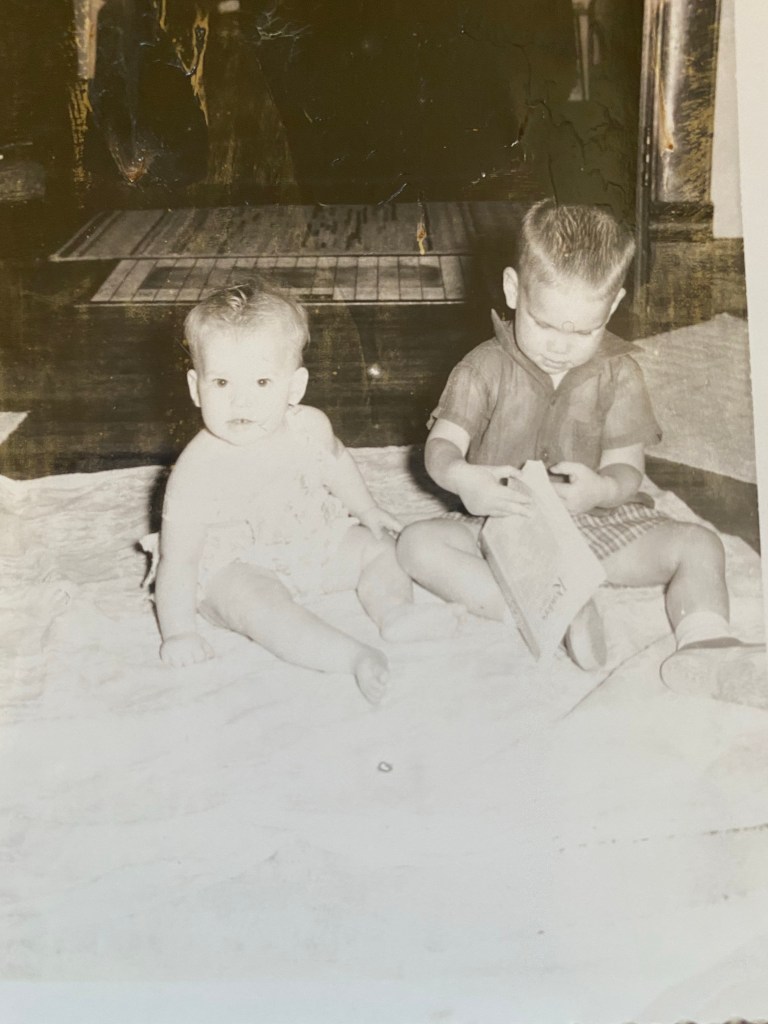
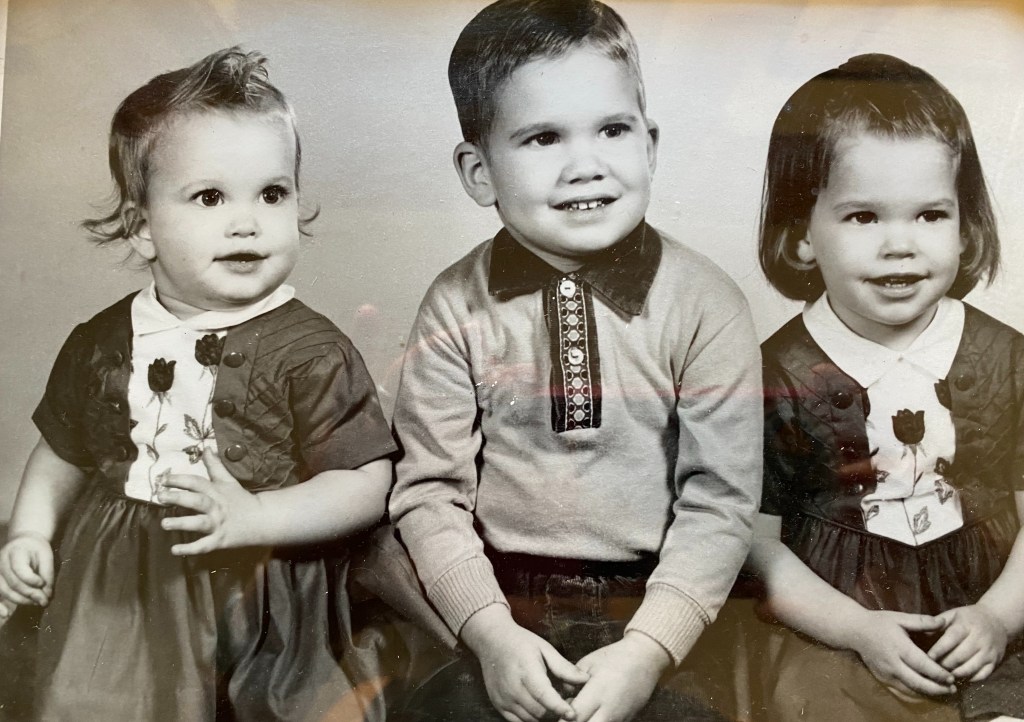
Little sister, older brother and me in happier times. Circa 1962.

If you looked at my family tree, you’d see the roots are severed. I am grateful, though, that the tree trunk has survived and flowered nonetheless. While I have been cut off from my family of origin for more than a decade, I am so very grateful for my husband, my sons, my granddaughter and my husband’s large extended family. I do not lack for people who care about me; what I was not able to produce for some time, though, was a witness to much of my life before the break with my parents, siblings and extended family. I lacked someone who could pick me out of the class photo (usually one of the taller kids on the back row). Missing was anyone who knew I didn’t usually eat my birthday cake, only the icing, or that I read every biography and autobiography in my elementary school library and that I grieved when I finished books because, for the few hours when I was reading, I was able to wander around in another space and time – one that was not mine. I lacked anyone who could give a witness to any of the reasons why I thought for so long that happy people were not paying attention to the pain in life.

Can I get a witness?

When asked to describe my family as I was growing up, I’d explain: you could be lying on the braided rug in the living room, devastated, distraught, lost, and sobbing, and every member of my family would step around you at best. Or, at worst, they would chastize you for your selfishness: just look how you are upsetting everyone else by your pain! Not only did we NOT hold onto one another in times of crisis or pain, we denied one another’s right to be in pain. “How long you gonna be a victim?” was what was asked of me by a family member after she’d heard I was in counseling for being assaulted as a teen. I was in my early twenties. I had just remembered the assault that I had blocked out of my consciousness for several years because it was just too painful to remember. I had only just begun counseling and I felt her rebuke keenly. There was evidently no place in our family for that. She, a woman thirty years older and presumably three decades wiser, could not cotton my taking any time to understand and come to terms with what had happened to me. Today, thanks to counselors and learning about trauma, I would be able to put my hand on her arm and reassure her that she would never need to listen to my struggles. I would also explain to her that recovering from trauma requires some reflection, though, and some help understanding what happened and more than a little work to heal. I would assure her I certainly did my part to finish that work – to come home from the journey someone else started me on. I would also plan to be there for her if she ever felt like she could share her own pain.

Sadly, family breaks are more common in my family than not, though, so, when the relationship with my mother’s family was severed, our entire nuclear family was already split from Dad’s people. As an adult, I started a genealogical search only to find I had a great-grandmother living about an hour away by car until I was a teen whom I hadn’t known existed. I asked my parents at the time and was told “We didn’t like her very much.” Later, I found an old family photo with one woman’s face scratched out completely (and she had been sitting next to her twin brother in the photo!). What do you have to do, for goodness, to get completely scratched out of existence? Evidently, severing ties, splitting up was the response of choice for my people.

In the past few years, though, through the magic of the internet, I have been able to reunite with some folks from my childhood. While for some, that can be a hilarious trip down a bumpy old memory lane, for others of us, restablishing connections can be healing and grounding. As a sixty-something woman estranged from her entire family of birth for more than a decade, finding these old friends had been spurred by the need to find folks who could vouch for my previous life.

This, then, is a post about my friends from childhood and teen years reconnecting and discovering how little we knew about each other in spite of how close we thought we were.

Photo by Malcolm Hill on Pexels.com

I was always jealous of those who stayed close to their friends long after school; I believe now that most of my friendships were more akin to life boats in the midst of stormy seas. Survival was the goal, and perhaps we knew instinctively that two or three strands of rope were stronger than one, so we held onto one another. Once we found ourselves in new oceans, though, we grabbed onto new, different life connections, and let go of the old ones, not because we were inconsiderate or uncaring but out of necessity. No one had time or energy to look back; survival was the priority.

Puzzle Pieces

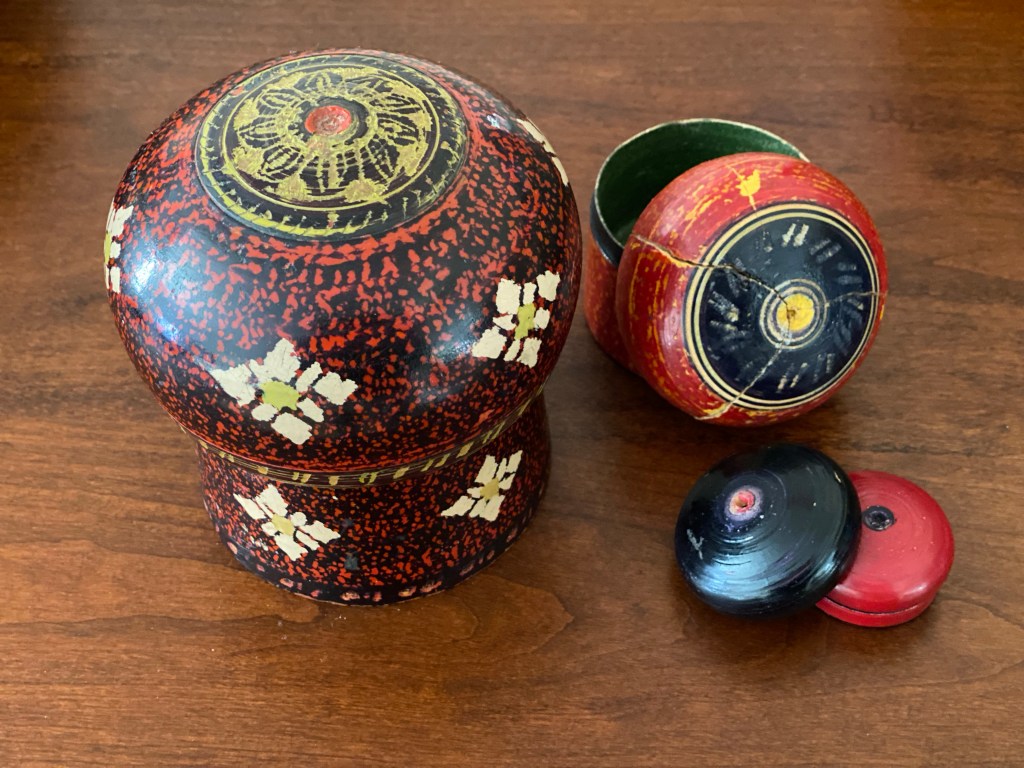
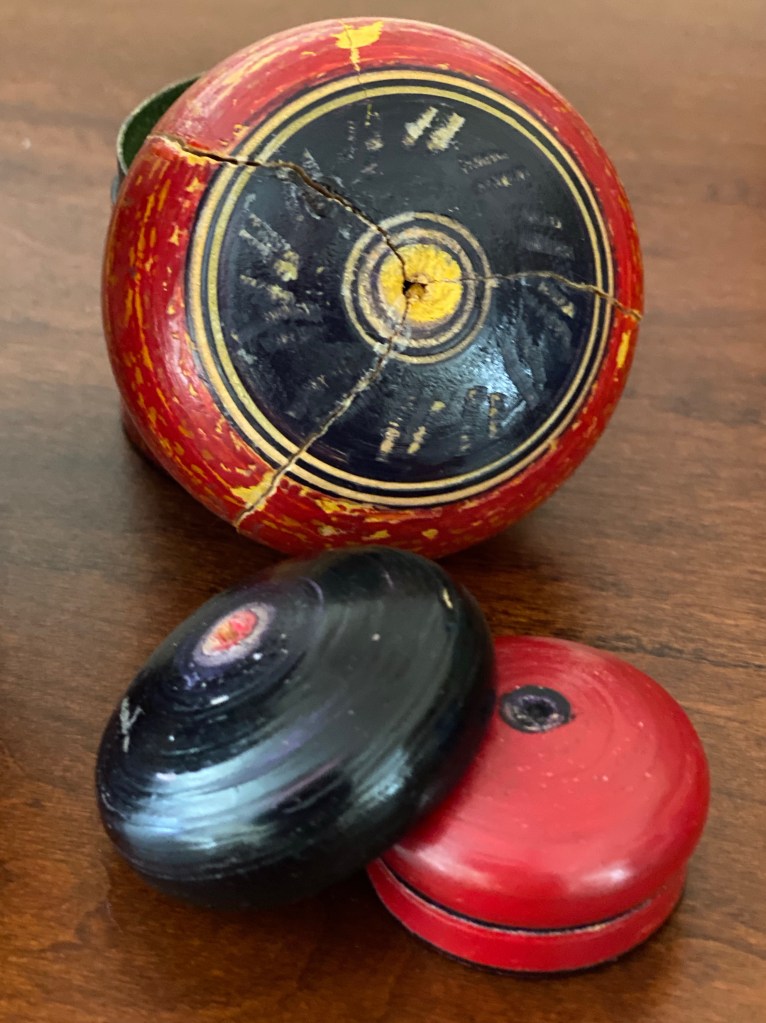
Trauma, though, can leave fragmented memories. One definition of trauma is that we remember all too well what we cannot forget but struggle to remember all the pieces in between – the rest of the story. I have long been embarrassed at being unable to remember large chunks of my life because I didn’t realize how large was the shadow of trauma and how it can so deeply darken the rest of our lives. The details, so many pieces, seem lost, scattered, in my case, all over the world like a favorite nesting toy. Through more than seventeen moves before I was old enough to leave home, curiously, I have somehow held onto most of a wooden nesting toy from Pakistan, where we lived when I was a child (stories for another post.) Some of the pieces are missing and others have been glued back together; today they serve as an apt metaphor for the struggle to repair and hold together memories of traumatic childhoods.

Comparing Notes

Once we reconnected, my friends and I began comparing notes. One childhood friend thought I was an only child though I have two siblings and we are all just a year apart in age. One of us had grown up with an abusive father. She married four times before she got help and stopped getting herself into abusive relationships. Another lived with an older brother who we now realize was a sociopath. She had found not words for when, as a seven-year-old, he had cheated, stole and tried to be sexual with her. Weren’t there rules about that?

That no adult saw all of this meant it continued, and by the time she was eight, he had run her over with a bike causing her to need stitches and hit her in the head with cutting board causing more stitches, and routinely touched her inappropriately. “Just a rowdy boy, right? Just a kid who doesn’t like to lose, wasn’t he? He’ll grow out of that, we are certain.” She grew up searching for an adult – any adult – around her to be the adult and a witness to what she was experiencing. She knows now that her brother simply passed along his own pain.

Healing began when a counselor said, “You were not imagining this. You are hurt, angry because you were betrayed by parents who were supposed to take are of you. You have those feelings because you have a brain and eyes to see. You doubted yourself and what you saw and experienced because you were raised by parents who were overwhelmed by their own pain and shame and guilt; they had nothing to offer you for yours.” A teen aged girl, she wanted her mother to teach her to curl her hair; instead, she watched her mother threaten to cut herself.

While it was happening, though, none of us “knew.” As teens in the late 60’s and early 70’s, we braved new styles together: we traded bell bottoms and hip huggers and together we tried cheap strawberry wine behind the concession stand at the drive-in movies, but we never shared about home. We didn’t “know” even though we saw each other every day at school, ate lunches together, joined cheer club together, and moved around in a pack as if we were attached to each other by velcro. We were all taken aback when we collectively realized that none of us, though fast friends throughout junior high and high school, had ever visited the others’ homes. No sleepovers. No parties together. None of us had ever even met the others’ parents. We didn’t know why, but we all somehow understood one another. Somehow we saw in each other kindred, if broken, spirits, and we found respite in our time together.

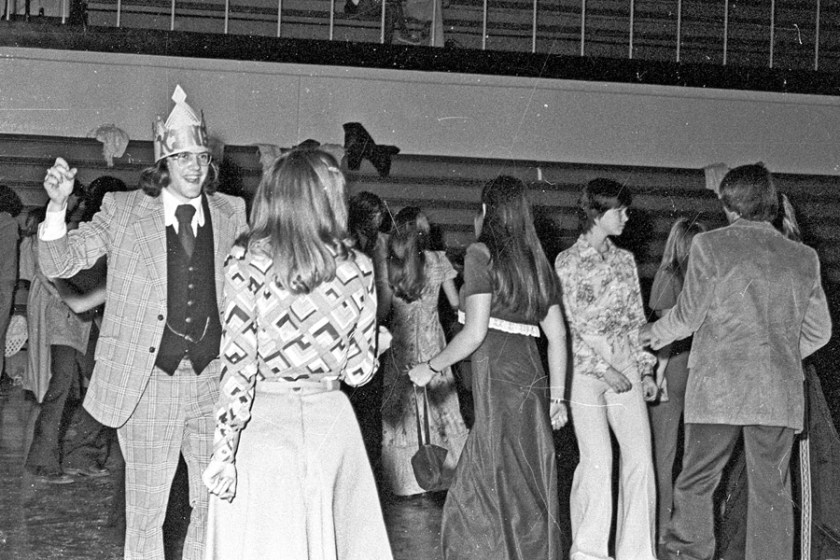
High School Dance 1973
We didn’t know how much we didn’t know.

Today, as the three of us somewhat gingerly share our memories, fragments and misunderstandings are beginning to make sense to us. Counselors and social scientists tell us now that we compartmentalised our lives, partly out of shame, partly to protect the others. We never spoke of life at home or after school; we kept those separate. In our defense, we didn’t often know what was going on in our homes wasn’t going on in everyone’s homes. Part of the power of dysfunction is that it simply seems like “that’s how it’s done, so why are you whining?” Or worse, we feared that the pain and chaos and constant crisis of our homes was somehow our own faults and if we’d only be better daughters….

Dysfunction, though, happens in shadows and darkness and thrives on secrecy.

We know now that each of us fought to get out of that darkness once we left those homes and we celebrate our individual efforts to keep our own lives in the light.

“The light came into the world, and people loved darkness more than the light, for their actions are evil. All who do wicked things hate the light for fear their actions will be exposed to the light.”

John 3:19b-20 CEB

What do we do differently?

We learned to encourage the children in our lives because each of us could remember at least one person who had encouraged us. Never underestimate the power of encouraging a child or teen; you may well be the only encouragement they receive.

We refuse to keep secrets. We ask tougher questions. When we see someone sobbing, we approach them gently and ask what we can do. If they don’t know or can’t answer, we sit down with them and wait until they are calmer. We hold sacred space for our own pain and for theirs.

One of the three of us refuses, even when facing family verbal and emotional abuse herself, to walk away completely herself because of a child in the extended family; she doesn’t want the child to feel alone. She knows how important it is for someone to say, “I see you. I see what happened. I see how confusing it must be.”

One of us worked hard to figure out why she kept getting herself into abusive relationships over the years and now she is able to choose healthier relationships and she doesn’t need to hide that relationship from us.

None of our parents paid any attention to where we went or with whom, so we each had resolved to offer our children a healthier childhood, making sure their friends knew us and we knew the parents of their friends.

We also grieve those who did not make it; each of us has family members still hurting, still in the darkness, unable for a variety of reasons to find their way out. We are grateful and we do not take our own growth for granted.

Okay, sharing isn’t always “nice,” but it IS healing.

The tagline on this blog is “Sharing is nice.” That is my witness. Sharing is difficult. Sharing is scary. Sharing is necessary. Sharing is essential. Sharing is healing. Sharing is powerful.

The good news is that we all found healing because we shared. There’s help out there and hope and healing and lots of folks who are called to listen and trained to help us when we share. Make sure you find someone who is trained and, if you don’t feel like you are being heard or they are helping, find someone else.

Several years after my aunt’s rebuke and her impatience with my healing process, I shared with a female friend at church. Sharing with the counselor had helped but the counselor wisely encouraged me to share with a friend. Me sharing, the counselor explained, can also create that sacred space where others find healing, too. That is the power of sharing. Choose someone safe, she said, but share. When we share safely, we create a safe place for ourselves and often for others, a place of healing. Amazingly, pain shared safely dissipates and loses its power over us.

Ask before you share with anyone other than a professional. Be aware that your trauma might trigger theirs. Always ask permission but ask and keep asking until you find someone to listen.

I did share and my friend was lovely and listened and the moment felt healing. The next day, though, her husband dropped by and stunned me when he said, “Mary told me what you told her.” I felt betrayed. How had Mary not known that I would not want others, especially men, to know? How dare she share my story? It was not hers to share.

“You just need to get over it,” he demanded. And suddently there I was again, back home, back where we keep our pain and illness in the dark, back where we keep secrets. I felt my pain rise up and choke me.

This time, however, I was different. This time it was the thought of going back into the darkness that had turned my stomach. “As it happens,” I told him, trying not to vomit, “healing apparently will only happen if I walk through the memory. They tell me I have to share to get well, so I’m gonna.” I was on the verge of apologizing to him for sharing with his wife because it had upset him so much when suddenly he sat down hard and started sobbing. Then he began his own sharing. He’d never talked about being a fighter pilot in VietNam and he desperately needed to tell someone. I don’t remember much of what he shared; what I do remember was being amazed that holding my own space for healing had created space for him. In that moment, he felt safe, too, and he stepped into that space for just a bit. We never talked again about his trauma or mine. Perhaps sharing helped him enough; perhaps he went on to seek more help because he, too, had seen the power of sharing.

Stepping out of the squirrel cage….

Mostly, the friends I reconnected with and I had individually found that, in an unexamined life, pain just gets passed down the line, generation to generation. We all were recipients of pain passed along, never knowing why or where it originated. The effects of trauma will keep rolling back around from generation to generation if no one stops long enough to find some healing and try to get out of that squirrel cage of crazy. Just ignoring the pain, or worse, denying its existence, guarantees the next generation will be expected to hold it, too, and they often have no idea the why or the where of that family trauma.

We may not have been able to protect our own children as well as we might have liked but it was not from lack of trying and we console ourselves by remembering that, because we have reflected, educated ourselves about trauma, shared with counselors, written and prayed, we have at least helped our children to get out of that damn cage. We may have done it clumsily, we may all be still rolling sometimes out of control on the floor after hurtling ourselves out of the cage, but we’re clear. We can take a breath. We can stop, stand back and reflect on that still-spinning wheel and maybe even pray for the family members still running on it. Because we are out, though, because we are talking, because we won’t hide any more, we have a fighting chance to NOT pass that trauma and dysfunction on down the line.

For a recent, well-done example of how trauma not shared can affect us and those around us, consider Tom Hanks’ movie, “A Man Called Otto,” or the book it’s based on, “A Man Called Ove,” by Fredrik Backman.

Asking Your Questions Before It’s Too Late

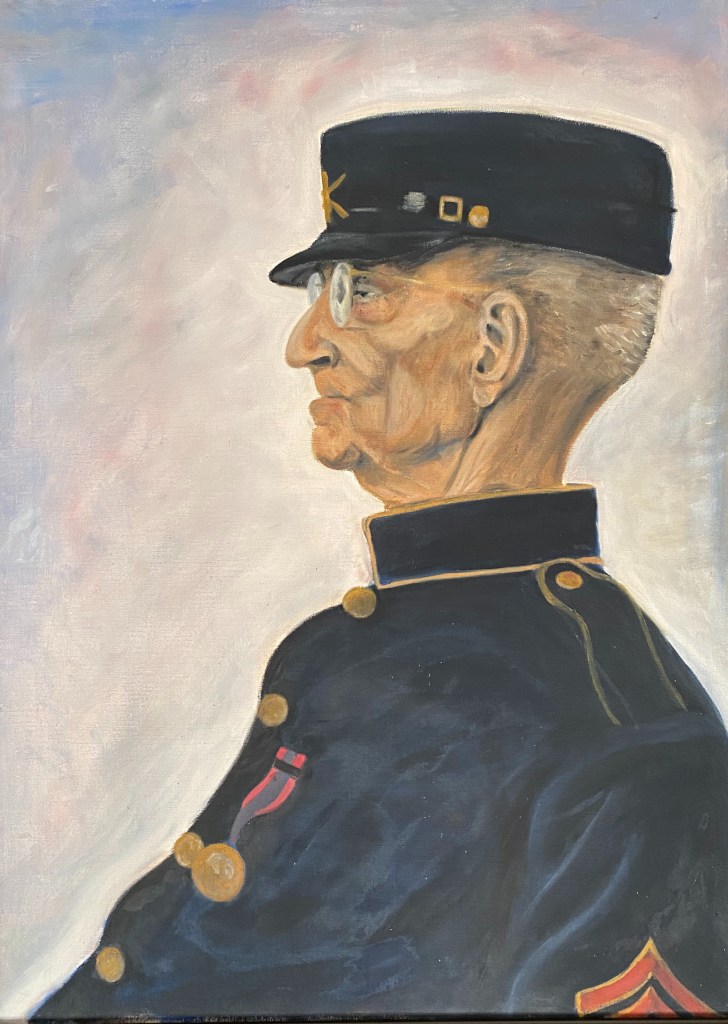
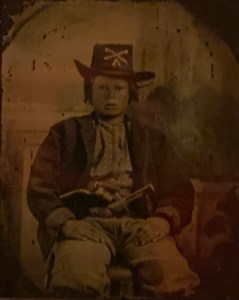
Erasmus Pershing – Civil War era Ambrotype Portrait – We have no other information about him so far.

During a visit some thirty years ago, my (now late) grandmother mentioned being descended from French Huguenots. (I had to look them up at the time: A French Protestant movement in the 16th and 17th centuries. Calvinist. Suffered persecution by the religious majority at the time and many thousands of them emigrated from France). Grandma also lamented at the time that very little of her family history was recorded anywhere. Because I was working outside the home then and raising two little boys, I could only lament with her and suggest she record some stories for us on a cassette recorder. She didn’t, though, and now she and her siblings are gone and we have lost most of that history, including any details about our little soldier in the Ambrotype portrait above.

Many family stories today go untold, or if they are told, they have gaps, and placing them in time or understanding the story is tough after all the actors have left the stage. After Grandma died, I could find no one who knew anything about Huguenots and a family connection. No one was left to rebut the rumors of our being related to President Grover Cleveland (because Grandma’s family name was Cleland, not Cleveland, that is highly unlikely.) I had known through my research that she was a cousin of Black Jack Pershing, but we had not talked about any of this and now we cannot.

Grandma lamented once that she possibly was descended from the author of the Fanny Hill: Memoirs of a Woman of Pleasure, an erotic novel that led to the arrest of author John Cleland in 1748. This particular piece of history especially mortified Grandma, which is sad because it is likely accurate, and I would love to know more about how her parents and grandparents felt then, too.

Most of my family history though has been learned through online research, which means that by itself, it is just the list of ancestors with little of the background, the scenery, or the props and, of course, no narration. The result of relying only on such research is that we get just enough of several of the stories to need and want more – context, detail, resolution – but, again, because the principals were gone, we are left to research and then try to fill in the gaps, leaving many of these rich stories to be lost forever. Needlessly.

Too many of these rich stories are lost forever. Needlessly.

I once even learned from online research that I had a great-grandmother who was alive until I was fourteen and lived an hour away, but I never met her. When I asked, I was told, “We didn’t like her very much.” I was stunned at the time and now of course totally regret that I did not press the matter and ask about what had happened, did not seek the story while there was a player still around to offer some narration.

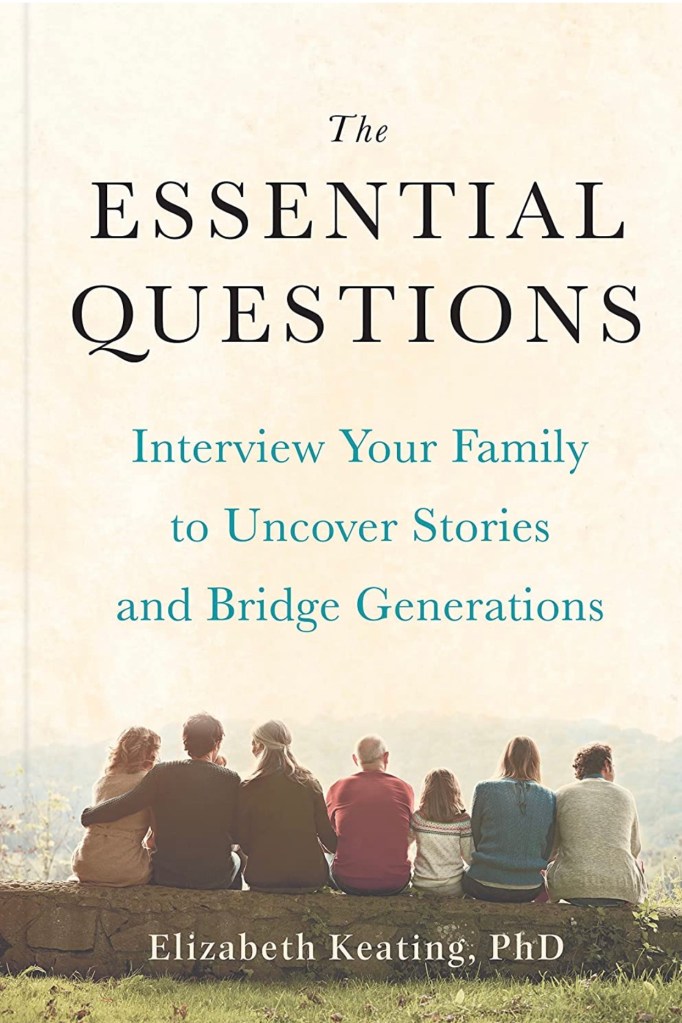
Turns out, I’m not alone. Elizabeth Keating, PH.D., is the author of The Essential Questions: Interview Your Family to Uncover Stories and Bridge Generations and writes about the loss of these stories:

“The people I interviewed knew so little about their grandparents’ or parents’ early lives, such as how they were raised and what they experienced as young people. Few could remember any personal stories about when their grandparents or parents were children. Whole ways of life were passing away unknown. A kind of genealogical amnesia was eating holes in these family histories as permanently as moths eat holes in the sweaters lovingly knitted by our ancestors.”

The Essential Questions: Interview Your Family to Uncover Stories and Bridge Generations, by Elizabeth Keating, PH.D., is available on back order if you want a hardcopy but a Kindle version is available. I think the hard copy would be a great gift for family members

Asking family members for family stories ought to be quite easy and entertaining but that doesn’t seem to be the case in our media-saturated world.

The good news is that we can use our online research and our boxes of pictures to start the conversations. Keating gives lots of examples of what to ask to flesh out your family’s tales. If there are still older family members alive, starting the storytelling can be as simply as carefully studying some of those old sepia tone family portraits.

On my father’s side of the family, most of the stories I’d learned were from online research until the day his sister asked if I’d be interested in a box of old photos. That cardboard box was a treasure chest of stories about tumult, typhoid and the kindness of strangers. The next time I saw my aunt, I came to the conversation with some specific questions and a vague feeling about why two photos in particular made no sense to me.

The photos set her memories flowing and one story in particular that she remembered as being set in the Depression but, we soon realized, could not be the case. Certainly the family, like many in the country, lived with few creature comforts even before the country was plunged into a depression. Indeed, pretty much everyone spent their lives at the mercy of the elements, epidemics and accidents with little modern health care and only the food they could plant and harvest, hunt or gain in a barter.

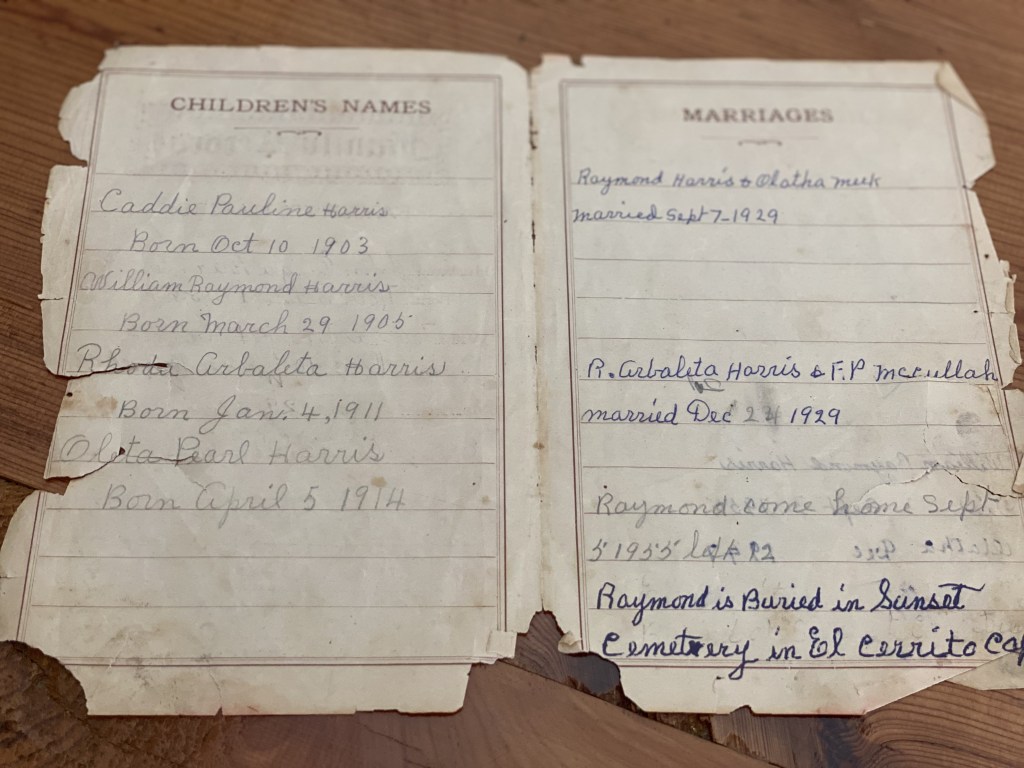
My aunt knew that the father in the family was out of the picture; he would die in a sanatorium with tuberculosis. So, at the time that this story begins, my great-grandmother was running a small farm with her children, whom records indicated were born in 1903, 1905, 1911 and 1914. My grandmother was the one born in 1911.

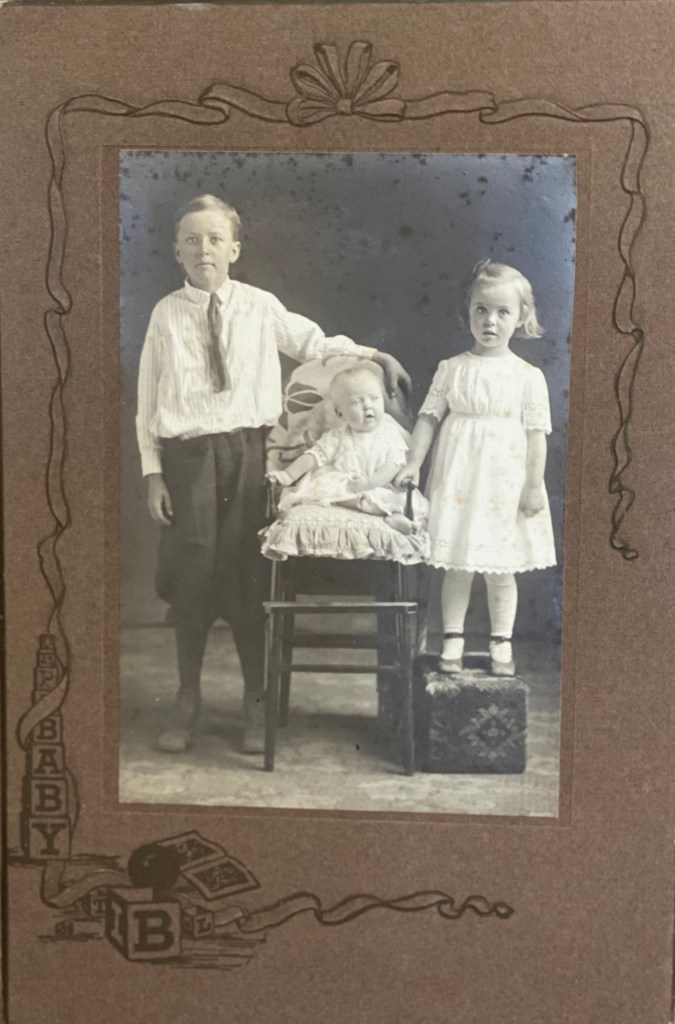
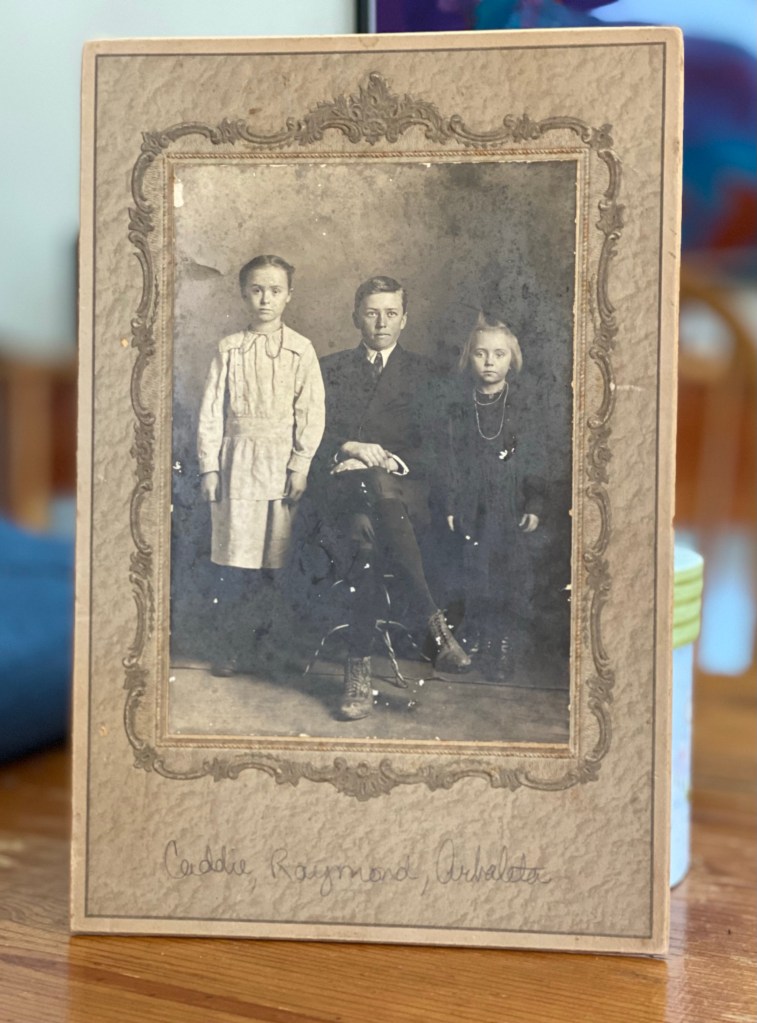
The children’s pictures below, shared with me by my aunt, were what directed my questions and, eventually, led her to remember and share the story of what she called “the family’s angel.” The configurations simply made no sense to me.

The first picture is of her (and my Dad’s) uncle Raymond (born 1905), with baby Pearl (born 1914) and my grandmother, Arbaleta, born 1911. That picture would have been taken after 1914, obviously. Love the box Grandma is standing on, by the way. The second picture would have been taken later, with Grandma Arbaleta (standing,) then Raymond and then Pearl. Even though the picture to the right says it is Caddie on the left, actually she is absent from either picture. Caddie, their older sister, was born in 1903, but died 1909. We found no pictures of her. Had she lived, there would have been a girl taller than Raymond in the picture to the left. Okay, that mystery was solved. Still, something was off.

From the family Bible

We turned to the rest of the the dates recorded in the front of the family Bible and my aunt was reminded that Pearl also had died young, and that particular tidbit of information started the memories swirling. Her memory of what happened to Pearl is the real treasure here: over the next hour, she told me about how a stranger, an “angel,” she said, kept the family together in a time that could only be described as bleak.

Evidently, Baby Pearl, (in both pictures) died in 1923 at age nine when Raymond was 18 and Grandma was 12. Their father had died three years earlier, and a typhoid epidemic took Pearl and made their mother, Mila, deathly ill.

Things would have been rough enough since Mila was trying to keep a small family farm going even before the typhoid epidemic hit the area.  When Pearl died, the fact that their mother was near death meant Raymond, 18, and Grandma Leta, 12, were left to do what most folks did back then: they had to prepare their sister’s body to be buried. Few could afford for an undertaker to come, so, typically, a coffin would be built by a friend or relative and then it would be laid upon the kitchen table so the family could prepare the body to be buried. As I sat there listening, I could not imagine how tragic and overwhelming it must have been to have a coffin for a sister laid on the kitchen table before me. I could not imagine taking a cloth and soap and water and preparing the body of someone I loved in order for them to be buried. Worse, in this case, though, was that, because the mother was so ill, two coffins were delivered, one for the little sister and one for the mother who was expected to die soon. 

The future for these two siblings looked pretty bleak, too. They likely both wondered how they’d manage, once their mother died, and how they’d find food, or pay for oil or firewood. We’re not aware if Raymond was working or at what at the time, but, for the time being, he was tasked with keeping things going and caring for their mother as well. It must have been somewhat overwhelming, but, the story goes, one day, a stranger happened by.   Travelers often stopped at farms then – there were no gas stations or Cracker Barrels – and even before the Great Depression swept across the nation, it was not at all unusual for a stranger traveling through to stop to ask for a bite of something to eat or offer to work for a day to earn a meal and a place to sleep.  

Such a traveler evidently stopped into the home of my great-grandmother Mila as she was dying of Typhoid and offered to help this young boy and girl keep the farm going. Perhaps this traveler was even hoping to stay after Mila died. 

Can you imagine standing outside the door, being told there was typhoid in the home but being so tired, destitute and hungry that you would offer to stay anyway if it meant some food for a few days?  Who knows, maybe he thought, “Either I’ll be spared this illness and have found a new home OR I’ll die soon.”  Evidently it was worth it to him because this stranger stayed.  He helped the two teens keep the farm running, helped them bury their little sister in the church cemetery and made sure they had heat, the occasional hamhock and hope while they cared for their dying mother.  

Turns out, though, Mila, my great-grandmother didn’t die.  Instead, she began to recover, and once she was able to be up and about, the traveler took his leave. When my aunt shared this rather miraculous ending, I hoped she also would share what happened to the traveler, but, alas, she said, we don’t know his name; that piece of the story was lost.  

All that my aunt remembered was that the children had a stranger willing to help to keep things going and, because of him,  the family stayed together and kept the home.  I’d love to know more about this stranger, this “angel.”

I encourage you not to rely simply on genealogical research if your desire is to know your own family’s stories. Such research is a great start, but it’s a little like being online friends: the tendency is for there to be very little face to face time or conversation, and, in the end, what you have is a more shallow, less meaningful, sanitized experience. Your interaction might be safe but not necessarily satisfying, like the “hug” emoji in place of a real hug. If you want the story, the real hug, you need to sit together and ask specific questions – about social interactions, treasured possessions, popular culture when Grandma was young, and how these all changed with historic events or her own life changes, for just a few examples.

What did you have to do to get your picture scratched off of the family record?

Of course, this is risky since the feel-good miracle stories often are right next to the bitter ones in the picture box. Potentially huge clues to family history can be found on documents that still exist but have been angrily altered like the photo below where some family member’s face has been scratched off. In a time when having even one portrait of yourself was a true luxury,  and often that picture is the only record of a family group, what did you have to do to get your picture scratched off of the family record?

What caused someone to scratch out the picture of the woman seated 2nd from right? You know there’s a story there.

In the book, Keating argues that sometimes this kind of research is touchy but NOT asking just perpetuates the pain. She talks about her own family stories and the questions she didn’t ask of her mother, for example: “Before she died, I—like many children, I suspect—avoided any potential clashes, wanting to preserve harmony rather than ask sensitive questions.” (Keating, Elizabeth. The Essential Questions, p. 2. Penguin Publishing Group. Kindle Edition.) Take the chance, she suggests, to avoid regrets.

Finally, Keating asks and I would ask too: what do you wish people knew about you? That question is one I ask myself as I write this blog. I think especially of my children and grandchildren and want to offer them some of the stories we have not shared before now. While on the one hand such explorations can feel selfish, I know how much I wish even one of my grandparents and I had sought the answers to these questions while we still could.

Go then.

Ask.

Ask specific questions.

Ask them to tell you what you don’t even know to ask. Maybe you’ll find your Huguenots before it’s too late.