
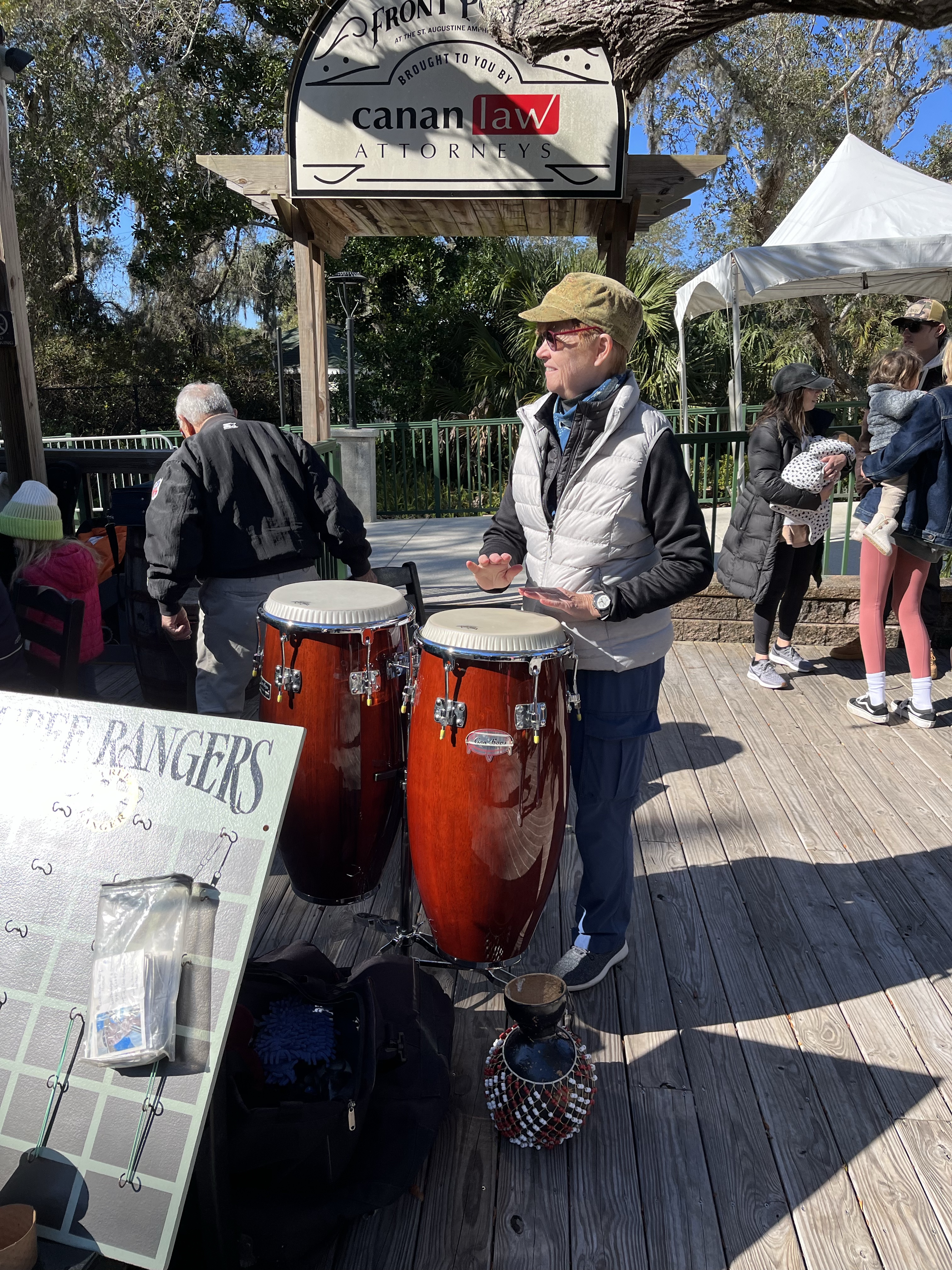
Good news this week from Papa Luie: You are never too old to learn something new! Papa Luie is the conga player who encouraged me to learn congas so I could make music with the Saturday morning music group playing at the St Augustine Farmers Market.
Actually, he said, “Learn conga or washboard. We need both.”
I chose conga, though I was more than a little intimidated. Now he’s teaching me and making a place for me to play music too. The lessons last week centered around some new patterns to practice, as well as three rules: 1) there are no rules for playing; 2) you’re never too old to learn; and 3) ya gotta commit. Papa Louie, whose age I will no longer try to guess, took up playing conga when he was 75. Yeah. Now he’s like my own personal Yoda and that is not because he is a head shorter than me. “There is no try. Only do. Commit… or go home to your recliner,” he said.
Commitment is the theme of the week: commit to not backing away, commit to not being timid but rather putting your back into the return of the ball in a volley, commit to the drive, commit to the first few notes of a verse. Commit or go home.

Commitment
Actually, commitment was this week’s lesson ad nauseum. From traffic, bluegrass music, pickleball, and life in general, I heard: Do not back away from what you want to or need to do.
The time is now to speed up a bit more when you enter traffic, to move forward, not backwards when you see the ball coming at you, and to sing out rather than wait for another chance.
Commit = speed up or move over?
As it was, the insistence of several noisy and angry drivers behind me was not so gentle after all, though. I confess they were justified in their angry gestures and (likely)rude comments; I was, in my mind, still driving in Monteagle, our bucolic and peaceful mountain (of course) town and summer home, where rush hour” means six cars, the speed limit on many roads is whatever you want it to be, and meandering drivers share the gravel roads with speeders. We don’t even have a stop light in Monteagle. That’s actually for safety’s sake. Besides the deer, the biggest danger for drivers in Monteagle is fog. We live at about 2000 feet elevation there, and the fog comes in and sets for a spell, has a cup of coffee and lingers far too long in the winter. Uninvited, the fog seems to camp out on our front lawn most of the winter, and, while it is pretty if you’re sitting by the fire looking out, driving in the fog is nerve-wracking for those of us who are already more timid drivers.

Photo Courtesy of Doug Mackenzie, Mackenzie Images.
The advice they give you for driving in the fog doesn’t help, either: “Roll down your window because you’ll hear the other cars before you see them.”
Driving in the fog 101: “Roll down your window because you’ll hear the other cars before you see them.”
Such dangerous driving conditions separate the timid drivers from the more aggressive ones; some drivers seem to see the fog as a reason to hit the accelerator. Wisdom dictates then that putting a stop light in downtown so some of us might be waiting to start or turn when another driver barrels through would be a foolish and short-lived experiment. Driving in Monteagle, though, usually allows me to meander, to notice who’s at the Piggly Wiggly when I drive by or decide if the line at the pharmacy is too long and I can wait to get those meds tomorrow. Driving in Florida, where we are “wintering,” however, does not tolerate, invite or accept any lack of commitment when I turn onto the road. Meander onto the Beach Highway at your own risk.
Wait, you might wonder: doesn’t being at the beach encourage you to meander?
That’s the rub, as they say. (Pass the Coppertone.) So many folks now want to live where they can meander that others move to the beach to serve them beers and crab legs, to sell them big beach houses or to build newer, even bigger ones. All those folks are in a hurry; they have zero patience for meandering. The many interactions between those two groups of beach dwellers as well as the struggle many visitors have with being able to slow down while on vacation combine to create what is the social ebb and flow of today’s beach life. Meander onto the Beach highway then at your own peril. You have to commit, to turn onto the road and be ready to accelerate immediately, not after you’ve checked the sidewalks for neighbors out walking dogs. They’re out there dodging traffic themselves as they make their way to the quiet of the actual beach, where we all have permission not to commit to much of anything except meandering.
Commit = Don’t Back Away

“Commit.” Be ready to accelerate. Be ready to hit that ball when it comes your way on the pickleball court or accept being in the losing team most of the time. “Don’t back away,” Steve, my partner in several games yesterday, encouraged me. “It [the ball] won’t hurt you,” he said. (Actually it does sting, but not as badly as always losing or worse being the one person no one wants to play with because you let the ball go by too often.) “Stand your ground,” he said, gently, but with some insistence. “You’re not here to watch, right?” Steve is older than I am, slender and wiry, clearly someone who has always been athletic. He sports a neatly-trimmed beard and is the kind of consistent player I’d like to be. “You didn’t start playing this game to watch the ball go by,” he says. Steve makes it look so easy to keep the ball in play without being aggressive. I find his coaching to be so much more compelling precisely because he isn’t one of the “Every shot is a kill shot” players. Those guys tell me not to back up and watch the ball go by as well but, in my thinking, they are suspect because their response to aggressive play is more aggressive play. “If the ball is hit hard, hit it back even harder.” Steve, though, is himself trying to navigate the game by being assertive rather than aggressive, and I really appreciate the distinction.
Assertive Does Not Equal Aggressive
Coaches and Instructors have shown me how to practice returning those more aggressive volleys, they’ve shown me how to use my torso to garner greater strength myself, they’ve even taught me, at my request, how to slow down someone else’s aggressive volley. That takes a lot of practice. And commitment. We haven’t talked, though, about the struggles of those of us who have been intimidated around more aggressive folks all our lives. Easily half the pickleball players out there struggle when facing more aggressive players, which can be especially disappointing in light of the fact that many players take up the sport as much for the social outlet as for the workout or the competition. We’ve wondered more than a few times if this was really our game since we don’t want to be aggressive ourselves and so many players seem to embrace the aggressive potential of the pickleball.
I’m grateful I realized, though, that the encouragement from Steve was not whether to be aggressive but whether or not to stand my ground as best I could, to take my place as one of the players on the court for that particular game, or simply to give it up. Instead, his encouragement was just that: encouraging. He was suggesting I needed to see how it feels to claim my space. That’s not the same as being aggressive. Aggressive players want their space and mine. I have the option of walking away and letting aggressive players have my space, or, I have the option of standing my ground and that, Steve was trying to tell me, is satisfying and even empowering and is why many of us play. I’m actually okay( with not winning all the time. Well, most of the time.) I’m good so long as matches are close games and include lots of good volleys and points. I don’t like getting “pickled” (losing 11-0) any more than the next player, but, mostly, the fun comes when the games are fairly evenly matched. A game where one server simply aces every serve bores most of us. Like most every other player, I’m here on the court to try to improve my skills, to compete, and to play. “You gotta commit,though,” Steve said. “You aren’t out here to watch the ball go by.”
Commit = Sing Out
That message seems to be everywhere right now. The next step in my joining in with the Saturday morning jam session at the St. Augustine Farmers Market (see previous post about setting goals) is being allowed to sing a song or two, and I’ve been practicing to meet that goal. I’ve been studying bluegrass singing techniques, practicing finding the tenor or baritone line above or below the melody and learning lyrics to old bluegrass songs.
“Commit,” Annie said. Annie took up banjo later in life also and she gets my hesitation but she knows hesitation is not a singer’s friend. “You gotta hit that note or it’Il sound like you’re being strangled,” she says.
At a session in the near future, I’m gonna have to ask to sing lead but first they need to hear me harmonize and so I’ve been joining on Mondays with a smaller group to harmonize and offer percussion.
Talking about singing won’t get me anywhere, though; they need to hear me sing. So, this week I jumped in with that smaller group and, while I’m not sure my tenor line wasn’t flat, I committed. I sang loudly enough to be heard or so I thought. Let’s just say the invitations to sing did not come flying in, though, and it was clear heading into the larger jam session this week that I would have to work that much harder at overcoming my timidity. My desire to participate needed to outweigh the tendency to shrink back into the wings, to stay on the fringe, not risk being bad at this.
My desire to participate needed to outweigh the tendency to shrink back into the wings, to stay on the fringe, not risk being bad at this.
I used to have nerve until…
I’m pretty sure I was considerably more self-assured, bolder even, when I was younger. I did not hesitate to enter the flow of traffic using only peripheral vision to scan lanes while I pedaled a ten-speed bicycle into city traffic. I didn’t think twice about riding at night through town or riding alone even in the dark. That, though, was before I realized I was mortal.
Perhaps realizing you will not actually live forever is something most folks don’t realize until they are “up in years” as my grandmother used to say, or declining in health or strength. Some of us can point to a moment when we lost at least some of our nerve, though, because we suddenly realized, “Hey, we could die.” Until that time, many of us had ridden or skated or raced through life, jumped trestles, run stop signs and woven through traffic like our favorite friend of Mario. Life – or at least the possibility of it ending – first slapped me upside the head when I was about eighteen. I was biking to a college class, weaving in and out of city traffic and, of course, wearing no helmet. No one wore them back then. I stopped at a light next to a semi. The light changed and I started pedaling just as the truck turned my way, dragging me and my ten-speed along the road. Another driver evidently alerted him to the bicycle and rider he had been trying to crush, and, thank God, he stopped. I remember thinking, as I was being dragged, that those big rigs looked even more menacing from underneath. When the dragging stopped, I laid my head on the pavement for a moment, grateful that my bike had protected me from the truck’s tires. I phoned home and got a ride to my classes.
…that moment when I realized I am mortal after all.
Maybe realizing I could die, that I was not going to live forever, ought to have compelled me to trade up from my ten-speed to something more substantial—a small tank, for instance—but mine and my parents’ response at the time was to get me a motorcycle. Maybe we figured I’d be able to outrun the big rigs. I got a couple of lessons from the guy at the dealership, then the salesman said I was good to go and so I went. I had to get to work and school, and, with two adults and three driving teens in the family, we simply could not afford a car just for me.
Like so much else, the motorcycle worked for a while, right up until I woke up in the back of an ambulance. Thing is, I wasn’t driving that motorcycle when we wrecked; my mother and I had decided together that she ought to learn to drive the motorcycle as well. Yes, my mother was driving and no, she had not taken the lessons. In retrospect, that was not exactly a shining moment for either mother or daughter. I have long regretted climbing on the back of that little Yamaha 250 to share with my mother my vast experience handling a motorcycle. In our defense, we lived on a small road where the only regular traffic consisted of neighbors pulling into their driveways. The road did, however, dump out onto a busier road so while Mom did well driving down our road away from calamity, the trip back required she remember how to apply the brakes and, well, that didn’t happen. It was a bonafide miracle that we ran into the side of that car; if we’d been going another mile per hour faster, he likely would have hit us full on and shoved us into ongoing traffic. As it was, I was thrown backwards onto our road. Thank God we were wearing helmets. Mine was cracked; that’ll tell you something about impact. I woke up in the ambulance the first time, looked at the EMT and asked him what day it was. He got flustered and couldn’t tell me and I remember thinking that, if the EMT didn’t know what day it was, what chance did I have to figure it out? A nurse told me when I awoke again later in the hospital that I had upset the EMT. Poor guy, he was not much older than I was, and it had been his first day. I would like to be able to tell you that he wore the uniform well or that he visited me in the ER and I found his blue eyes haunting. Instead, I wonder to this day if he had any personal thoughts about mortality when he saw a girl his age lying next to her mother on the pavement unconscious.
The physical effects for both my mother and me were miraculously minor. We each had a concussion and lots of scrapes but those injuries were far less memorable than the tension and strain of living in our home for the next few weeks. I did apologize several times over the next few weeks to my father without much effect. He couldn’t speak to me or my mother for several weeks even though neither of us were injured worse than we were. He didn’t even lecture me when he showed up in a used car for me to drive from then on.
I can show you the scars on my legs nearly five decades later, but the greater impact of those two incidents was that I was no longer confident about much of anything and my go-to response for anything coming at me fast was to curl up like an armadillo and hope whatever it was would bounce off me. This is the red carpet of trauma I have been trying to unfurl now for years and lately, life has been saying in so many ways, it’s time.
…lately, life has been saying in so many ways, it’s time for me to find my nerve again.
Everywhere I turn in the past few months, weeks, days, I see or hear encouragement to commit, to overcome the tendency to sit back and let the ball go by or miss my chance to make music. Yesterday, Annie, who gets my hesitation, took matters into her own hands and shoved me up front to where the microphone was so I could sing that tenor line on “Roll in My Sweet Baby’s Arms.” It’s apparently time. Being thrown onto the pavement was neither the beginning nor the end of trauma for me; but, after decades of watching too much of my life go by, it seems the universe is urging me to accelerate back into the midst of life’s flow, to not just sit and watch the ball go by, to risk being the one making music and to not simply stay on the sidelines any more.
“There is no try. Only do. Commit… or go home to your recliner.”
Papa Luie
 Emptying The Backpack