

Always a Fashionista…gotta love the boots.
When I was five, I ran away from home. Of course I didn’t get far. My world then revolved around a quarter-acre yard in Springfield, Missouri, on a corner lot, two blocks from my elementary school. We lived a short drive away from where I was attending kindergarten at our First Baptist Church and near enough to some train tracks that I knew it was bedtime by the train whistle every night. The little three-bedroom, one bath brick house on Marlin Street had a fenced-in backyard, a sand box, a metal clothesline and a weeping willow tree, all seemingly perfect for three children under six. Its feathery leaves hung to the ground, draping around the trunk with just enough room under the canopy for a five- year-old to hide and imagine different worlds than were to be found inside the little house on Marlin.
For the longest time, I couldn’t tell you why I ran away on that particular day. I often wondered if it hadn’t been that I didn’t want to go back to kindergarten. I went on the afternoon shift, so we basically had an hour or two of ABC’s, singing, and a snack in the gymnasium of First Baptist Church before we took a nap. I already could read and write some when I got to kindergarten, so there was no struggle for me there.
There had been a memorable first day spent on the vinyl chair in our kitchen trying to learn to tie my shoes. “Little boys and girls who can’t tie their own shoes are not big enough to go to kindergarten,” I’d been told again and again. “They’ll send you right home.” I had spent the morning of my first day of kindergarten tying and untying my red plaid tennis shoes, both my mother and me praying I’d avoid the shame of the teacher calling my mother to bring her little “baby” home. We needn’t have worried. Not once did I ever have to tie my shoes while at school.
Perhaps, on that morning, I simply didn’t want another perm.
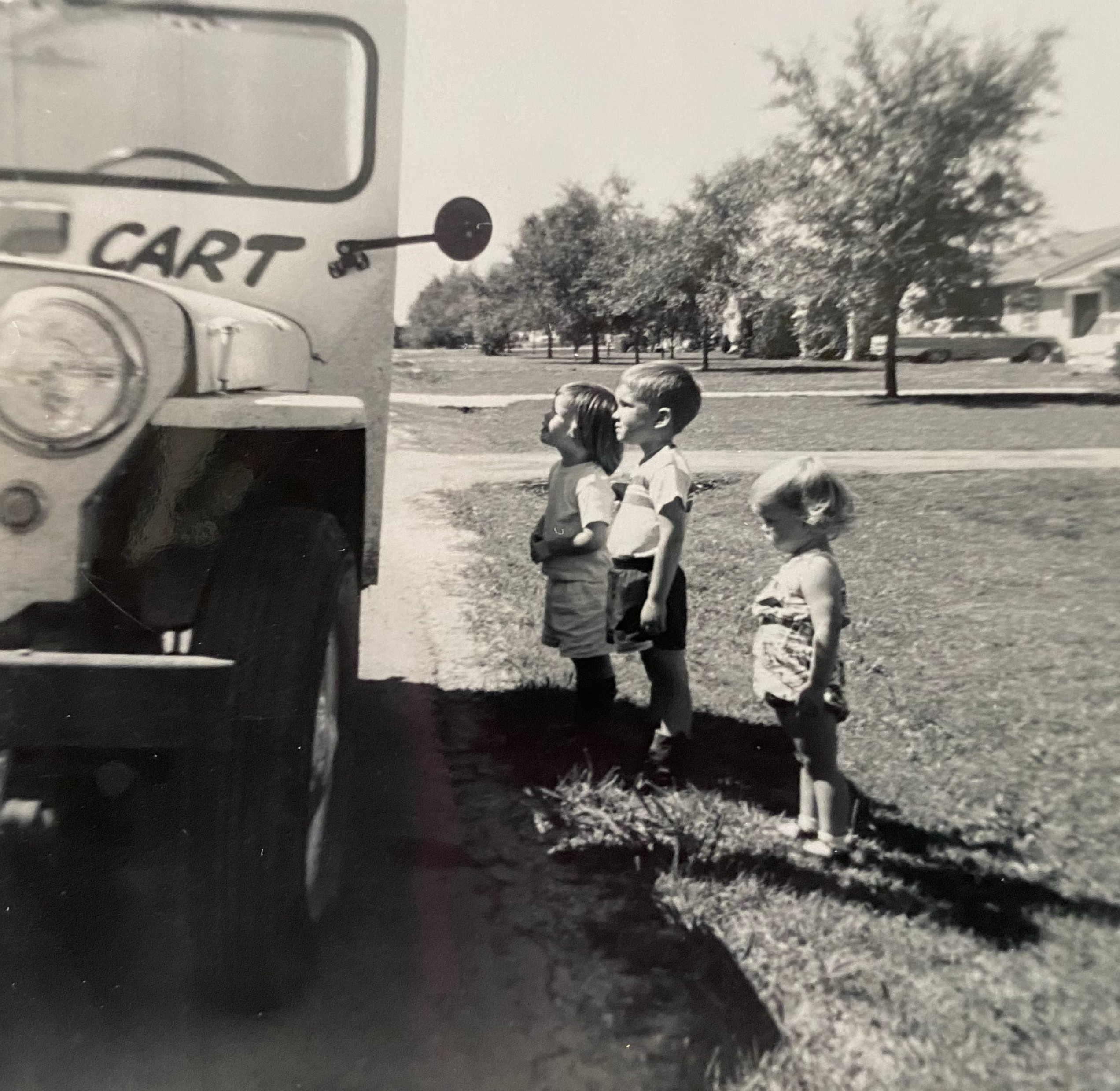
My mother struggled daily with my full head of “straight as a pencil” “dirty-brown” hair because it was constantly tangled. Every day, we’d have the same conversation about brushing the underside of my hair, that thick mat next to my neck, and every day I would stare at her as if I were hearing the laments and reprisals for the first time. My hair may have been the bane of her existence but her brushing my hair is the only physical connection with her I remember. Her brushing it angrily. Her trimming errant bangs until the top of my head was nearly visible. Her trying to make it curl. Her finally chopping the hair off rudely, at a strange angle because she was done with it, as fed up as I was with trying to tame that mane.
Mom had been introduced that summer to the “home permanent.” I’d never been to a salon even to have my hair cut. Mom cut our hair herself with her sewing scissors, black handled shears that were never sharpened or oiled, as far as I could tell, so they’d pull when she hacked away at the thick bunch she’d grab in her left hand and chop with her right hand. I remember staring into the bathroom mirror blankly. I hadn’t cared that she cut it because of how horrid it looked, I realize now. I cared because she said, as she was sweeping up the hair from the floor, “Now you can just brush it yourself.” She would no longer brush it for me. I think I would even in that moment have agreed to another permanent like the one that had failed so miserably and sent her to her sewing basket for the shears.
I can still smell a home perm a mile away….
The day before, the permanent had required a couple of hours of me seated on that sticky vinyl chair in our kitchen while she rolled strand after strand in metal-curlers, the kind with bristles meant to grab and hold the hair long enough for the chemicals to alter the makeup of your hair and teach it to curl like those golden locks on Shirley Temple If the rolling of the curlers wasn’t bad enough, the chemicals made my nose burn and my eyes water and the bristles on the curlers pricked my scalp. Then, once the solution had been applied and wiped off my neck and back, I was told to take my daily nap. Whether we slept or not, we “napped” every day so Mom could have time to herself, a practice I appreciated when I had children. Only on this day, because of the perm, I was relegated to a rug on the floor by the washer in our laundry room. I could have no pillow for my head because we didn’t want to ruin a pillow. Were we worried about ruining my head? Also, no pillow meant any attempts to rest my head caused dozens of tiny needles to prick my scalp, but sitting up and trying to read sent rivulets of stinky solution dripping down my neck and back. I would not rest well that afternoon.
Sadly, the perm did not “take.” My hair rebelled. My mother was furious, disgusted, as she yanked curler after curler off only to watch the long brown strands defiantly continue to hang as straight as pencils. She was crying. I was crying. She’d been trying to prepare me to participate in a Girls’ Auxiliary ceremony at our church where her teenage cousin would be “crowned ” a princess. The Girls’ Auxiliary was the church’s alternative to the Girl Scouts, designed to encourage girls to learn Scripture, study the lives of missionaries and participate in ministries like collecting monies for children India and China. To the program’s credit, many of us certainly were inspired by godly women like Lottie Moon. My cousin had completed the requirements for attaining the “Princess” rank and there was to be a ceremony at church. I was tasked with carrying a paper gold crown on a pillow to be placed on her head. Mom wanted me to represent the family well, to look pretty and be a shining example of the next generation of princesses.
But my shock of brown hair refused to do its part. And mom was fed up. She’d gotten the shears out just as her aunt called and offered to come over and help. Her aunt had three daughters, all teens, and somehow managed to fashion a dainty pony tail for the ceremony.
The next day, however, the shears returned and that was all she wrote. My hair would not cover my neck again that year or the next. Not until I learned to brush it myself. I could not for my part, see the point. I didn’t care about my hair being pretty, which may seem ironic, since I was teased incessantly by my father. He was annoyed that I was so attached to my white straw hat, white gloves and white wicker purse, all gifts from grandparents the year before for Easter. He thought I wanted to be “a little lady” because I carried my purse with the gloves inside it and donned my little white straw hat with a yellow ribbon nearly every day for most of that year. I didn’t participate in outdoor activities anymore with my brother or sister that year. I preferred instead to go outside in my hat and carry my purse to sit under my tree and pretend I was somewhere else. It would be years later when I’d realize why I wanted to be anywhere else.
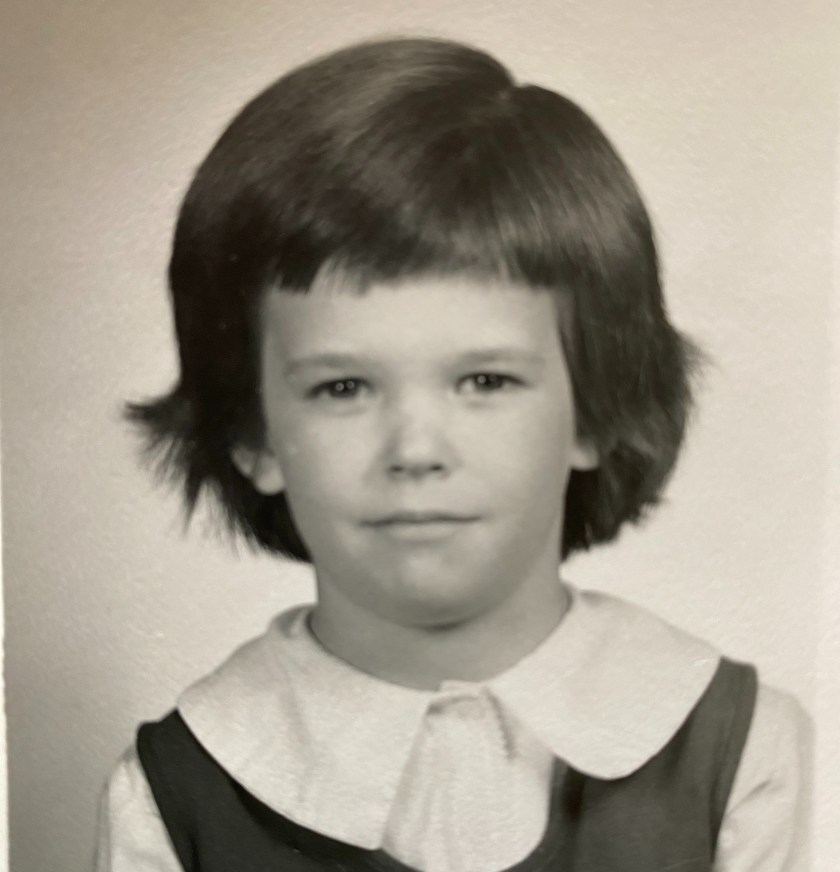
Of course, picture day came soon after the cut.
At the time, I just remember being grateful I could pull that straw hat over my crooked bangs. That afternoon then, while mom was sweeping my hair off of the bathroom floor, and I was supposed to be on my bed for naptime, I pulled the hat down over my ears, shoved my gloves into the purse and snuck out the screen door from the laundry room, careful not to let it creak or slam shut.
I had left a note on my bed that I expected her to find, a note that simply said, “I am running away. Jodi.” Then I went outside and sat under my tree, my back against the trunk, legs stretched out towards the backside of the house, the branches drooping and fingering the ground as the breeze tried to cool the afternoon. Then I waited. I waited for her to find my note and come running frantically out of the laundry room into the carport, searching. I waited for her to scoop me up and hug me and exclaim how relieved she was that I was safe. I waited for her to carry me inside proclaiming she would never let me go, maybe even to bake cookies for me. Just for me.
I waited, and, then, worried she wouldn’t be able to see me under the tree whose branches drooped to the ground, I moved to the sandbox. And waited some more. When the heat got to me, I moved to the back door that led to the laundry room and perched on the steps, clutching my purse, waiting to be found. I’ll never know how long I waited, but eventually I got tired and gave up. Then, slowly so as to not make the screen door squeak, I peered into the laundry room at the ugly rug that still stank of permanent solution. I crept past the opening to the kitchen and found no one, so I crept to the bedroom I shared at the time with my sister. She was asleep on her bed. My brother was asleep across the hall in his bedroom. Even my mother lay sleeping on her bed; drugged by the heat and disappointed by the day.
I guess I was sure Mom must have seen the note and ignored it, so, ever the quick thinker, I crossed my name off and penciled in my sister’s name on it instead, then fell asleep. It would be years before I’d wonder why I hadn’t just crumpled the note up, why it hadn’t dawned on me that my little sister couldn’t read or write at the time. As it turned out, the note was still on my bed when I awoke from the nap, so I folded it up and tucked in into my white wicker purse where I carried it for the rest of the summer.
 Emptying The Backpack